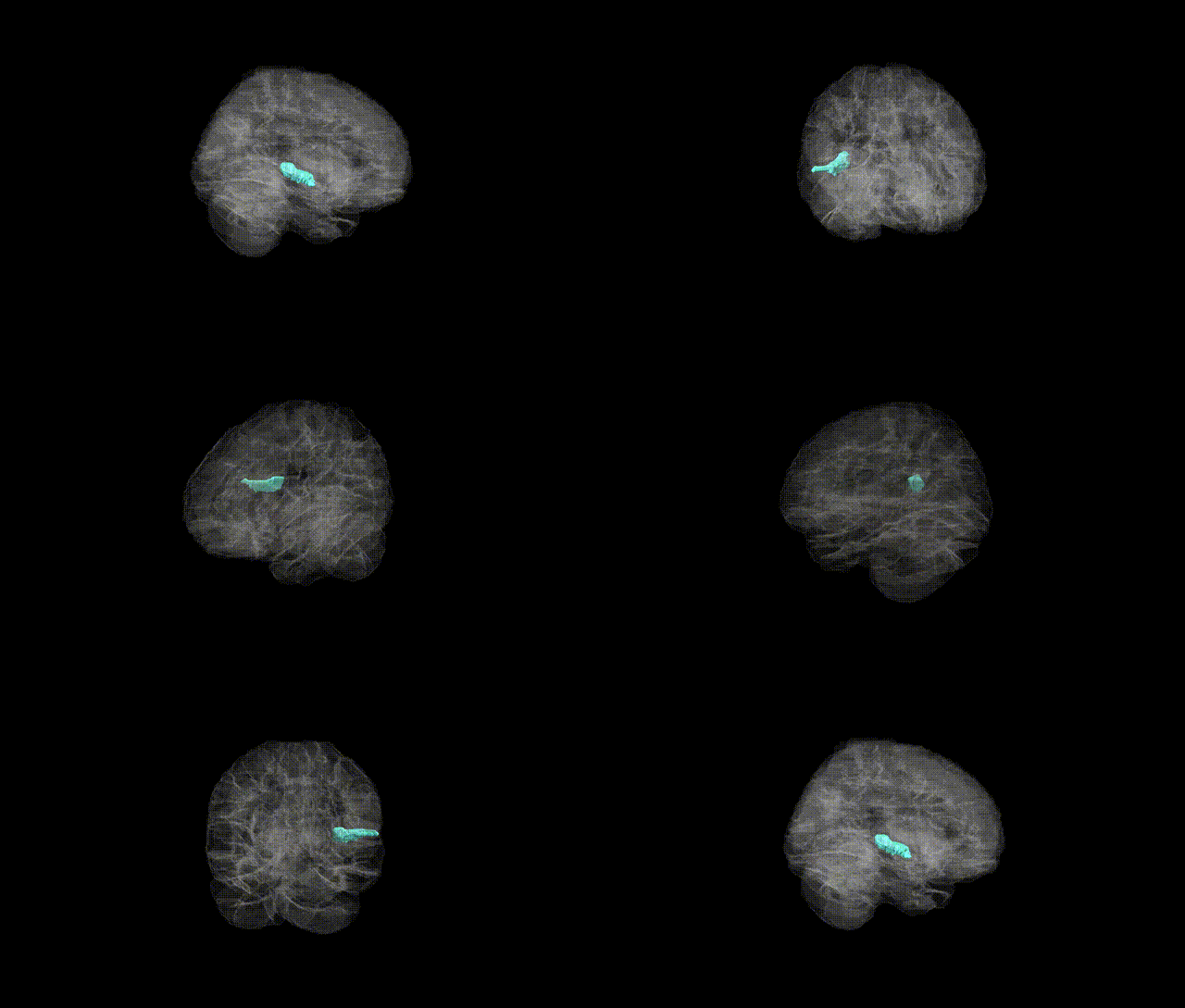
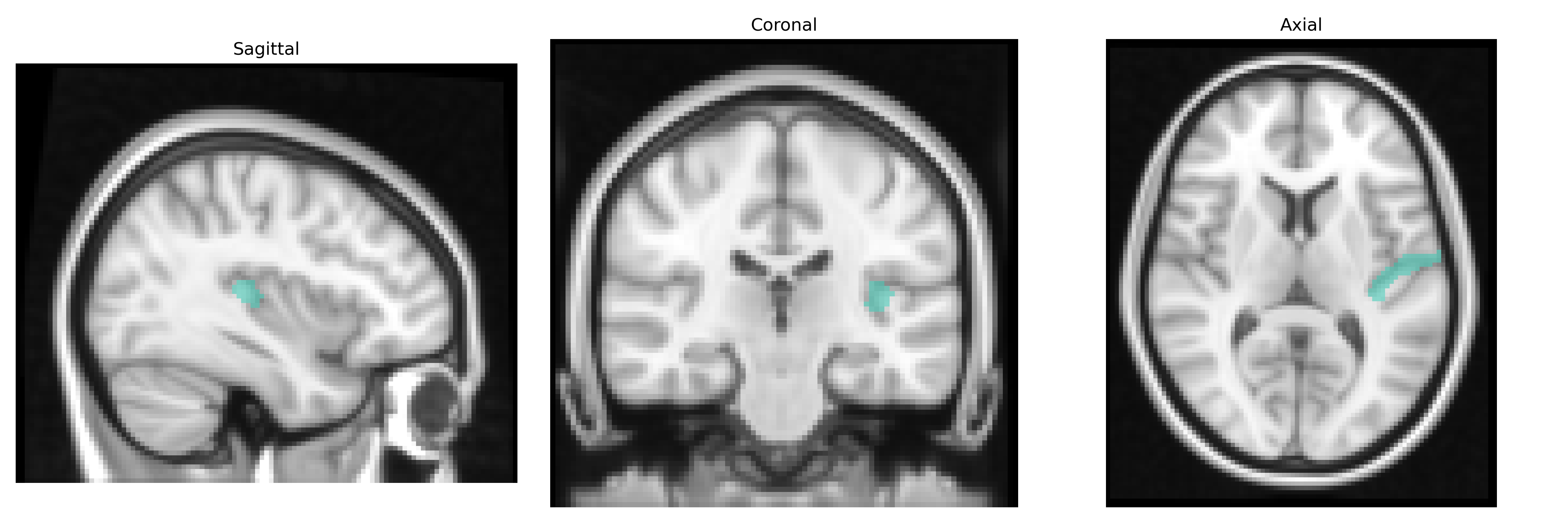
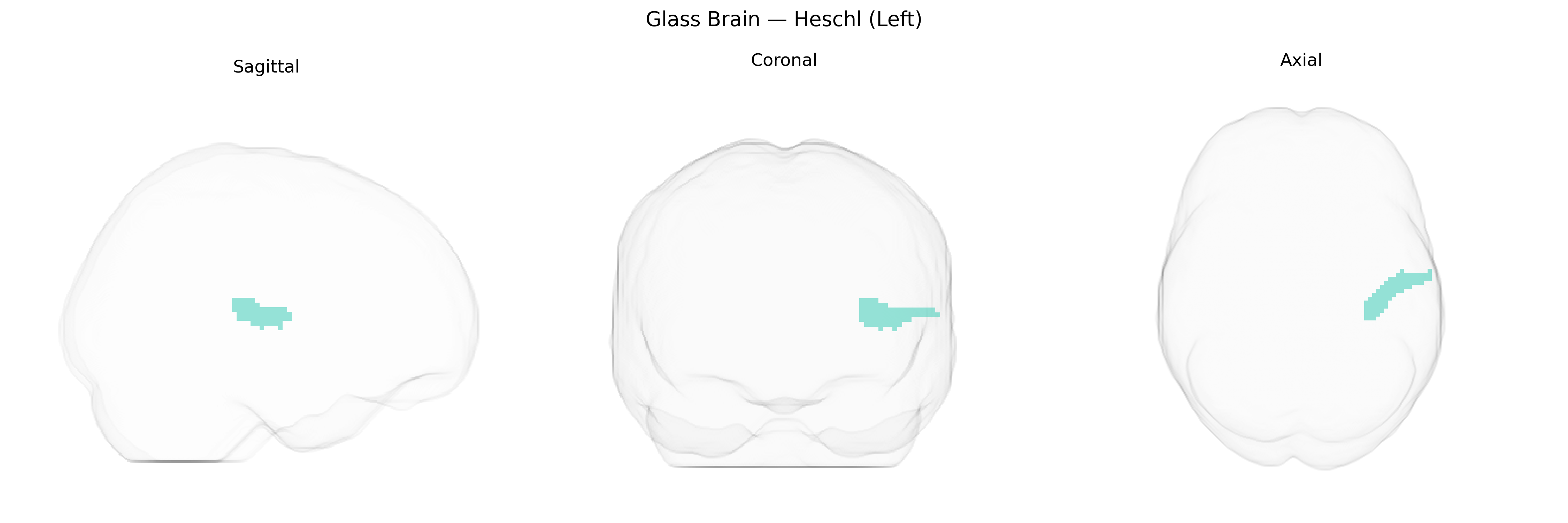
The left Heschl gyrus (AAL2: Heschl_L) is a transverse temporal cortical region situated within the superior temporal lobe, buried in the lateral sulcus on the superior surface of the temporal operculum. It corresponds largely to primary auditory cortex (Brodmann areas 41 and parts of 42) and receives dense thalamocortical input from the ventral division of the medial geniculate body, forming the initial cortical relay for acoustic information. Neurons within this region exhibit tonotopic organization, encoding sound frequency, intensity, and temporal features, and contribute to basic auditory perception as well as early stages of speech and language processing. As the principal entry point for auditory signals into the cortical hierarchy, the left Heschl gyrus plays a key role in integrating spectral and temporal sound features that support higher-order auditory and phonological functions in adjacent superior temporal and perisylvian language areas. Heschl’s gyrus
The left Heschl gyrus, encompassing primary auditory cortex in the AAL2 atlas, has been implicated in several genetic and GWAS-based associations involving auditory, language, and neurodevelopmental traits. Imaging–genetics studies, particularly from large consortia such as ENIGMA and UK Biobank, indicate that cortical thickness and surface area of Heschl gyrus show modest but significant SNP-based heritability, with polygenic influences overlapping genes involved in neurodevelopment (e.g., axon guidance, synaptic organization, and myelination), though no single locus is uniquely or consistently assigned specifically to left Heschl gyrus across studies. Variants associated with reading and language-related traits (including loci near DCDC2, KIAA0319, and FOXP2 pathway genes) have been linked to structural or functional alterations in perisylvian auditory–language regions that include Heschl gyrus, and altered left Heschl structure or activation has been reported in dyslexia, specific language impairment, and stuttering, though causal genes remain incompletely defined. Schizophrenia and psychosis-related GWAS, particularly those examining auditory hallucinations, have connected risk polygenic scores to reduced gray matter or altered activation in primary auditory cortex, including left Heschl gyrus, suggesting that genetic liability for psychosis partly manifests through this region’s structure and function. Additional associations have been reported in tinnitus (with candidate genes in glutamatergic and GABAergic pathways affecting Heschl activity), autism spectrum conditions (showing atypical auditory cortical organization with shared polygenic influences on sensory cortical development), and musical aptitude or pitch perception, where candidate-gene and small-scale GWAS work implicates loci in neurodevelopmental and synaptic genes that modulate morphology and activation of Heschl gyrus, especially in the left hemisphere, though findings remain heterogeneous and generally below the level of firmly established, region-specific genetic markers.
Overview generated by GPT-4o (2026).
Region ID: 8101
Hemisphere: left
Atlas: AAL2
Full Quality Version: Download MP4
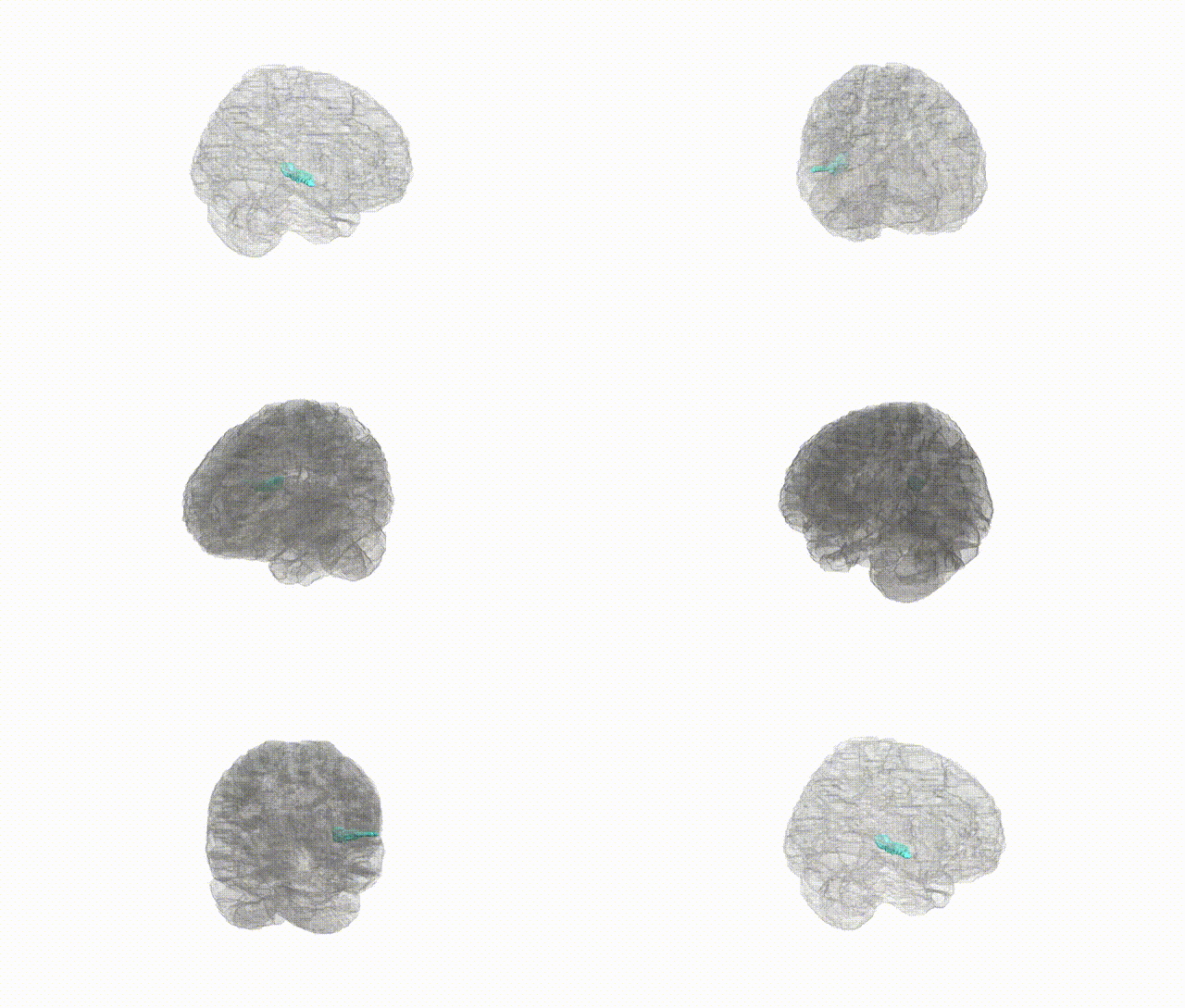
Full Quality Version: Download MP4
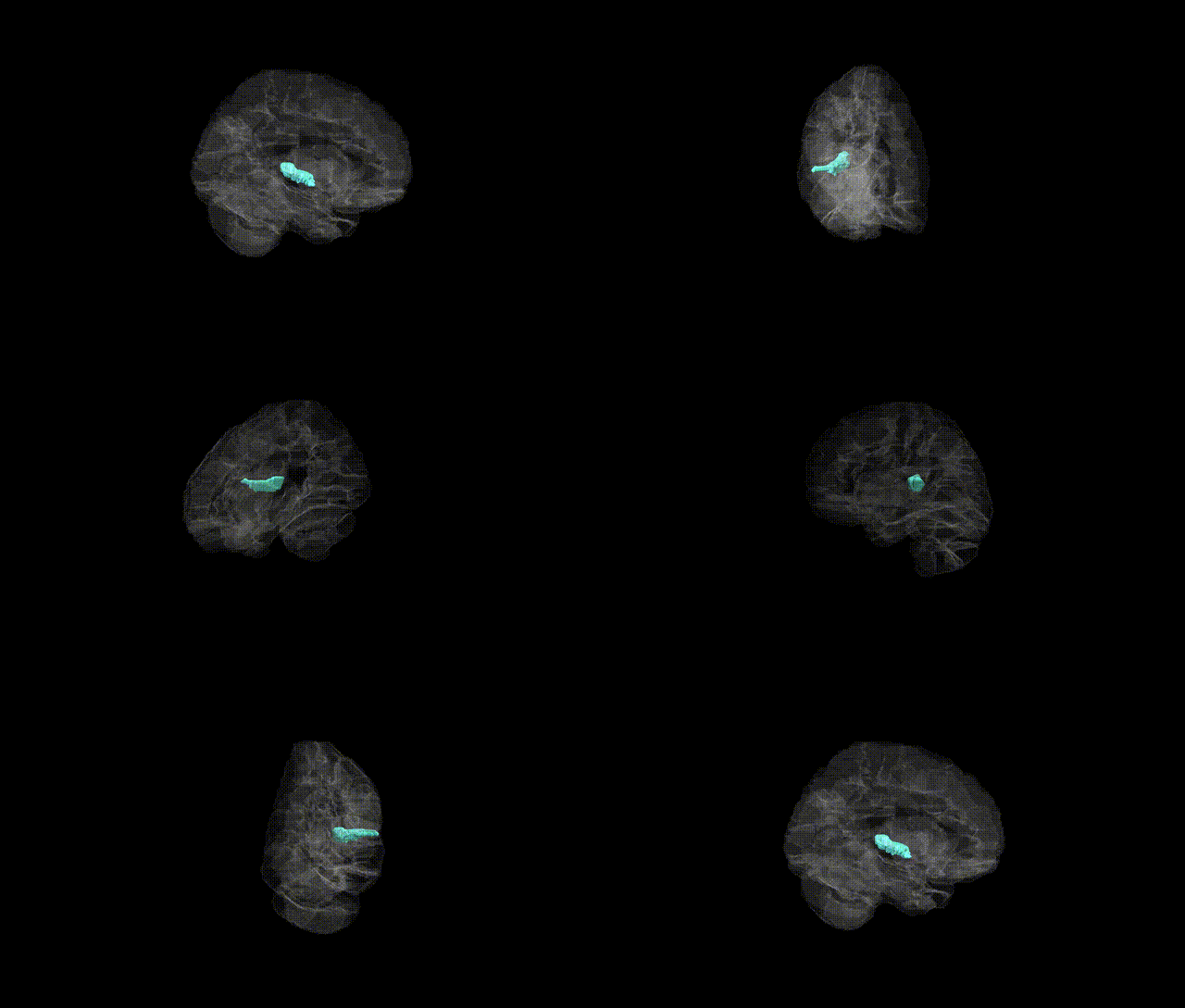
Full Quality Version: Download MP4
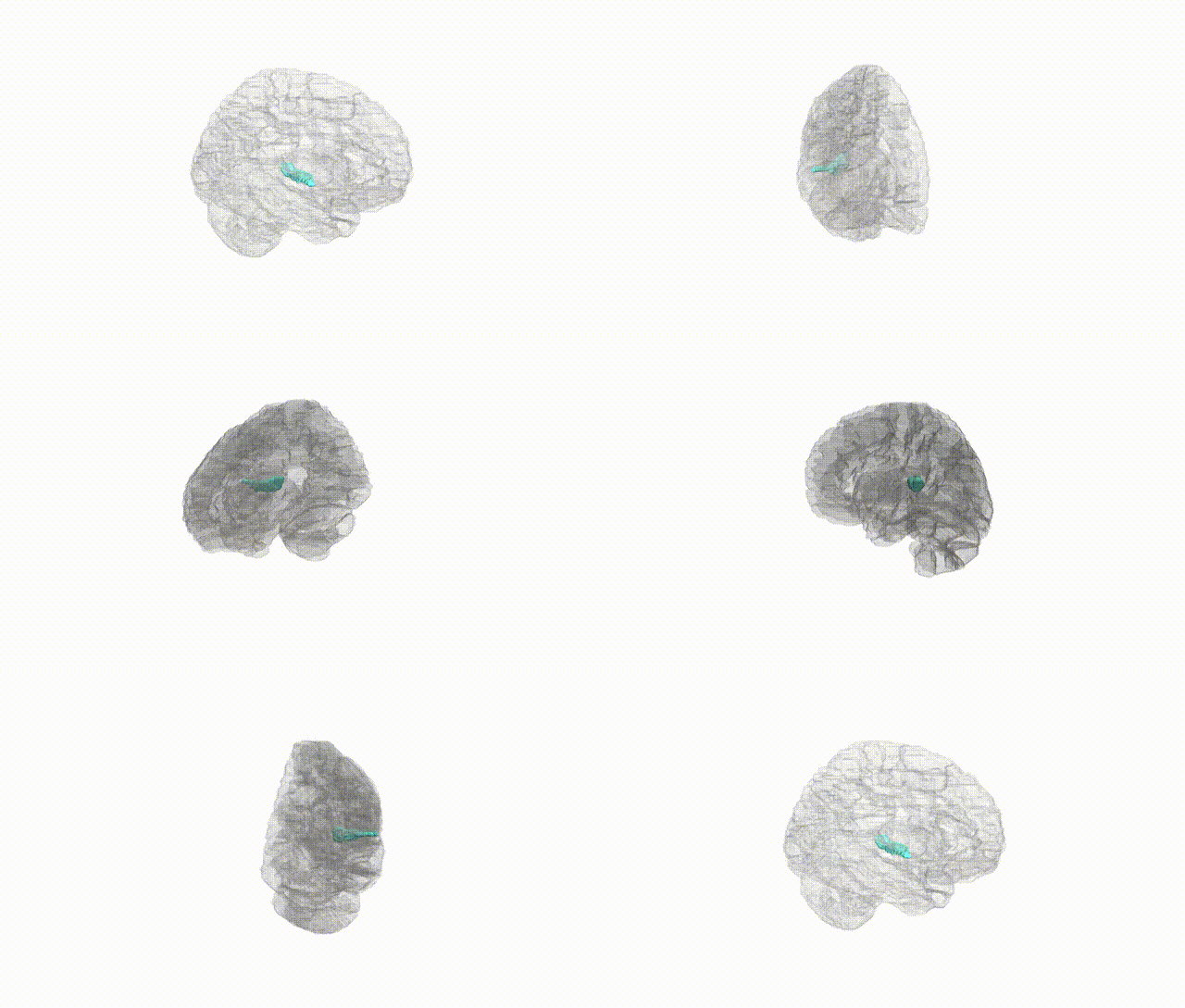
Full Quality Version: Download MP4
Wali Sidiqyar*, Gaurav Rudravaram*, Elyssa M. McMaster, Trent M. Schwartz, Adam M. Saunders, Kurt G. Schilling, Bennett A. Landman "Introducing SPINS: A Shared Public Visualization Library of Neuroanatomical Structures." Medical Imaging with Deep Learning- short paper
This resource is licensed under CC0 1.0 Universal (Public Domain).