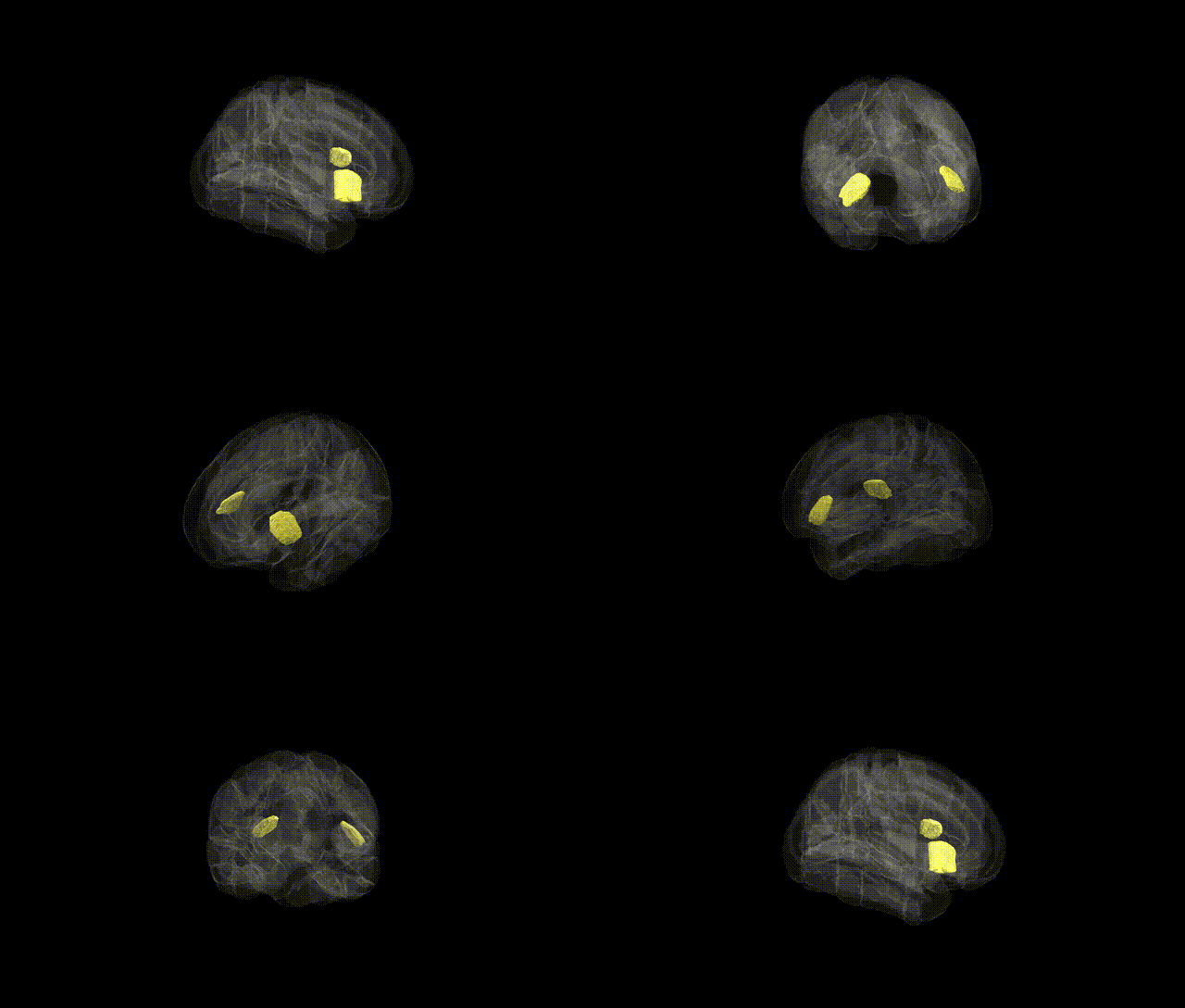
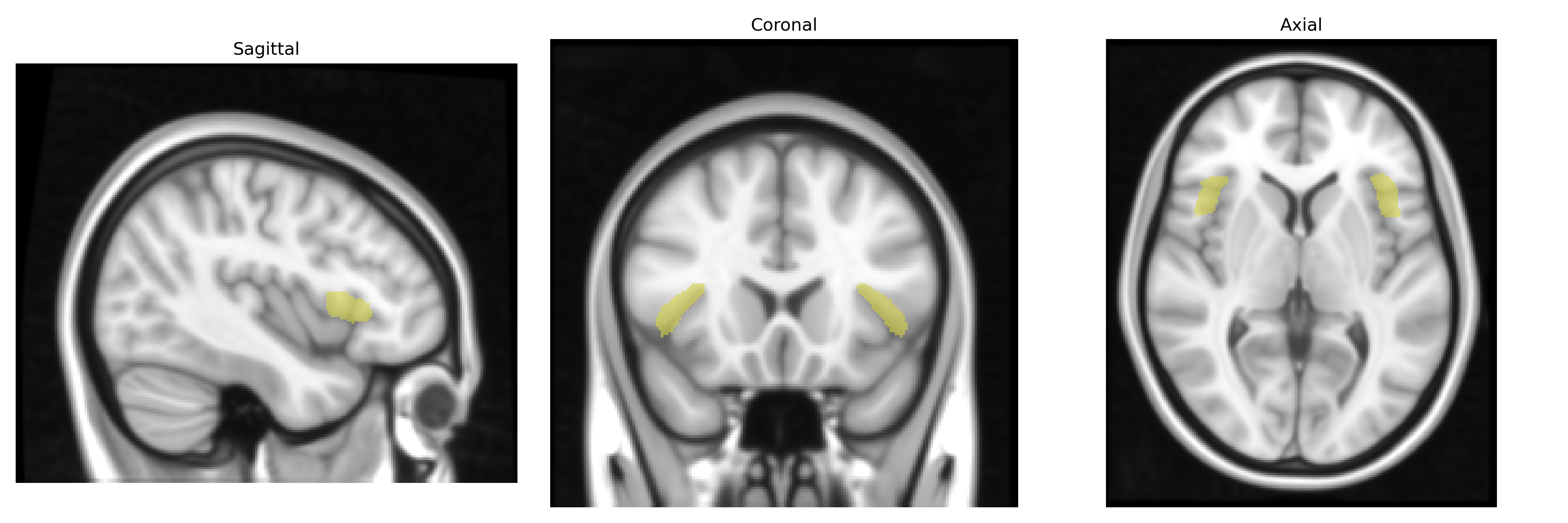
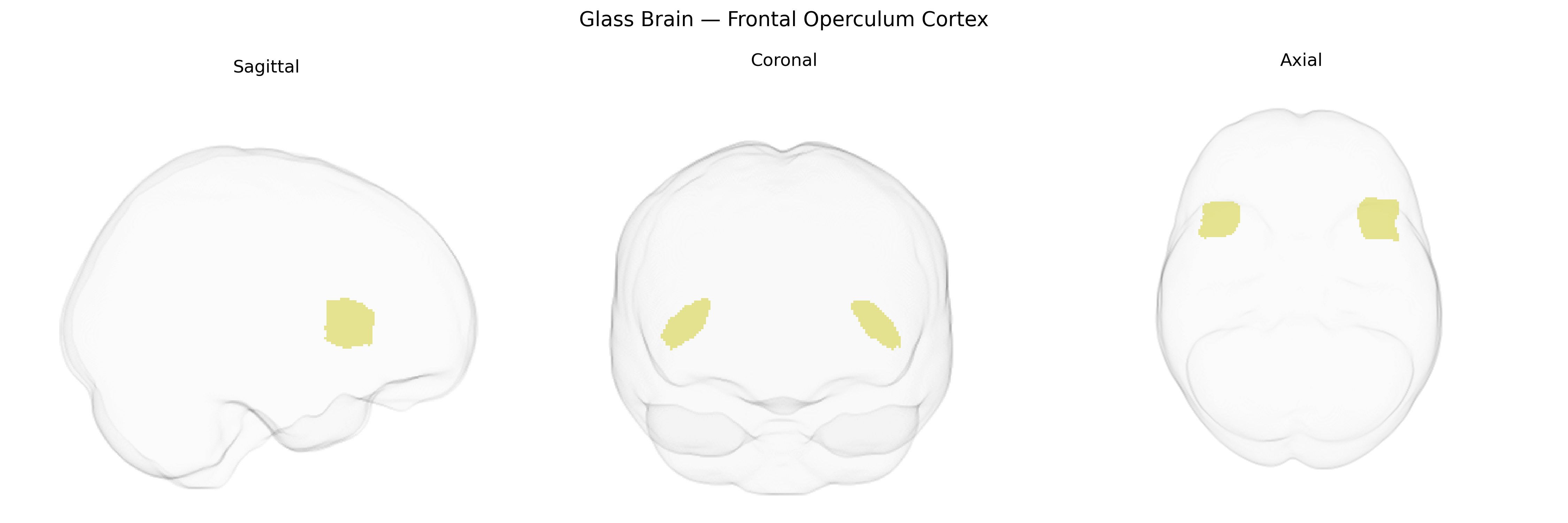
The bilateral Frontal Operculum Cortex, as defined in the Harvard–Oxford Cortical Structural Atlas, comprises the cortical mantle overlying the insula along the lateral sulcus, forming part of the frontal lobe opercular region that bridges frontal and temporal territories. It includes portions of the inferior frontal gyrus adjacent to the Sylvian fissure and is structurally associated with the anterior insula and adjacent premotor and language-related areas. Functionally, this region is implicated in speech and language processing (including aspects of articulation), executive control, and integration of sensorimotor and interoceptive information, as well as participation in networks related to cognitive control and salience detection. There is no direct link for “Frontal Operculum Cortex” as a standalone article; a closely related structure is the opercular part of the inferior frontal gyrus: Opercular part of the inferior frontal gyrus.
The bilateral frontal operculum cortex, as defined in the Harvard–Oxford cortical atlas, is part of the inferior frontal and insular-opercular network implicated in language, speech production, and cognitive control, and genetic associations typically emerge from imaging genetics and GWAS of cortical measures or related neuropsychiatric traits rather than region-specific gene mapping. Large-scale GWAS of cortical structure (e.g., ENIGMA and UK Biobank) have identified variants in genes such as CENPW, TBR1, PAX6, KIAA0586, and others that influence frontal cortical thickness and surface area, which encompass or partially overlap opercular frontal regions, although not usually isolating the operculum as a distinct locus. Polygenic risk scores for schizophrenia, bipolar disorder, and major depressive disorder have been associated with altered activation and structural characteristics in the frontal operculum–insula network, and specific risk variants in genes like CACNA1C, ZNF804A, and GRM3 have been linked to functional differences in tasks recruiting this region (e.g., language, cognitive control, emotion regulation) through fMRI and imaging-genetic studies. GWAS of language-related traits, such as educational attainment, reading/language ability, and stuttering, have implicated loci near FOXP2, KIAA0319, DCDC2, and CNTNAP2, and neuroimaging work often shows functional and structural correlates in inferior frontal regions including the operculum, suggesting convergent gene–brain–behavior pathways. Additionally, genetic variants associated with smoking, alcohol use, and obesity (e.g., in CHRNA5-CHRNA3-CHRNB4, FTO) have been linked to differences in insular-opercular and frontal opercular activation and morphology, reflecting this region’s role in interoception and reward-related decision making. Overall, while no single gene or variant is uniquely or specifically tied to the Harvard–Oxford frontal operculum label, converging GWAS and imaging-genetics studies associate polygenic risk for psychiatric disorders, language traits, and substance use behaviors with structural and functional variation in the frontal operculum as part of broader frontal–insular networks.
Overview generated by GPT-4o (2026).
Region ID: 41
Hemisphere: bilateral
Atlas: HarvardOxford cort maxprob thr25 1mm
Full Quality Version: Download MP4
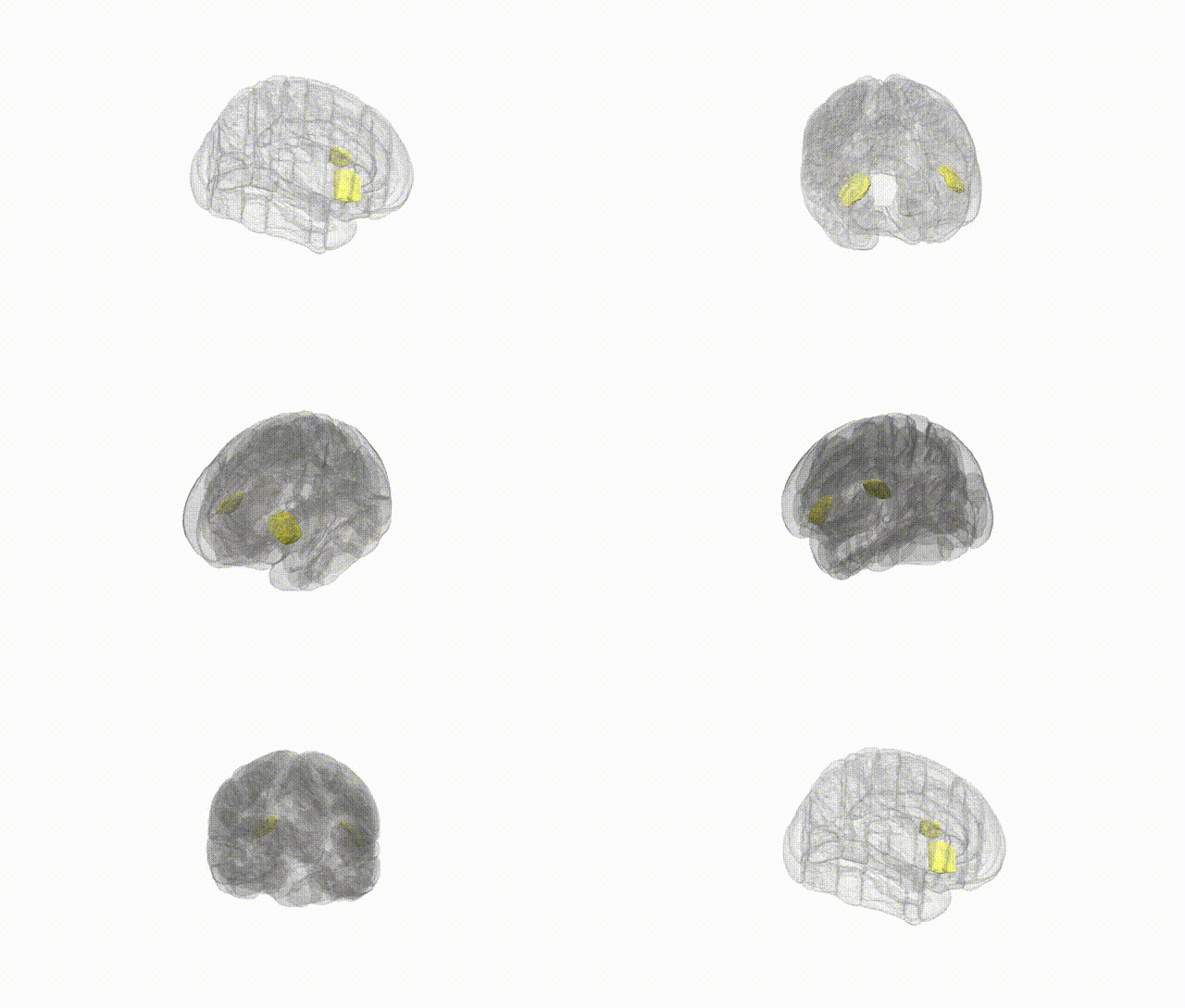
Full Quality Version: Download MP4
Wali Sidiqyar*, Gaurav Rudravaram*, Elyssa M. McMaster, Trent M. Schwartz, Adam M. Saunders, Kurt G. Schilling, Bennett A. Landman "Introducing SPINS: A Shared Public Visualization Library of Neuroanatomical Structures." Medical Imaging with Deep Learning- short paper
This resource is licensed under CC0 1.0 Universal (Public Domain).