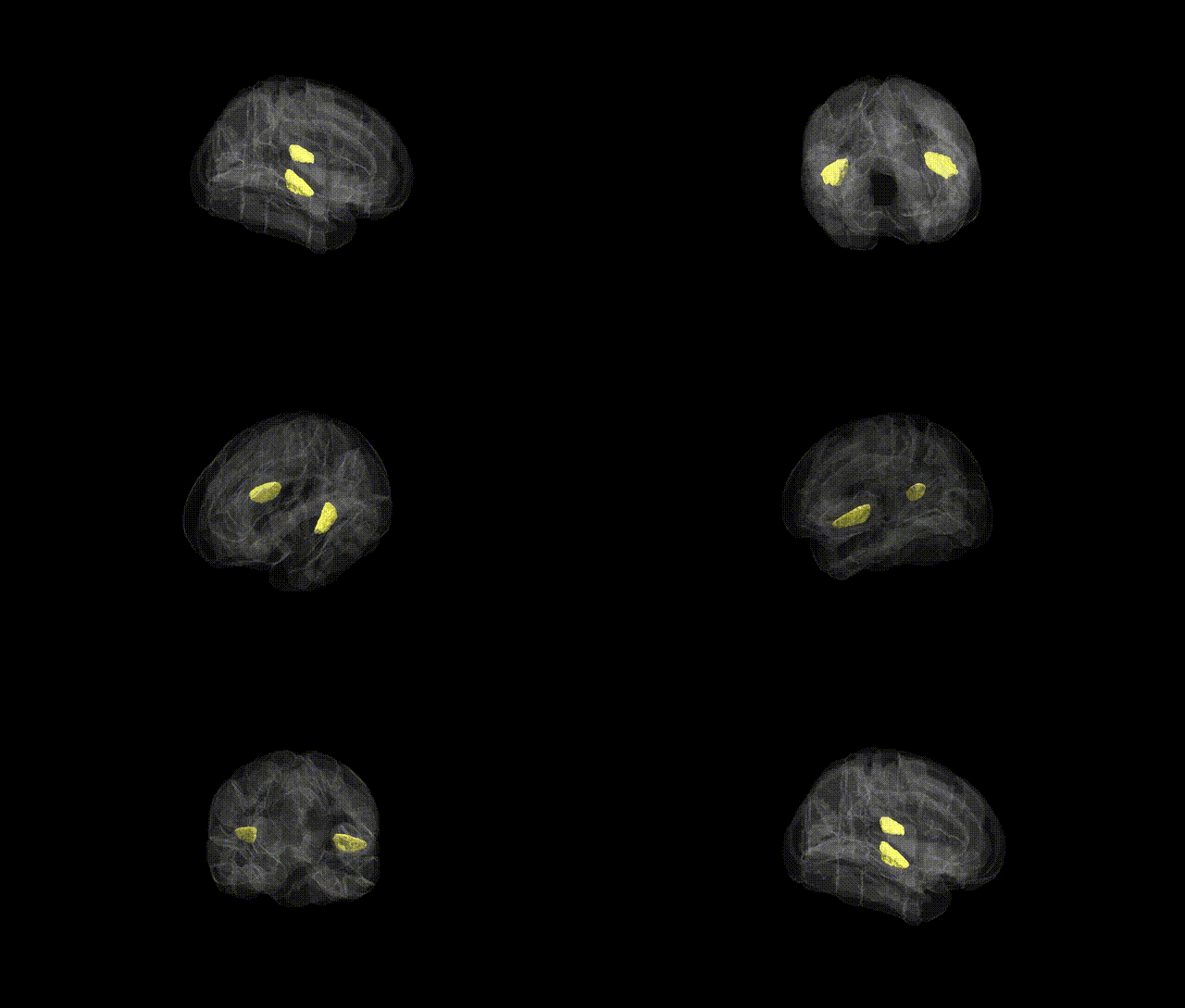
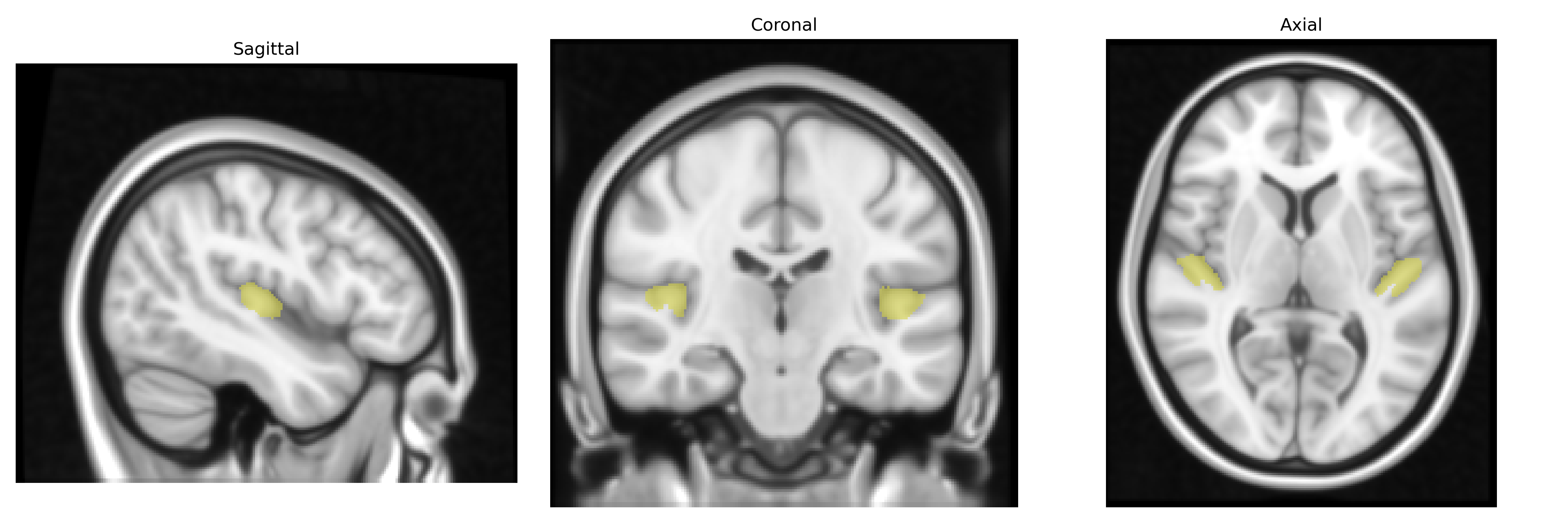
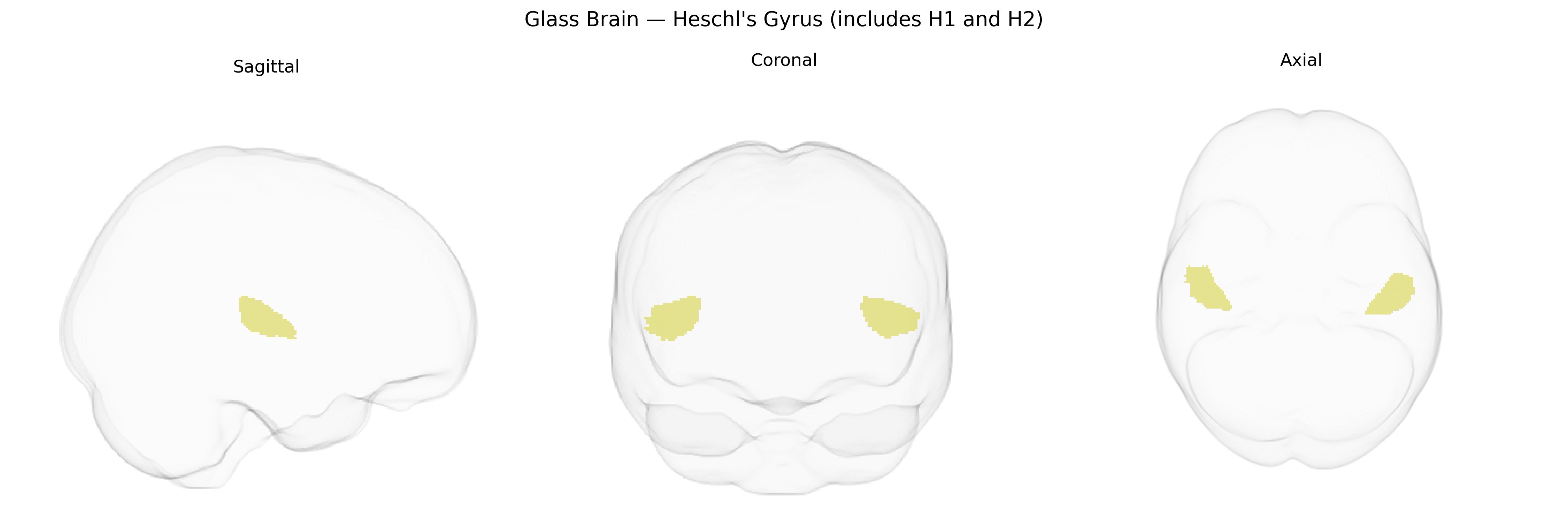
The bilateral Heschl’s Gyrus (including H1 and H2) comprises the primary auditory cortex located on the superior surface of the temporal lobe within the lateral sulcus, forming the transverse temporal gyri. This region is characterized cytoarchitectonically by dense granular layers and is the principal cortical termination site for auditory thalamic input from the medial geniculate body, supporting initial cortical processing of sound frequency, intensity, and temporal patterns. Heschl’s gyrus participates in early spectrotemporal analysis underlying sound perception, speech and language processing, and music perception, with hemispheric specialization often showing left-dominant involvement in linguistic features and right-dominant involvement in spectral and prosodic aspects. It is closely interconnected with adjacent auditory association cortices, including planum temporale and superior temporal gyrus, forming part of broader auditory and language networks. Heschl’s gyrus
Bilateral Heschl’s gyrus (including primary and secondary auditory cortex, H1/H2) shows convergent genetic associations with auditory processing, language, and neurodevelopmental traits: twin and SNP-based heritability studies indicate moderate–high heritability of Heschl’s gyrus volume and cortical thickness, and GWAS of cortical morphology (e.g., ENIGMA, UK Biobank) have identified common variants near genes involved in neuronal migration, synaptic function, and cortical patterning such as microtubule- and adhesion-related genes (e.g., variants near ASPM, LMX1A, and other neurodevelopmental loci) influencing superior temporal and Heschl’s anatomy. Heschl’s gyrus asymmetry and morphology have been implicated in dyslexia and specific language impairment, with genetic links to auditory and language networks involving FOXP2, KIAA0319, DCDC2, and related reading-disorder loci in imaging–genetics work, while altered Heschl’s structure and function have been reported in schizophrenia and bipolar disorder, aligning with large psychiatric GWAS that highlight polygenic effects on superior temporal and auditory cortex. In addition, imaging–genetic studies connect polygenic risk for autism spectrum disorder and schizophrenia to atypical Heschl’s gyrus thickness and gyrification, and GWAS of tinnitus, musical aptitude, and pitch perception suggest shared polygenic architectures affecting auditory cortex, although individual risk loci are typically reported at the level of broader superior temporal regions rather than Heschl’s gyrus specifically.
Overview generated by GPT-4o (2026).
Region ID: 45
Hemisphere: bilateral
Atlas: HarvardOxford cort maxprob thr25 1mm
Full Quality Version: Download MP4
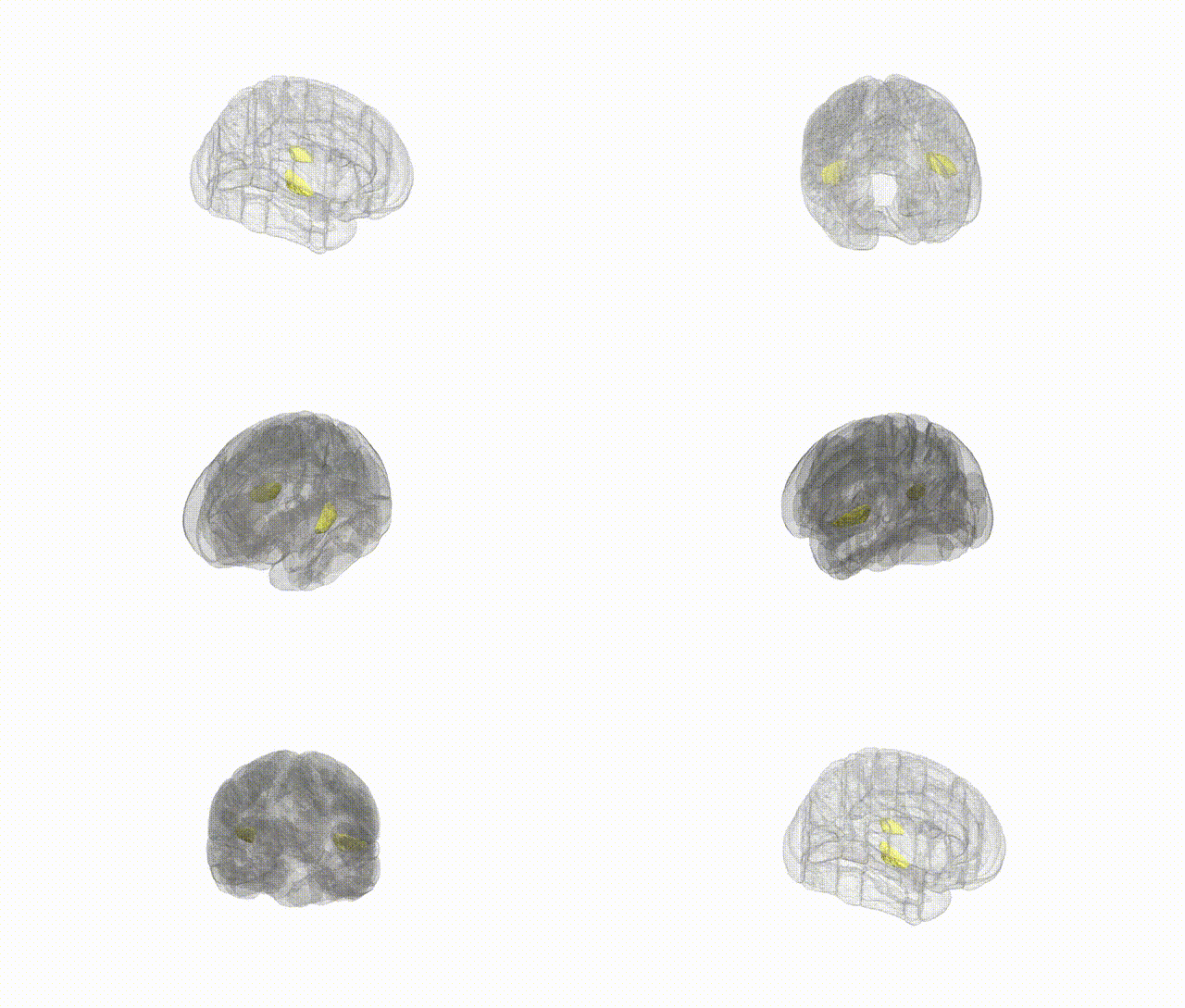
Full Quality Version: Download MP4
Wali Sidiqyar*, Gaurav Rudravaram*, Elyssa M. McMaster, Trent M. Schwartz, Adam M. Saunders, Kurt G. Schilling, Bennett A. Landman "Introducing SPINS: A Shared Public Visualization Library of Neuroanatomical Structures." Medical Imaging with Deep Learning- short paper
This resource is licensed under CC0 1.0 Universal (Public Domain).