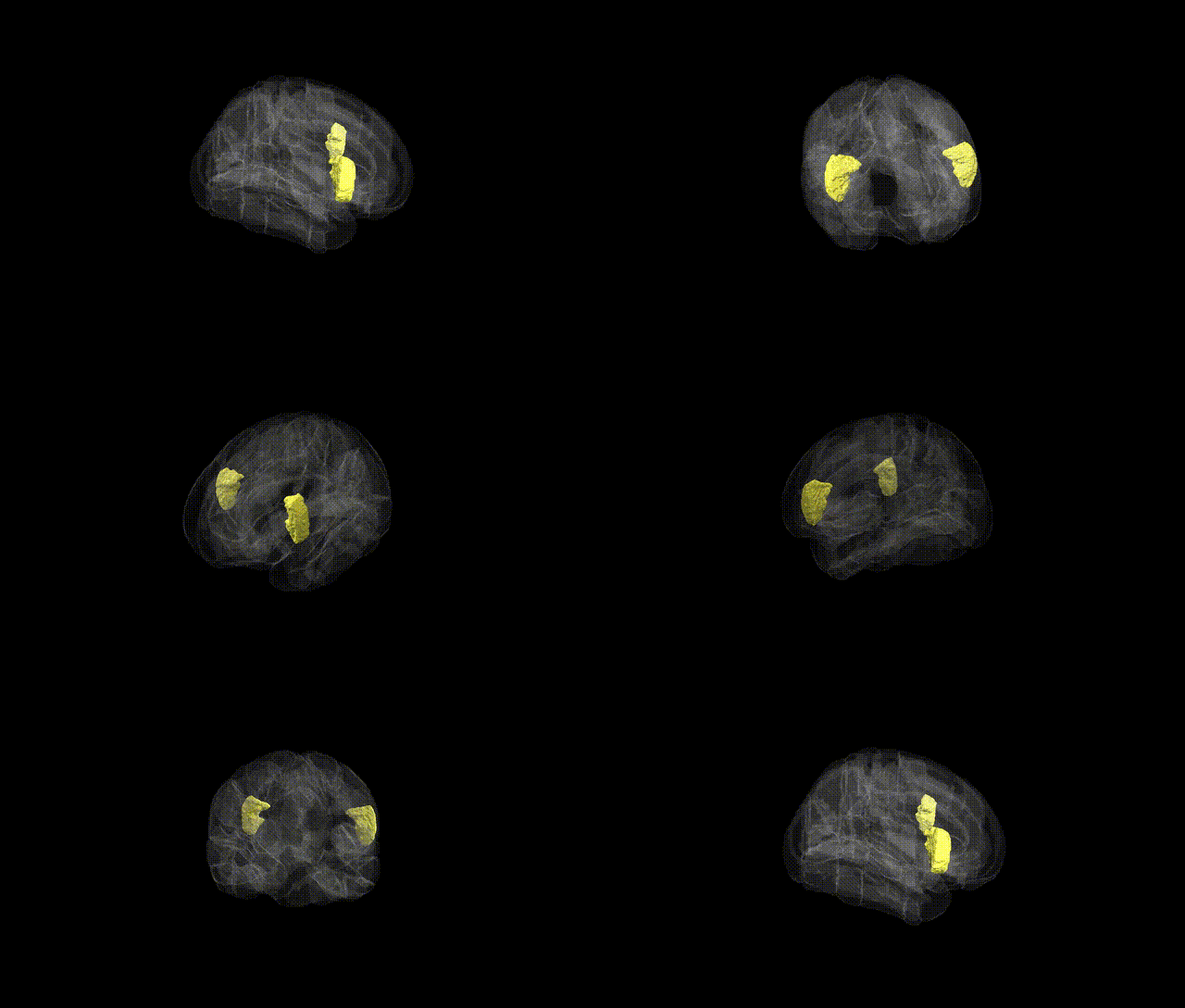
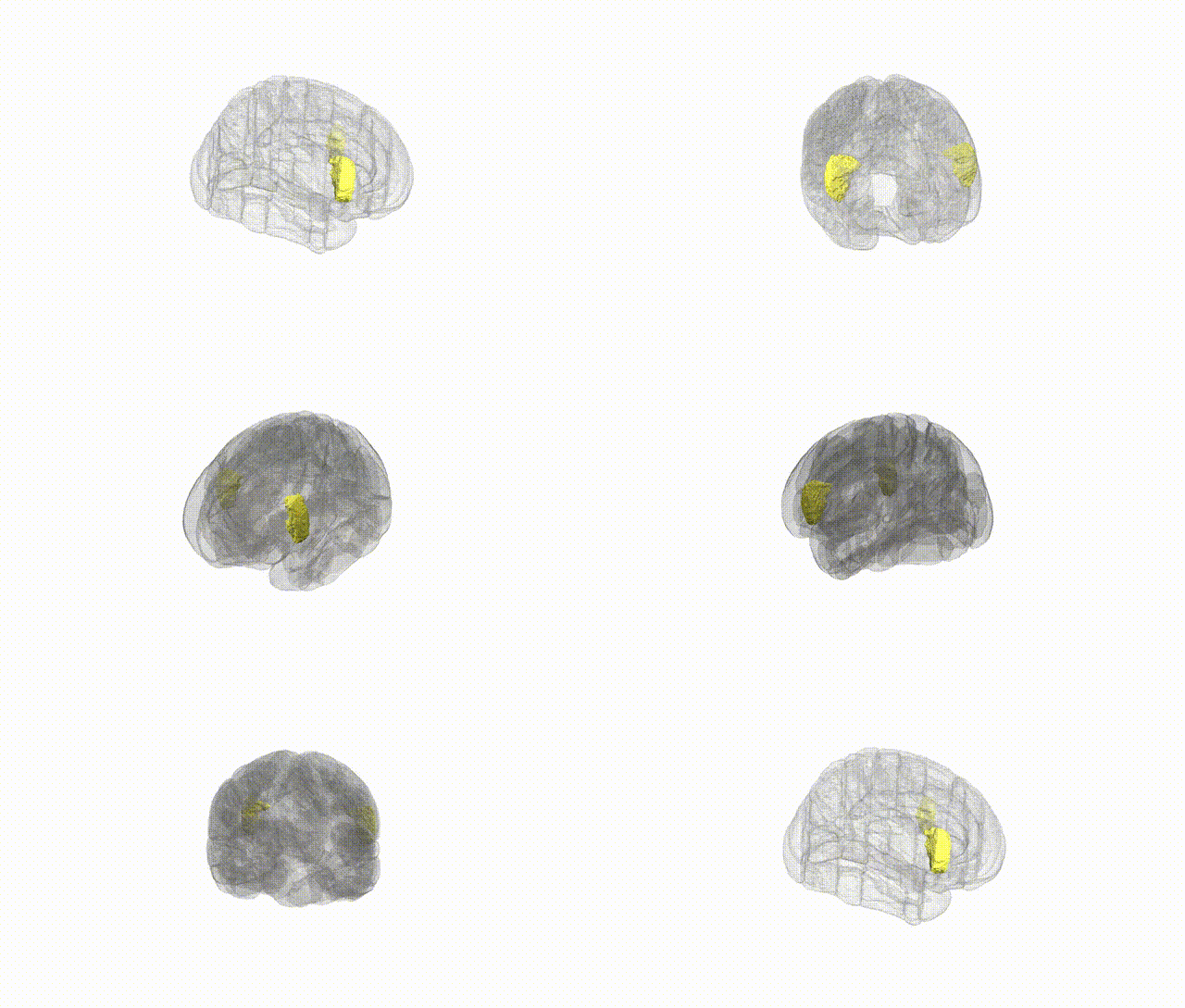
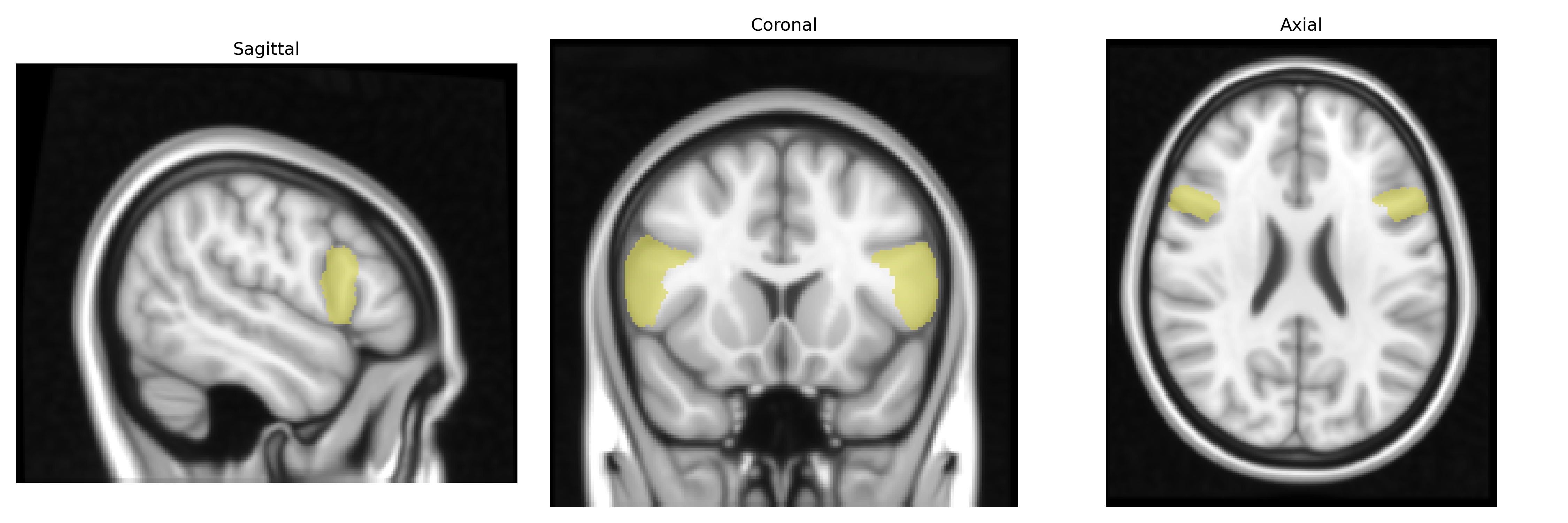
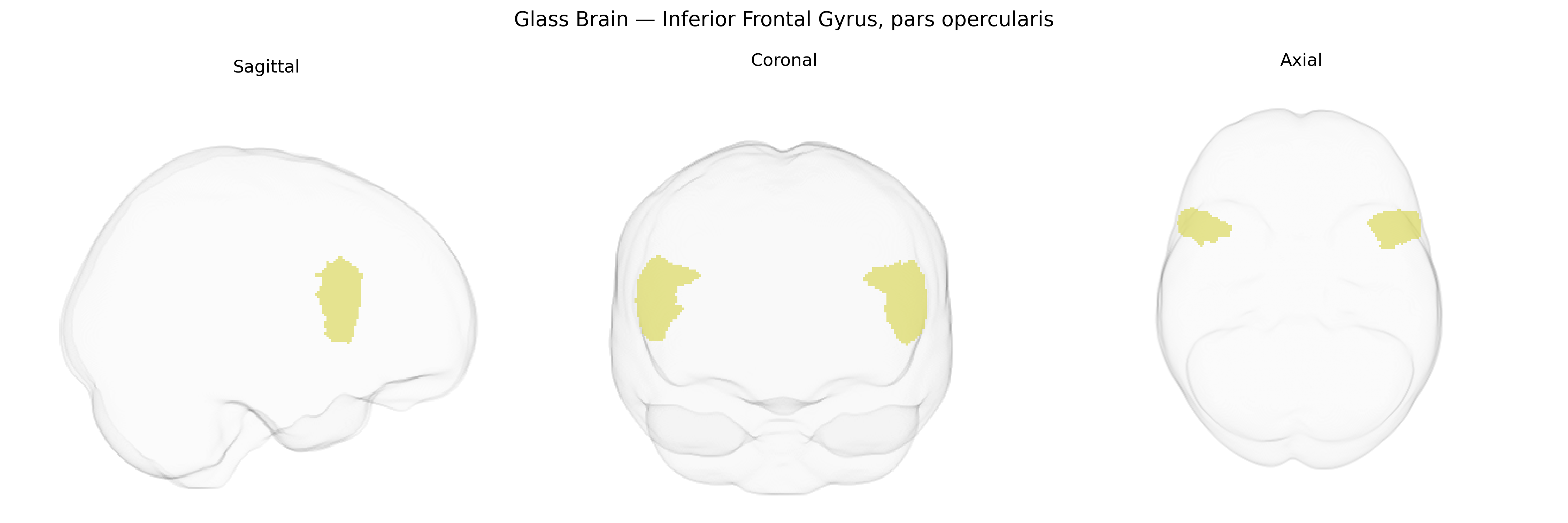
The bilateral Inferior Frontal Gyrus, pars opercularis, as defined in the Harvard–Oxford cortical atlas (maxprob thr25, 1 mm), corresponds approximately to the opercular portion of the inferior frontal gyrus (often associated with Brodmann area 44) in both hemispheres. This region forms part of the ventrolateral prefrontal cortex and, in the dominant hemisphere, is a core component of the classical Broca’s area involved in speech production, phonological processing, and aspects of syntactic and morphosyntactic operations. It participates in motor planning for orofacial movements, articulatory coding, and the integration of auditory–motor information, and is also implicated in cognitive control processes such as response inhibition and the selection among competing representations. Structurally, the pars opercularis lies dorsal to the pars triangularis and anterior to the precentral gyrus, contributing to the fronto-opercular network and interacting with temporal and parietal language regions via major white-matter pathways such as the arcuate fasciculus and superior longitudinal fasciculus. There is no direct Wikipedia article specifically for the pars opercularis of the Inferior Frontal Gyrus; a closely related structure is Inferior frontal gyrus.
Genetic associations involving the bilateral Inferior Frontal Gyrus (IFG), pars opercularis—an area overlapping Broca’s region and implicated in language, cognitive control, and social cognition—have emerged primarily from imaging genetics and GWAS of brain structure and function. Large-scale neuroimaging GWAS (e.g., ENIGMA, UK Biobank) have identified common variants influencing cortical thickness and surface area in inferior frontal and adjacent frontal regions, including loci near genes involved in neurodevelopment and synaptic signaling such as FOXP2-related pathways, although effects are typically polygenic and regionally diffuse rather than specific to the pars opercularis ROI defined by the Harvard-Oxford atlas. Variants within the CNTNAP2, FOXP2, and related language-network genes have been linked to functional changes in IFG activation during speech and linguistic tasks, and polygenic risk scores for schizophrenia, bipolar disorder, and major depression show associations with altered IFG structure or connectivity, supporting a role for this region in psychiatric vulnerability. GWAS of stuttering, autism spectrum conditions, and dyslexia have implicated genes involved in neuronal migration and connectivity (e.g., KIAA0319, CNTNAP2), with functional and structural imaging repeatedly highlighting abnormal IFG pars opercularis involvement, though the genetic findings are not narrowly specific to this subregion. Additionally, GWAS of cognitive traits such as educational attainment, general intelligence, and executive function demonstrate polygenic influences on frontal cortical morphology and activation patterns, with the IFG pars opercularis frequently engaged in tasks indexing these traits, but the current evidence supports broad polygenic effects on frontal language–control networks rather than single, robust variant associations uniquely tied to this bilateral IFG pars opercularis atlas region.
Overview generated by GPT-4o (2026).
Region ID: 6
Hemisphere: bilateral
Atlas: HarvardOxford cort maxprob thr25 1mm
Full Quality Version: Download MP4
Full Quality Version: Download MP4
Wali Sidiqyar*, Gaurav Rudravaram*, Elyssa M. McMaster, Trent M. Schwartz, Adam M. Saunders, Kurt G. Schilling, Bennett A. Landman "Introducing SPINS: A Shared Public Visualization Library of Neuroanatomical Structures." Medical Imaging with Deep Learning- short paper
This resource is licensed under CC0 1.0 Universal (Public Domain).