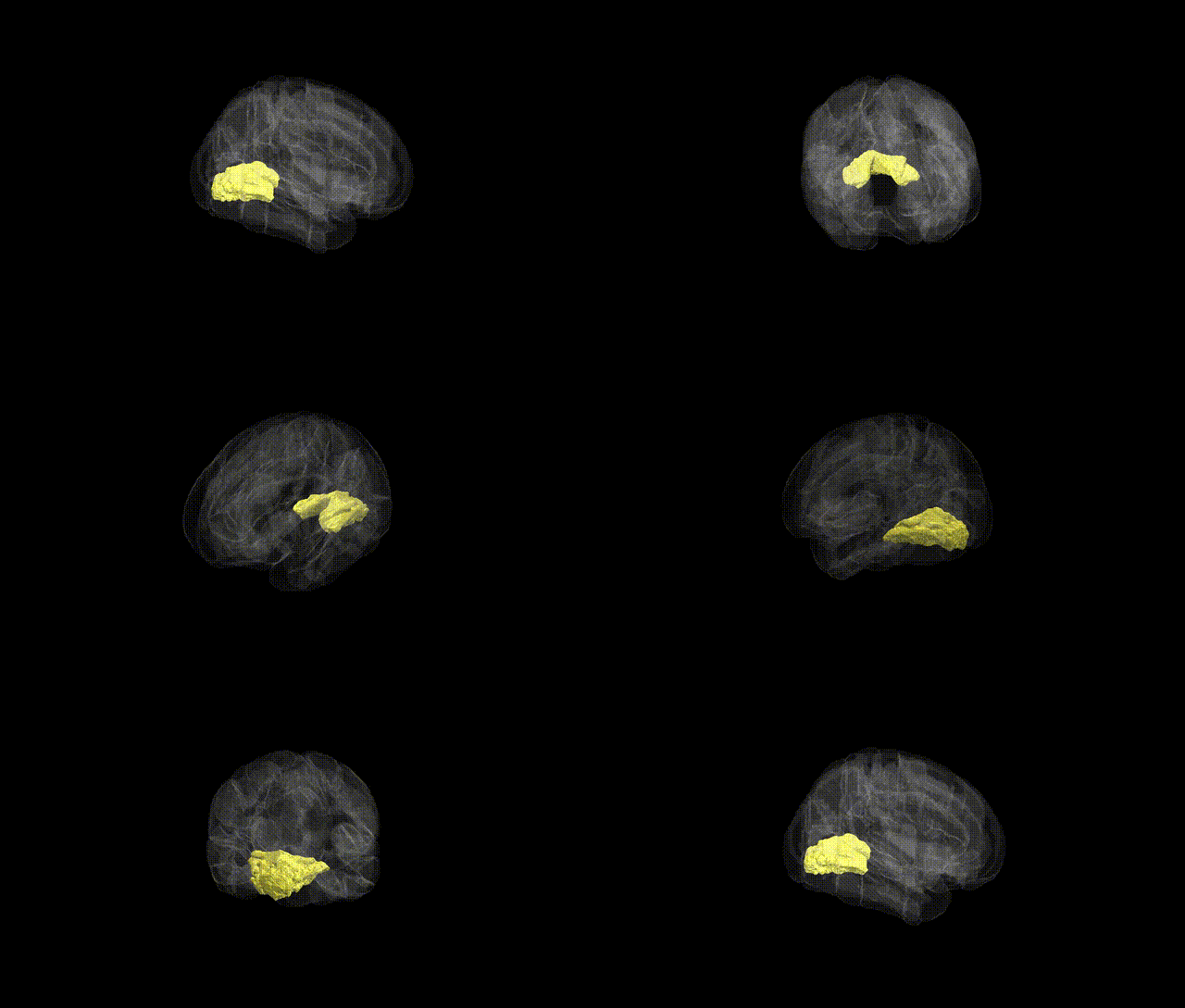
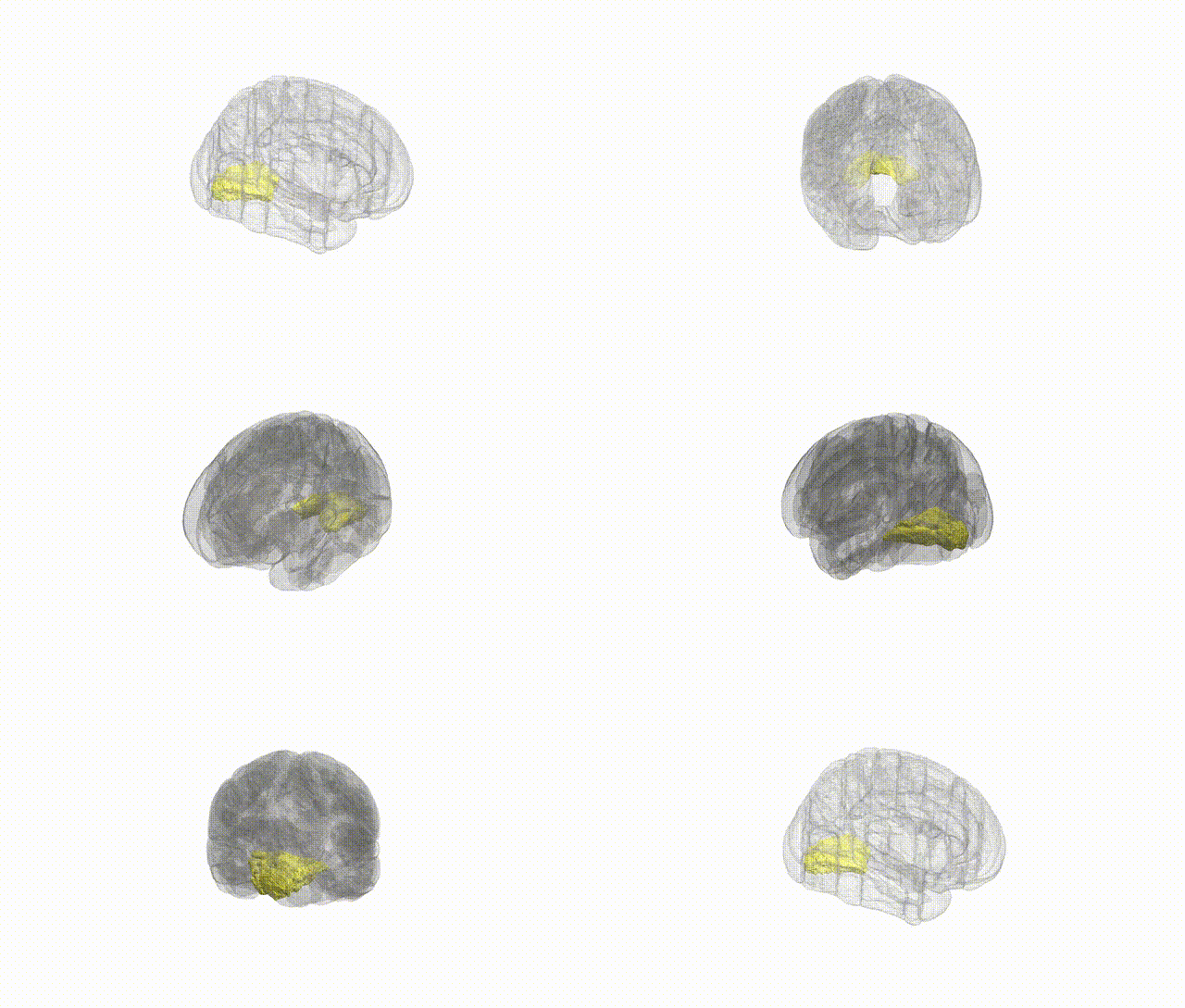
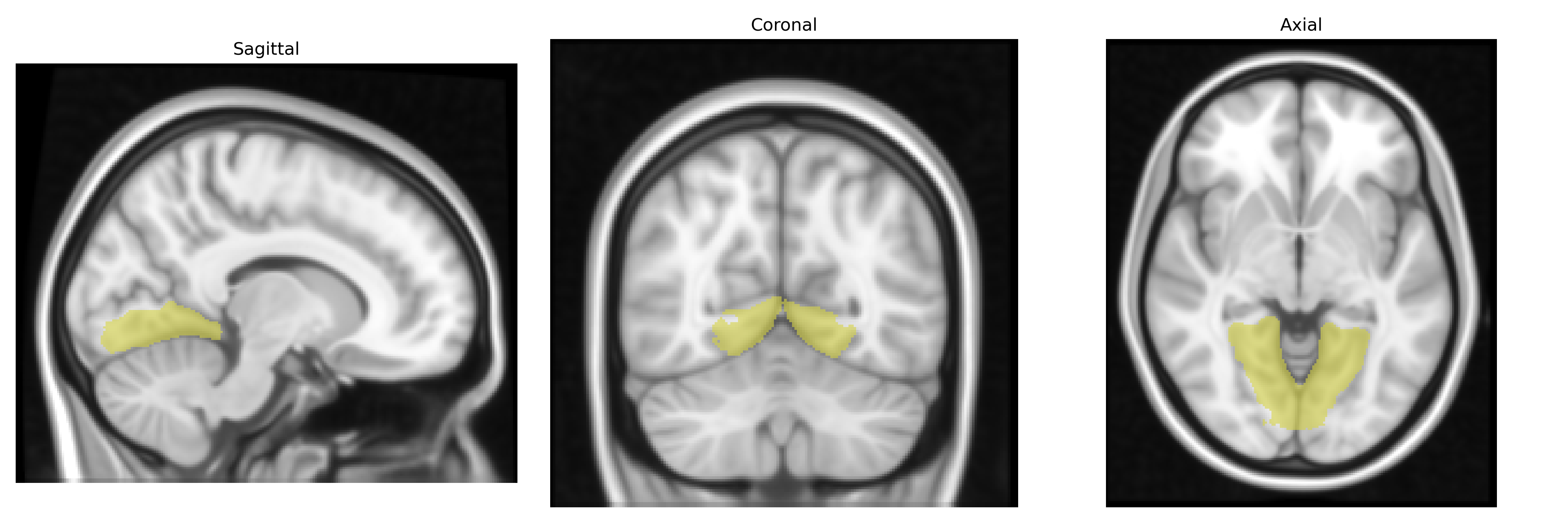
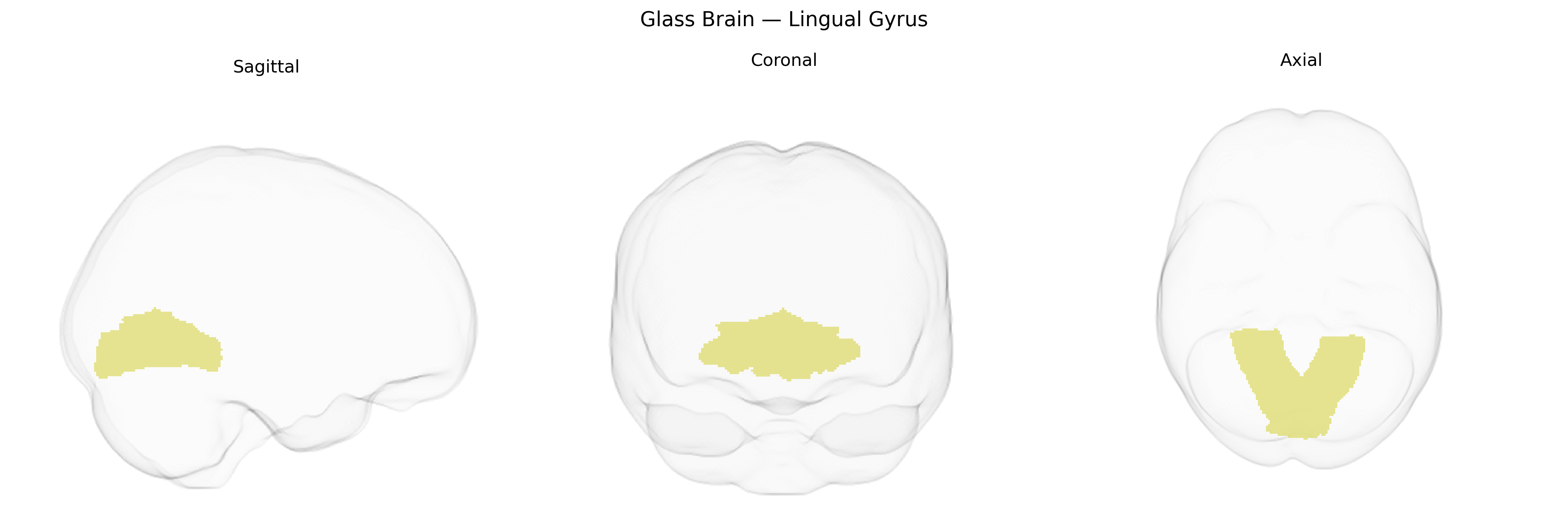
The bilateral lingual gyrus is a medial occipital cortical region located on the ventral surface of the occipital lobe, extending into the posterior medial temporal region and bounded superiorly by the calcarine sulcus and inferiorly by the collateral sulcus. In the Harvard–Oxford Cortical Structural Atlas, it encompasses gray matter involved primarily in early and higher-order visual processing, including analysis of complex visual patterns, color, and form, and contributes to functions such as visual memory, word and letter recognition, and processing of scenes and faces. The lingual gyrus is supplied by branches of the posterior cerebral artery and connects with other occipital areas, the fusiform gyrus, and limbic structures via association pathways. Functional imaging frequently implicates this region in tasks requiring detailed visual analysis, visual imagery, and reading-related processes. Lingual gyrus
The bilateral lingual gyrus, as defined in the Harvard–Oxford cortical atlas, has been implicated in genetic studies primarily through its roles in visual processing, reading, and higher-order cognition, with multiple genome-wide association studies (GWAS) linking its structure and function to specific variants and polygenic architectures rather than single genes. Imaging–genetics work from large cohorts such as ENIGMA and UK Biobank has shown that lingual gyrus volume and cortical thickness exhibit substantial SNP-based heritability and are associated with variants in pathways related to neurodevelopment, synaptic function, and myelination, including loci overlapping general cortical surface area/volume genes (e.g., near HMGA2, FGFR3, and other broadly neurodevelopmental loci). GWAS of reading ability and dyslexia, as well as functional imaging–genetics studies, suggest that polygenic risk for dyslexia and language/reading difficulties correlates with altered activation or structure in the lingual and adjacent occipitotemporal regions, while schizophrenia, bipolar disorder, and major depression GWAS-based polygenic risk scores have been associated with differences in lingual gyrus morphology or functional connectivity in case–control and population imaging samples. Additional associations have been reported between lingual gyrus measures and genetic risk for migraine, autism spectrum disorder, and Alzheimer’s disease, reflecting this region’s involvement in visual and mnemonic networks; however, no single genetic variant has been uniquely or specifically assigned to the lingual gyrus, and most findings indicate that its structural and functional variation arises from distributed polygenic influences shared with other visual and association cortices.
Overview generated by GPT-4o (2026).
Region ID: 36
Hemisphere: bilateral
Atlas: HarvardOxford cort maxprob thr25 1mm
Full Quality Version: Download MP4
Full Quality Version: Download MP4
Wali Sidiqyar*, Gaurav Rudravaram*, Elyssa M. McMaster, Trent M. Schwartz, Adam M. Saunders, Kurt G. Schilling, Bennett A. Landman "Introducing SPINS: A Shared Public Visualization Library of Neuroanatomical Structures." Medical Imaging with Deep Learning- short paper
This resource is licensed under CC0 1.0 Universal (Public Domain).