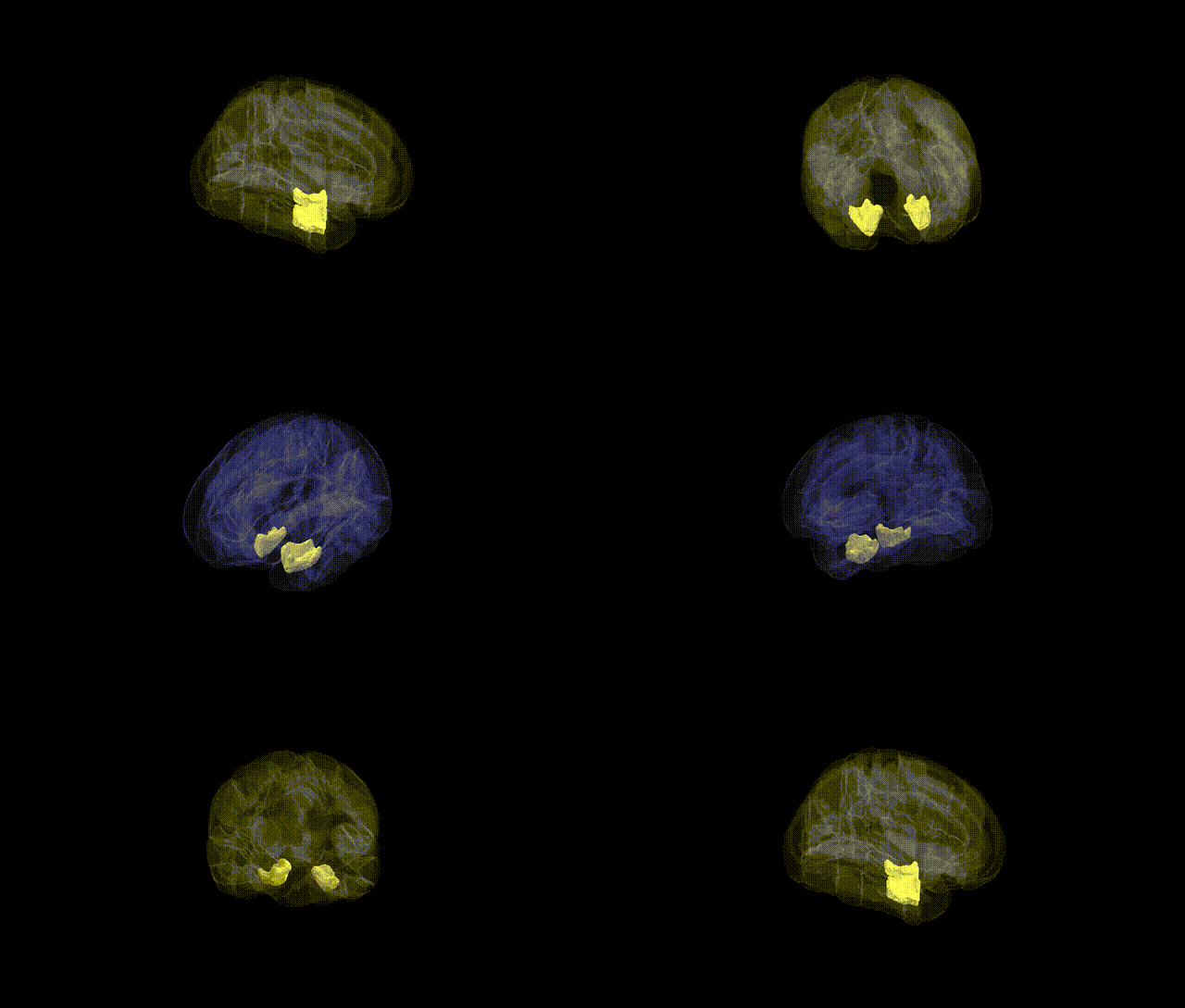
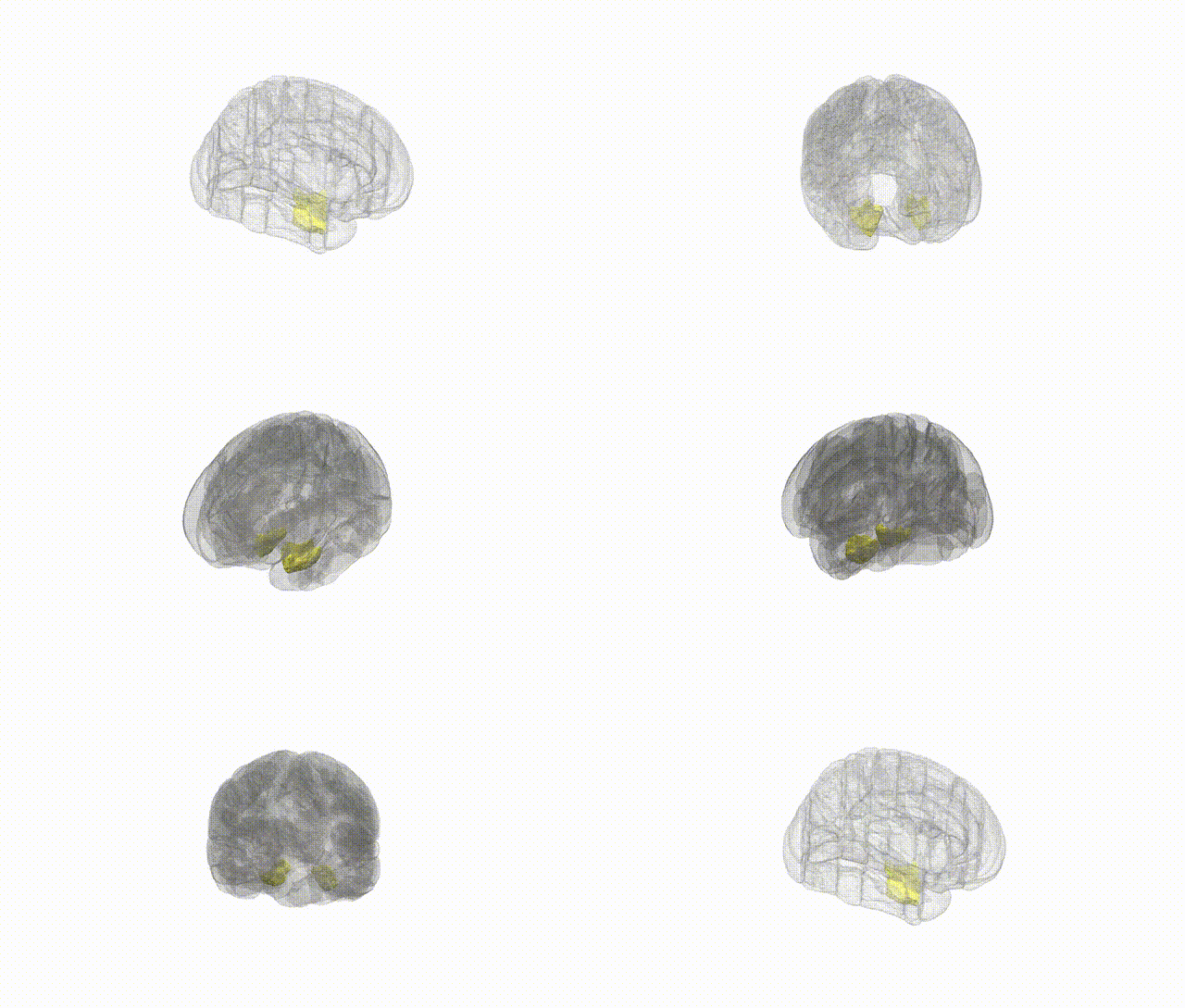
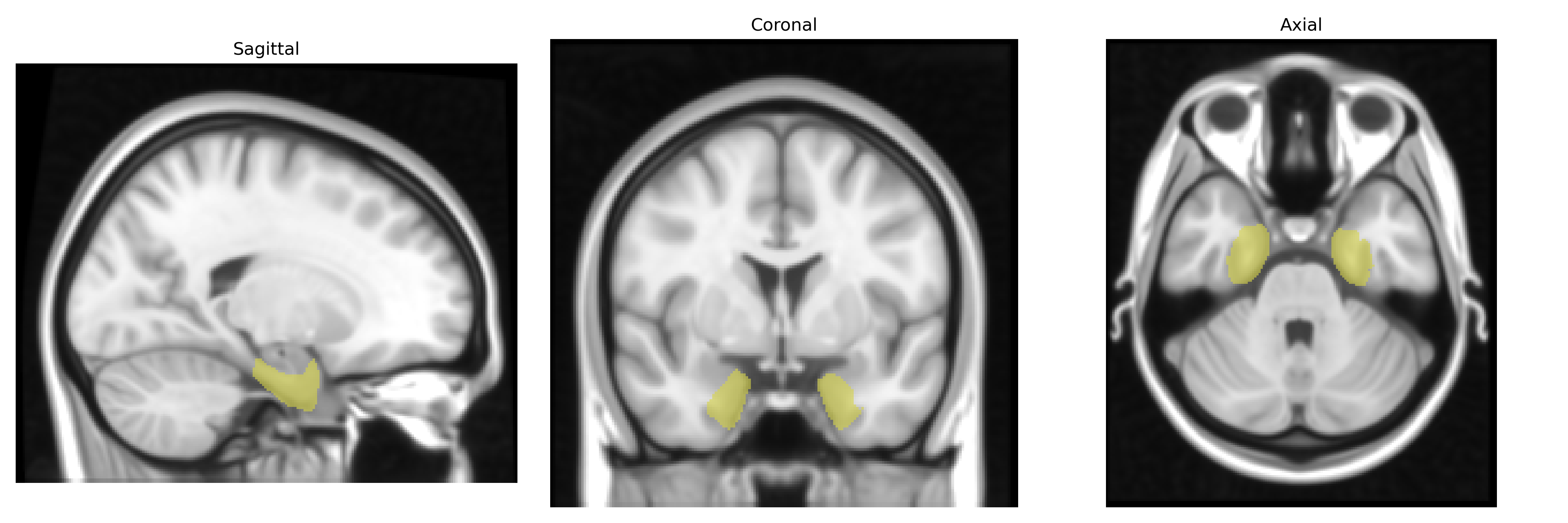
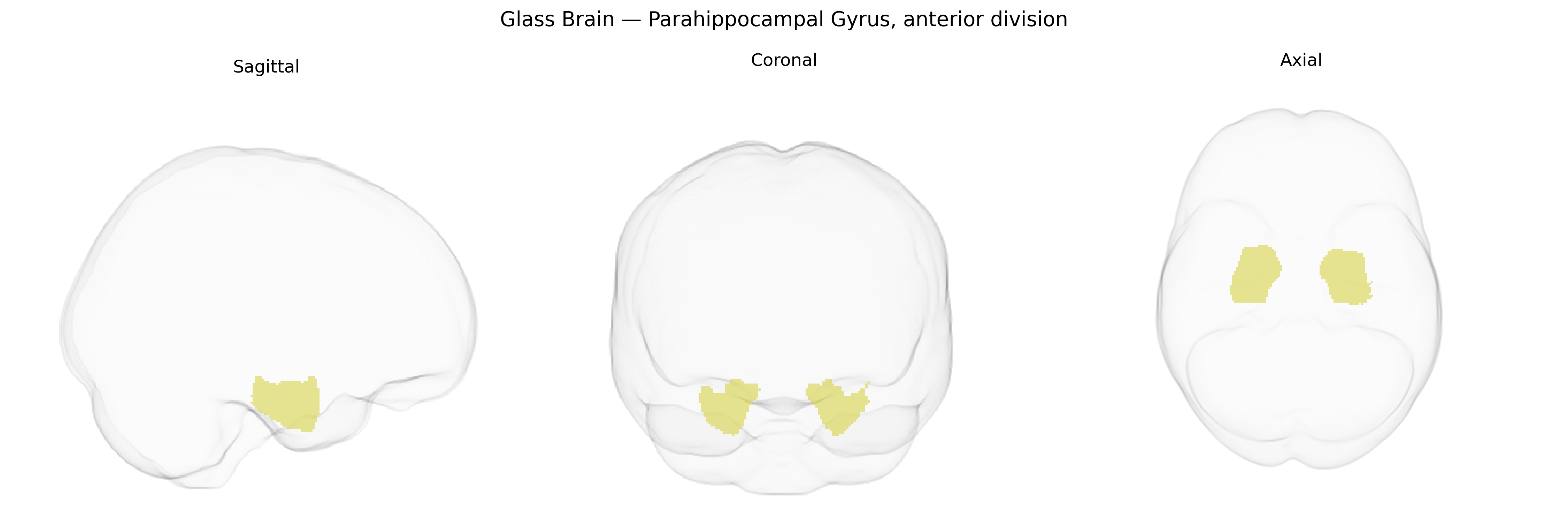
The bilateral parahippocampal gyrus, anterior division, as defined in the Harvard–Oxford cortical maxprob thr25 1 mm atlas, refers to the rostral portion of the parahippocampal gyrus located in the medial temporal lobe of both hemispheres. This cortical region lies adjacent to the hippocampus and amygdala and is heavily interconnected with limbic and association cortices. Functionally, it is implicated in episodic memory encoding and retrieval, contextual and scene processing, and aspects of emotional and associative learning, integrating multimodal sensory information with memory-related networks. Its cytoarchitecture transitions between perirhinal and entorhinal territories and forms a key gateway between neocortical association areas and the hippocampal formation. There is no direct Wikipedia article for this specific sub-division; a related structure is the Parahippocampal gyrus.
The bilateral parahippocampal gyrus, anterior division, is a medial temporal lobe structure whose volume, cortical thickness, and functional activity have been repeatedly implicated in large-scale genetic and imaging-genetic studies, particularly GWAS of brain morphology and neuropsychiatric traits. Common variants in genes related to synaptic plasticity and neurodevelopment—such as BDNF, DISC1, and ERBB4—have been associated with parahippocampal and broader medial temporal lobe structure and function, often in the context of memory performance, episodic recollection, and navigation. GWAS from consortia like ENIGMA and UK Biobank have identified multiple loci (e.g., near genes such as WNT3, DPP4, and others involved in neurodevelopmental signaling and axon guidance) associated with parahippocampal and hippocampal volumes, suggesting polygenic influences on this region’s morphology. Genetic risk for Alzheimer’s disease (including APOE ε4 and loci such as CR1 and CLU), schizophrenia, major depressive disorder, and anxiety-related traits has been linked to altered parahippocampal structure or connectivity, often showing regionally specific atrophy or functional dysconnectivity in carriers of high polygenic risk. Additionally, GWAS of cognitive traits—such as general cognitive ability, verbal memory, and spatial memory—frequently show mediation or endophenotypic effects through parahippocampal and adjacent hippocampal regions, reinforcing this area’s role as a genetically modulated hub for memory, scene processing, and vulnerability to neurodegenerative and psychiatric disorders.
Overview generated by GPT-4o (2026).
Region ID: 34
Hemisphere: bilateral
Atlas: HarvardOxford cort maxprob thr25 1mm
Full Quality Version: Download MP4
Full Quality Version: Download MP4
Wali Sidiqyar*, Gaurav Rudravaram*, Elyssa M. McMaster, Trent M. Schwartz, Adam M. Saunders, Kurt G. Schilling, Bennett A. Landman "Introducing SPINS: A Shared Public Visualization Library of Neuroanatomical Structures." Medical Imaging with Deep Learning- short paper
This resource is licensed under CC0 1.0 Universal (Public Domain).