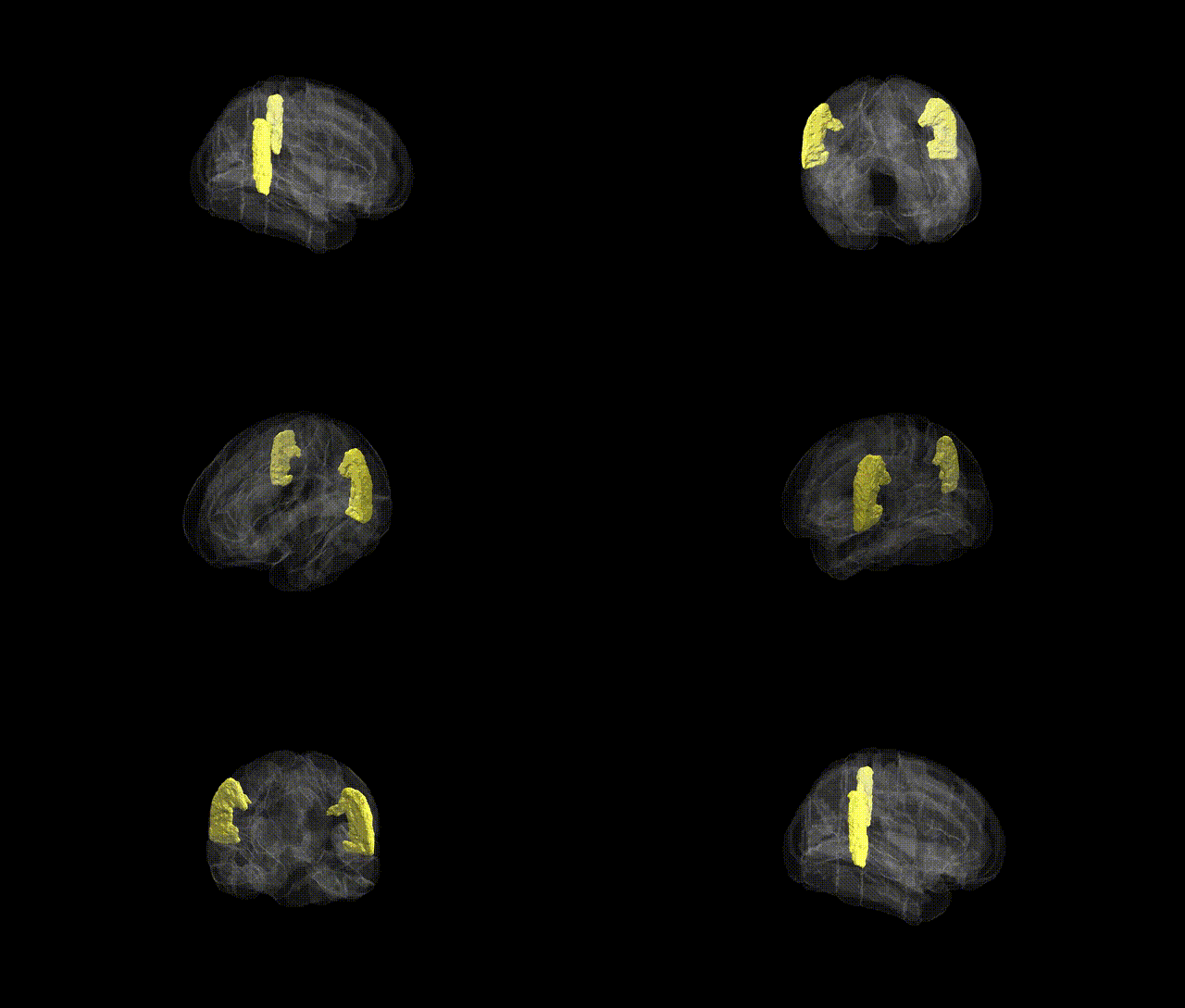
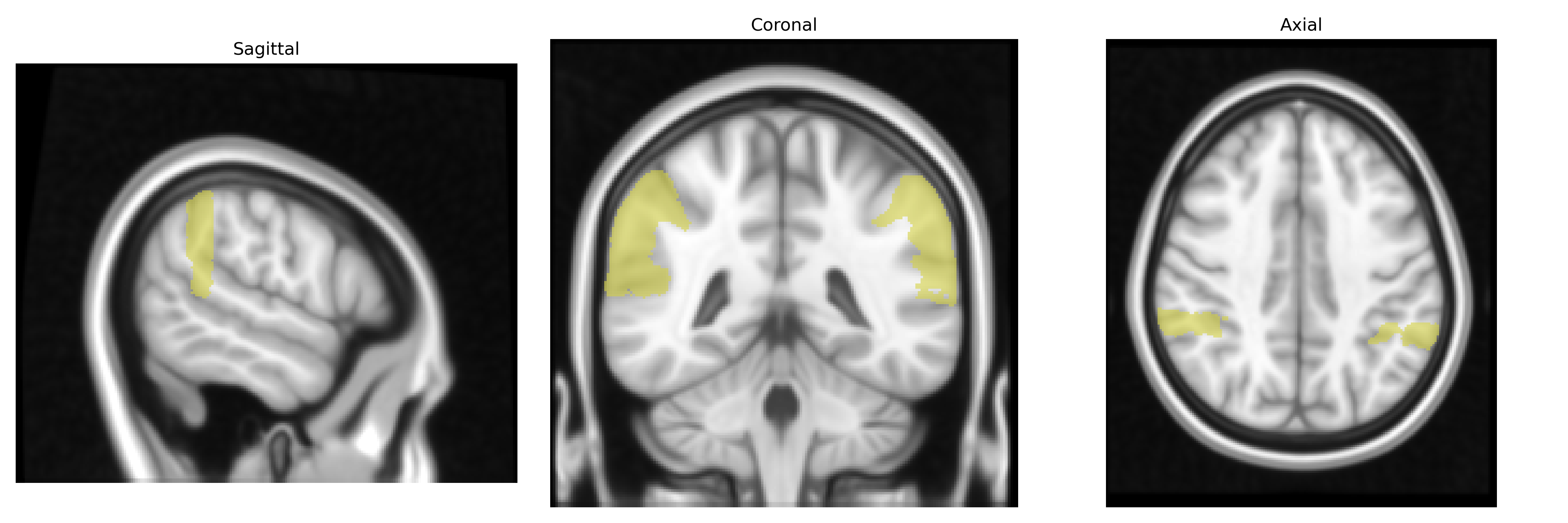
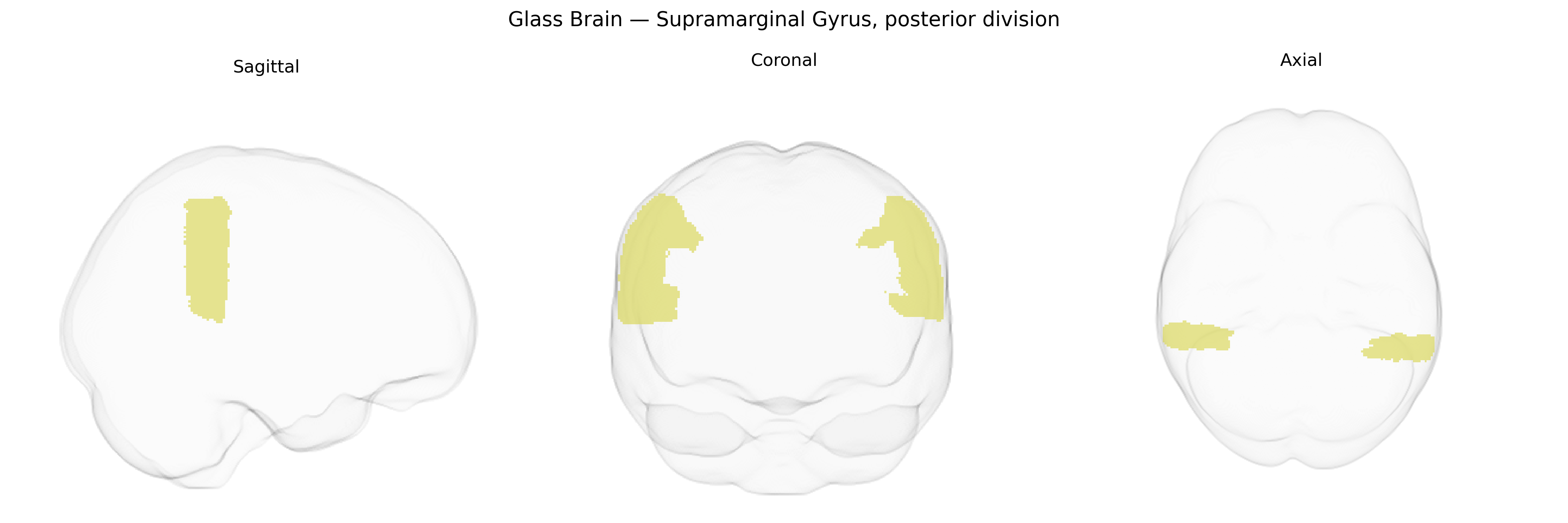
The bilateral Supramarginal Gyrus, posterior division (Harvard–Oxford Cortical Structural Atlas; maxprob, thr25, 1 mm) corresponds to the posterior portion of the supramarginal gyrus, a parietal lobe structure that arches around the posterior end of the lateral fissure and forms part of the inferior parietal lobule. This region is structurally adjacent to the angular gyrus and superior temporal gyrus and is supplied primarily by branches of the middle cerebral artery. Functionally, the posterior supramarginal gyrus has been implicated in higher-order multimodal integration, including aspects of language processing (particularly phonological and semantic integration), spatial attention, and sensorimotor mapping of actions. It participates in large-scale networks involving temporal and frontal association cortices, contributing to processes such as perspective taking, praxis, and the integration of auditory, somatosensory, and visual information. A closely related reference entry is: Supramarginal gyrus.
The bilateral supramarginal gyrus, posterior division, as defined in the Harvard–Oxford atlas, has been implicated in several genetic and genome-wide association studies that link this region to variation in cortical surface area and thickness, as well as to complex cognitive and psychiatric phenotypes. Large-scale imaging genetics consortia (e.g., ENIGMA, UK Biobank–based GWAS) have identified common variants in genes involved in neurodevelopment, synaptic plasticity, and axon guidance (such as those near or within HMGA2, MIR-548F3, and other loci on chromosomes 3, 6, and 17) that show significant associations with structural metrics encompassing the supramarginal gyrus and adjoining inferior parietal cortex. Polygenic risk for schizophrenia, major depressive disorder, and autism spectrum disorder has been associated with altered parietal and temporoparietal morphology and connectivity, including posterior supramarginal regions implicated in language processing, empathy, and social cognition. Additionally, GWAS of cognitive performance, educational attainment, and reading-related traits have reported overlap between genetic variants affecting these traits and those influencing cortical structure and function in parietal language and phonological networks that include the supramarginal gyrus, although specific loci are usually reported at the level of broader lobar or network-based parietal measures rather than this subregion alone.
Overview generated by GPT-4o (2026).
Region ID: 20
Hemisphere: bilateral
Atlas: HarvardOxford cort maxprob thr25 1mm
Full Quality Version: Download MP4
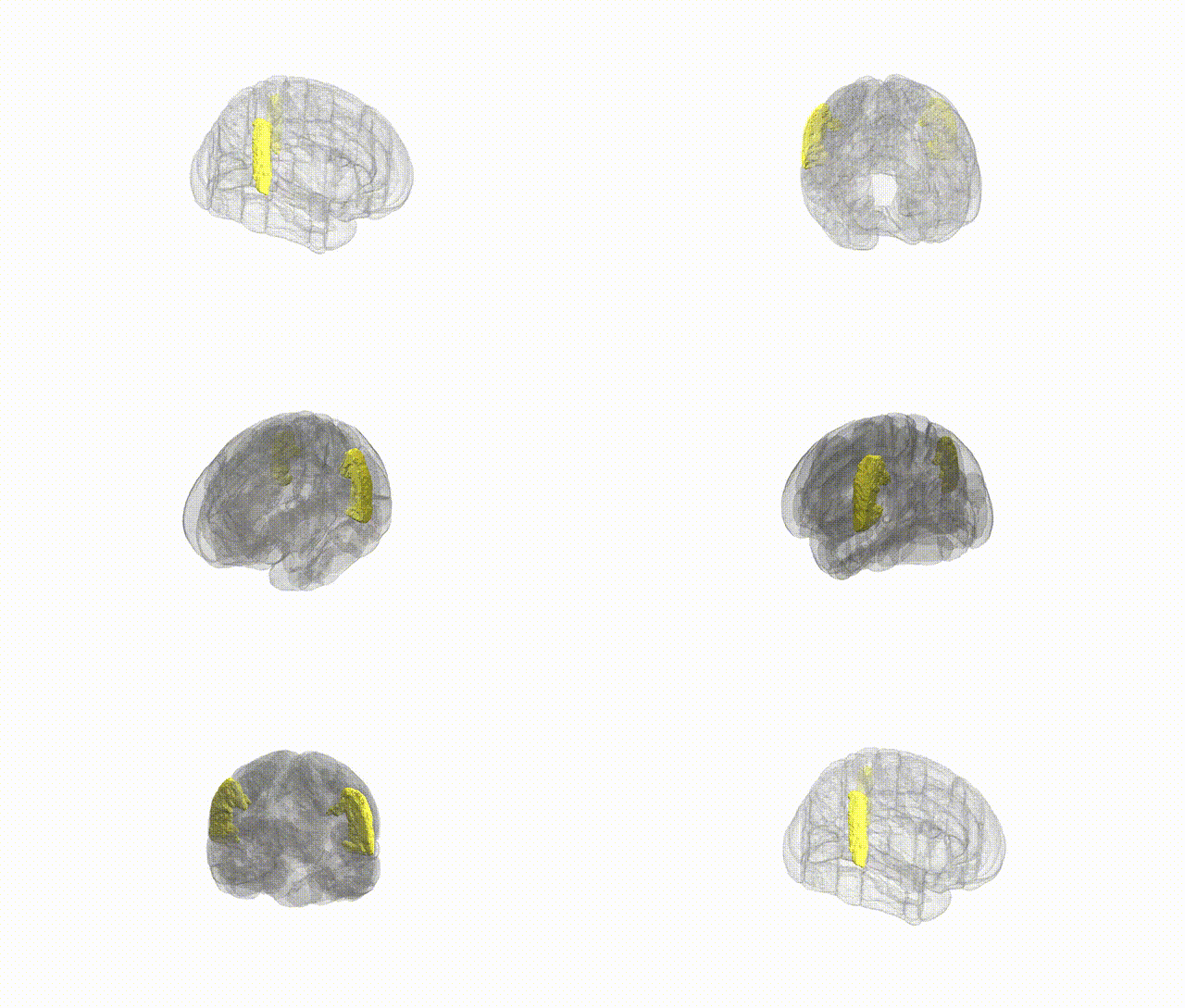
Full Quality Version: Download MP4
Wali Sidiqyar*, Gaurav Rudravaram*, Elyssa M. McMaster, Trent M. Schwartz, Adam M. Saunders, Kurt G. Schilling, Bennett A. Landman "Introducing SPINS: A Shared Public Visualization Library of Neuroanatomical Structures." Medical Imaging with Deep Learning- short paper
This resource is licensed under CC0 1.0 Universal (Public Domain).