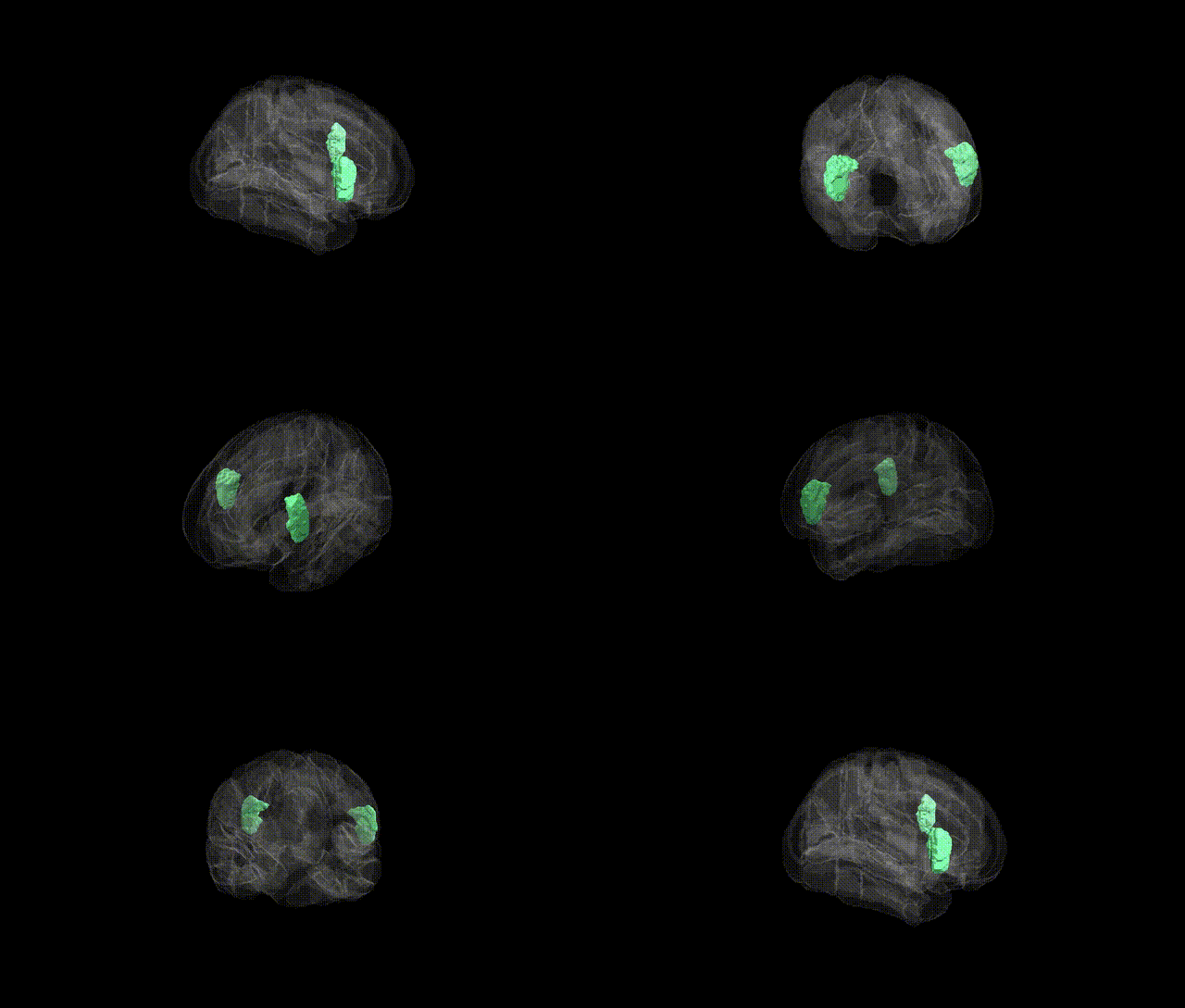
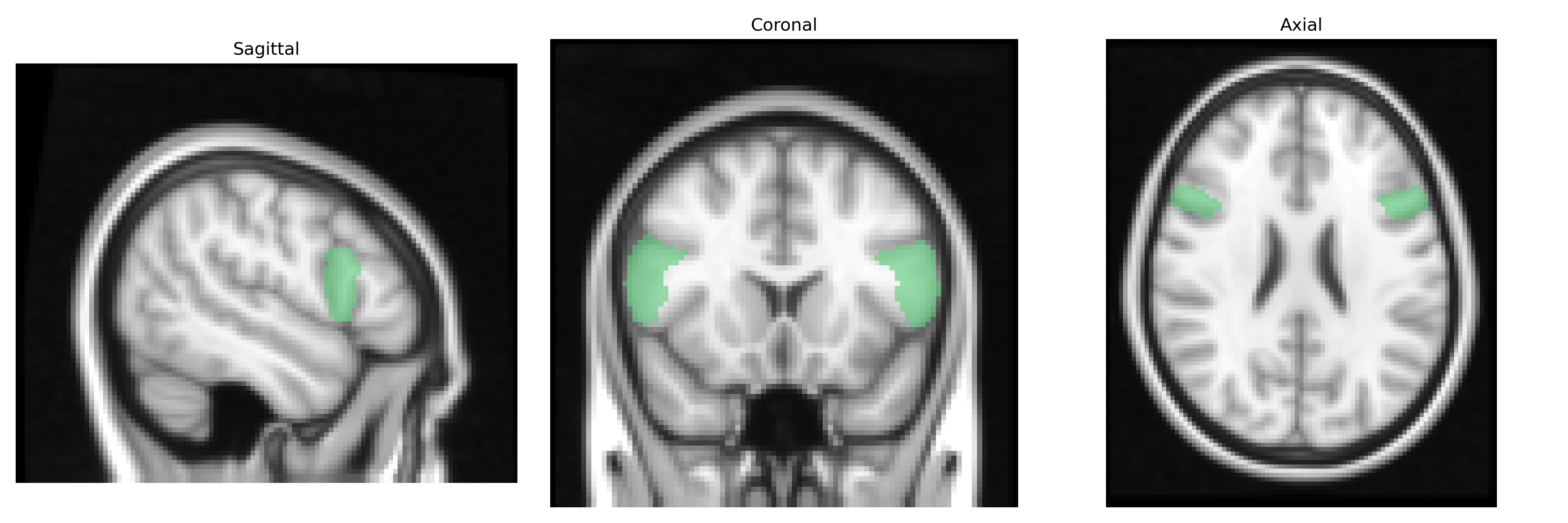
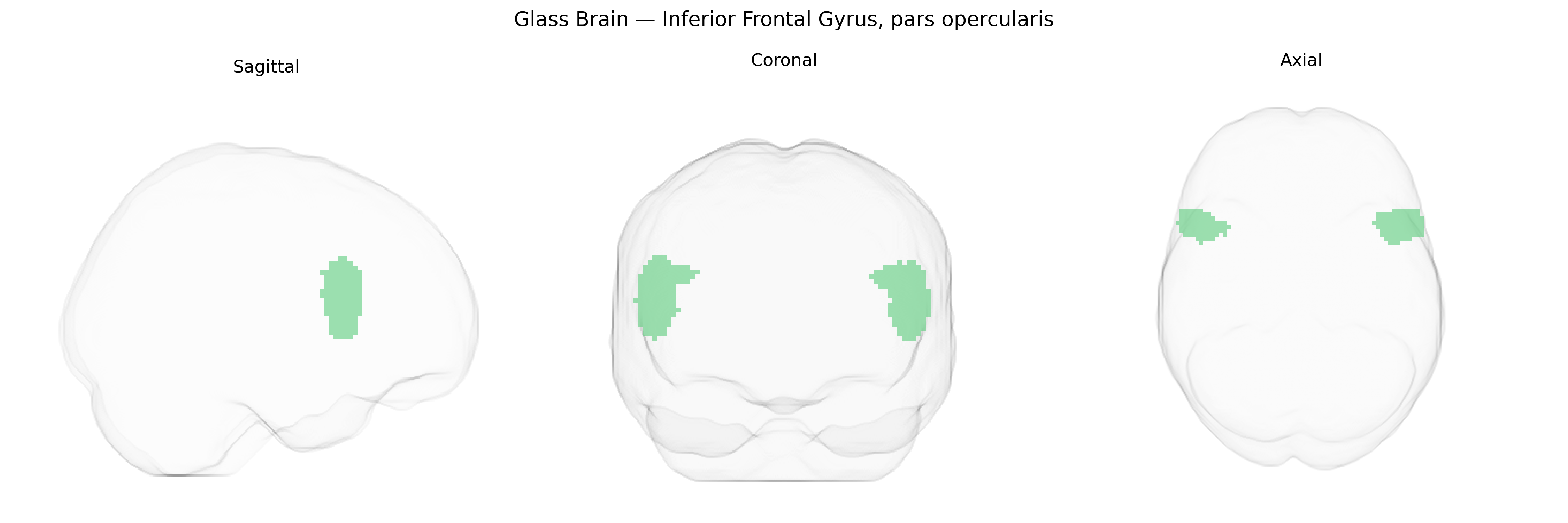
The bilateral Inferior Frontal Gyrus, pars opercularis, as defined in the Harvard-Oxford cortical atlas, corresponds to the opercular segment of the inferior frontal gyrus located in the posterior portion of the frontal lobe, bordering the precentral gyrus dorsally and the insular cortex deep to the lateral sulcus. It is cytoarchitectonically related to Brodmann areas 44 and adjacent regions and forms a core component of the ventrolateral prefrontal cortex. Functionally, this region is implicated in speech and language production (classically associated with Broca’s area in the dominant hemisphere), phonological and syntactic processing, and aspects of motor planning and control, including orofacial and manual action representation. It also contributes to response inhibition, cognitive control, and the integration of sensory–motor information during complex, goal-directed behaviors. There is no direct link specifically for the “pars opercularis of the inferior frontal gyrus”; a related structure is the Inferior frontal gyrus.
The bilateral Inferior Frontal Gyrus pars opercularis (IFGop), corresponding roughly to part of Broca’s region, has been implicated in multiple genetic and GWAS-based findings related to language, cognitive control, and neuropsychiatric risk. Imaging genetics studies have shown that common variants influencing cortical thickness, surface area, and gyrification in this region are enriched among loci associated with general cognitive ability, educational attainment, and reading/language traits, including variants near genes such as FOXP2, CNTNAP2, and KIAA0319 that are broadly implicated in speech and language development rather than specifically in IFGop. Large-scale brain MRI GWAS consortia (e.g., ENIGMA, UK Biobank–based studies) report polygenic influences on IFG morphology and activation patterns that overlap with risk loci for schizophrenia, major depressive disorder, and ADHD, consistent with IFGop involvement in response inhibition and language-related executive functions. Psychosis- and mood-disorder–related risk alleles, including those in synaptic and neurodevelopmental genes (e.g., CACNA1C, GRIN2A, and other glutamatergic/calcium channel genes), show downstream associations with altered activation or structure in IFGop during tasks requiring verbal fluency and cognitive control. Additionally, GWAS of stuttering and developmental language disorder highlight polygenic architectures that converge on frontotemporal language networks, with IFGop consistently emerging as a key node whose variability in structure and function is modulated by common genetic variation, although specific, high-confidence IFGop-exclusive loci have not yet been firmly established.
Overview generated by GPT-4o (2026).
Region ID: 6
Hemisphere: bilateral
Atlas: HarvardOxford cort maxprob thr25 2mm
Full Quality Version: Download MP4
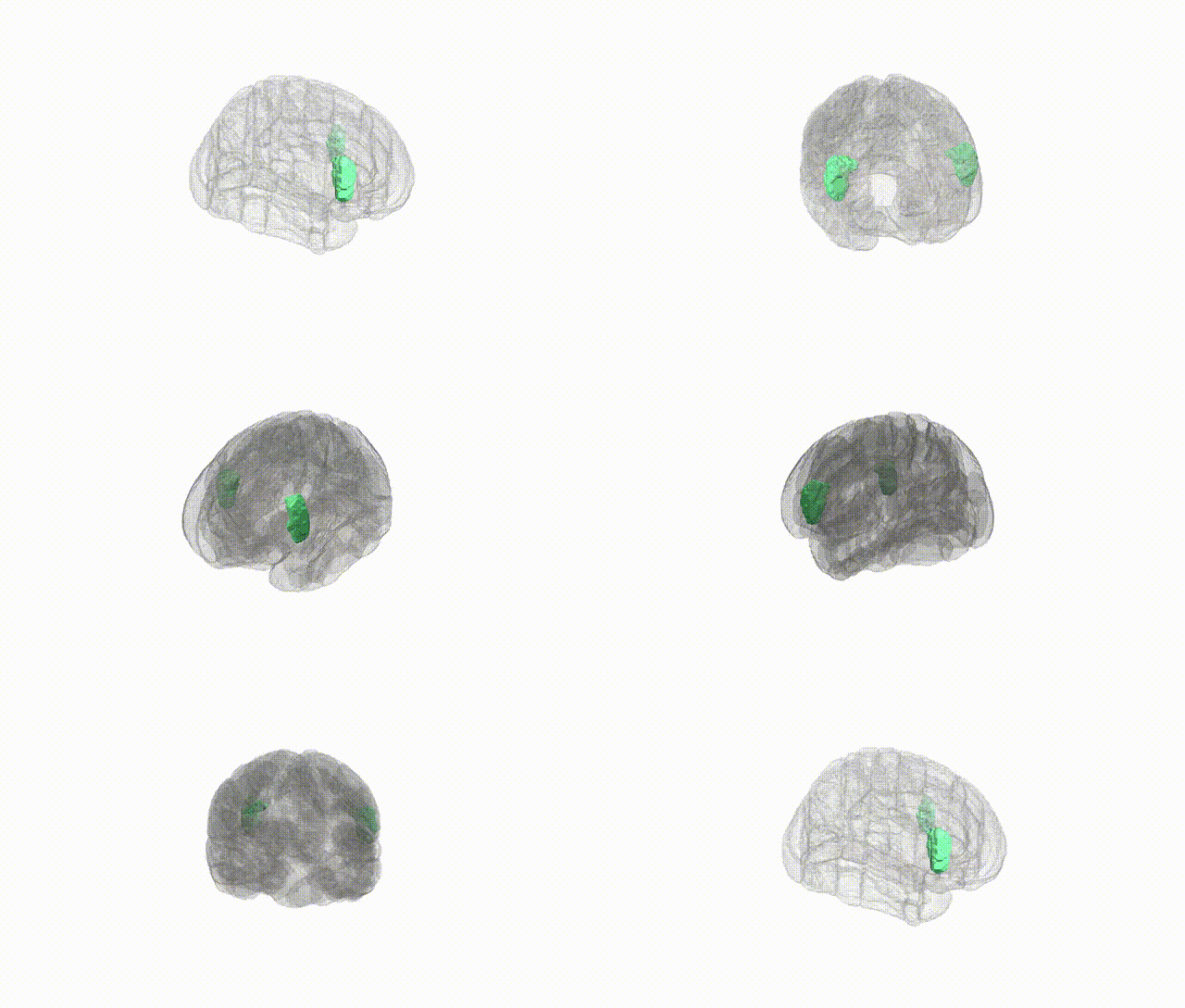
Full Quality Version: Download MP4
Wali Sidiqyar*, Gaurav Rudravaram*, Elyssa M. McMaster, Trent M. Schwartz, Adam M. Saunders, Kurt G. Schilling, Bennett A. Landman "Introducing SPINS: A Shared Public Visualization Library of Neuroanatomical Structures." Medical Imaging with Deep Learning- short paper
This resource is licensed under CC0 1.0 Universal (Public Domain).