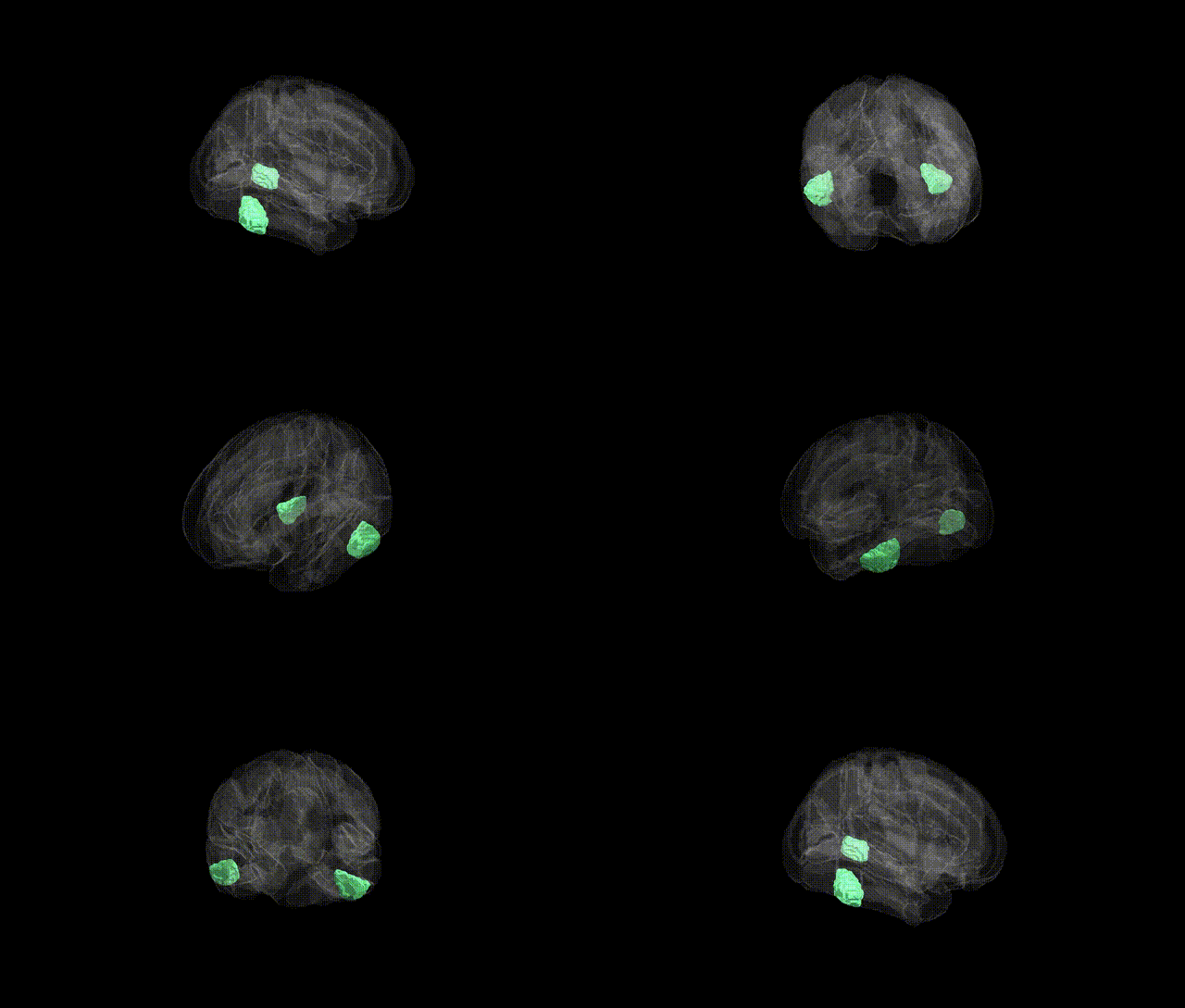
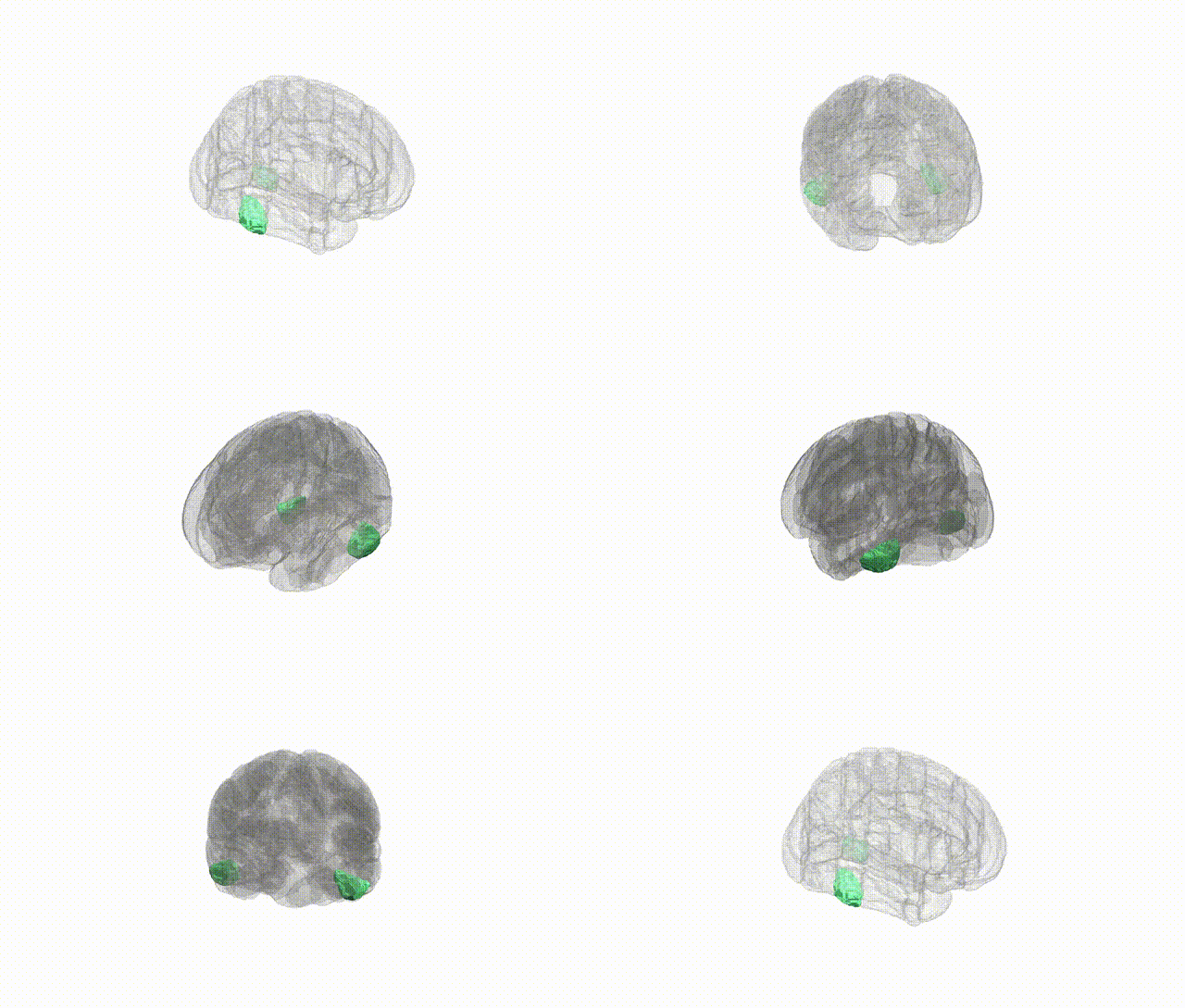
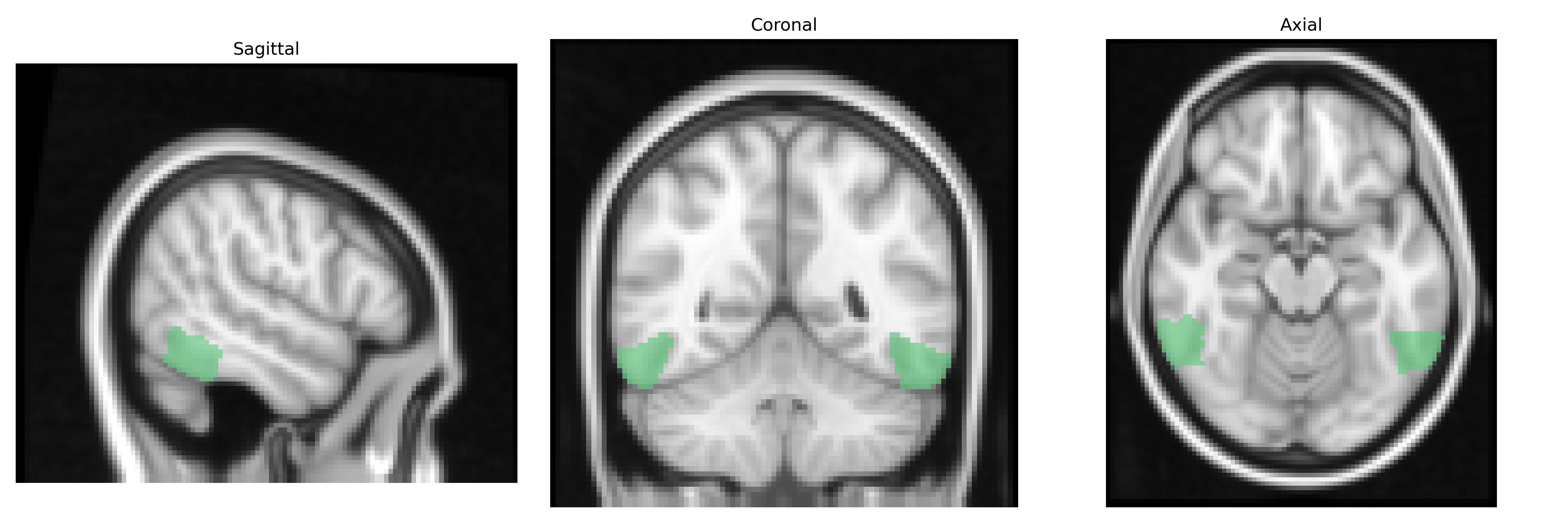
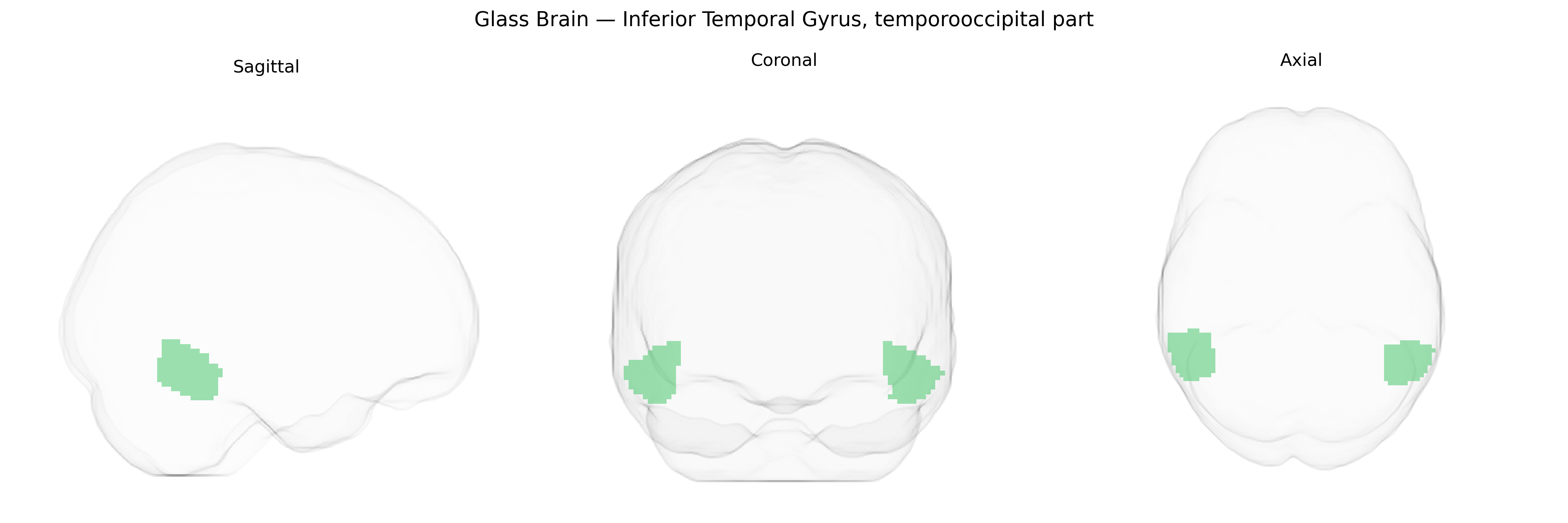
The bilateral Inferior Temporal Gyrus, temporooccipital part, as defined in the Harvard–Oxford cortical maxprob atlas (thr25, 2 mm), corresponds to the posterior segment of the inferior temporal gyrus extending into the temporo‑occipital junction, lying ventrolateral to the fusiform gyrus and inferior to the middle temporal gyrus. This region forms part of the ventral visual processing stream (“what” pathway) and is implicated in higher-order object and shape recognition, visual semantic processing, and aspects of language-related visual integration. It receives convergent visual input from occipital areas and projects to anterior temporal and limbic structures, supporting the transformation of visual features into meaningful representations. There is no direct Wikipedia article for this exact subregion; a closely related structure is the Inferior temporal gyrus.
The bilateral inferior temporal gyrus, temporooccipital part—encompassing high-level visual association cortex involved in object, face, and word-form processing—has been implicated in several genetic and GWAS-based associations, although often under broader temporal or ventral visual stream labels rather than this exact atlas-defined parcel. Large-scale imaging–genetics consortia such as ENIGMA and UK Biobank have identified common variants, including loci near genes such as HMGA2, MAPT, KANSL1, and others involved in neurodevelopment, synaptic function, and neurodegeneration, that influence temporal lobe cortical thickness, surface area, or volume measures that extend into inferior and occipitotemporal cortex. Polygenic risk scores for schizophrenia, autism spectrum disorder, major depression, and Alzheimer’s disease show associations with structural and functional variation in inferior and lateral temporal regions, including the fusiform and occipitotemporal gyri, which neighbor or overlap the temporooccipital inferior temporal region. Specific rare variants and monogenic conditions affecting ventral temporal structures (for example, certain copy number variants such as 22q11.2 deletions or genes involved in synaptic scaffolding and axon guidance) have been linked to atypical face and object recognition, reading-related circuits, and social cognition, implicating this region’s circuitry in neurodevelopmental phenotypes. GWAS of cognitive traits (general intelligence, educational attainment, reading ability) and face recognition have also reported associations with structural or activation differences in inferior/occipitotemporal cortex, suggesting that distributed polygenic influences on cortical development and plasticity contribute to interindividual variability in this region’s morphology and function.
Overview generated by GPT-4o (2026).
Region ID: 16
Hemisphere: bilateral
Atlas: HarvardOxford cort maxprob thr25 2mm
Full Quality Version: Download MP4
Full Quality Version: Download MP4
Wali Sidiqyar*, Gaurav Rudravaram*, Elyssa M. McMaster, Trent M. Schwartz, Adam M. Saunders, Kurt G. Schilling, Bennett A. Landman "Introducing SPINS: A Shared Public Visualization Library of Neuroanatomical Structures." Medical Imaging with Deep Learning- short paper
This resource is licensed under CC0 1.0 Universal (Public Domain).