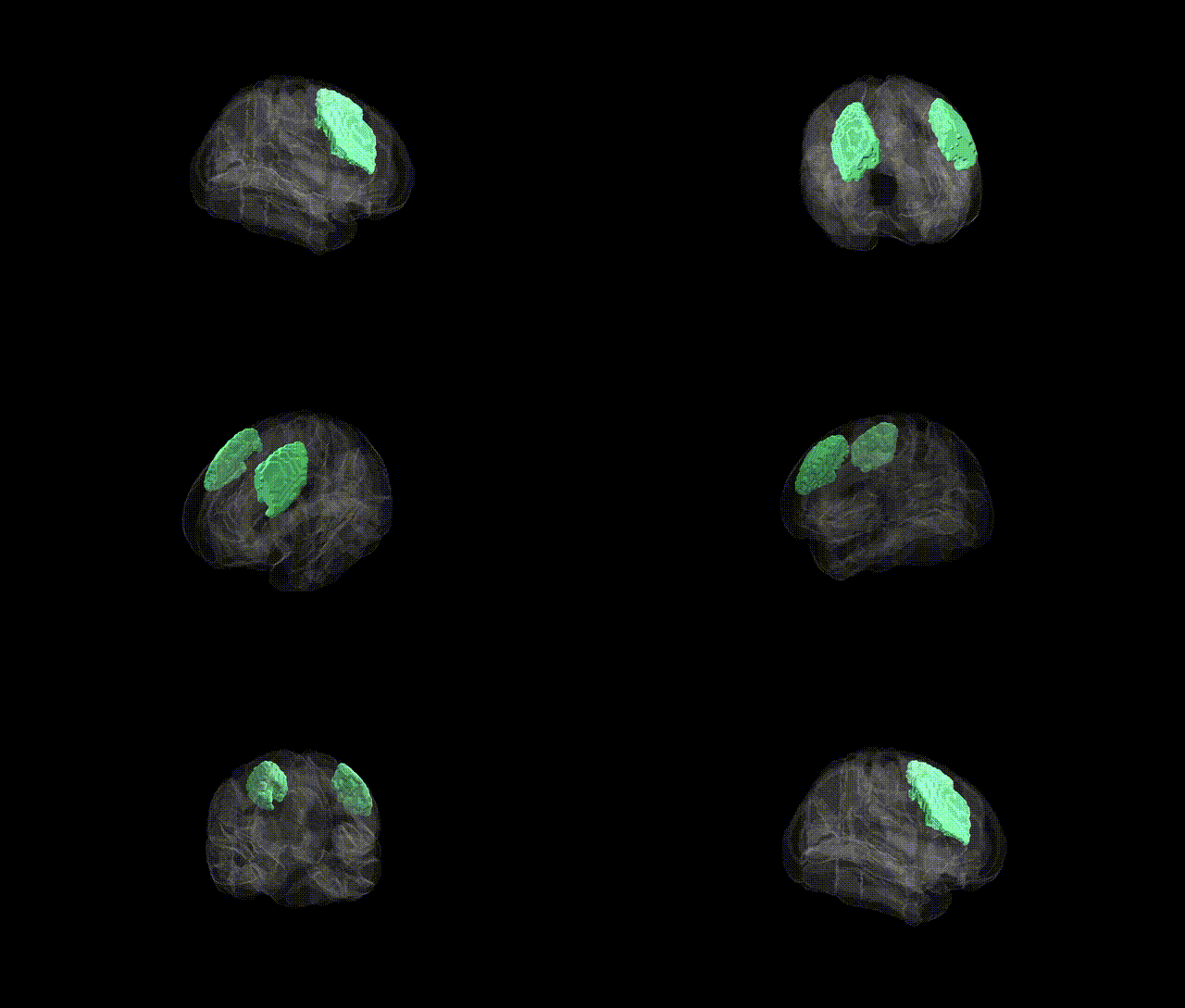
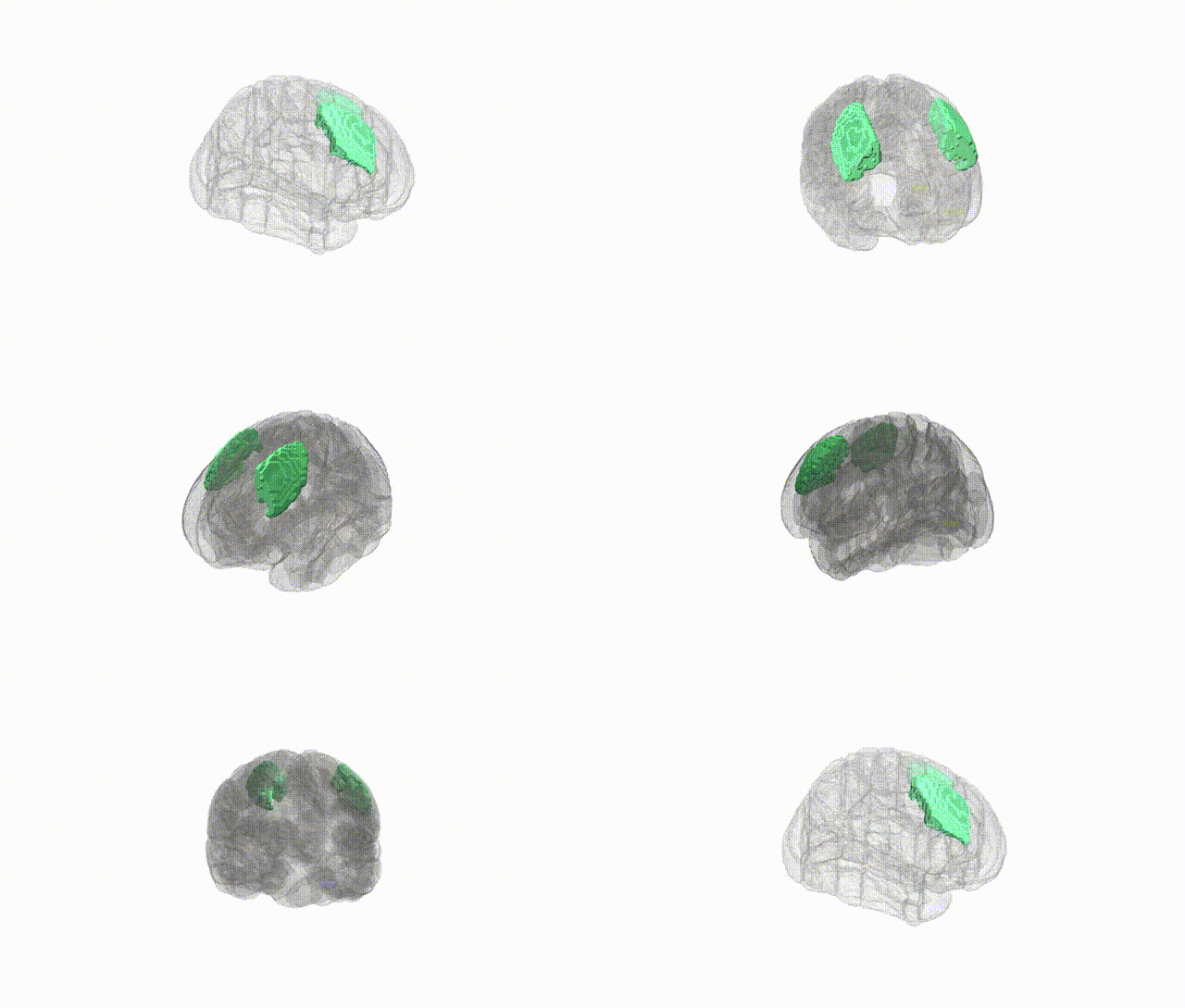
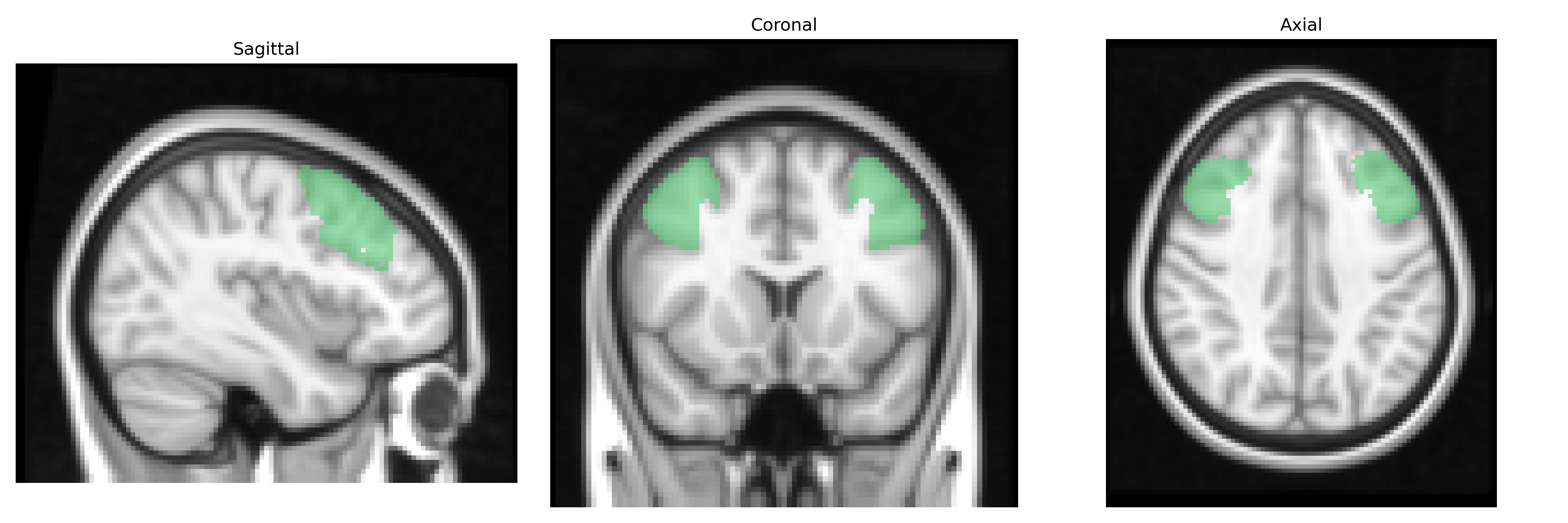
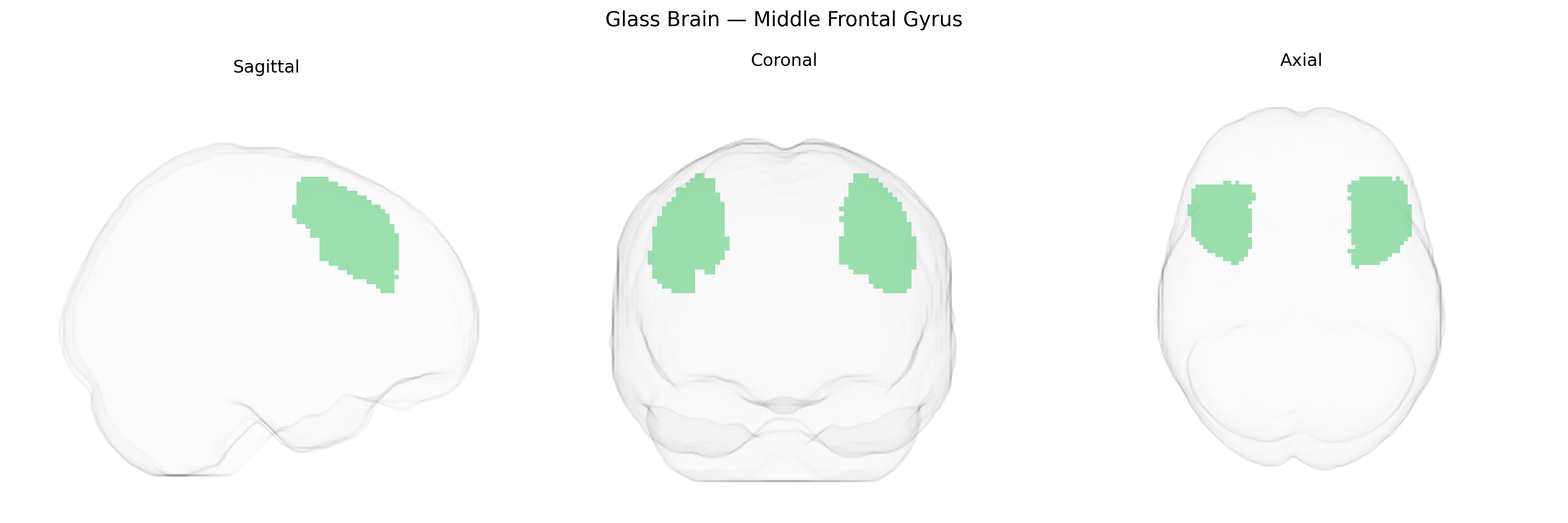
The bilateral Middle Frontal Gyrus, as defined in the Harvard-Oxford Cortical Structural Atlas (maxprob thr25 2mm), comprises dorsolateral portions of the frontal lobe located between the superior and inferior frontal gyri, extending anteriorly from the precentral gyrus toward the frontal pole. This region is primarily associated with higher-order executive functions, including working memory, attentional control, planning, cognitive flexibility, and aspects of decision-making, and forms a key component of the dorsolateral prefrontal cortex (DLPFC). Cytoarchitectonically, it encompasses parts of Brodmann areas 9 and 46 and is heavily interconnected with parietal association cortices, premotor regions, and subcortical structures such as the thalamus and basal ganglia, supporting integrative cognitive processing and goal-directed behavior. There is no direct Wikipedia article specifically for the “Middle Frontal Gyrus”; a closely related structure is the dorsolateral prefrontal cortex: Dorsolateral prefrontal cortex.
The bilateral Middle Frontal Gyrus, a key component of the dorsolateral prefrontal cortex as defined in the Harvard-Oxford cortical atlas, has been implicated in multiple genetic and GWAS findings involving cognition, psychiatric risk, and brain structural variation. Large neuroimaging GWAS meta-analyses (e.g., ENIGMA, UK Biobank) have identified common variants in genes such as HMGA2, KIAA0586, and those in the 17q21.31 locus associated with cortical thickness and surface area in middle frontal and broader prefrontal regions, reflecting polygenic influences on executive-control circuitry. Variants in genes involved in synaptic function and neurodevelopment (including CACNA1C, DRD2, and GRIN2A) have been linked to activation and connectivity patterns in the middle frontal gyrus during working memory, cognitive control, and decision-making tasks in imaging genetics studies. Psychiatric GWAS studies in schizophrenia, bipolar disorder, major depressive disorder, and ADHD repeatedly implicate genetic risk scores that correlate with altered middle frontal gyrus structure and function, suggesting that polygenic risk for these disorders partially manifests through disruption of prefrontal circuits. In addition, GWAS of intelligence, educational attainment, and general cognitive performance show that alleles conferring higher cognitive ability are associated with greater activation or preserved volume in middle frontal regions, while neurodegenerative risk loci (e.g., APOE in Alzheimer’s disease) have been related to atrophy and hypometabolism in this area. Collectively, these findings indicate that the bilateral Middle Frontal Gyrus is a convergent target of diverse genetic influences related to executive function, psychiatric vulnerability, and cognitive aging, although associations are highly polygenic and not specific to a single locus.
Overview generated by GPT-4o (2026).
Region ID: 4
Hemisphere: bilateral
Atlas: HarvardOxford cort maxprob thr25 2mm
Full Quality Version: Download MP4
Full Quality Version: Download MP4
Wali Sidiqyar*, Gaurav Rudravaram*, Elyssa M. McMaster, Trent M. Schwartz, Adam M. Saunders, Kurt G. Schilling, Bennett A. Landman "Introducing SPINS: A Shared Public Visualization Library of Neuroanatomical Structures." Medical Imaging with Deep Learning- short paper
This resource is licensed under CC0 1.0 Universal (Public Domain).