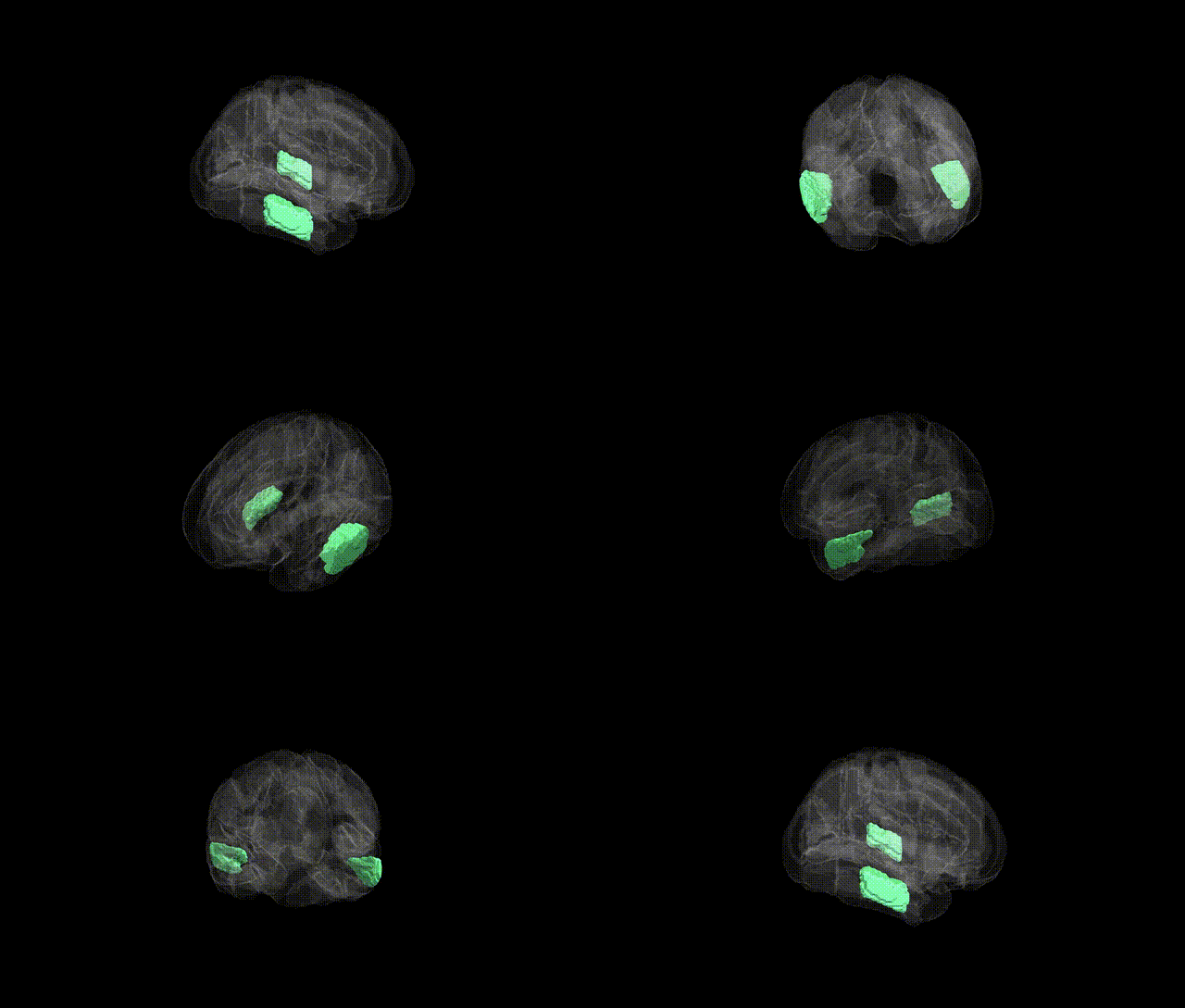
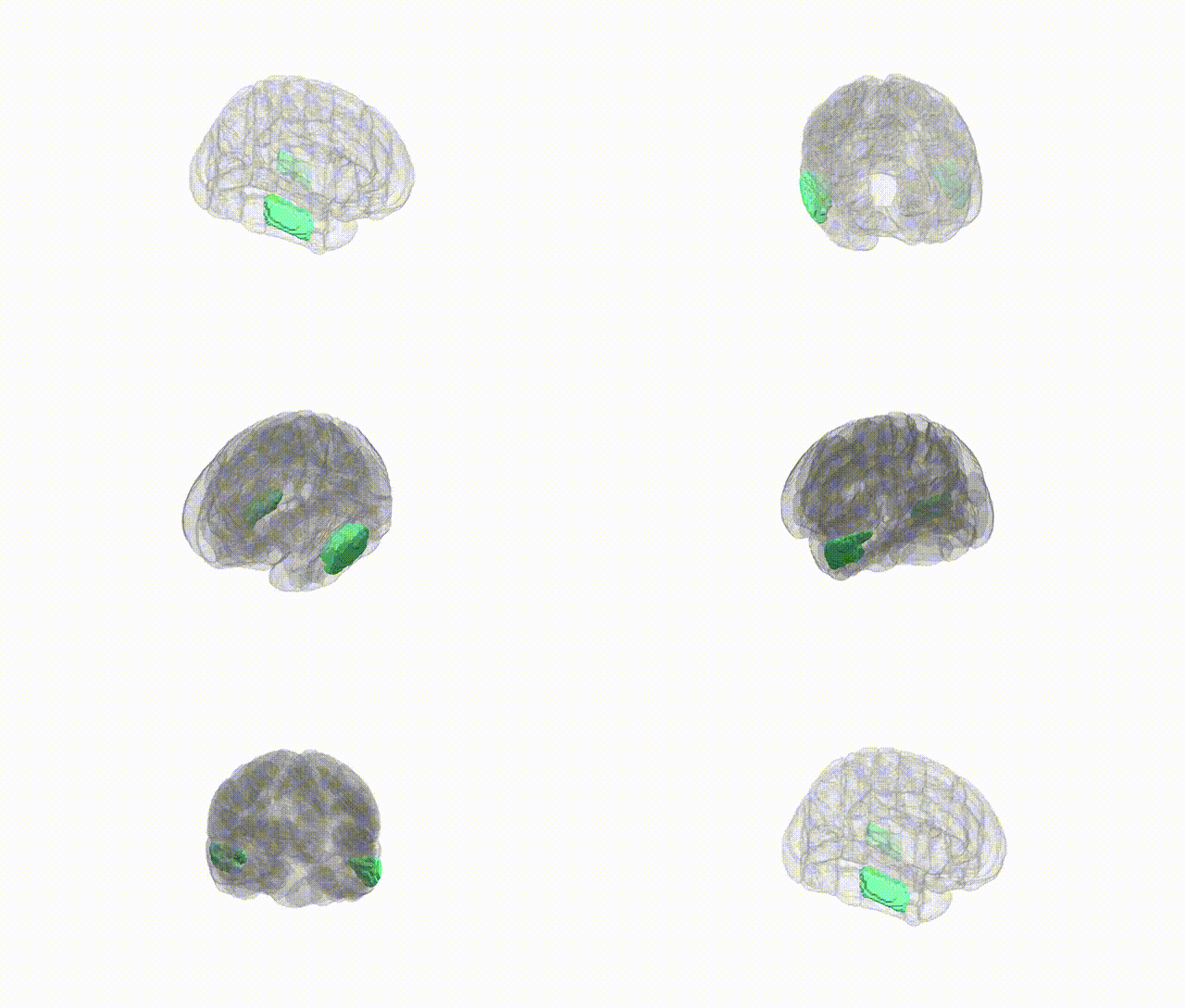
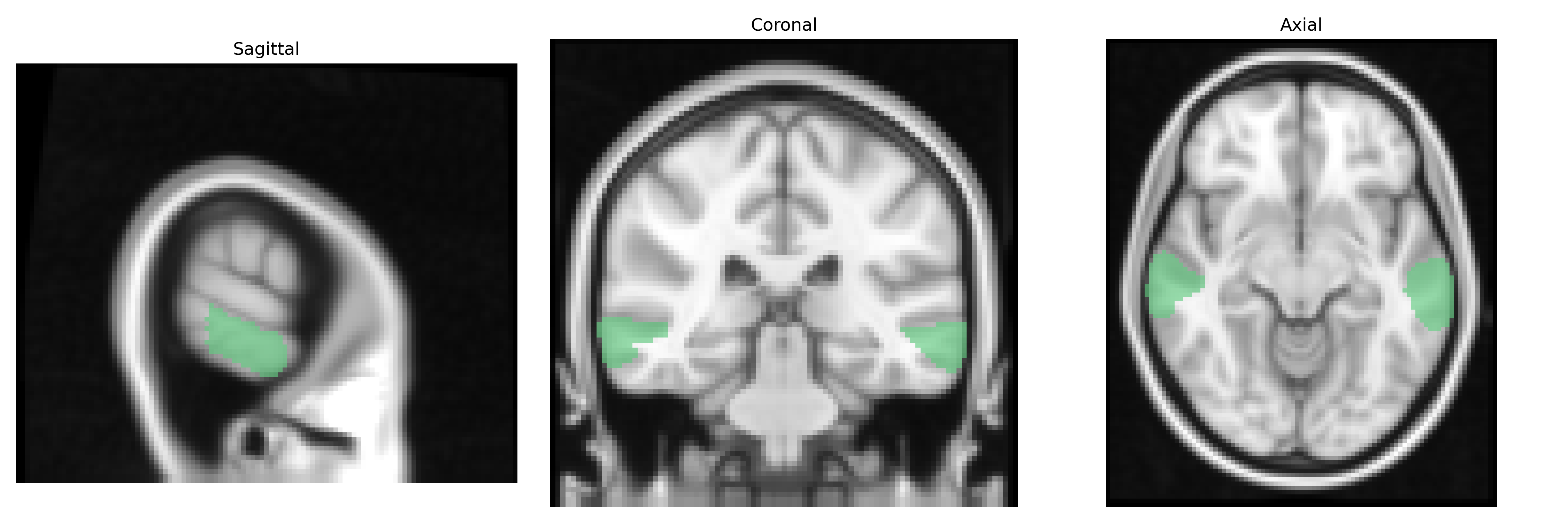
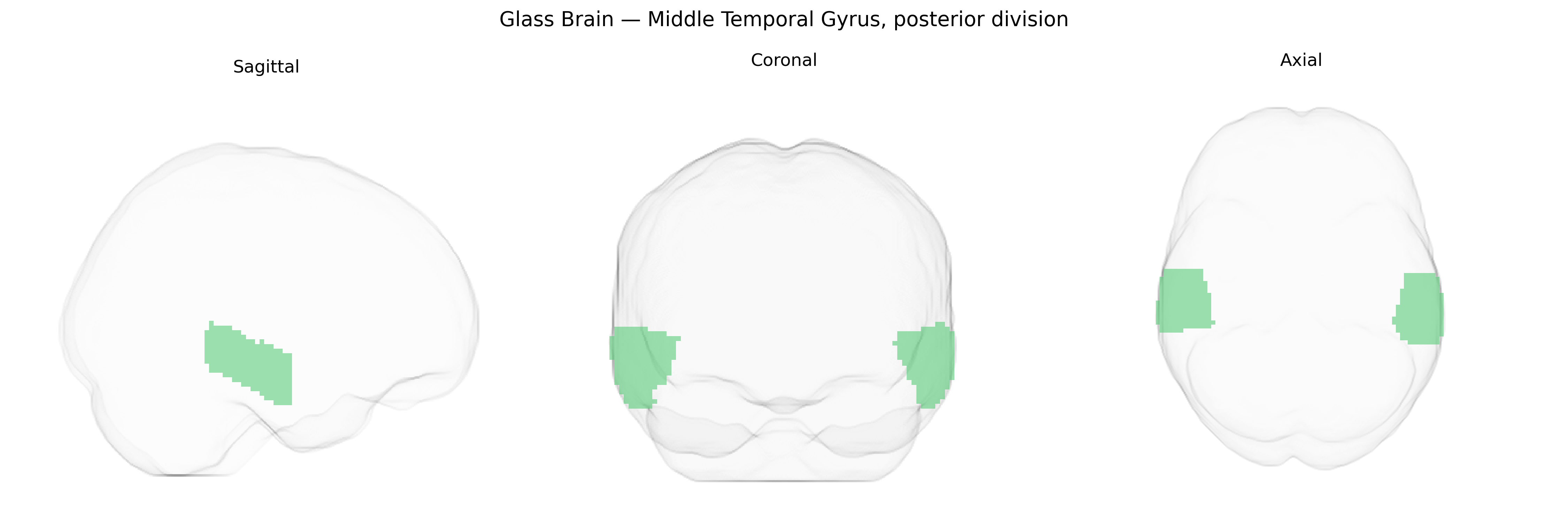
The bilateral Middle Temporal Gyrus, posterior division (as defined in the Harvard-Oxford Cortical Maxprob Thr25 2mm Atlas) comprises the caudal segment of the middle temporal gyrus in both hemispheres, spanning lateral temporal cortex between superior and inferior temporal gyri. This region is structurally associated with higher-order auditory and language-related processing, including aspects of semantic comprehension, lexical access, and integration of audiovisual information, and has also been implicated in social cognition and the perception of biological motion. Cytoarchitectonically, it lies within association cortex of the temporal lobe, receiving multimodal input from auditory, visual, and frontoparietal networks, and contributes to large-scale semantic and default-mode networks. There is no dedicated Wikipedia page for this exact atlas-defined subdivision; a closely related structure is the middle temporal gyrus: Middle temporal gyrus.
The bilateral posterior division of the Middle Temporal Gyrus (MTG) is a key node in language, semantic processing, and social cognition networks, and genetic associations identified via GWAS and imaging‑genetics studies converge on pathways influencing cortical structure and function in this region. Variants in genes such as DLPFC‑expressed microtubule and synaptic genes (e.g., MAPT‑region loci on 17q21, GRIN2A, and other glutamatergic and synaptic plasticity genes) have been associated with MTG cortical thickness and surface area, with several large consortia (ENIGMA, UK Biobank) reporting heritable variation in temporal lobe morphology linked to neurodevelopmental and neuropsychiatric risk loci. Common risk variants for schizophrenia and bipolar disorder, including those in CACNA1C, GRM3, and other synaptic and calcium-channel genes, show associations with altered activation and connectivity of posterior MTG during language and semantic tasks; similarly, polygenic risk scores for autism spectrum disorder and social communication difficulties correlate with structural and functional differences in posterior temporal regions implicated in social perception and theory of mind. GWAS of educational attainment, general cognitive ability, and reading/language skills indicate that polygenic influences on these traits partially act through temporal cortical regions, including middle and superior temporal gyri, which show genetically mediated variation in thickness and gyrification. Additionally, Alzheimer’s disease and frontotemporal dementia risk loci (APOE, CLU, BIN1, and MAPT) have been linked to accelerated atrophy and altered connectivity in temporal association cortex, with posterior MTG changes appearing in longitudinal imaging-genetics analyses of prodromal and established disease. Overall, genetic influences on synaptic signaling, neurodevelopmental patterning, and neurodegeneration contribute to individual differences and disease-associated alterations in the bilateral posterior MTG, though most findings reflect network-level rather than region-specific effects and are derived from large-scale cortical parcellations that encompass this Harvard–Oxford atlas region.
Overview generated by GPT-4o (2026).
Region ID: 12
Hemisphere: bilateral
Atlas: HarvardOxford cort maxprob thr25 2mm
Full Quality Version: Download MP4
Full Quality Version: Download MP4
Wali Sidiqyar*, Gaurav Rudravaram*, Elyssa M. McMaster, Trent M. Schwartz, Adam M. Saunders, Kurt G. Schilling, Bennett A. Landman "Introducing SPINS: A Shared Public Visualization Library of Neuroanatomical Structures." Medical Imaging with Deep Learning- short paper
This resource is licensed under CC0 1.0 Universal (Public Domain).