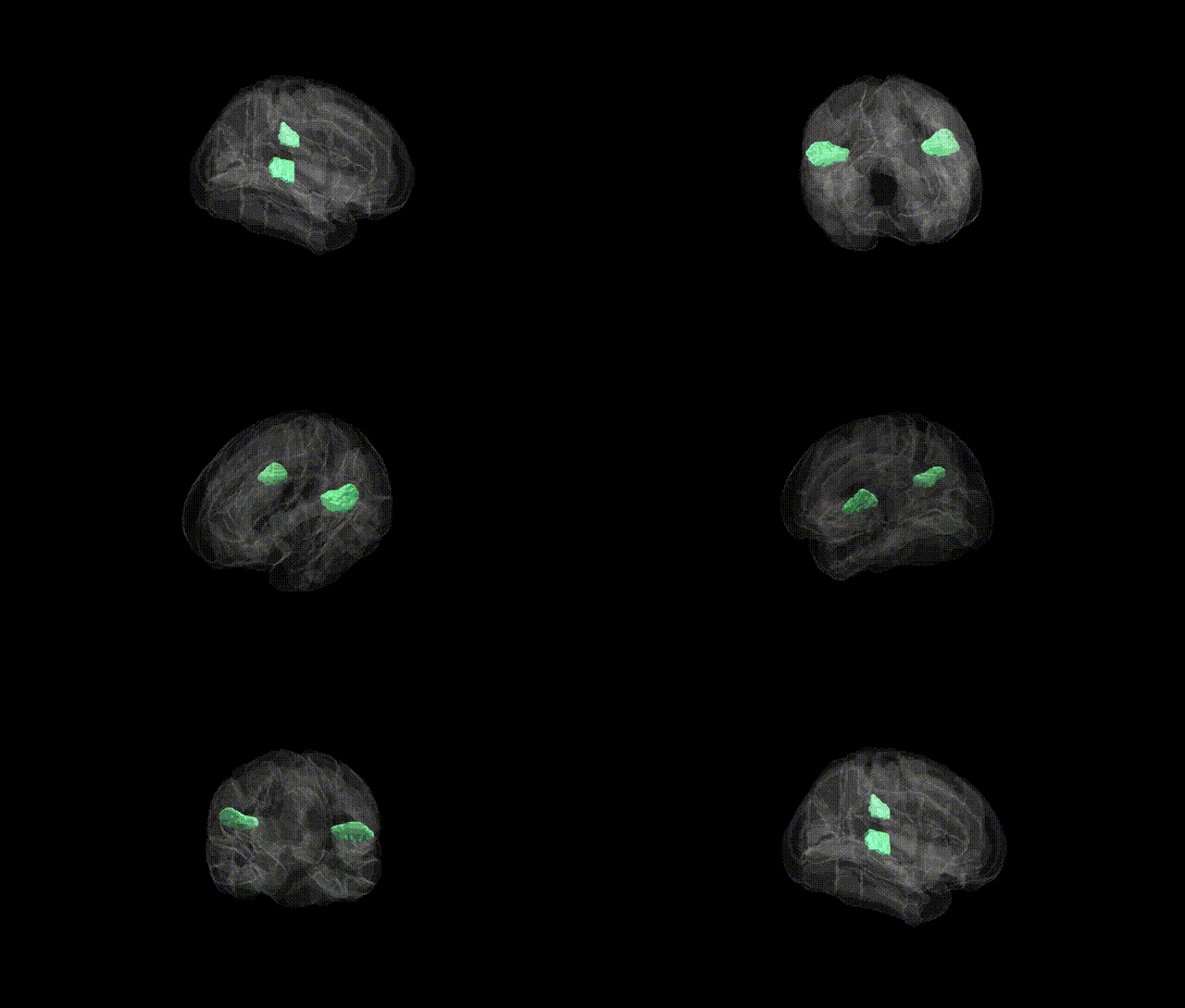
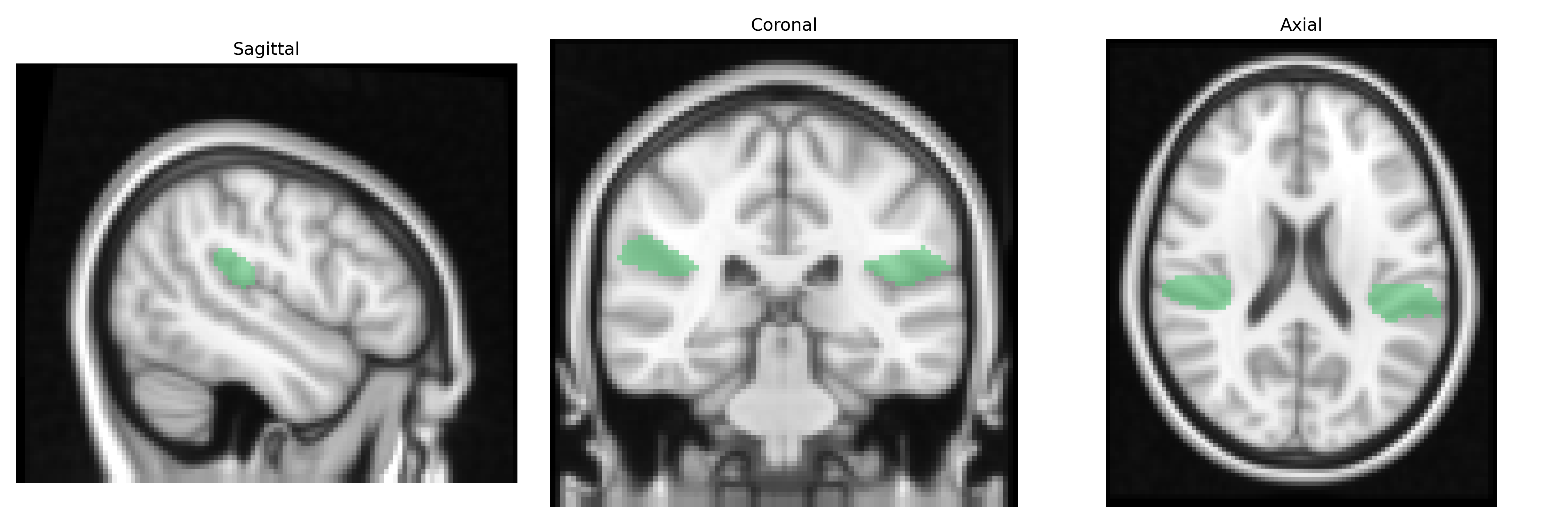
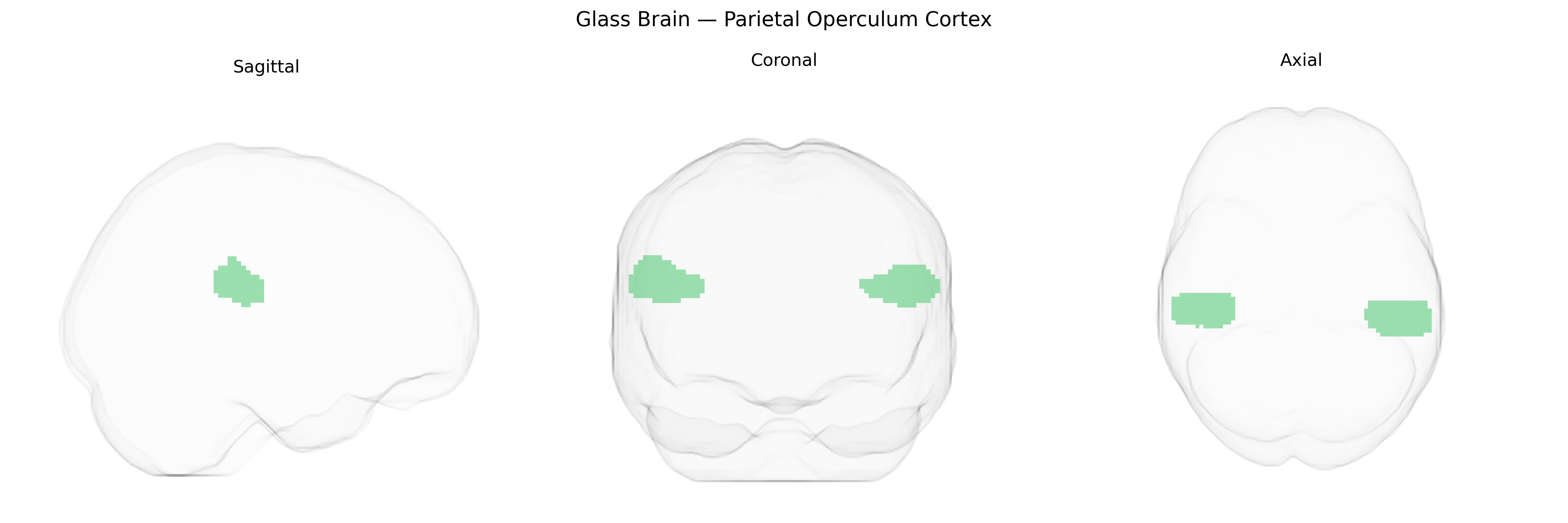
The bilateral Parietal Operculum Cortex, as defined in the Harvard–Oxford cortical maxprob thr25 2mm atlas, corresponds to the opercular portion of the inferior parietal lobe overlying the insula, forming part of the lateral sulcus region and often overlapping with secondary somatosensory cortex (SII). This region is involved in higher-order somatosensory processing, including tactile discrimination, sensorimotor integration, and aspects of pain and temperature perception, and has been implicated in multisensory integration and body perception. Structurally, it lies deep to the supramarginal and postcentral gyri, bordering the insular cortex and opercular portions of the frontal and temporal lobes. There is no direct Wikipedia article for the Parietal Operculum Cortex as a standalone entry; a closely related and overlapping functional area is Secondary somatosensory cortex.
The bilateral Parietal Operculum Cortex, encompassing secondary somatosensory and adjacent gustatory and vestibular regions as defined in the Harvard-Oxford atlas, has been indirectly implicated in several genetic and GWAS-based findings, though few studies target it explicitly by name. Large-scale imaging genetics consortia (e.g., ENIGMA, UK Biobank) have identified polygenic influences on cortical thickness and surface area in inferior parietal and perisylvian opercular territories, with variants in genes involved in neurodevelopment, synaptic signaling, and axon guidance (such as those in the protocadherin, neurexin/neuroligin, and MAPK-related pathways) contributing to inter-individual variability in this region’s structure and connectivity. Functional and structural alterations in parietal operculum or adjacent insulo-opercular regions have been reported in genetic risk contexts for neurodevelopmental and psychiatric disorders—including schizophrenia, autism spectrum disorder, attention-deficit/hyperactivity disorder, and major depression—where polygenic risk scores correlate with changes in somatosensory and pain-related networks involving this cortex. GWAS and candidate gene studies of chronic pain, somatosensory sensitivity, and phantom limb phenomena highlight the parietal operculum as part of a genetically influenced nociceptive and body-schema network, with heritable variation in genes regulating glutamatergic and GABAergic transmission and neuroinflammation linked to altered activity or morphology in this area. Additionally, taste and eating-related traits, vestibular and balance phenotypes, and language-related functions (particularly sensorimotor integration of speech) show modest genetic associations involving broader perisylvian and parietal opercular circuits, suggesting that genetic variation affecting cortical development and thalamo-cortical wiring can influence this region’s contribution to multisensory integration and higher-order somatosensory processing, although region-specific loci for the parietal operculum itself remain incompletely resolved.
Overview generated by GPT-4o (2026).
Region ID: 43
Hemisphere: bilateral
Atlas: HarvardOxford cort maxprob thr25 2mm
Full Quality Version: Download MP4
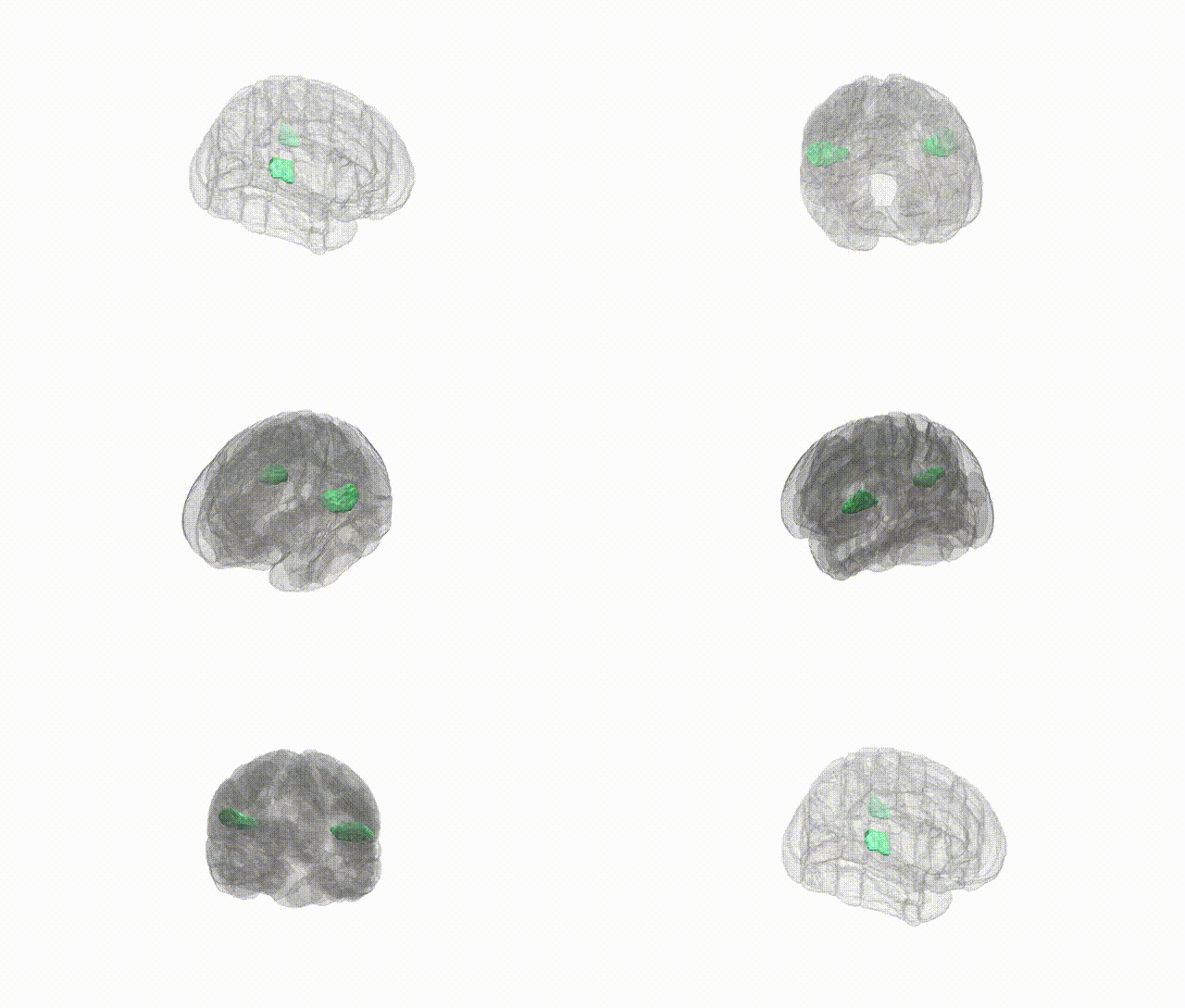
Full Quality Version: Download MP4
Wali Sidiqyar*, Gaurav Rudravaram*, Elyssa M. McMaster, Trent M. Schwartz, Adam M. Saunders, Kurt G. Schilling, Bennett A. Landman "Introducing SPINS: A Shared Public Visualization Library of Neuroanatomical Structures." Medical Imaging with Deep Learning- short paper
This resource is licensed under CC0 1.0 Universal (Public Domain).