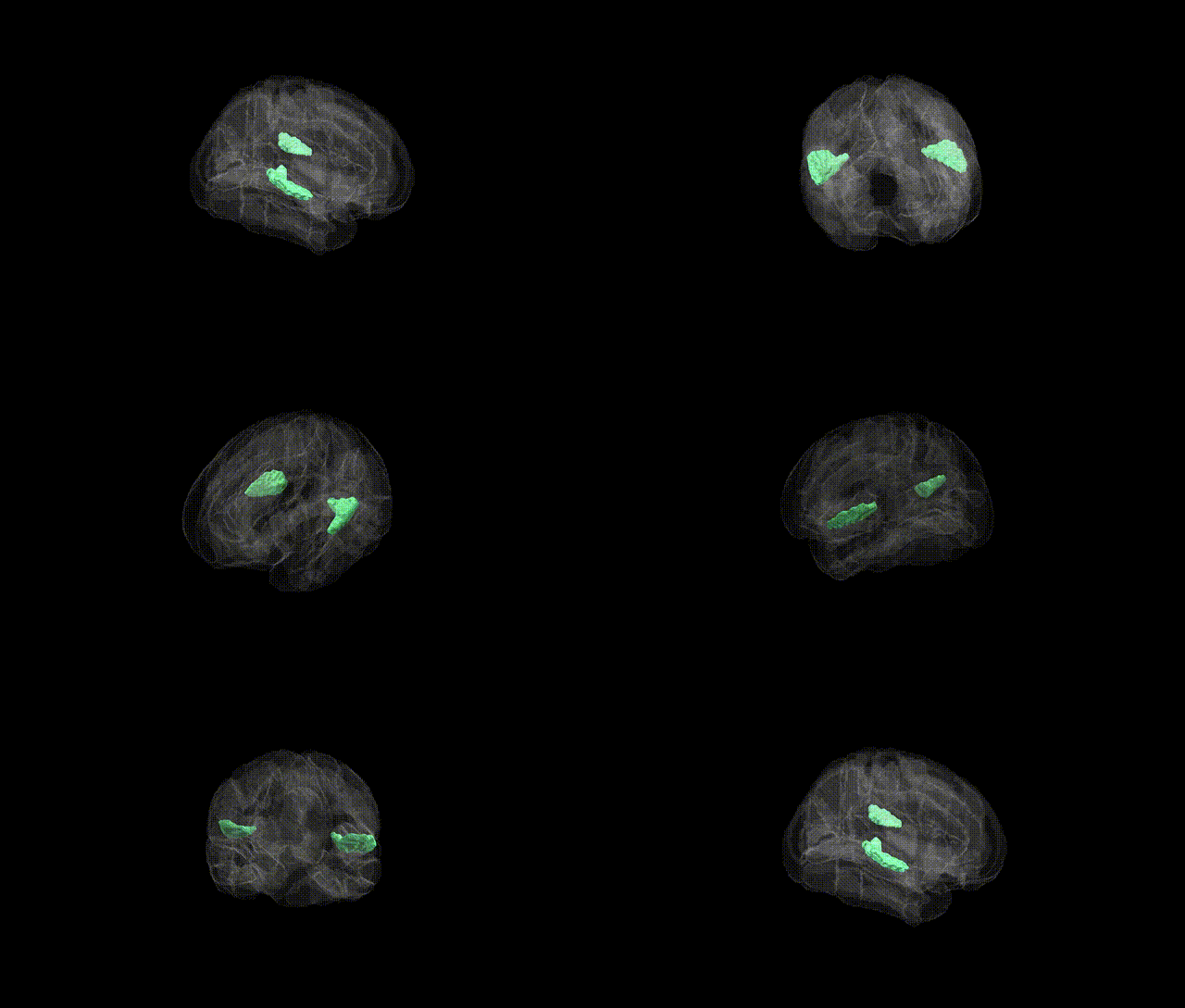
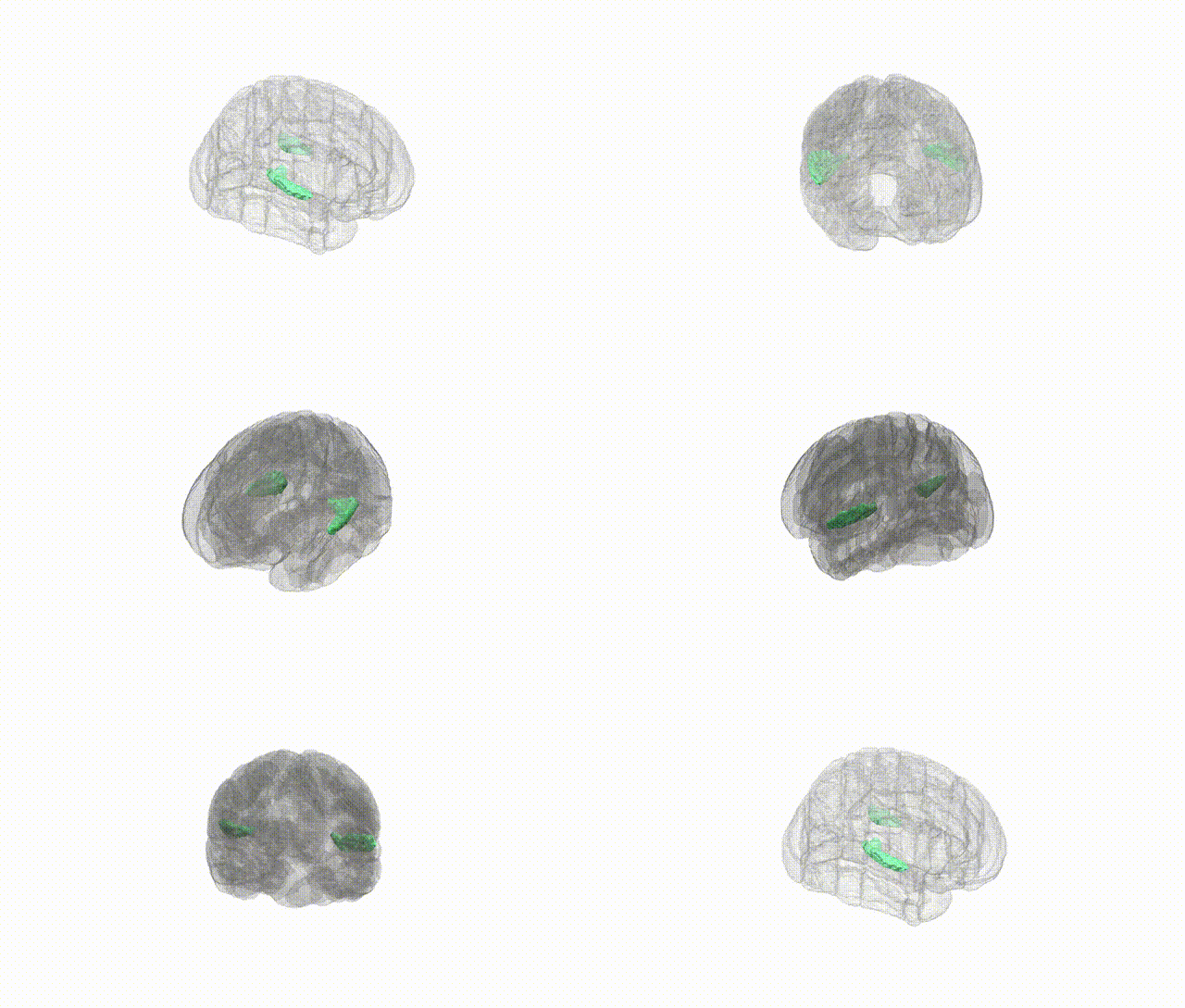
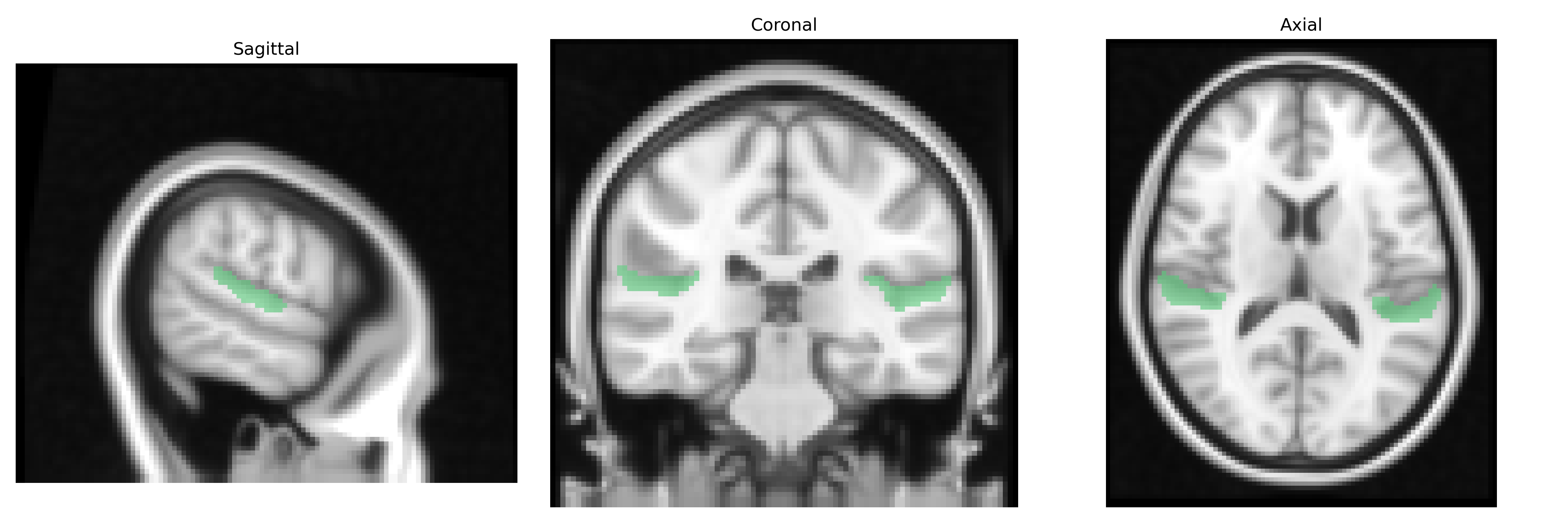
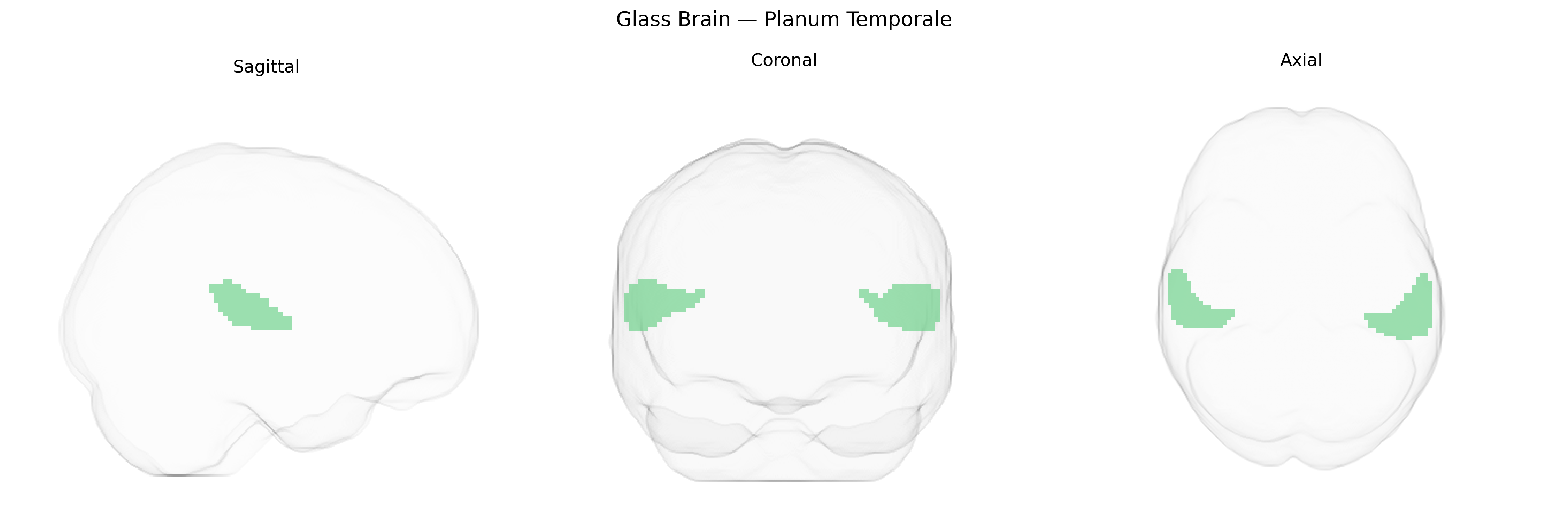
The bilateral Planum Temporale is a cortical region on the superior temporal plane, posterior to Heschl’s gyrus, and forms part of the superior temporal lobe near the Sylvian (lateral) fissure. It is cytoarchitectonically associated with posterior superior temporal areas and is considered a core hub of the auditory association cortex, playing a key role in complex auditory processing, language perception, and phonological analysis. Functionally, it exhibits structural and functional asymmetries—typically larger on the left in humans—linked to hemispheric specialization for speech and language. In the HarvardOxford cort maxprob thr25 2mm Atlas, the bilateral Planum Temporale reflects this region in both hemispheres as a probabilistic label, capturing interindividual variability in its boundaries and aligning with broader perisylvian language networks. There is no dedicated Wikipedia page for this specific atlas-defined label; a closely related structure is the Superior temporal gyrus.
The bilateral planum temporale, a key auditory and language-related region defined in the Harvard-Oxford cortical atlas, shows strong genetic influences on its structure and asymmetry, with SNP-based heritability estimates from large imaging-genetics consortia (e.g., ENIGMA, UK Biobank) indicating substantial additive genetic effects on cortical surface area, thickness, and asymmetry in this region; several loci near genes involved in neuronal development and axon guidance (such as FOXP2, DCDC2, KIAA0319, and ROBO1) and broader polygenic architectures for language and reading traits have been associated with planum temporale morphology, particularly leftward asymmetry. Variants linked to developmental dyslexia, specific language impairment, and reading ability frequently converge on networks affecting posterior superior temporal and perisylvian cortices, including the planum temporale, while imaging GWAS have also connected genetic variation in this region to susceptibility for schizophrenia, autism spectrum conditions, and, more weakly, mood and psychotic disorders via polygenic risk scores. Additional studies suggest that planum temporale volume and asymmetry share genetic correlations with musical aptitude, auditory processing, and general cognitive ability, indicating that common genetic factors contribute to a spectrum of language-, communication-, and cognition-related phenotypes through effects on this bilateral temporal plane.
Overview generated by GPT-4o (2026).
Region ID: 46
Hemisphere: bilateral
Atlas: HarvardOxford cort maxprob thr25 2mm
Full Quality Version: Download MP4
Full Quality Version: Download MP4
Wali Sidiqyar*, Gaurav Rudravaram*, Elyssa M. McMaster, Trent M. Schwartz, Adam M. Saunders, Kurt G. Schilling, Bennett A. Landman "Introducing SPINS: A Shared Public Visualization Library of Neuroanatomical Structures." Medical Imaging with Deep Learning- short paper
This resource is licensed under CC0 1.0 Universal (Public Domain).