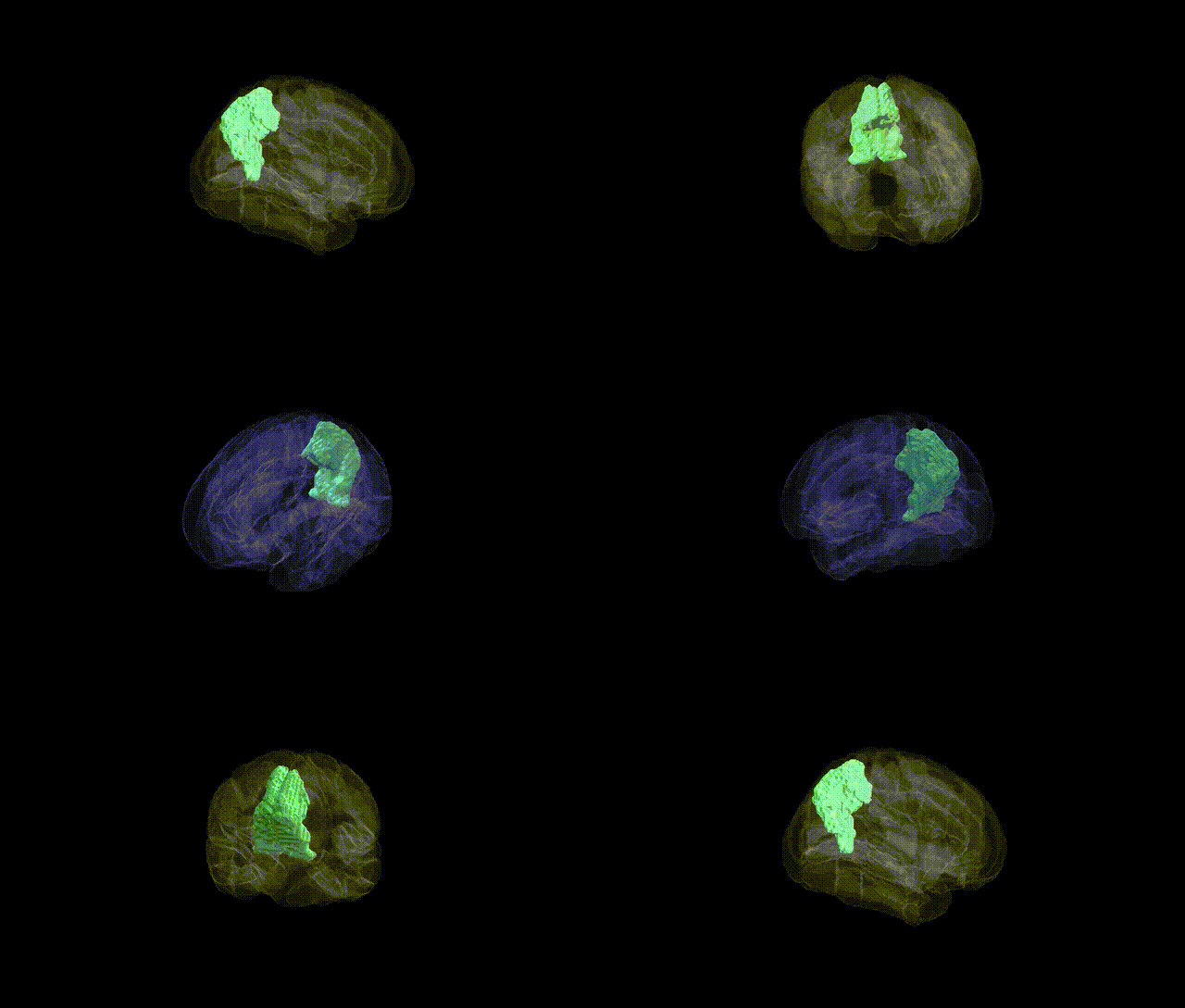
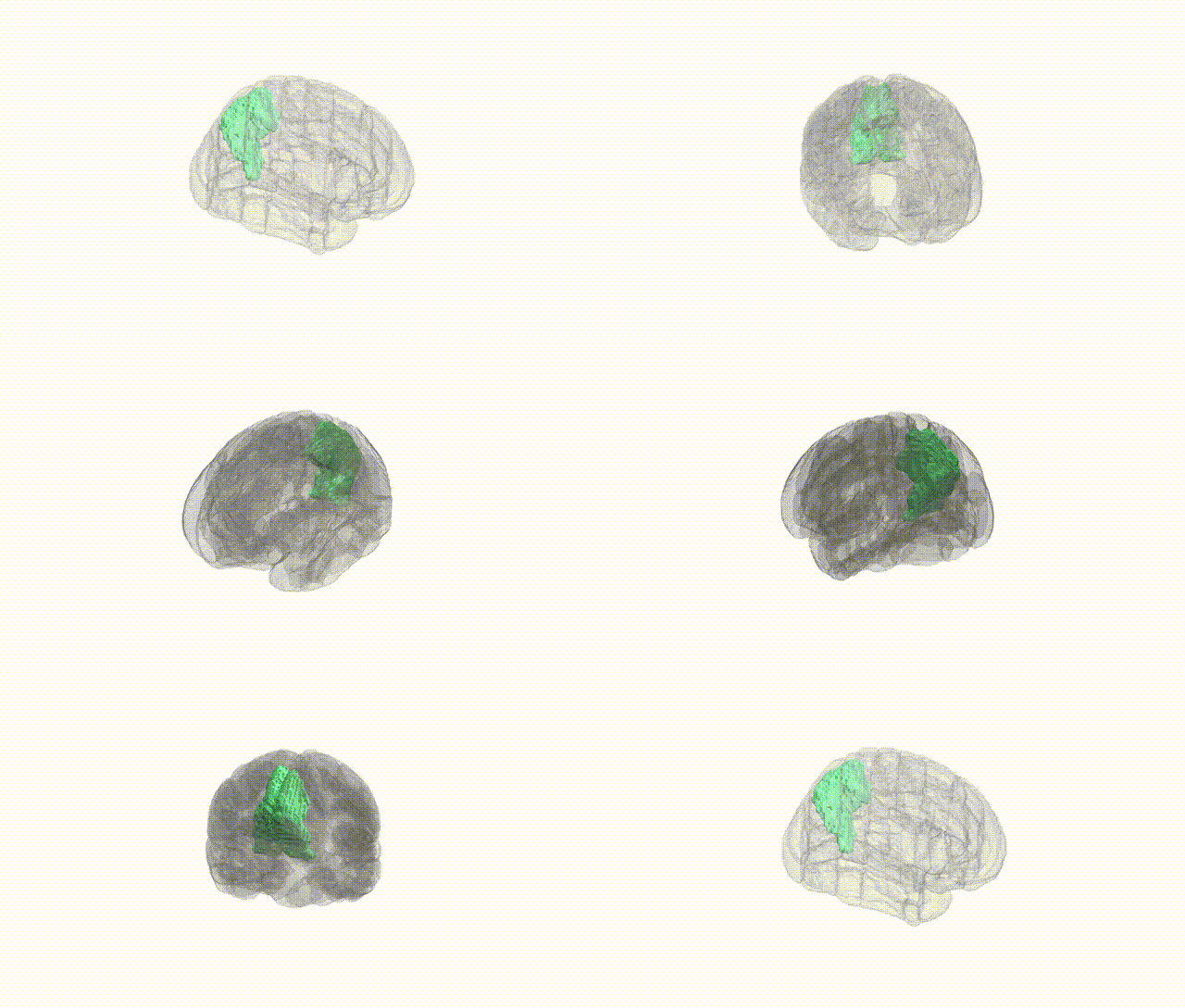
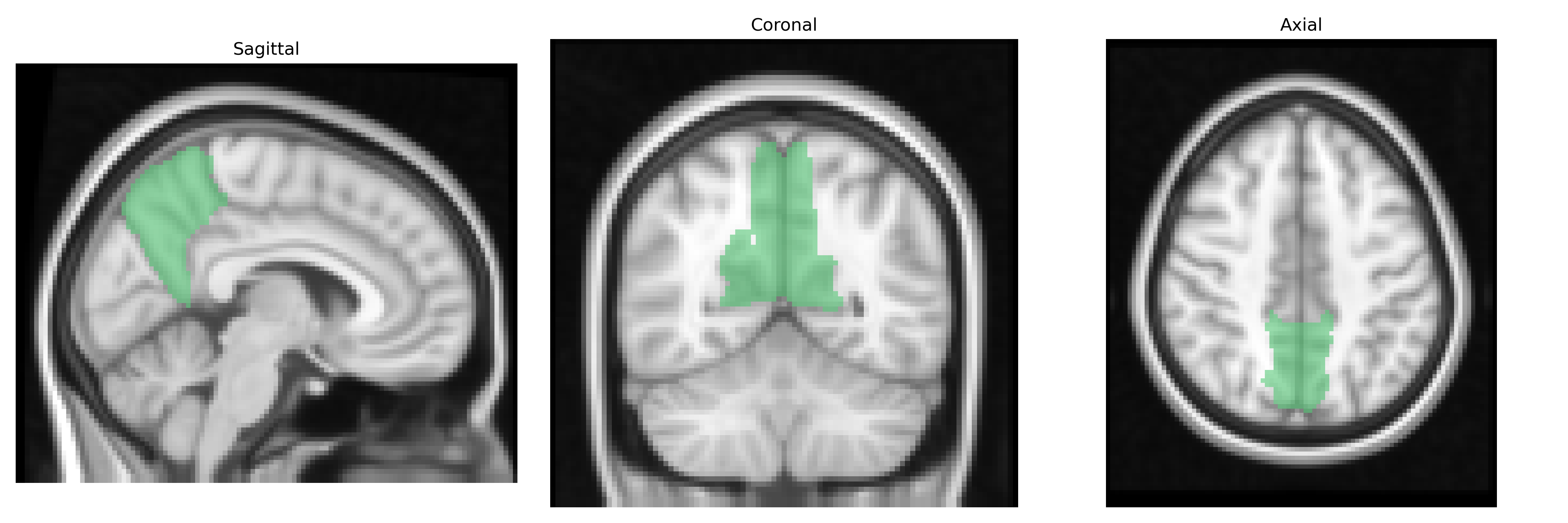
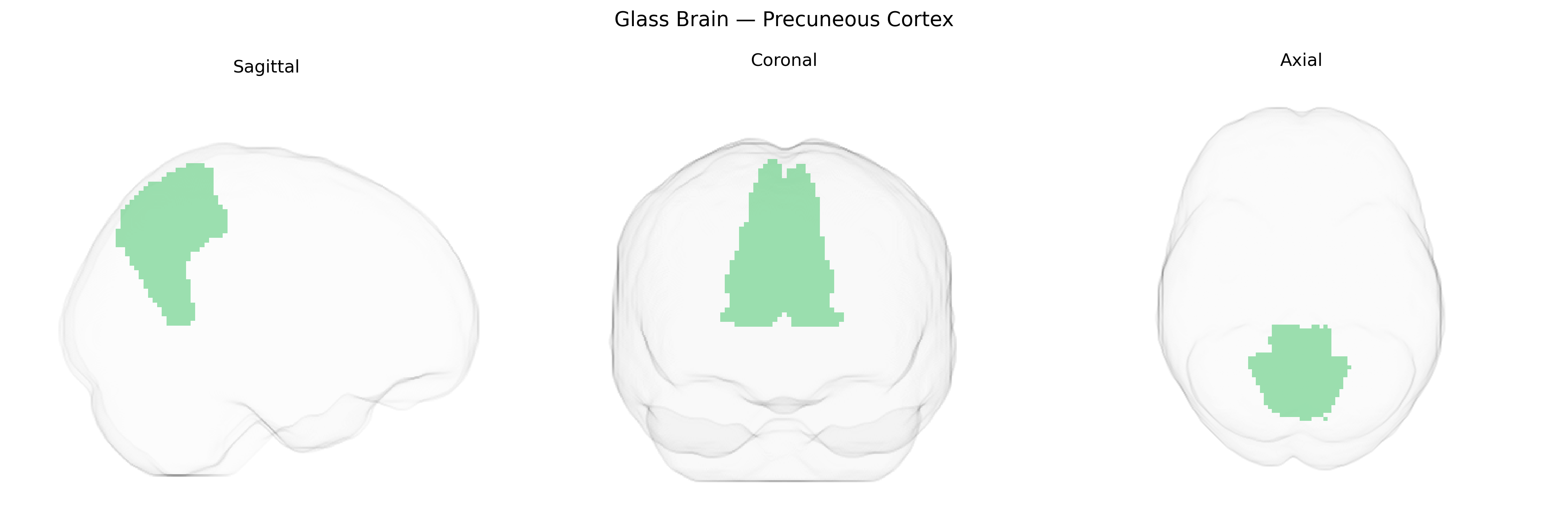
The bilateral Precuneous Cortex, as defined in the Harvard-Oxford cortical maxprob (thr25, 2 mm) atlas, refers to a medial parietal lobe region located on the medial surface of the hemisphere, anterior to the cuneus and posterior to the paracentral lobule, roughly corresponding to Brodmann area 7. It is a key hub within the default mode network and is implicated in visuo-spatial imagery, episodic and autobiographical memory retrieval, self-referential processing, and aspects of consciousness and internally directed cognition. Structurally, it is supplied primarily by branches of the posterior cerebral artery and shows dense connectivity with the posterior cingulate cortex, medial prefrontal cortex, lateral parietal regions, and thalamic and subcortical structures. Functionally, neuroimaging studies associate this region with tasks involving mental imagery, perspective taking, and integration of multimodal information, as well as altered activity patterns in disorders of consciousness and certain neuropsychiatric conditions. Precuneus
The bilateral precuneus cortex, as defined in the Harvard–Oxford cortical maxprob atlas, has been repeatedly implicated in genetic studies of brain structure, connectivity, and behavior, although most findings concern broader parietal or default mode network phenotypes rather than this parcel alone. Large-scale GWAS of cortical thickness and surface area (e.g., ENIGMA, UK Biobank) have identified multiple loci (including variants near genes such as IGF1, CENPW, and others involved in neurodevelopment, synaptic function, and cell adhesion) associated with precuneus morphology, and twin studies consistently show high heritability of its volume and functional connectivity. GWAS of resting-state networks have linked polygenic variation influencing default mode connectivity—often including the precuneus—to genes implicated in glutamatergic signaling and neuropsychiatric risk. In psychiatric genetics, altered structure and function of the precuneus have been associated with polygenic risk scores and GWAS loci for Alzheimer’s disease (e.g., APOE region), schizophrenia, major depressive disorder, and autism spectrum disorder, as well as with cognitive traits such as general intelligence, memory performance, and mind-wandering or self-referential processing, although these links usually emerge at the level of distributed networks rather than uniquely localized to the atlas-defined precuneus region.
Overview generated by GPT-4o (2026).
Region ID: 31
Hemisphere: bilateral
Atlas: HarvardOxford cort maxprob thr25 2mm
Full Quality Version: Download MP4
Full Quality Version: Download MP4
Wali Sidiqyar*, Gaurav Rudravaram*, Elyssa M. McMaster, Trent M. Schwartz, Adam M. Saunders, Kurt G. Schilling, Bennett A. Landman "Introducing SPINS: A Shared Public Visualization Library of Neuroanatomical Structures." Medical Imaging with Deep Learning- short paper
This resource is licensed under CC0 1.0 Universal (Public Domain).