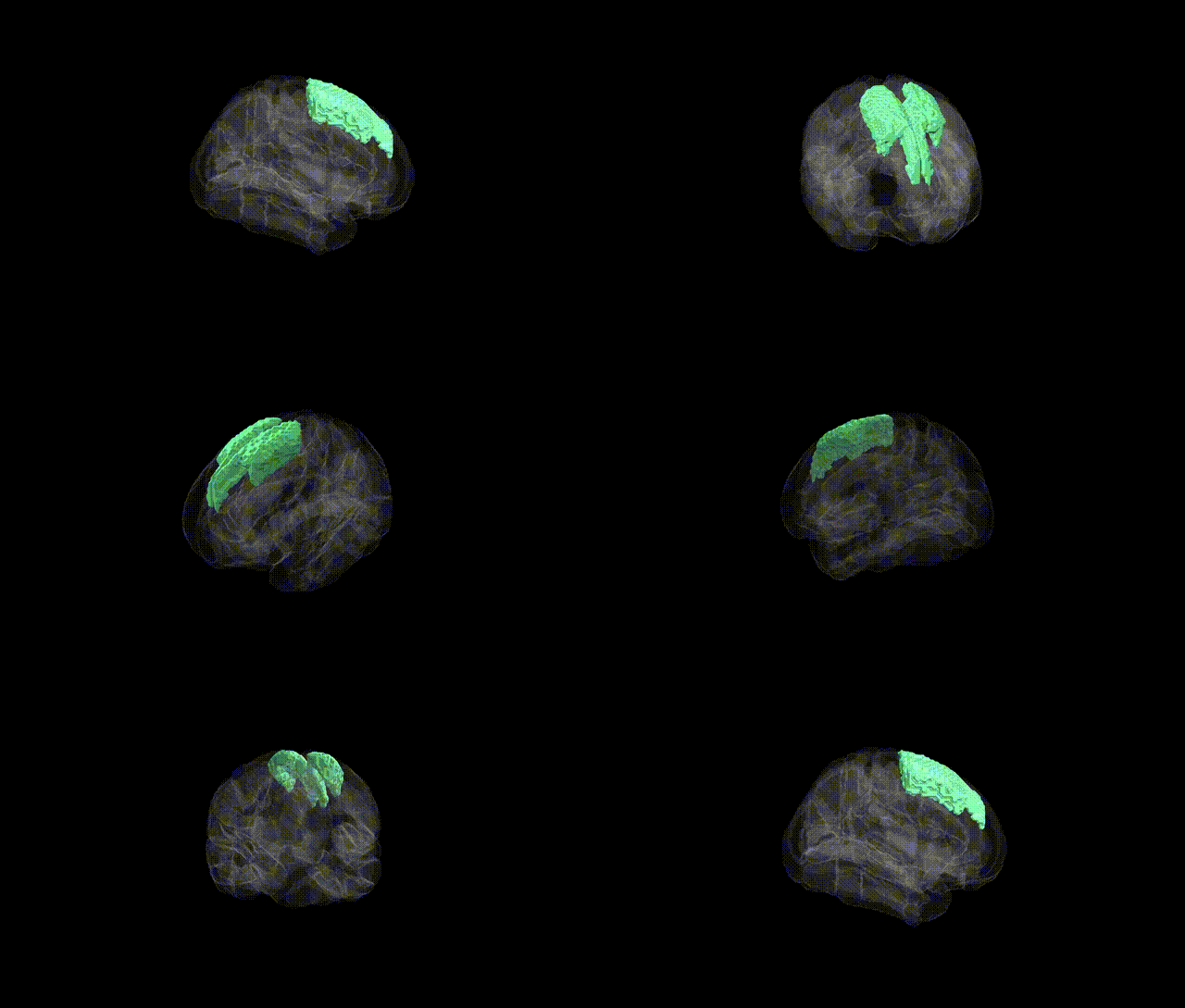
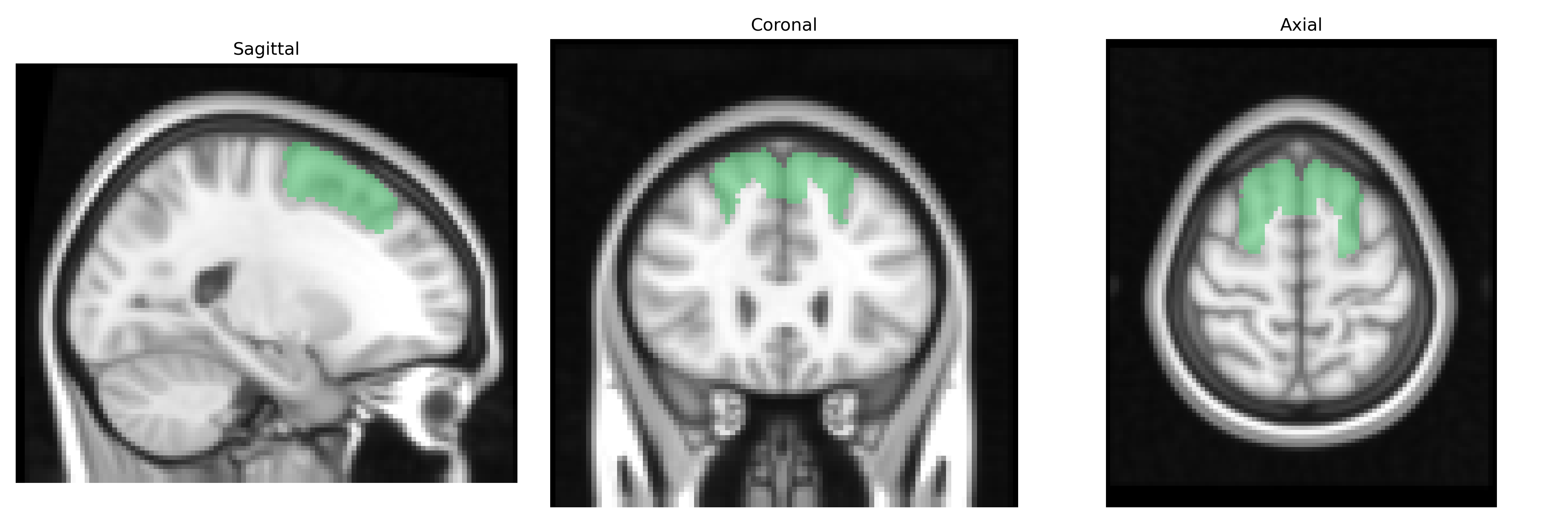
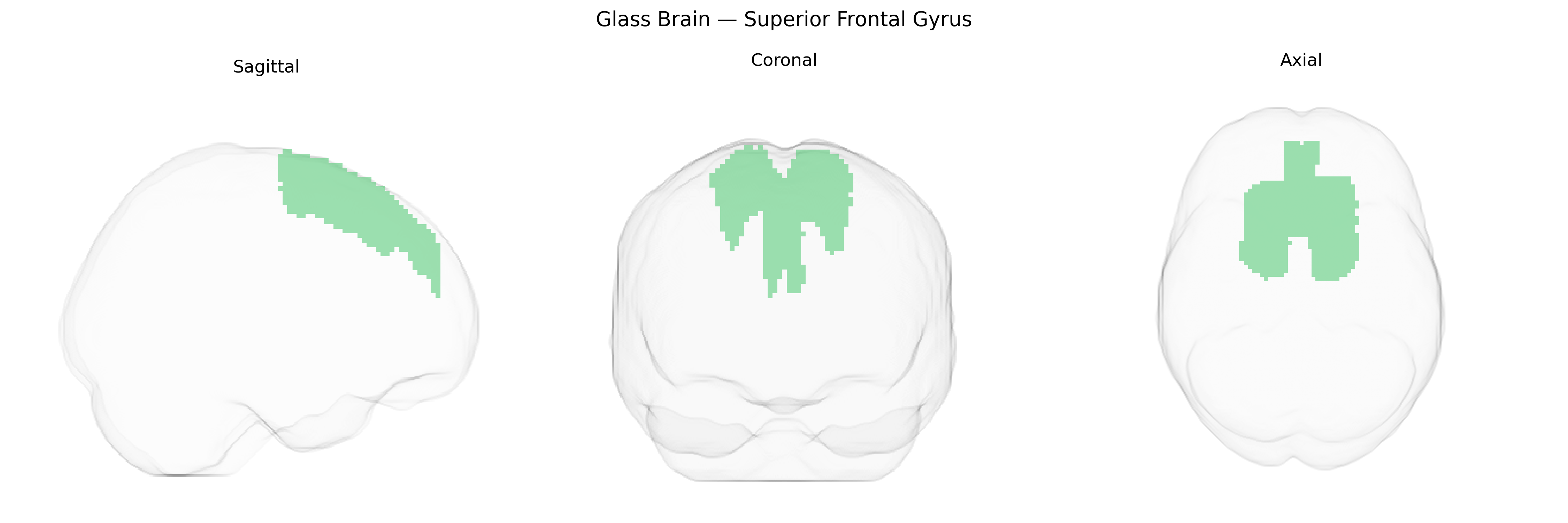
The bilateral Superior Frontal Gyrus is a dorsomedial frontal cortical region extending along the superior aspect of the frontal lobe, anterior to the precentral gyrus and bordering the medial longitudinal fissure. It participates in higher-order executive functions, including working memory, cognitive control, and attentional regulation, and contributes to aspects of self-referential processing and motor planning, particularly in the supplementary and pre-supplementary motor areas embedded within its medial portion. Cytoarchitectonically, it includes parts of Brodmann areas 6, 8, and 9, with dense reciprocal connections to other prefrontal regions, premotor cortex, parietal association areas, and limbic structures, enabling integration of cognitive, motor, and affective information. Functionally, activity in the Superior Frontal Gyrus is frequently observed in tasks requiring decision making, response inhibition, and the maintenance and manipulation of information in working memory, as well as in resting-state networks such as the default-mode and frontoparietal control networks.
Superior frontal gyrus
The bilateral Superior Frontal Gyrus (SFG), as defined in the Harvard–Oxford cortical atlas, has been implicated in multiple large-scale imaging–genetics and GWAS studies that link common genetic variation to cortical thickness, surface area, and functional connectivity in this region, including loci near genes involved in neurodevelopment (for example, microtubule- and synapse-related genes) identified by consortia such as ENIGMA and UK Biobank–based analyses. Polygenic risk scores for schizophrenia, bipolar disorder, and major depressive disorder show associations with altered SFG structure or activation, consistent with repeated reports of SFG volume and connectivity differences in these conditions. GWAS of cognitive traits (particularly general intelligence, working memory, and educational attainment) have identified variants whose brain-structural mediation maps prominently onto dorsomedial prefrontal and SFG territories, suggesting a partial genetic basis for individual differences in executive control and higher-order cognition localized in this region. Additional imaging–genetics work connects SFG measures to genetic liability for attention-deficit/hyperactivity disorder, autism spectrum conditions, and obsessive–compulsive symptoms, as well as to cross-disorder psychiatric polygenic scores, indicating that the SFG serves as a convergence zone where pleiotropic neuropsychiatric risk variants influence frontally mediated control, self-referential processing, and default-mode network function.
Overview generated by GPT-4o (2026).
Region ID: 3
Hemisphere: bilateral
Atlas: HarvardOxford cort maxprob thr25 2mm
Full Quality Version: Download MP4
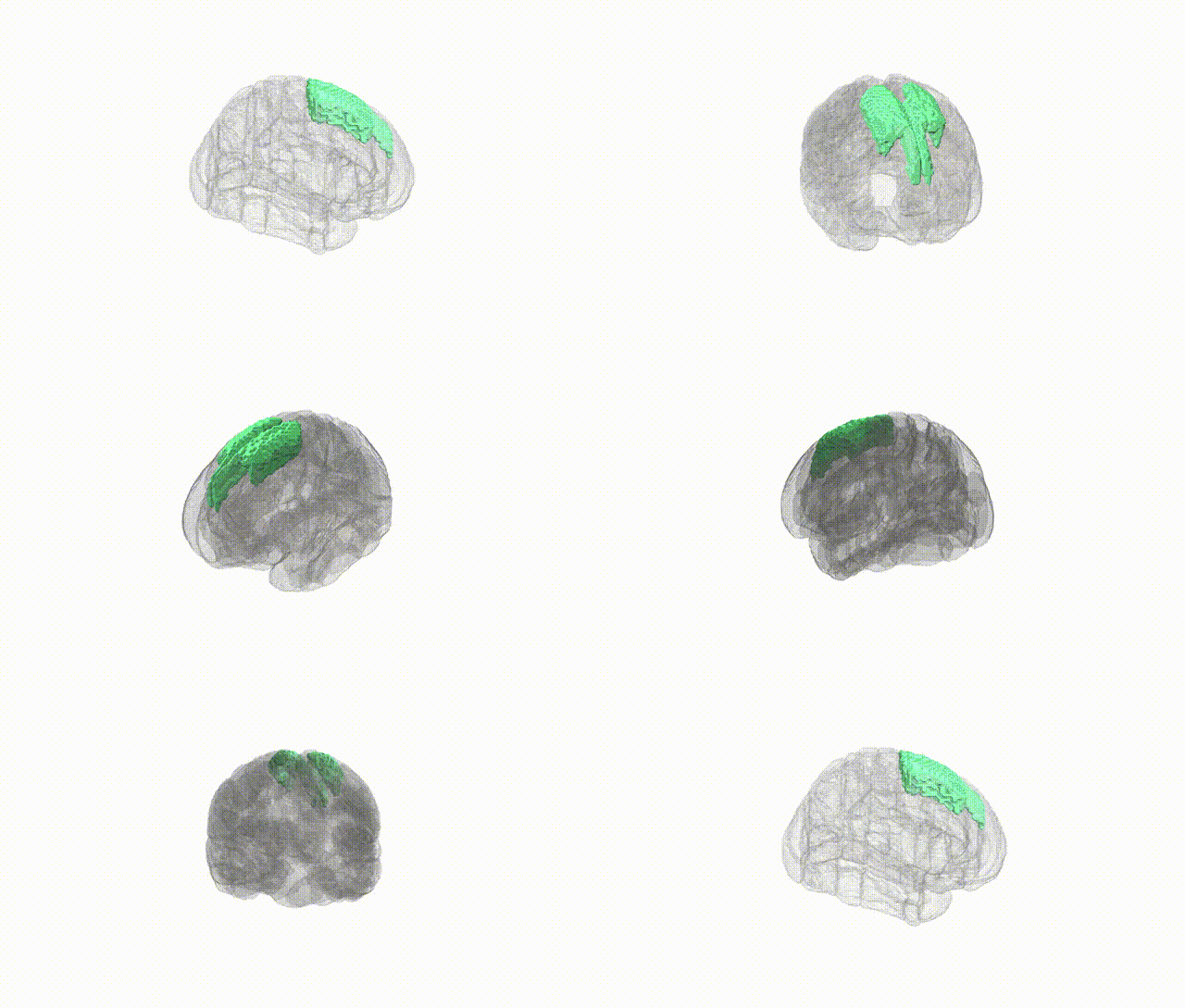
Full Quality Version: Download MP4
Wali Sidiqyar*, Gaurav Rudravaram*, Elyssa M. McMaster, Trent M. Schwartz, Adam M. Saunders, Kurt G. Schilling, Bennett A. Landman "Introducing SPINS: A Shared Public Visualization Library of Neuroanatomical Structures." Medical Imaging with Deep Learning- short paper
This resource is licensed under CC0 1.0 Universal (Public Domain).