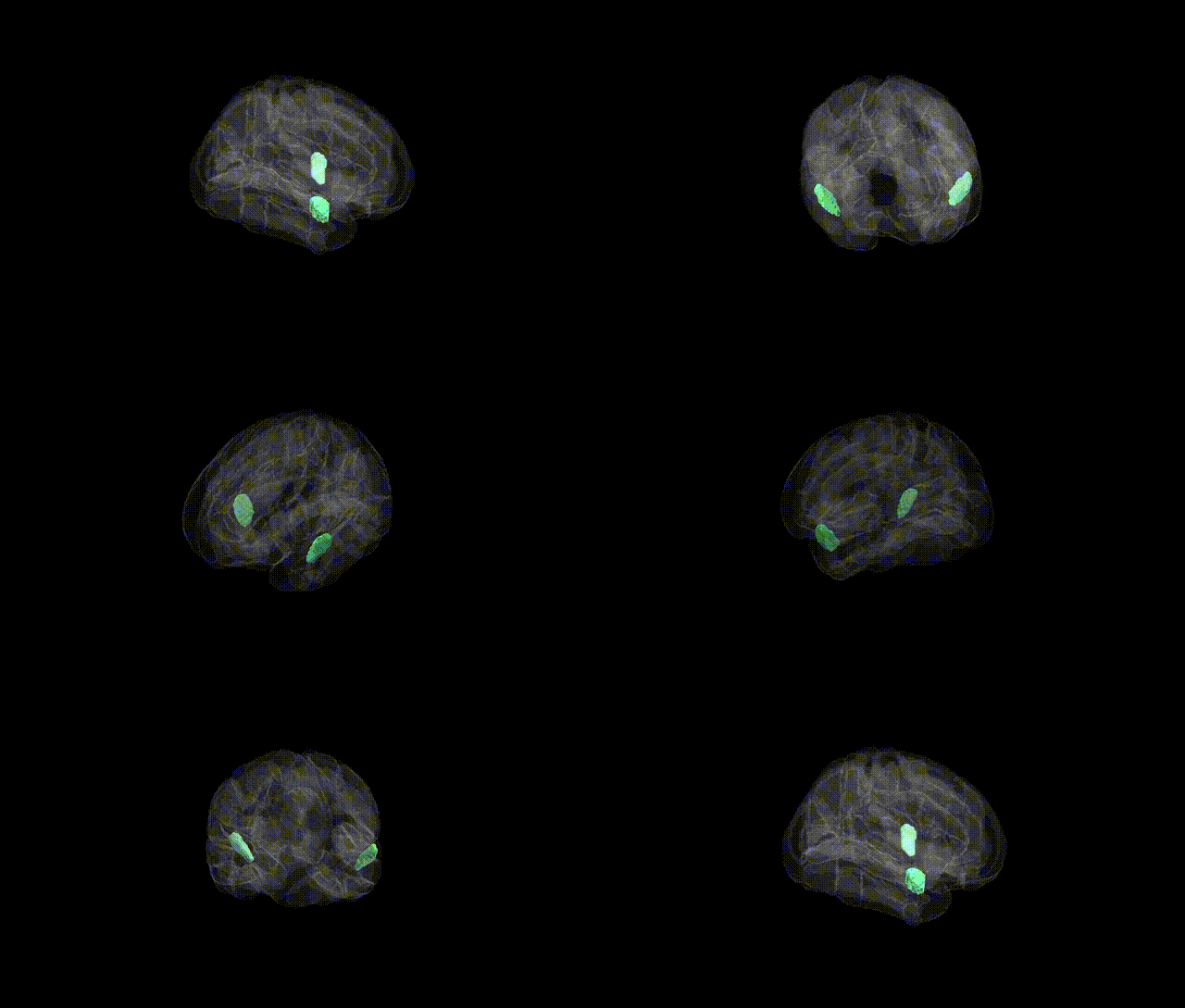
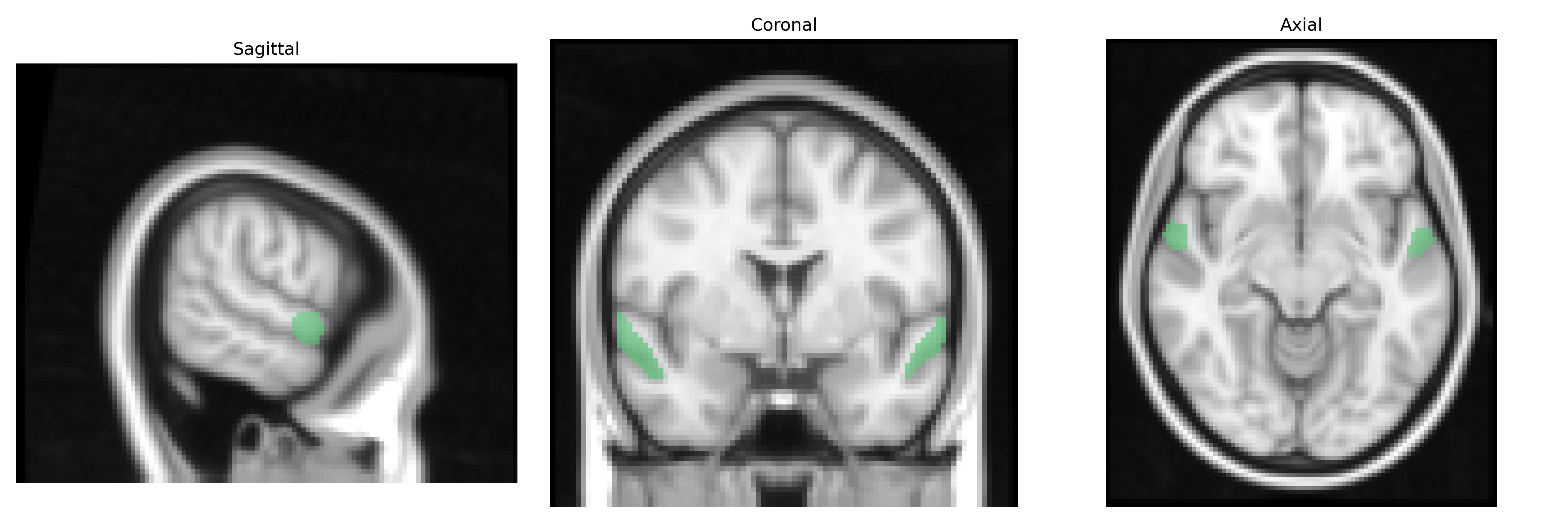
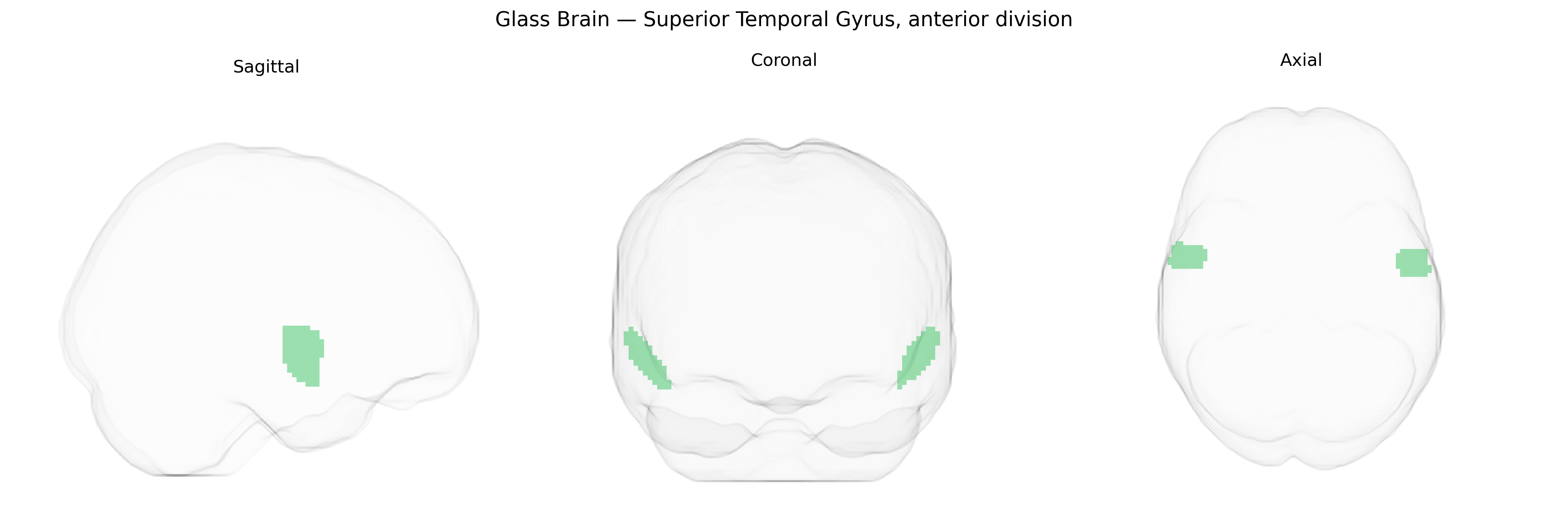
The bilateral Superior Temporal Gyrus, anterior division (from the Harvard-Oxford Cortical Maxprob Thr25 2mm Atlas) corresponds to the rostral portion of the superior temporal gyrus, a key region in the lateral temporal lobe implicated in early-stage auditory and speech processing, social perception, and aspects of language comprehension. Cytoarchitectonically, it overlaps with anterior portions of primary and association auditory cortices and borders regions involved in semantic processing and voice-sensitive analysis. This area participates in networks subserving phonological decoding, prosodic interpretation, and integration of complex sounds, as well as processing socially relevant vocal cues. The anterior superior temporal cortex also shows connectivity with frontal language areas, limbic structures, and multimodal association cortices, supporting roles in higher-order auditory cognition and socio-emotional communication. Related article: Superior temporal gyrus.
The bilateral anterior division of the Superior Temporal Gyrus (STG), as defined in the Harvard-Oxford atlas, is a key component of auditory, language, and social-cognitive networks, and genetic studies implicate numerous variants and pathways in shaping its structure and function. GWAS of cortical thickness and surface area have repeatedly associated common variants in neurodevelopmental and synaptic genes—such as those near KIAA0586, TBR1, and other regulators of cortical patterning—with morphological differences in temporal regions that include the anterior STG. Polygenic risk for schizophrenia, bipolar disorder, and major depressive disorder has been linked to altered STG volume and activation, and imaging–genetics work shows that schizophrenia risk alleles (e.g., in CACNA1C, ZNF804A, MIR137-related loci) are associated with structural and functional abnormalities in anterior temporal cortices involved in auditory and language processing. Similarly, autism spectrum disorder genetic risk (including common variants in genes like CNTNAP2 and rare CNVs affecting synaptic and neurodevelopmental genes) has been tied to atypical development and connectivity of the STG, with effects on speech perception and social communication networks. Language- and reading-related traits (e.g., dyslexia) show associations between risk loci for phonological processing (such as DCDC2 and KIAA0319, among others) and temporal lobe measures that encompass the anterior STG, while GWAS of musical aptitude and pitch perception point to variants in genes involved in auditory pathway development and synaptic plasticity influencing activation of the STG during sound and music processing. Collectively, genetic findings suggest that variants influencing neurodevelopmental patterning, synaptic transmission, and cortical plasticity contribute to individual differences and disorder-related alterations in the anterior STG, although many associations are regionally broad and not specific to this subdivision alone.
Overview generated by GPT-4o (2026).
Region ID: 9
Hemisphere: bilateral
Atlas: HarvardOxford cort maxprob thr25 2mm
Full Quality Version: Download MP4
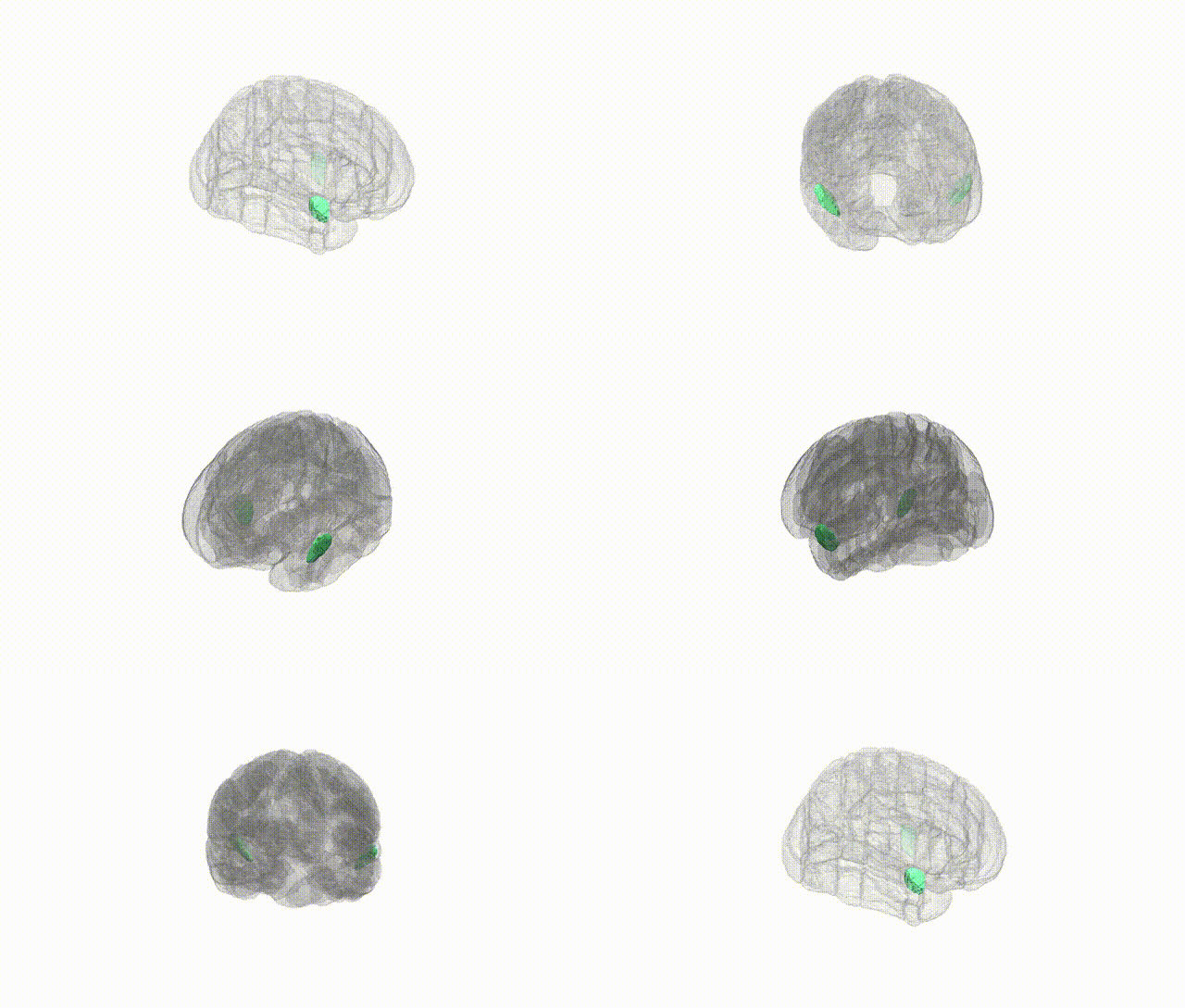
Full Quality Version: Download MP4
Wali Sidiqyar*, Gaurav Rudravaram*, Elyssa M. McMaster, Trent M. Schwartz, Adam M. Saunders, Kurt G. Schilling, Bennett A. Landman "Introducing SPINS: A Shared Public Visualization Library of Neuroanatomical Structures." Medical Imaging with Deep Learning- short paper
This resource is licensed under CC0 1.0 Universal (Public Domain).