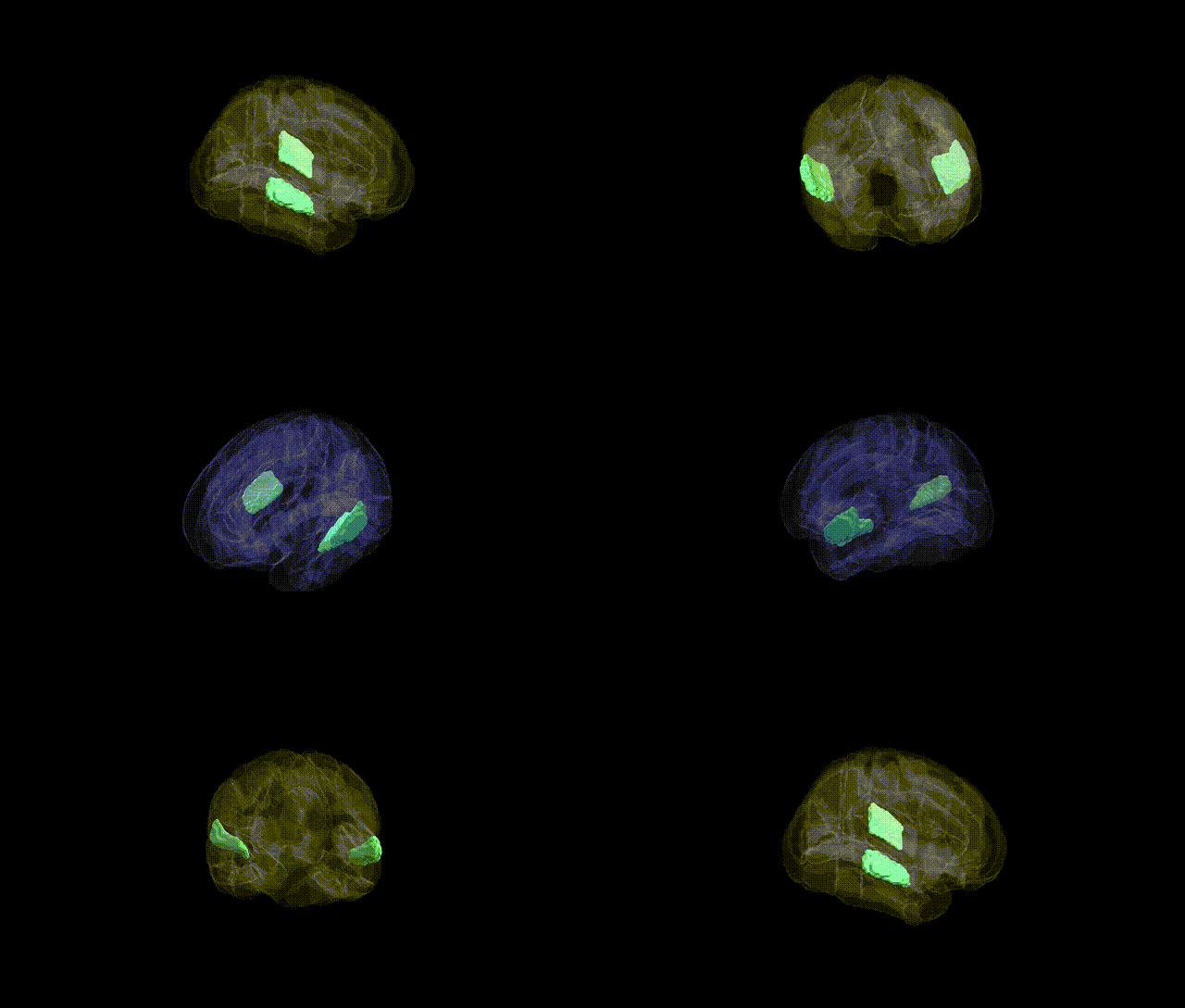
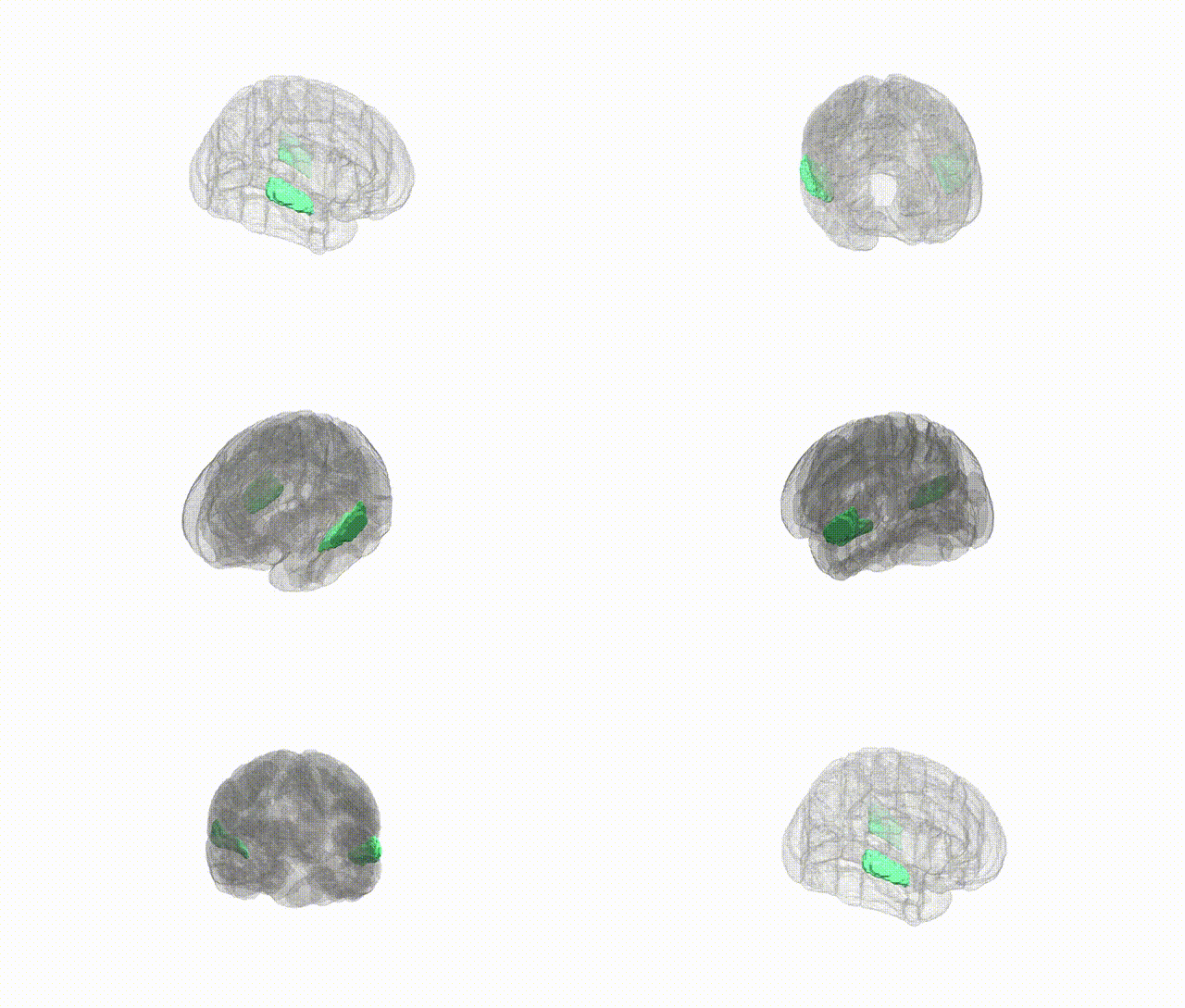
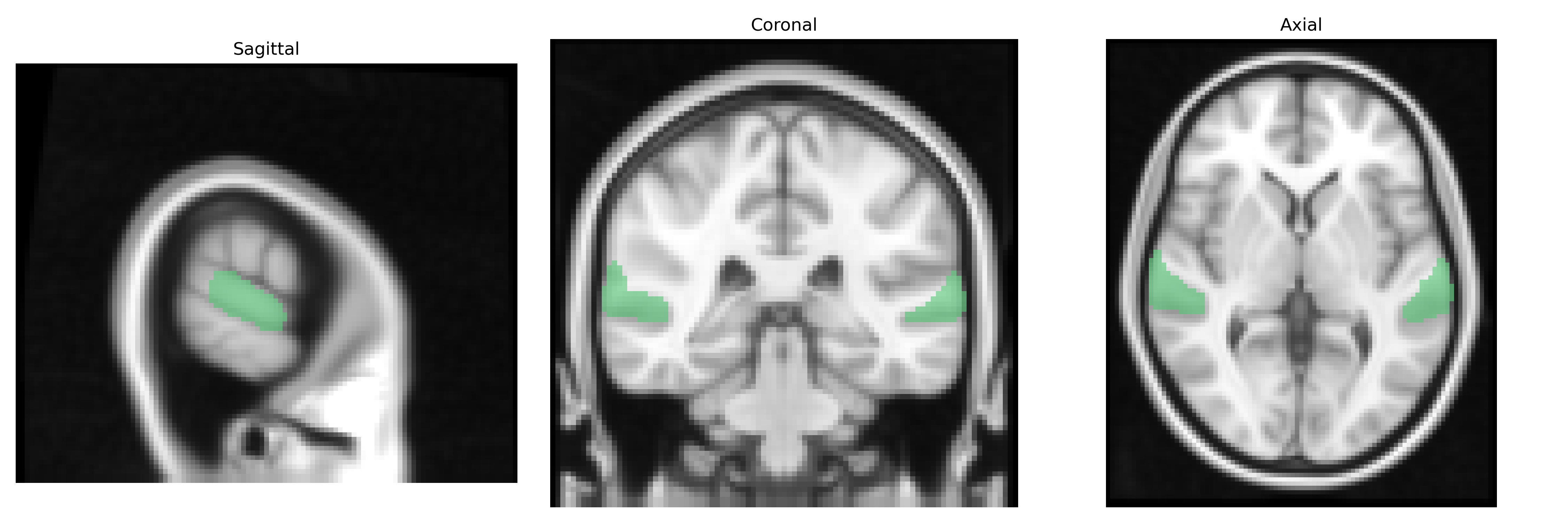
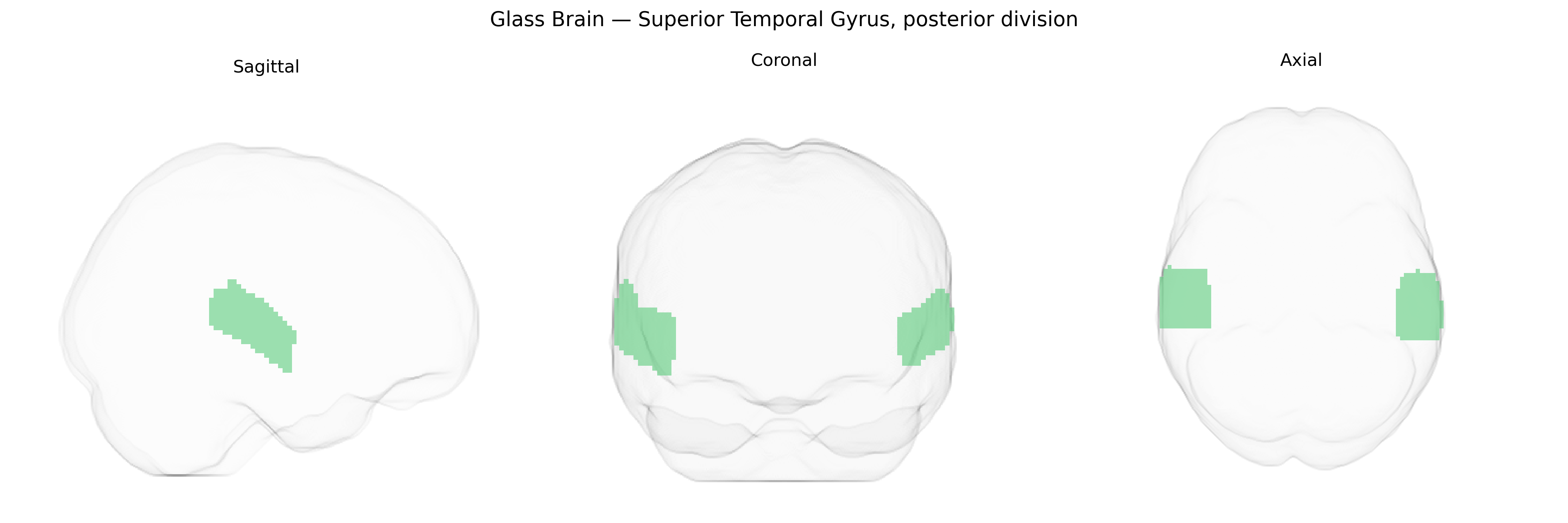
The bilateral Superior Temporal Gyrus, posterior division, as defined in the Harvard–Oxford cortical maxprob atlas, encompasses the caudal portion of the superior temporal gyrus along the lateral aspect of the temporal lobe, extending posteriorly toward the temporoparietal junction and bordering regions such as the angular and supramarginal gyri. This area is heavily involved in higher-order auditory processing, including analysis of complex sounds and speech features, and contributes to language comprehension, phonological processing, and integration of auditory input with multimodal information. Hemispheric specialization is prominent, with the left posterior superior temporal region (classically overlapping Wernicke’s area) playing a critical role in receptive language functions, whereas the right homologue is more engaged in prosody, music perception, and aspects of social and emotional signal decoding. Through dense connectivity with frontal, parietal, and limbic structures, the posterior superior temporal gyrus participates in networks supporting semantic processing, auditory–motor mapping, and social cognition. Superior temporal gyrus
The bilateral posterior division of the Superior Temporal Gyrus (STG) has been implicated in multiple genetic and GWAS findings, primarily through large-scale imaging–genetics and disorder-focused studies. Variants in genes involved in synaptic function, neurodevelopment, and language have been associated with STG volume, thickness, and functional activation, including loci near FOXP2, CNTNAP2, and other language- and auditory-related genes identified in ENIGMA and UK Biobank MRI GWAS of temporal lobe structures. Schizophrenia and psychosis risk genes (e.g., complement pathway genes such as C4, and polygenic risk scores for schizophrenia) show associations with structural and functional alterations in the posterior STG, consistent with its role in auditory hallucinations and speech perception; similar imaging–genetic links have been described for bipolar disorder and major depression, though less specifically localized. Autism spectrum disorder and language impairment risk loci, including genes implicated in synapse formation and axon guidance (e.g., NRXN, NRG, and related pathways), have been related to atypical development or connectivity of superior temporal regions, supporting a genetic contribution to social communication and language networks. GWAS of reading, phonological processing, and musical aptitude have also highlighted temporal-lobe–related variants that correlate with posterior STG activation and morphology, although often at the level of broader temporal or perisylvian regions rather than a precise posterior STG subfield. Overall, convergent evidence from imaging genomics, psychiatric genomics, and language-related GWAS indicates that common and rare variants affecting neurodevelopmental, synaptic, and language pathways contribute to structural and functional variation in the posterior STG, which in turn is linked to susceptibility for psychotic, neurodevelopmental, and language-related traits.
Overview generated by GPT-4o (2026).
Region ID: 10
Hemisphere: bilateral
Atlas: HarvardOxford cort maxprob thr25 2mm
Full Quality Version: Download MP4
Full Quality Version: Download MP4
Wali Sidiqyar*, Gaurav Rudravaram*, Elyssa M. McMaster, Trent M. Schwartz, Adam M. Saunders, Kurt G. Schilling, Bennett A. Landman "Introducing SPINS: A Shared Public Visualization Library of Neuroanatomical Structures." Medical Imaging with Deep Learning- short paper
This resource is licensed under CC0 1.0 Universal (Public Domain).