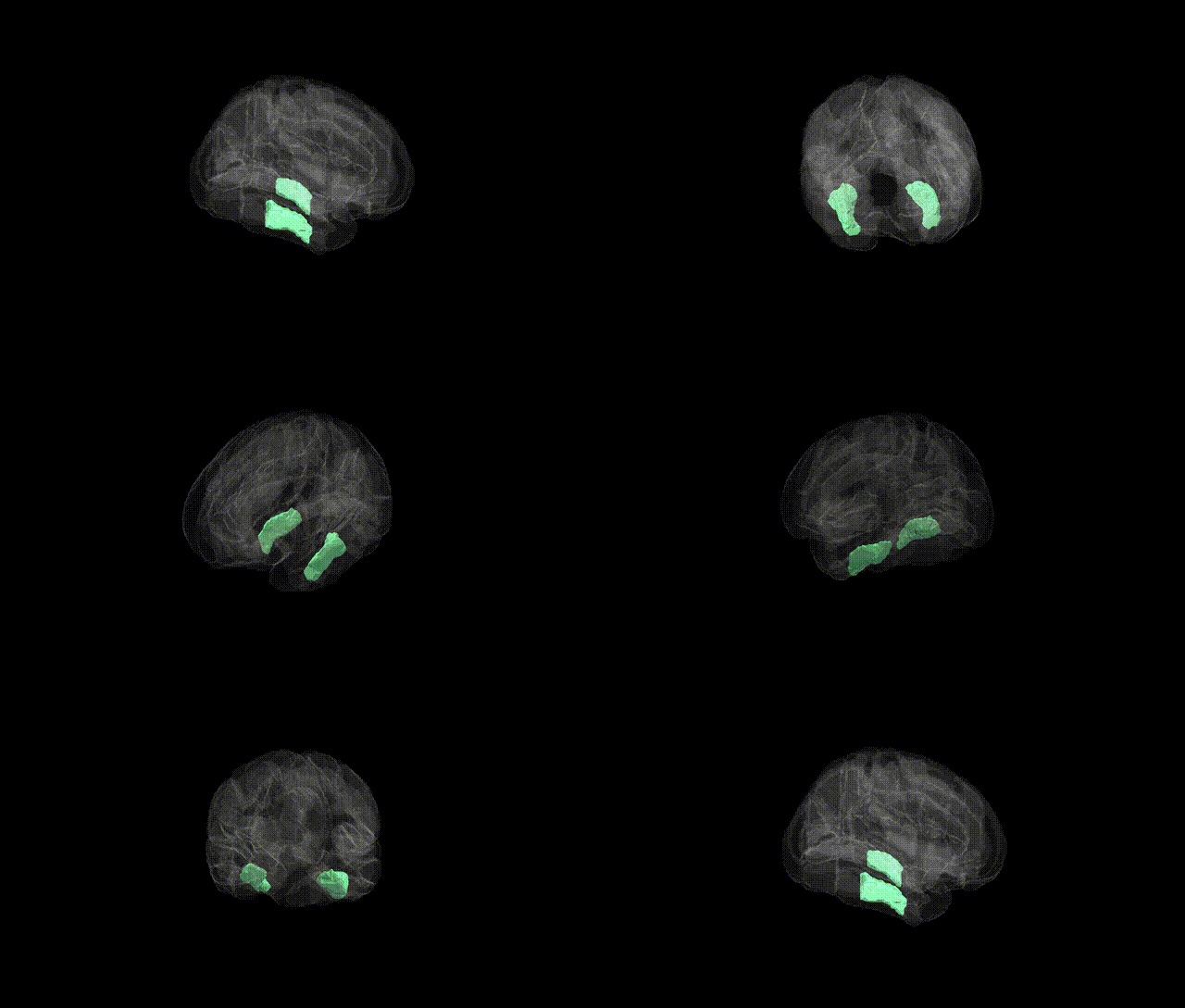
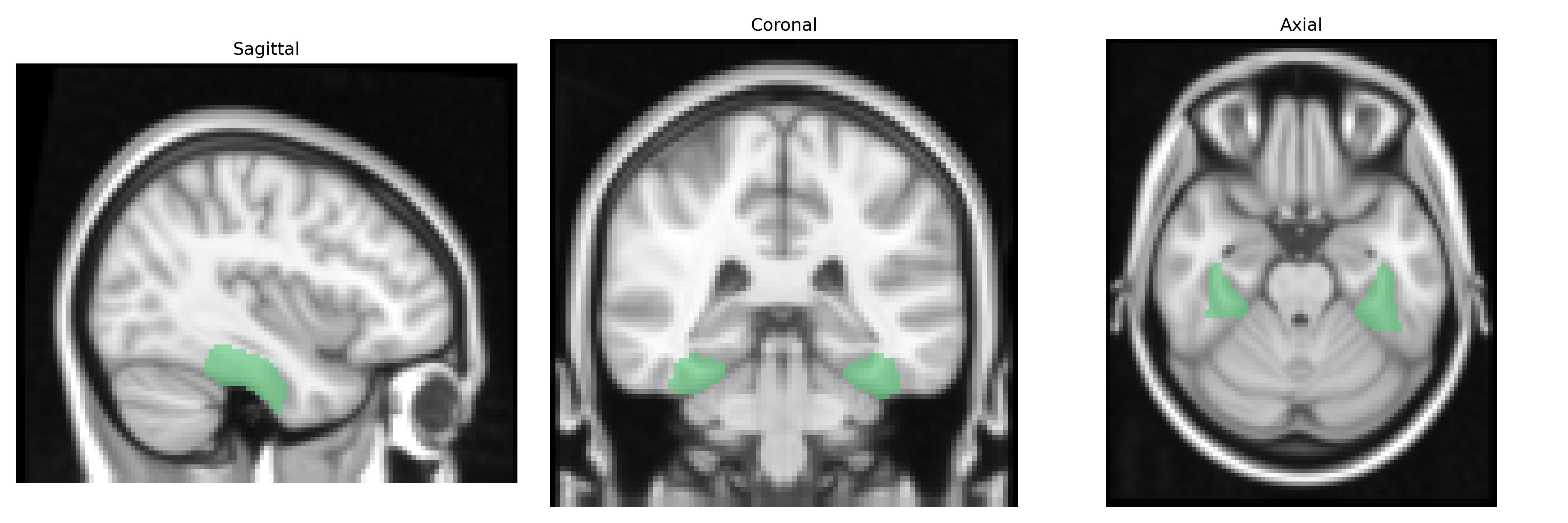
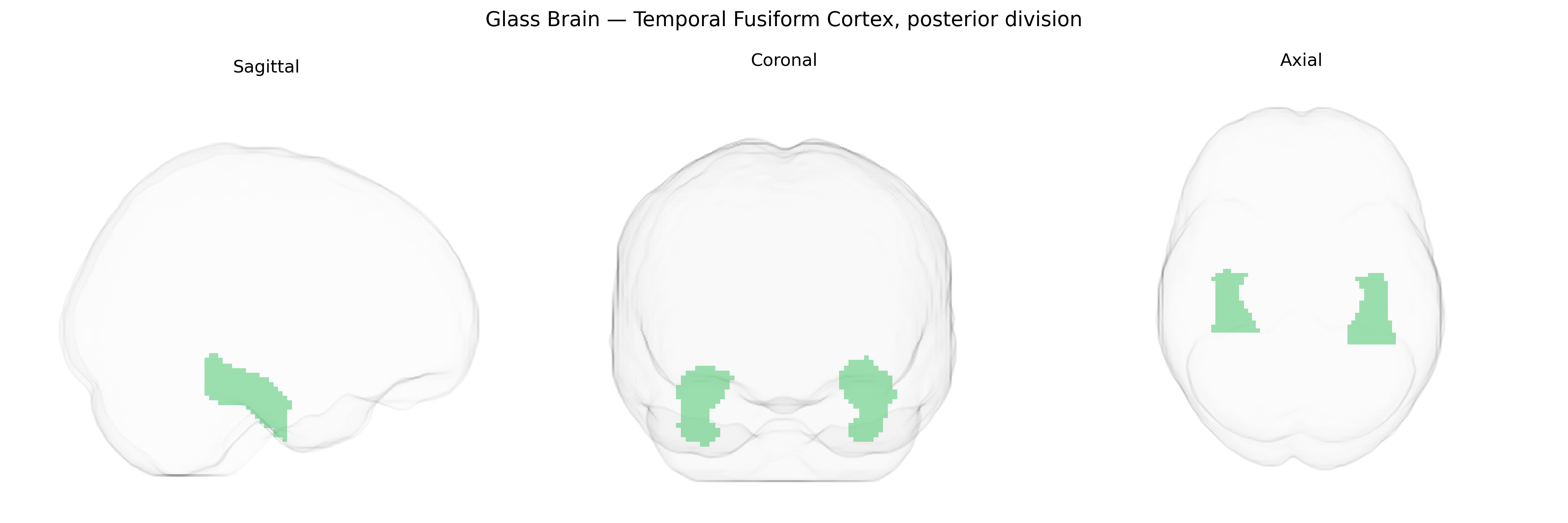
The bilateral Temporal Fusiform Cortex, posterior division, as defined in the Harvard–Oxford cortical structural atlas (maxprob thr25 2 mm), is a posterior segment of the fusiform gyrus located on the ventral surface of the temporal lobe, bordering occipitotemporal regions involved in high-level visual processing. This area participates in complex object and face recognition, integrating visual features into coherent percepts and contributing to category-specific processing (for example, faces, words, and other expertise-dependent stimuli). Cytoarchitectonically, it corresponds roughly to parts of Brodmann areas 37 and adjacent regions, and it is heavily interconnected with inferior temporal, occipital, and limbic cortices, reflecting its role in visual memory and semantic association. There is no direct link for this precise atlas-defined subdivision; a closely related structure is the Fusiform gyrus.
The bilateral temporal fusiform cortex, posterior division, as defined in the Harvard-Oxford cortical atlas, falls within a broader ventral temporal/fusiform territory whose genetics have been characterized mainly through imaging genetics and GWAS of brain structure. Large neuroimaging GWAS (e.g., ENIGMA consortium and UK Biobank) have identified multiple common variants influencing fusiform and inferior temporal cortical thickness, surface area, and volume, with robust signals near genes involved in neurodevelopment and synaptic function such as MAPT, KIAA0586, DPP4, and others, although these are typically reported at lobar or gyral (e.g., fusiform/inferior temporal) rather than fine-grained subregional resolution. Functionally, this region contributes to high-level visual and social processing (including face and object recognition), and convergent genetic evidence has linked variation in ventral temporal/fusiform anatomy and activation to neurodevelopmental and psychiatric conditions: autism spectrum disorder (ASD; several risk loci including those affecting synaptic genes such as SHANK3 and neurexin/neuroligin pathways show downstream effects on fusiform structure and face-processing networks), schizophrenia and bipolar disorder (where risk polygenic scores and specific loci like those near CACNA1C and MIR137 have been associated with altered temporal and fusiform morphology), and social communication or prosopagnosia-related traits (with rare variants in genes like MCTP2 reported in familial congenital prosopagnosia affecting fusiform functional specialization). Additional GWAS of cognitive and behavioral traits that engage this region—such as general intelligence, reading and language skills, social cognition, and depression/anxiety—have identified polygenic profiles that correlate with fusiform and inferior temporal cortical measures, though these associations are typically modest and distributed across many loci rather than region-specific. Overall, genetic influences on the temporal fusiform cortex, posterior division appear highly polygenic and pleiotropic, embedded within broader networks for visual, social, and language processing rather than being driven by unique, well-characterized variants specific to this exact atlas-defined subregion.
Overview generated by GPT-4o (2026).
Region ID: 38
Hemisphere: bilateral
Atlas: HarvardOxford cort maxprob thr25 2mm
Full Quality Version: Download MP4
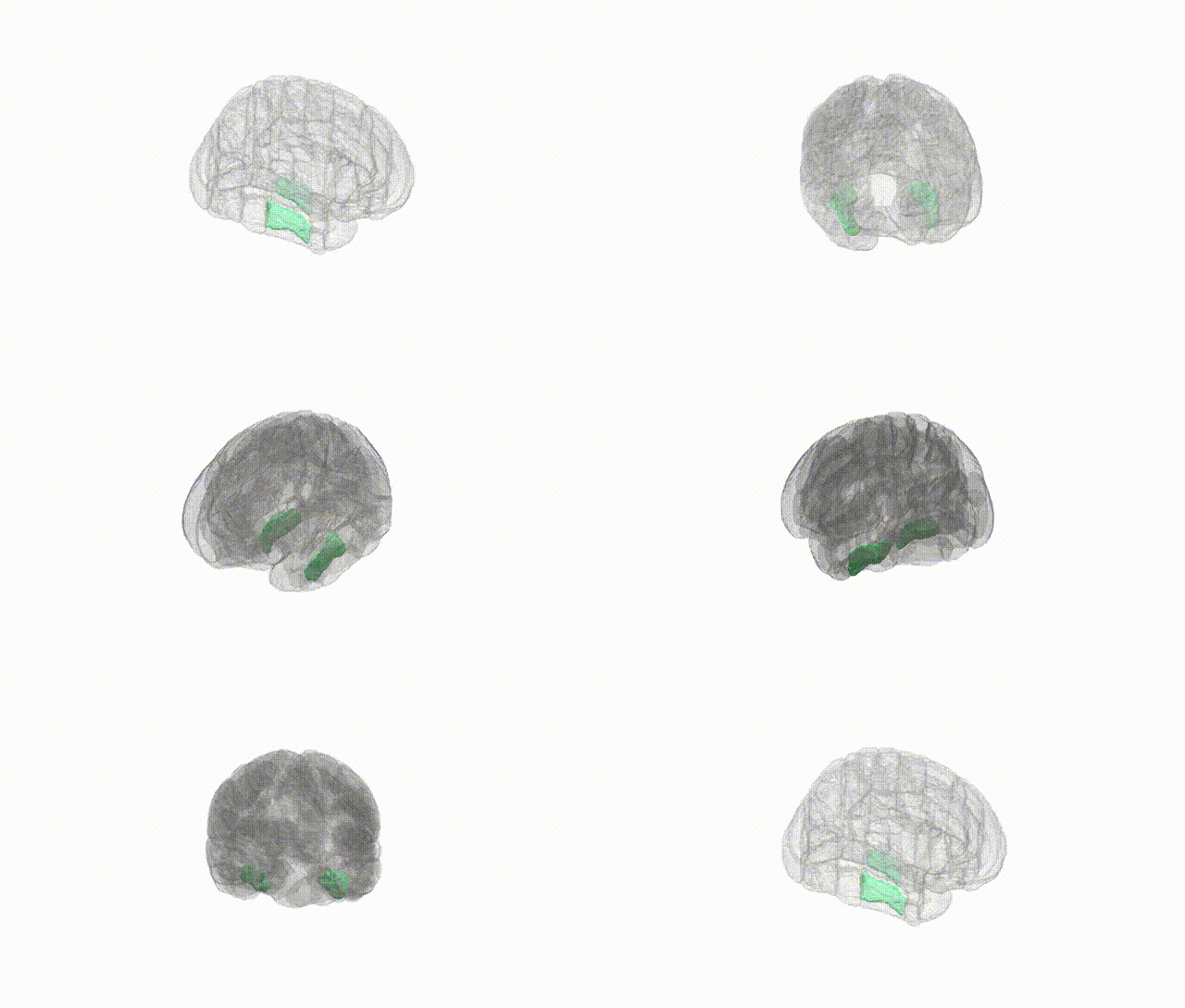
Full Quality Version: Download MP4
Wali Sidiqyar*, Gaurav Rudravaram*, Elyssa M. McMaster, Trent M. Schwartz, Adam M. Saunders, Kurt G. Schilling, Bennett A. Landman "Introducing SPINS: A Shared Public Visualization Library of Neuroanatomical Structures." Medical Imaging with Deep Learning- short paper
This resource is licensed under CC0 1.0 Universal (Public Domain).