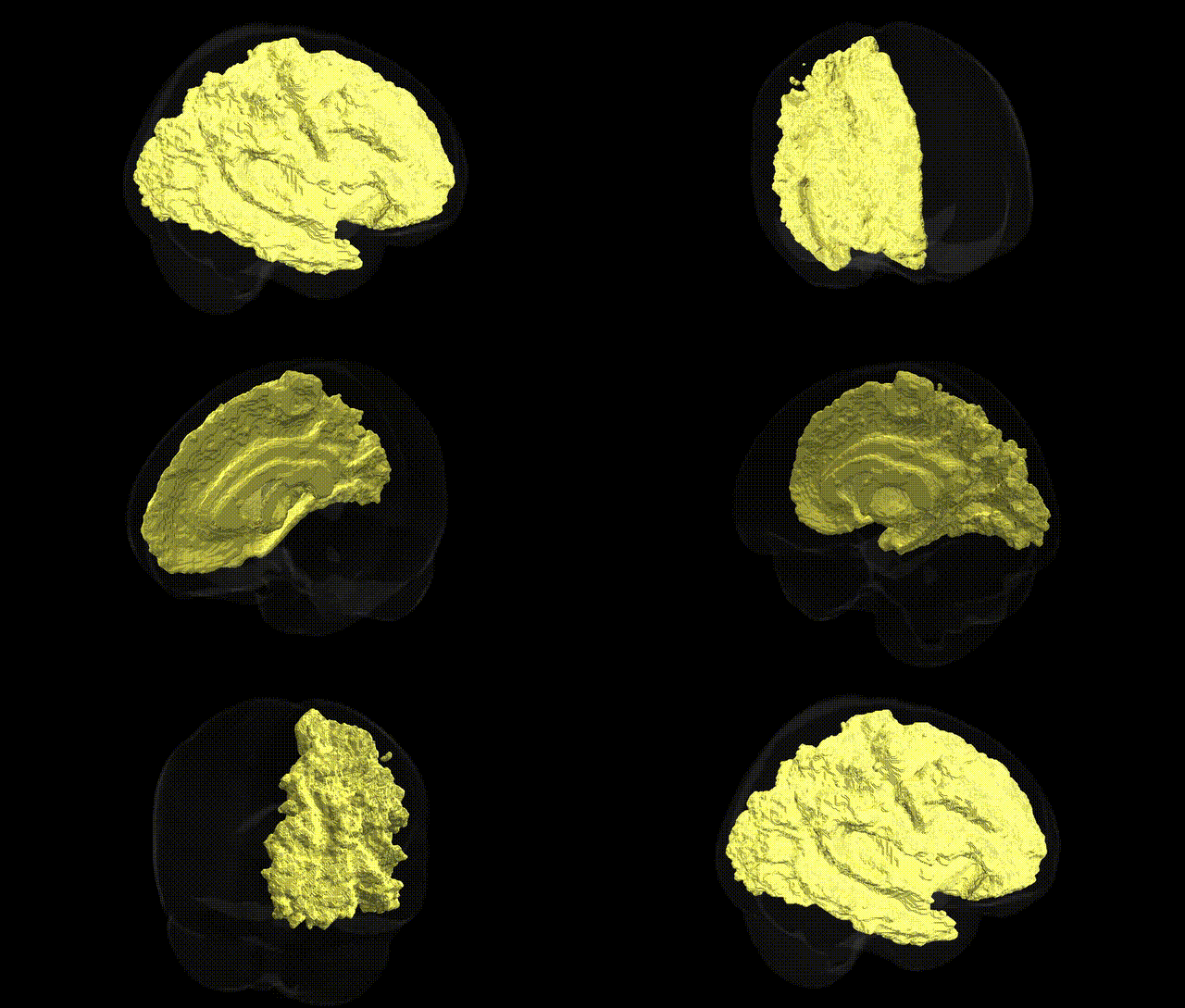
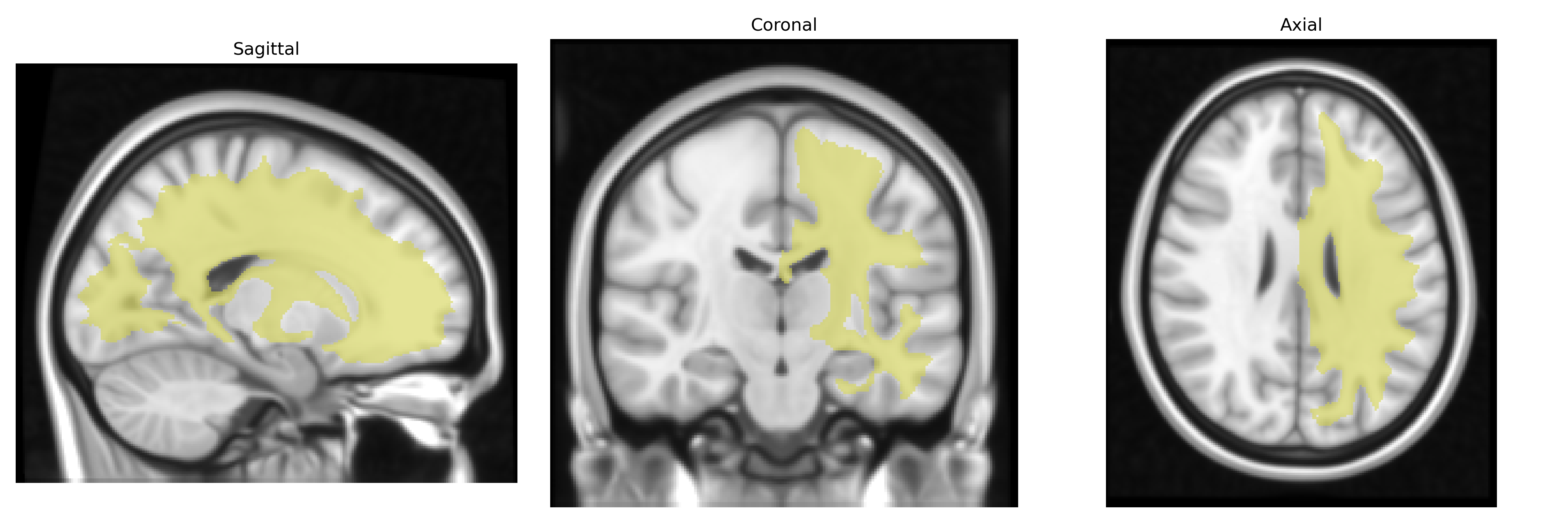
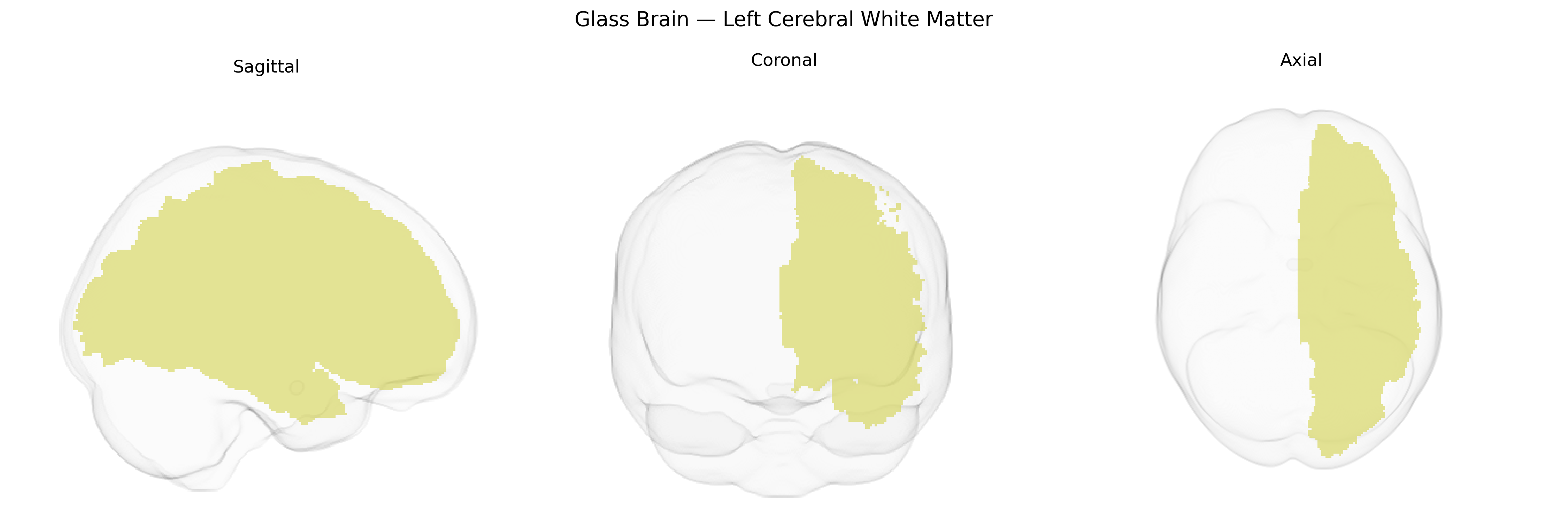
The bilateral left cerebral white matter comprises the myelinated axonal fibers deep to the left cerebral cortex that interconnect cortical regions within the left hemisphere and link them to subcortical and contralateral structures. These tracts include association fibers (such as the superior and inferior longitudinal fasciculi, uncinate fasciculus, and cingulum bundle), projection fibers (such as the internal capsule and corona radiata), and components of commissural pathways passing toward the corpus callosum, all of which support efficient conduction of neural signals underlying motor control, sensory integration, language, and higher cognitive functions typically lateralized to the left hemisphere. In the Harvard–Oxford atlas, this label represents a probabilistic delineation of the white matter volume in the left cerebrum, rather than a single discrete anatomical tract. There is no direct link for “Left Cerebral White Matter”; a related overview is provided at White matter.
The bilateral left cerebral white matter, as defined in the Harvard–Oxford subcortical atlas, encompasses major association, projection, and commissural fiber pathways whose microstructure and volume show substantial heritability and polygenic influences. Large-scale GWAS of diffusion MRI measures (e.g., fractional anisotropy, mean diffusivity) and white matter volume consistently implicate common variants in genes involved in axonal guidance, myelination, and oligodendrocyte biology, including loci near or within genes such as NRG1/NRG3, ERBB4, MAG, MBP, CNTN4/6, and NCAN, as well as broader polygenic overlap with neurodevelopmental pathways (axon growth, synaptic organization). Polygenic scores for schizophrenia, bipolar disorder, major depression, autism spectrum disorder, and ADHD have been associated with altered left-hemisphere white matter integrity in frontotemporal, frontostriatal, and callosal tracts, while specific risk loci (e.g., in ZNF804A, CACNA1C, and DISC1-related pathways) have been linked to microstructural changes in left frontal and temporal white matter. Moreover, GWAS of cognitive traits and educational attainment identify variants that jointly influence left hemispheric white matter organization and higher-order cognitive abilities, suggesting that left cerebral white matter acts as an intermediate neuroanatomical phenotype through which distributed polygenic risk for psychiatric disorders, cognitive performance, and related traits is partially expressed.
Overview generated by GPT-4o (2026).
Region ID: 1
Hemisphere: bilateral
Atlas: HarvardOxford sub maxprob thr25 1mm
Full Quality Version: Download MP4
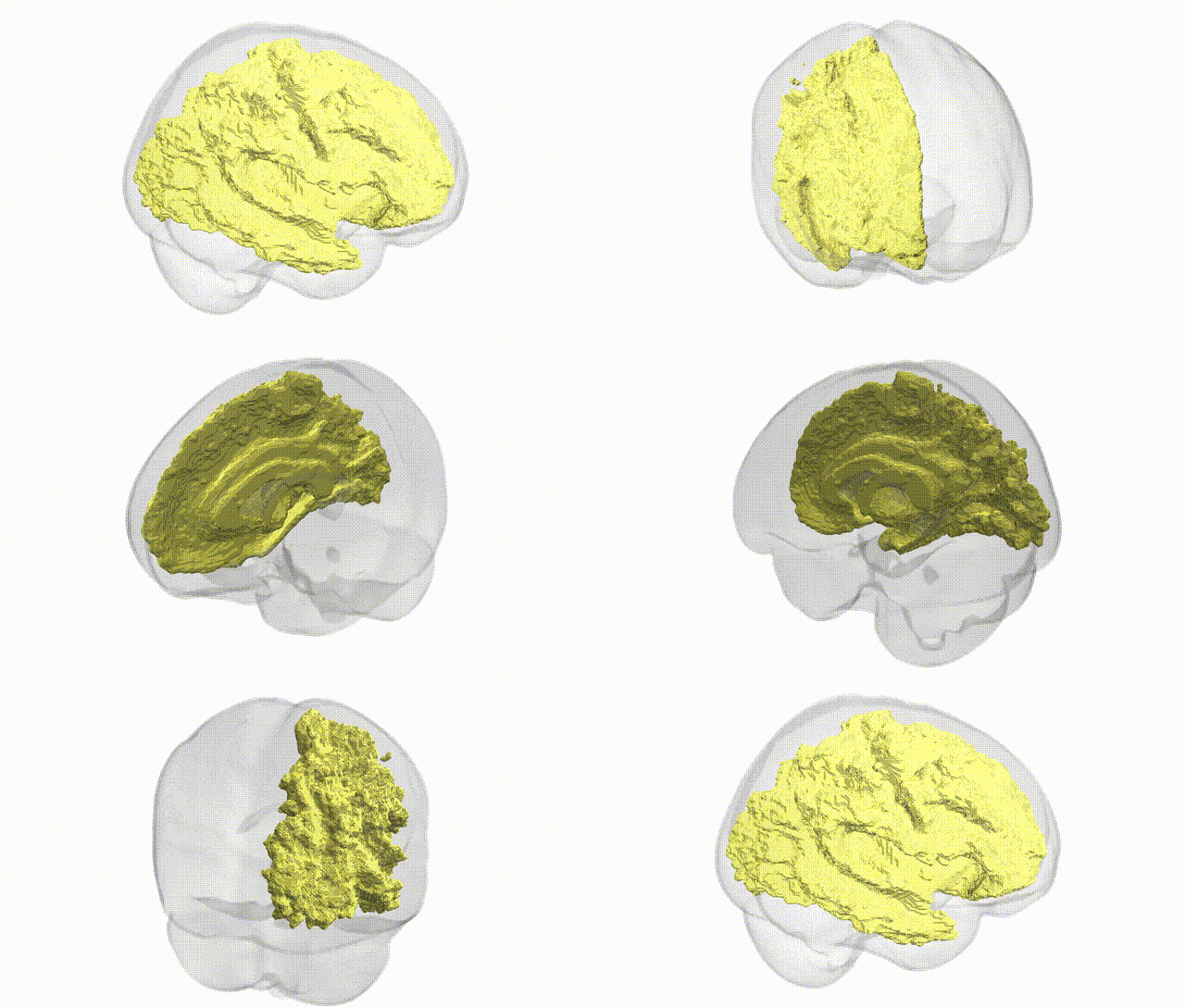
Full Quality Version: Download MP4
Wali Sidiqyar*, Gaurav Rudravaram*, Elyssa M. McMaster, Trent M. Schwartz, Adam M. Saunders, Kurt G. Schilling, Bennett A. Landman "Introducing SPINS: A Shared Public Visualization Library of Neuroanatomical Structures." Medical Imaging with Deep Learning- short paper
This resource is licensed under CC0 1.0 Universal (Public Domain).