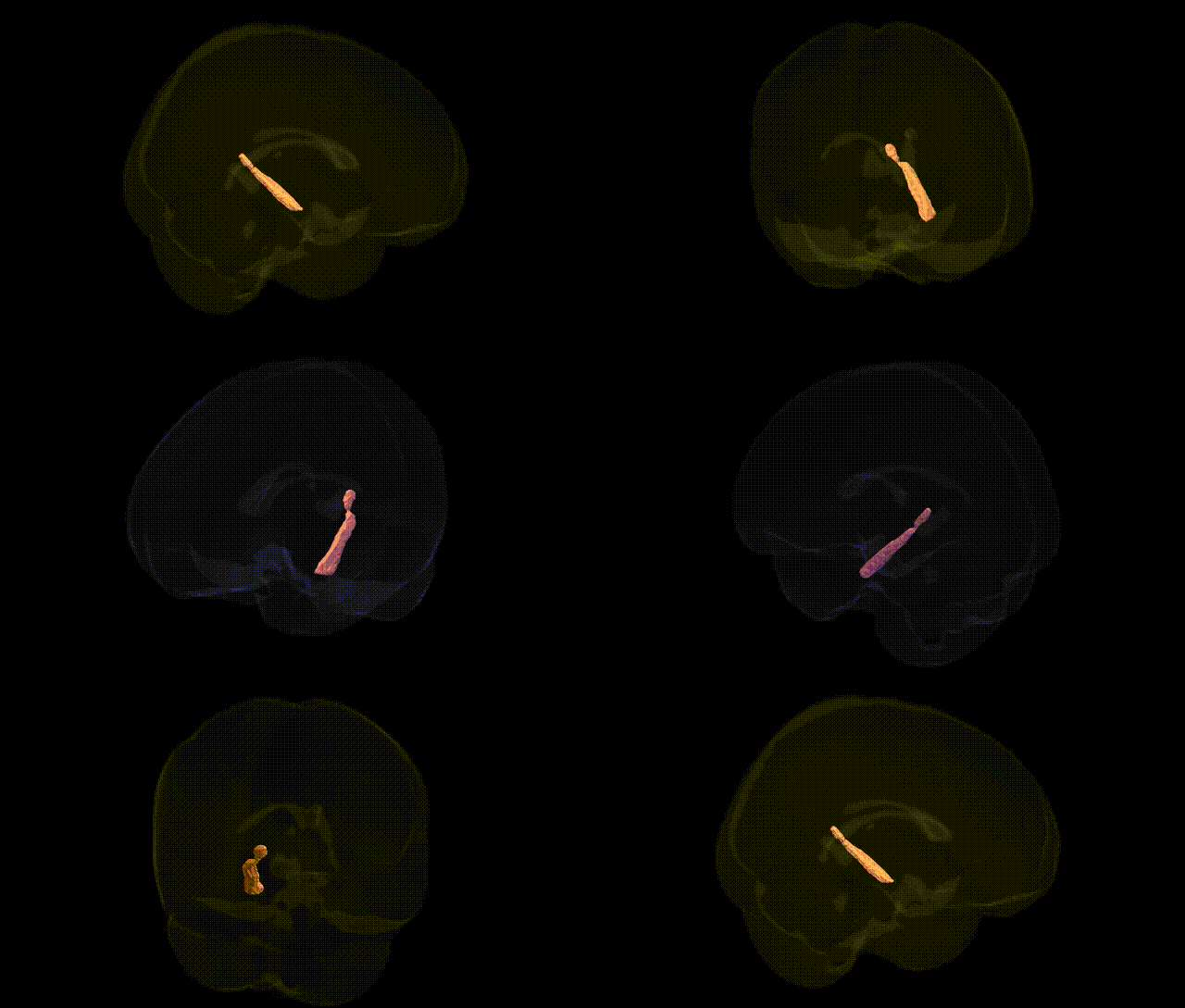
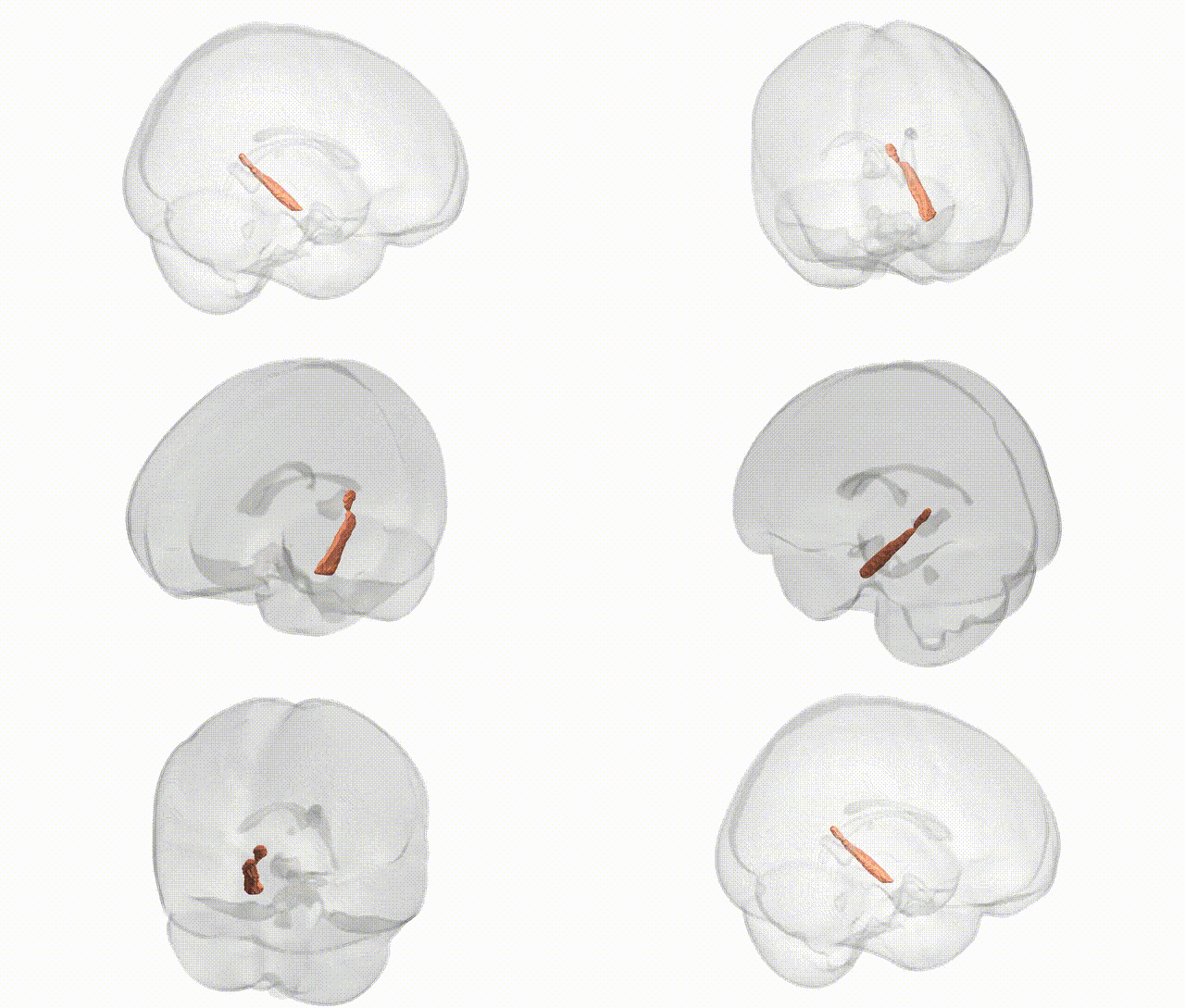
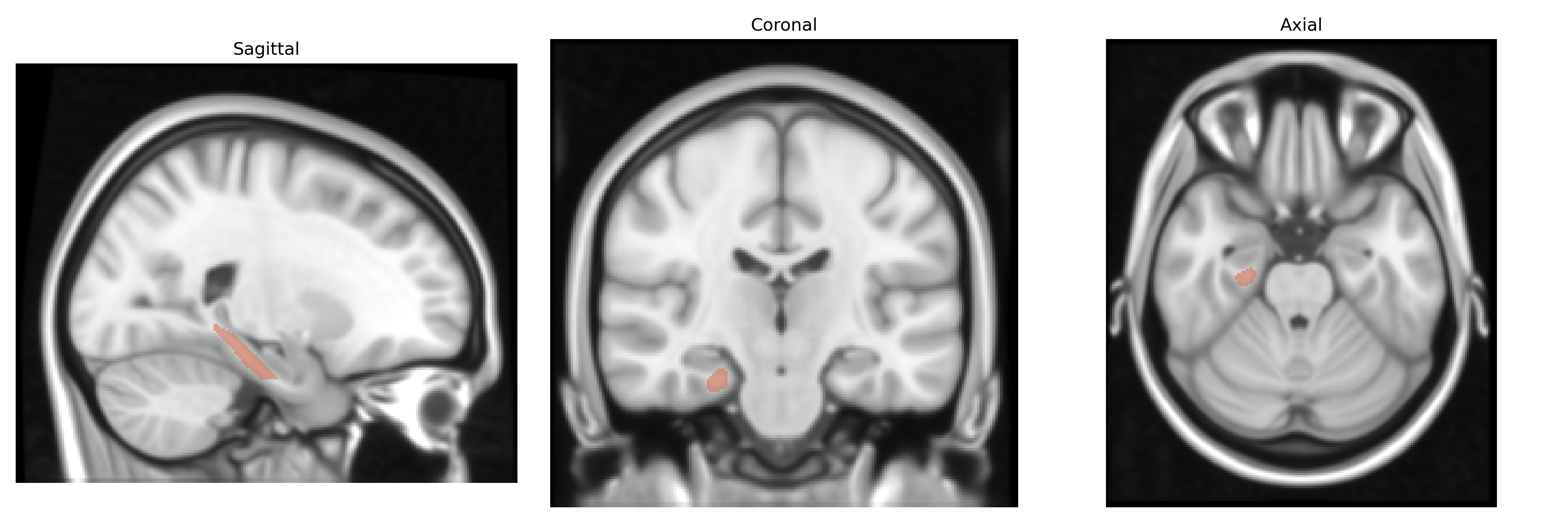
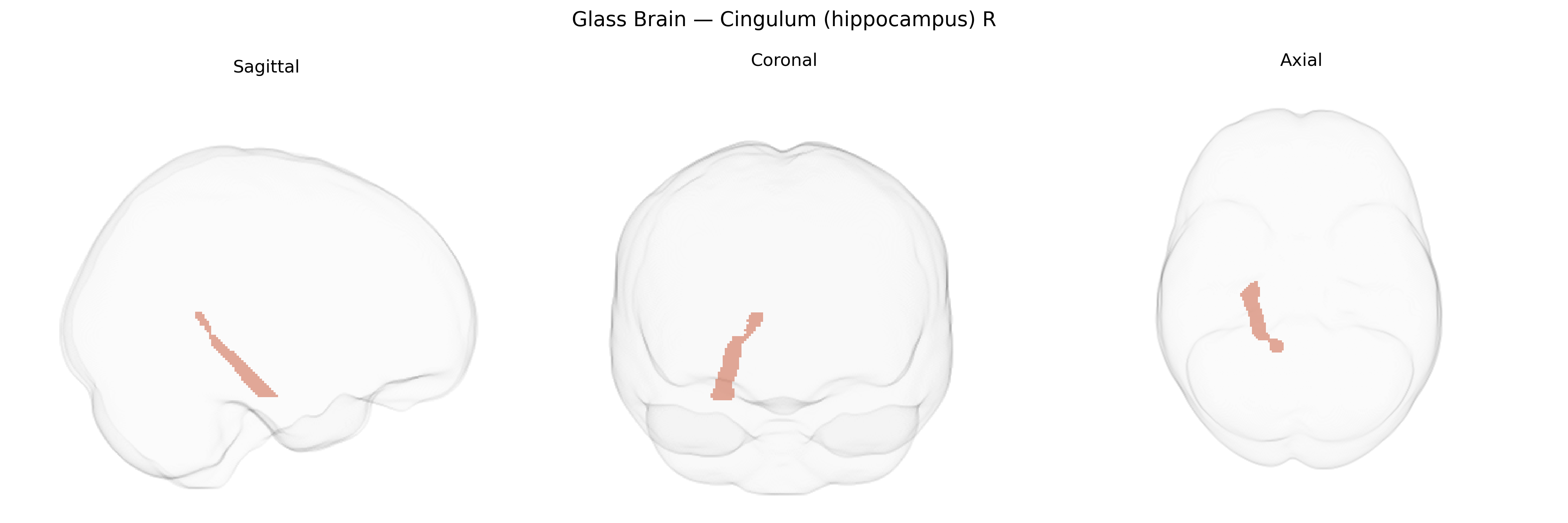
The bilateral Cingulum (hippocampus) R, as defined in the JHU ICBM Labels 1 mm Atlas, corresponds to the portion of the cingulum white matter tract coursing within the parahippocampal region and adjacent to the hippocampal formation. It is a major association fiber bundle that forms part of the limbic network, connecting medial temporal lobe structures (including hippocampus and parahippocampal gyrus) with the cingulate gyrus and other medial cortical areas, thereby supporting episodic memory, spatial navigation, and integration of emotional and cognitive processes. Structurally, it consists of tightly packed myelinated fibers running longitudinally along the medial temporal lobe, and functionally it participates in circuits underpinning memory consolidation and retrieval as well as aspects of attention and executive control through its connections with frontal and parietal cortices. There is no direct Wikipedia article for this labeled subcomponent; a closely related structure is the broader cingulum bundle: Cingulum.
The bilateral cingulum (hippocampus) bundle as defined in the JHU ICBM 1 mm atlas has been repeatedly implicated in imaging-genetics and GWAS studies of white matter microstructure, memory, and neuropsychiatric risk, with its fractional anisotropy and related diffusion metrics showing moderate heritability and robust associations with common genetic variation. Large-scale ENIGMA and UK Biobank analyses have identified loci in or near genes related to axon guidance, myelination, and oligodendrocyte function (for example, variants near CNTNAP2, NRG1/ERBB signaling components, and myelin-associated genes) that influence cingulum-hippocampal integrity, often as part of multitract white matter factors rather than as a uniquely isolated region. Polygenic risk scores for schizophrenia, major depressive disorder, bipolar disorder, and autism spectrum disorder have been associated with altered microstructural properties of the cingulum–hippocampal tract, consistent with its role in limbic circuitry and cognitive-emotional regulation. Genetic variants affecting Alzheimer’s disease risk, including APOE ε4 and loci involved in tau and amyloid pathways, have been linked to reduced integrity or accelerated age-related decline in this tract, paralleling hippocampal and entorhinal cortical vulnerability. Additional GWAS of cognitive performance, episodic memory, and neuroticism have shown that alleles associated with lower white matter integrity and smaller hippocampal volume often co-occur with altered cingulum-hippocampal metrics, suggesting pleiotropic effects of neurodevelopmental and synaptic genes on both gray and white matter components of medial temporal-limbic networks.
Overview generated by GPT-4o (2026).
Region ID: 37
Hemisphere: bilateral
Atlas: JHU ICBM labels 1mm
Full Quality Version: Download MP4
Full Quality Version: Download MP4
Wali Sidiqyar*, Gaurav Rudravaram*, Elyssa M. McMaster, Trent M. Schwartz, Adam M. Saunders, Kurt G. Schilling, Bennett A. Landman "Introducing SPINS: A Shared Public Visualization Library of Neuroanatomical Structures." Medical Imaging with Deep Learning- short paper
This resource is licensed under CC0 1.0 Universal (Public Domain).