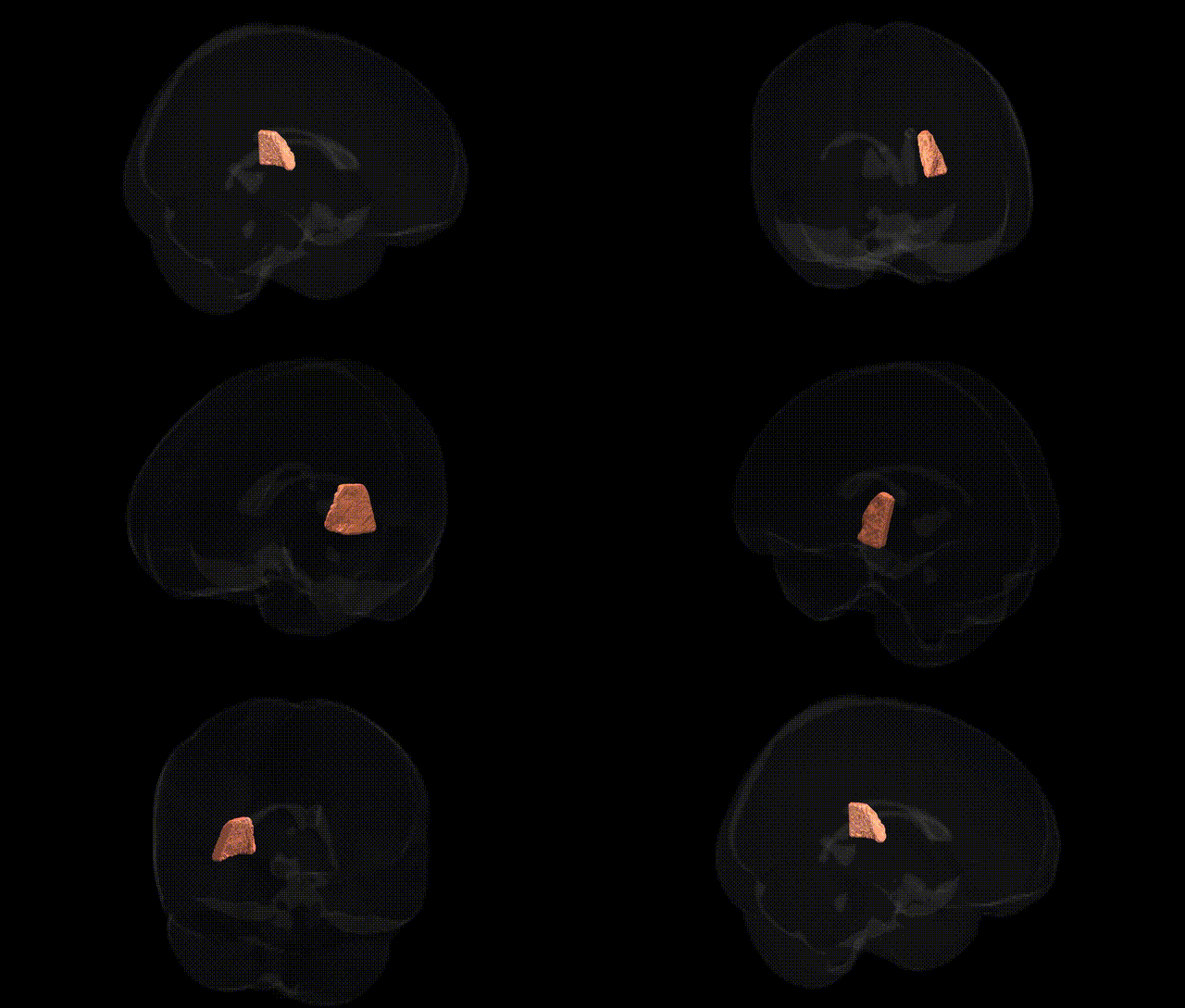
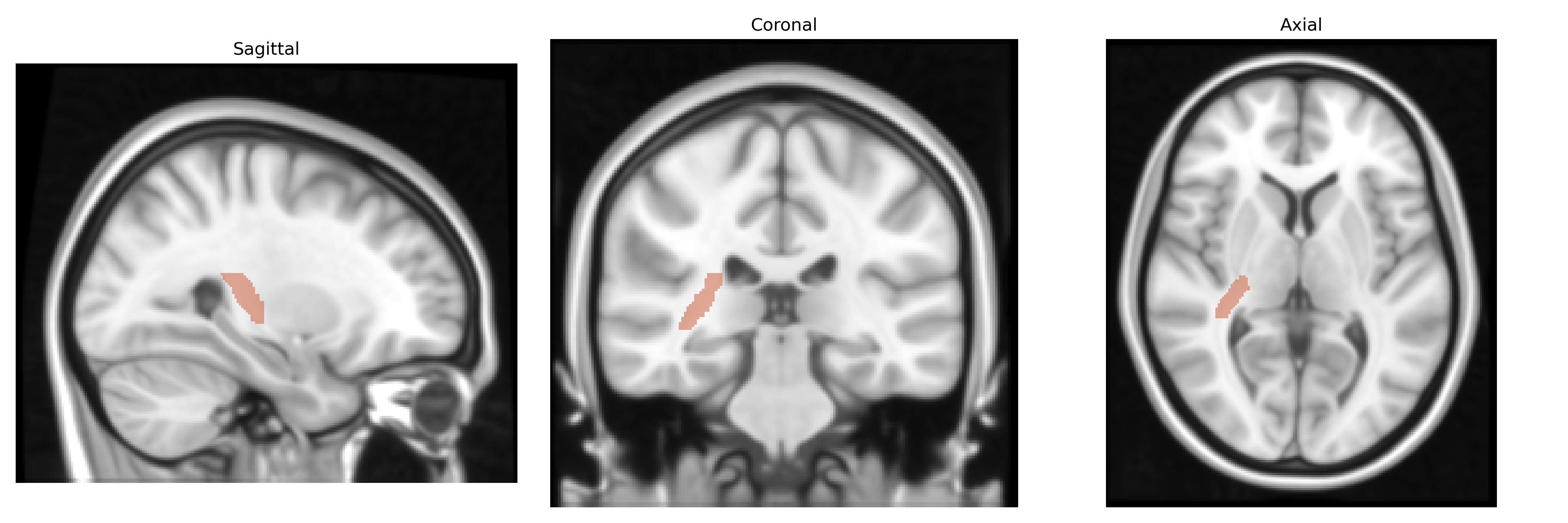
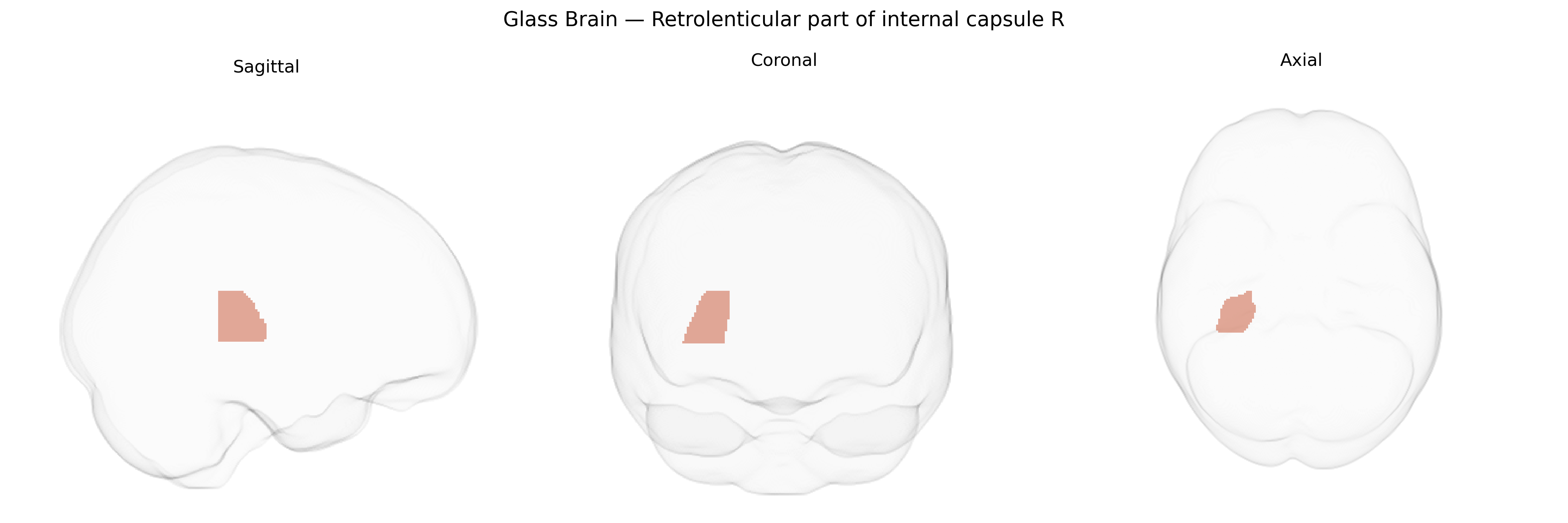
The bilateral Retrolenticular part of the internal capsule (right) is a white matter region located posterior to the lentiform nucleus, forming part of the internal capsule that carries major projection fibers between the cerebral cortex and subcortical structures. It contains fibers of the optic radiation (connecting the lateral geniculate nucleus to the visual cortex), auditory radiations, and posterior thalamic radiations, as well as association and corticopontine fibers, thus playing a key role in visual, auditory, and multimodal sensory integration. Damage to this region can result in visual field deficits, sensory disturbances, and higher-order perceptual impairments due to disruption of thalamocortical and corticocortical connectivity. There is no direct link for the retrolenticular part alone; see the related structure Internal capsule.
The bilateral retrolenticular part of the internal capsule (RLIC) has been implicated in several genetic imaging and GWAS studies that examine white-matter microstructure, often using JHU ICBM 1 mm atlas labels as reference regions for diffusion tensor imaging. Variation in RLIC fractional anisotropy and other diffusion metrics has shown associations with common genetic variants in pathways related to axonal guidance, myelination, and neurodevelopment, including genes such as NTRK3, CNTN4, and oligodendrocyte-related loci identified in large brain-wide GWAS of white matter integrity. Polygenic risk scores for schizophrenia, bipolar disorder, and major depressive disorder have been linked to altered microstructure in posterior internal capsule tracts that include the RLIC, while risk variants for neurodevelopmental disorders (e.g., autism spectrum disorders) and cognitive traits (general intelligence, processing speed) have been associated with structural differences across major long-range white-matter pathways traversing this region. Moreover, GWAS of stroke, small-vessel disease, and cerebral white-matter hyperintensities have highlighted genetic loci (such as those near COL4A2 and HTRA1) influencing vulnerability of deep white matter tracts, including the internal capsule, although these findings typically reference broader internal capsule or posterior limb regions rather than the RLIC specifically. Overall, genetic associations for the retrolenticular internal capsule tend to emerge in large, atlas-based imaging-genetics studies that treat it as part of a distributed network of posterior projection and association fibers, rather than as an isolated target structure.
Overview generated by GPT-4o (2026).
Region ID: 21
Hemisphere: bilateral
Atlas: JHU ICBM labels 1mm
Full Quality Version: Download MP4
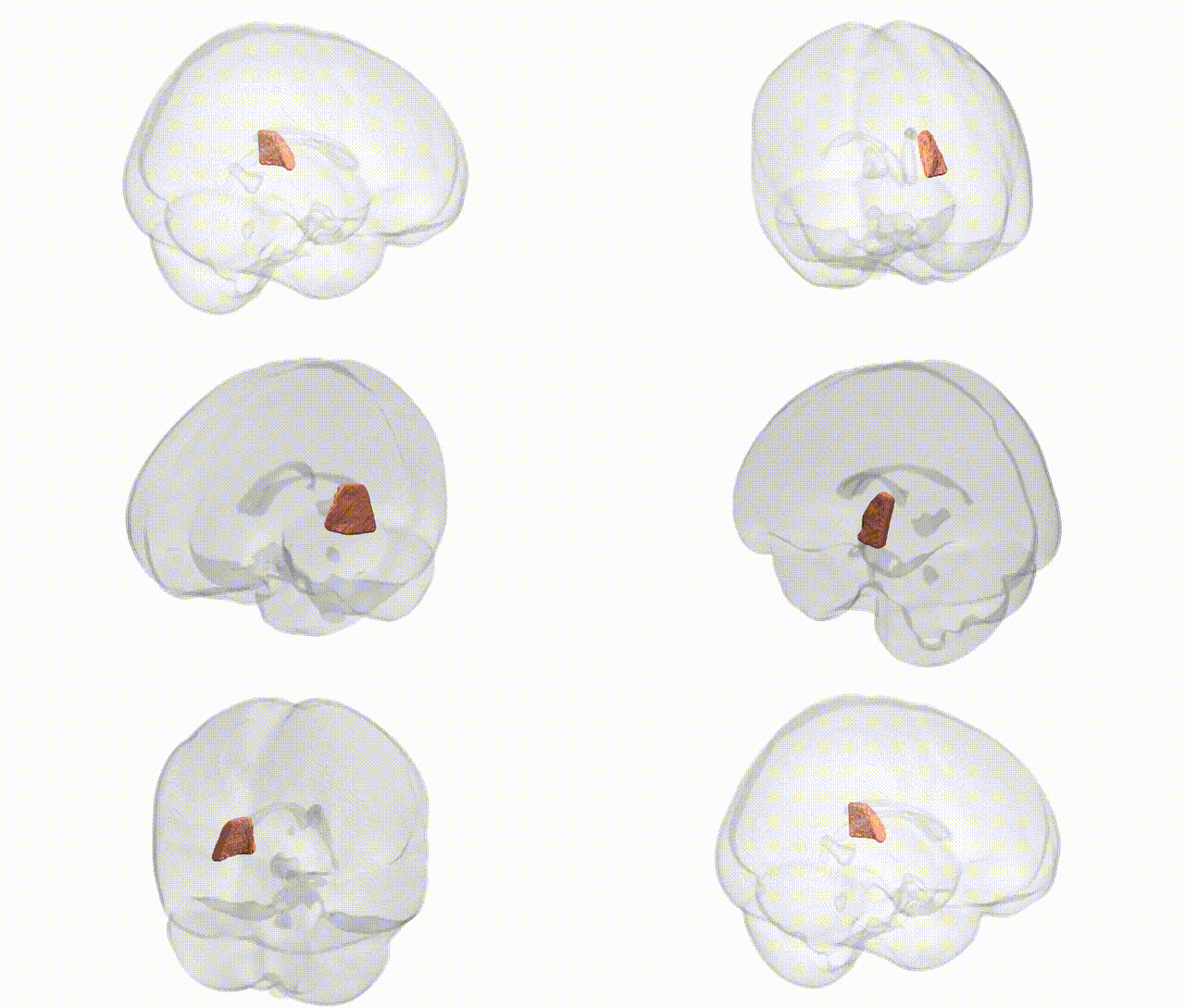
Full Quality Version: Download MP4
Wali Sidiqyar*, Gaurav Rudravaram*, Elyssa M. McMaster, Trent M. Schwartz, Adam M. Saunders, Kurt G. Schilling, Bennett A. Landman "Introducing SPINS: A Shared Public Visualization Library of Neuroanatomical Structures." Medical Imaging with Deep Learning- short paper
This resource is licensed under CC0 1.0 Universal (Public Domain).