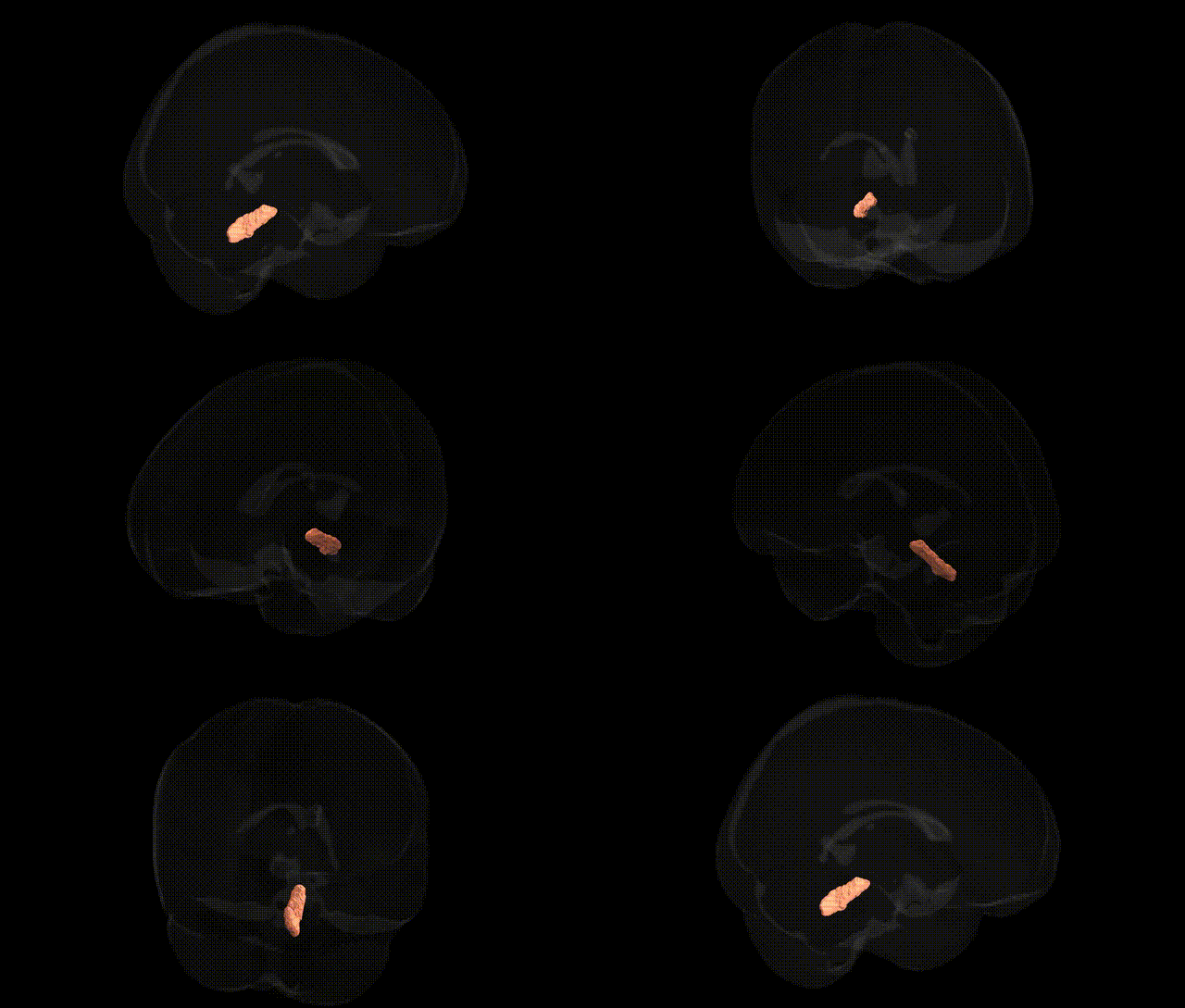
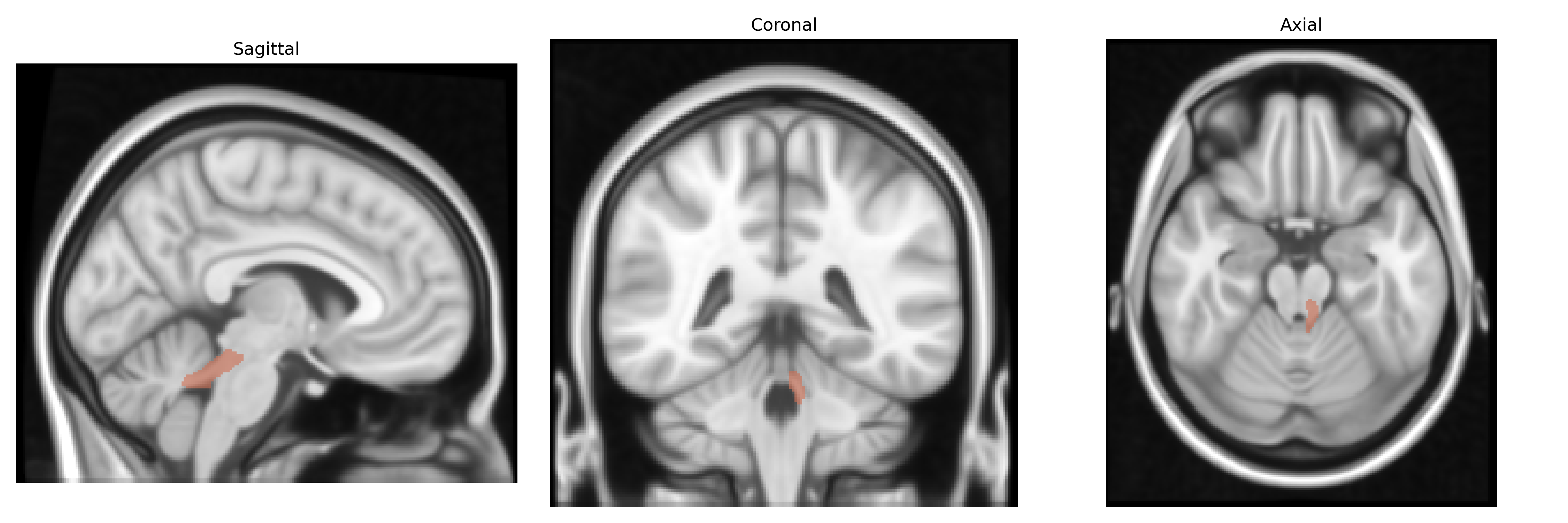
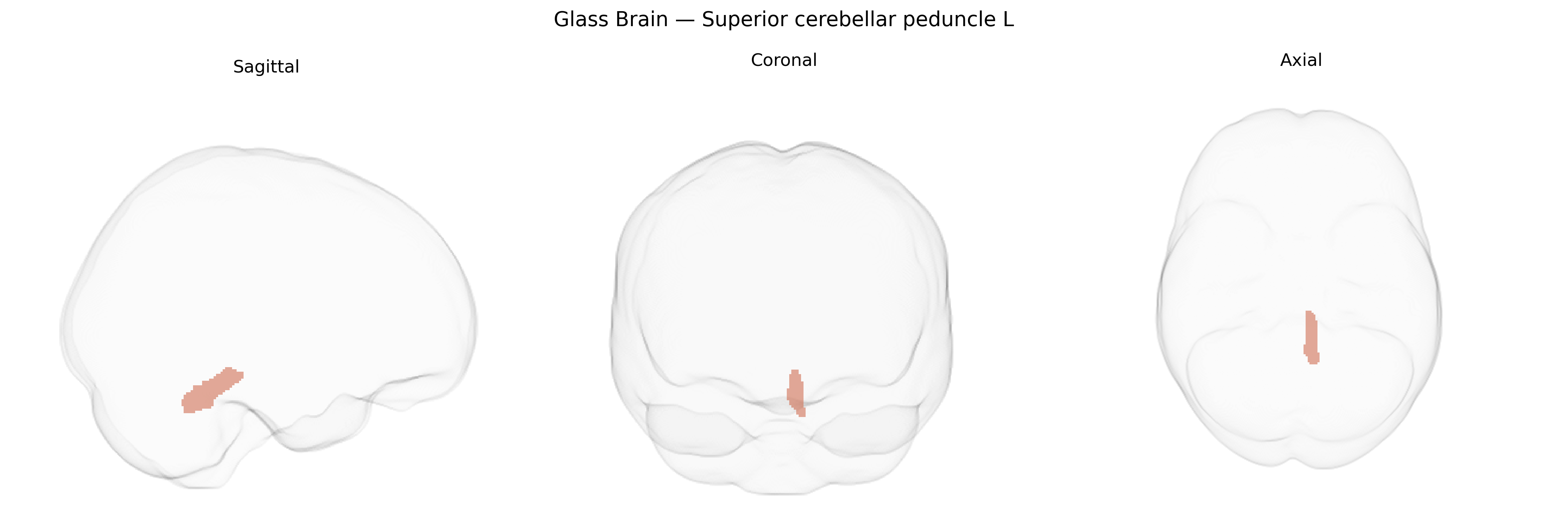
The bilateral Superior cerebellar peduncle L, as defined in the JHU ICBM labels 1mm Atlas, is a major white matter tract linking the cerebellum to the midbrain and thalamic regions, primarily carrying efferent fibers from the deep cerebellar nuclei (especially the dentate nucleus) toward motor and premotor cortical areas via the red nucleus and ventrolateral thalamus. It plays a crucial role in the coordination, timing, and fine-tuning of voluntary movements, as well as in motor learning and the integration of proprioceptive information into motor output. The superior cerebellar peduncle also contributes to the modulation of muscle tone and the adaptation of motor programs, with lesions commonly producing ataxia, dysmetria, and intention tremor. There is no direct Wikipedia article specifically for the “bilateral Superior cerebellar peduncle L” atlas label; a related structure is the superior cerebellar peduncle: Superior cerebellar peduncle.
The bilateral superior cerebellar peduncle (SCP) in the JHU ICBM 1 mm atlas is a major cerebellar outflow tract whose microstructural variation has been associated in imaging–genetics studies with common polymorphisms in genes involved in neurodevelopment, myelination, and synaptic function, although few findings are region‑specific and most derive from broader white‑matter or cerebellar analyses. Diffusion MRI GWAS of white‑matter tracts (e.g., UK Biobank–based studies by Elliott et al., Zhao et al., and others) have reported SNP associations in loci near or within genes such as NCAN, TMEM106B, CNTN4, NRG1, and multiple oligodendrocyte-related genes, with effects on fractional anisotropy and mean diffusivity in cerebellar peduncles including the SCP, often in the context of global or posterior white‑matter factors rather than the SCP alone; these loci overlap with risk architecture for schizophrenia, major depressive disorder, and cognitive performance. SCP integrity has been implicated in Mendelian and rare variant disorders affecting cerebellar connectivity—such as autosomal recessive spastic ataxias, Joubert and related cerebellar malformation syndromes, and certain leukodystrophies—where pathogenic variants in genes (e.g., PMP22, PLP1, FA2H, and ciliary or axon guidance genes) lead to hypoplasia or microstructural abnormalities of cerebellar peduncles on MRI. In psychiatric and neurodevelopmental GWAS (for schizophrenia, bipolar disorder, autism, ADHD), polygenic risk scores have been associated with altered diffusion measures in cerebellar white matter including the SCP in large cohorts, suggesting that the same common genetic factors conferring risk for these conditions contribute to microstructural variation in this pathway. Additionally, imaging–genetic work on motor and cognitive traits indicates that genetic influences on general intelligence, processing speed, motor coordination, and educational attainment partly act through global and posterior white‑matter factors that include the SCP, although direct, uniquely SCP-specific GWAS hits remain limited, and most evidence reflects shared genetic architecture across multiple tracts rather than a distinct genetic signature for this single region.
Overview generated by GPT-4o (2026).
Region ID: 14
Hemisphere: bilateral
Atlas: JHU ICBM labels 1mm
Full Quality Version: Download MP4
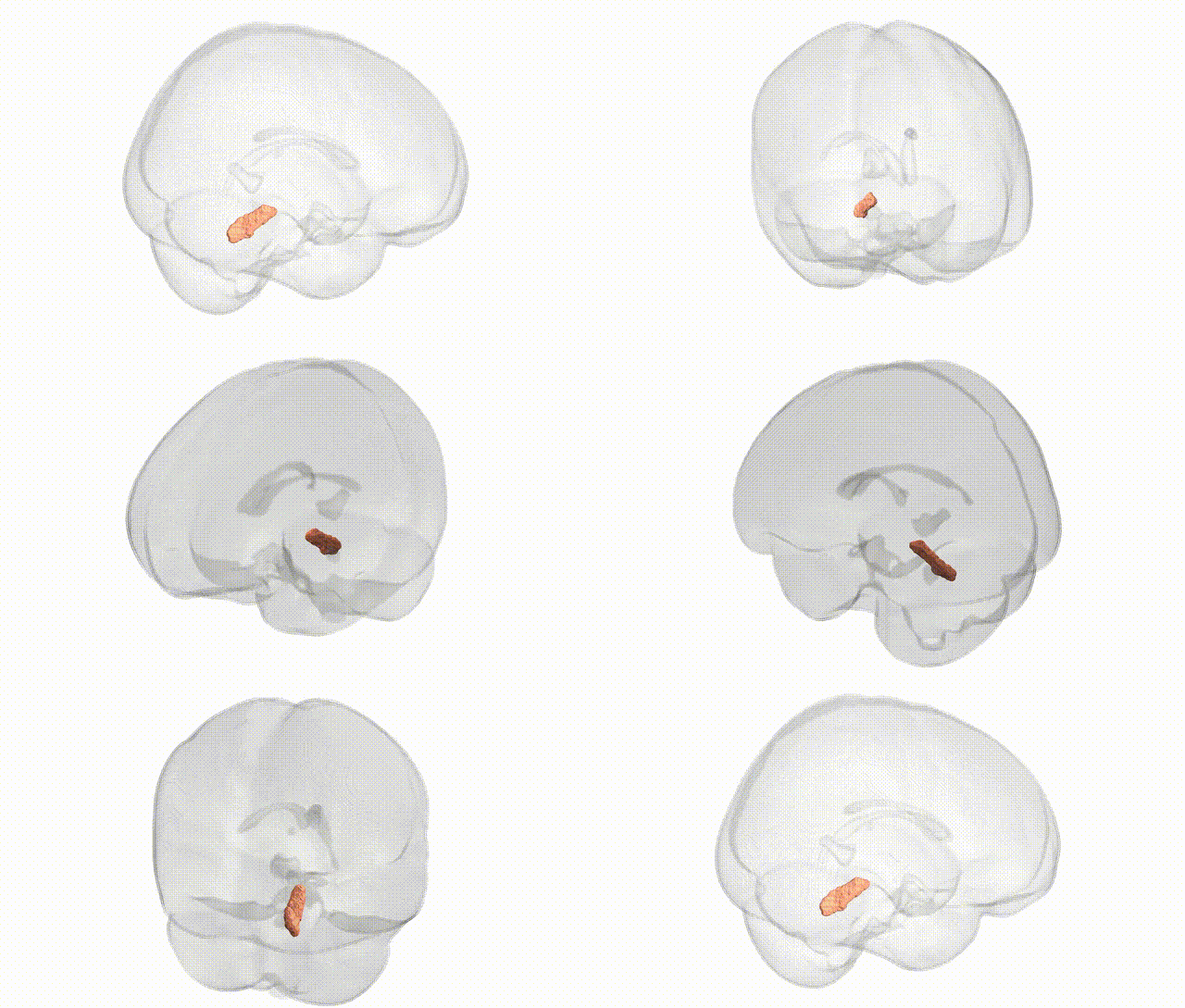
Full Quality Version: Download MP4
Wali Sidiqyar*, Gaurav Rudravaram*, Elyssa M. McMaster, Trent M. Schwartz, Adam M. Saunders, Kurt G. Schilling, Bennett A. Landman "Introducing SPINS: A Shared Public Visualization Library of Neuroanatomical Structures." Medical Imaging with Deep Learning- short paper
This resource is licensed under CC0 1.0 Universal (Public Domain).