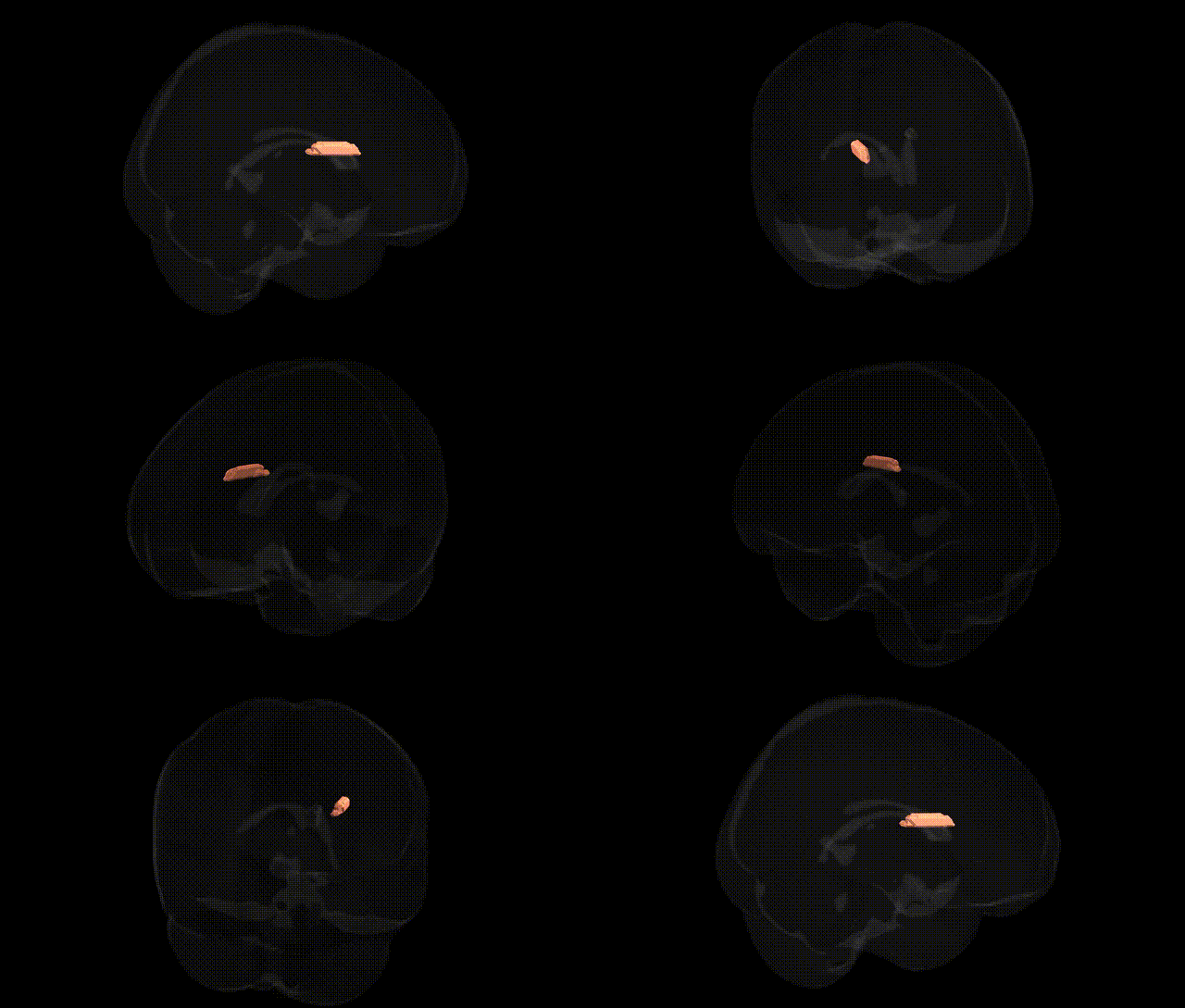
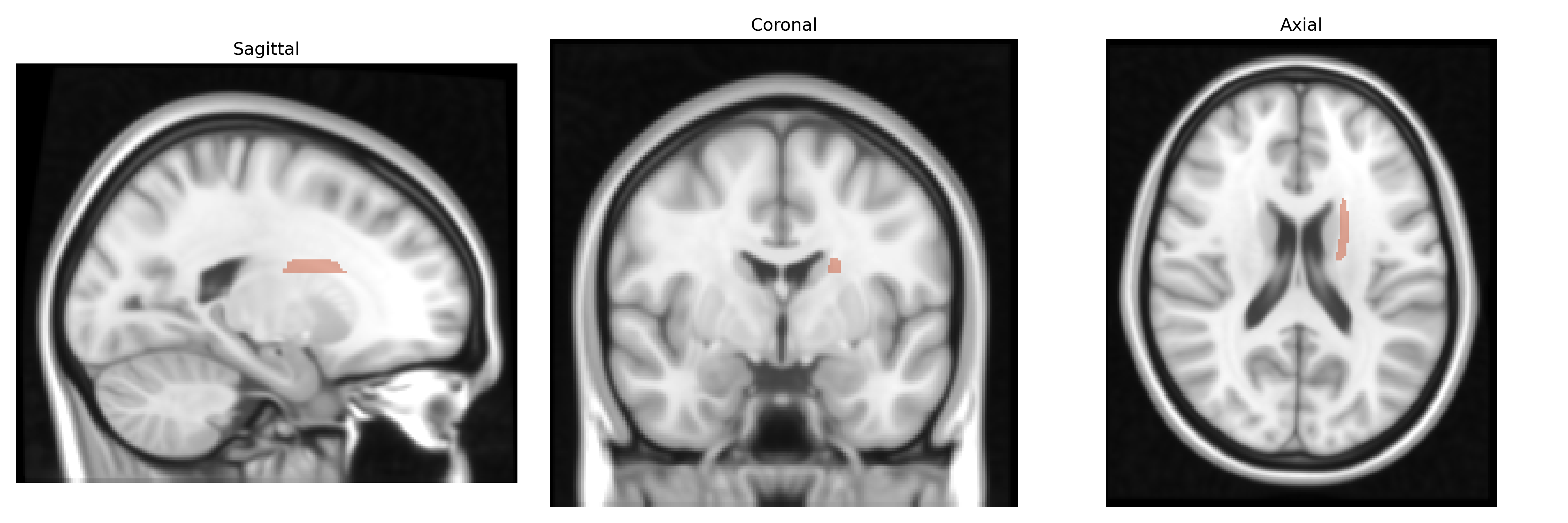
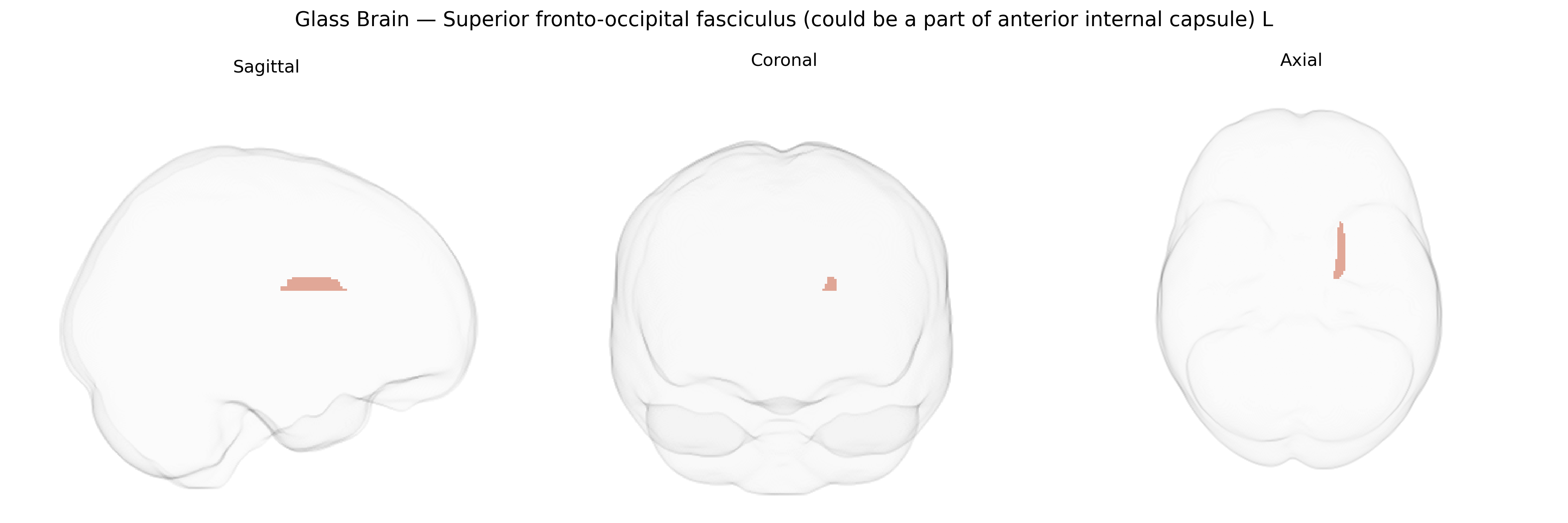
The bilateral Superior fronto-occipital fasciculus (could be a part of anterior internal capsule), left (L), as defined in the JHU ICBM labels 1mm Atlas, is a long associative white matter tract coursing within the deep cerebral hemispheres, typically running from frontal lobe regions through or adjacent to the anterior limb of the internal capsule toward parietal, occipital, and possibly temporal areas. It contributes to large-scale connectivity between anterior executive and premotor regions and posterior sensory–perceptual territories, supporting higher-order cognitive integration, visuospatial processing, and possibly language-related and attentional functions. The tract’s exact existence and delineation in humans have been debated, with some diffusion imaging studies suggesting that portions attributed to the superior fronto-occipital fasciculus may instead correspond to other association pathways; nonetheless, in the JHU atlas framework it is labeled as a coherent bilateral structure within the internal capsule–corona radiata complex. There is no direct Wikipedia article for this tract; a related structure entry is Internal capsule.
The bilateral superior fronto-occipital fasciculus (SFOF; often overlapping anterior internal capsule in the JHU ICBM 1 mm atlas) has been implicated in several imaging–genetics and GWAS studies that link white-matter microstructure to common genetic variation and neuropsychiatric phenotypes. Twin and SNP-heritability analyses of diffusion MRI (e.g., ENIGMA-DTI and UK Biobank) indicate that fractional anisotropy and related metrics in fronto-occipital and anterior internal capsule pathways show moderate heritability and are influenced by polygenic architecture involving genes related to axonal guidance, myelination, and oligodendrocyte function (such as variants near NTRK1/2, MAG, and other myelin-associated loci, though associations are generally distributed rather than region-specific). Large-scale brain structure GWAS have reported that polygenic risk for schizophrenia, bipolar disorder, major depression, and ADHD associates with reduced integrity or altered connectivity in fronto-occipital and internal capsule tracts, which are key components of thalamo-cortical and fronto-parietal networks; similar patterns appear in autism spectrum conditions and cognitive traits such as general intelligence and processing speed. Some studies have linked SFOF/internal capsule microstructure to risk alleles in genes involved in neurodevelopment and synaptic function (e.g., CNTNAP2, DISC1, and glutamatergic pathway genes), often showing reduced anisotropy in carriers of risk variants for psychosis or mood disorders. Additionally, GWAS of white-matter microstructure in UK Biobank have identified multiple genome-wide significant loci for fronto-occipital and internal capsule tracts, including variants near genes involved in axon growth cones, cell-adhesion molecules, and lipid metabolism, which collectively suggest that the genetic influences on the SFOF overlap heavily with those shaping broader white-matter architecture and vulnerability to neuropsychiatric and cognitive phenotypes rather than being unique to this single tract.
Overview generated by GPT-4o (2026).
Region ID: 44
Hemisphere: bilateral
Atlas: JHU ICBM labels 1mm
Full Quality Version: Download MP4
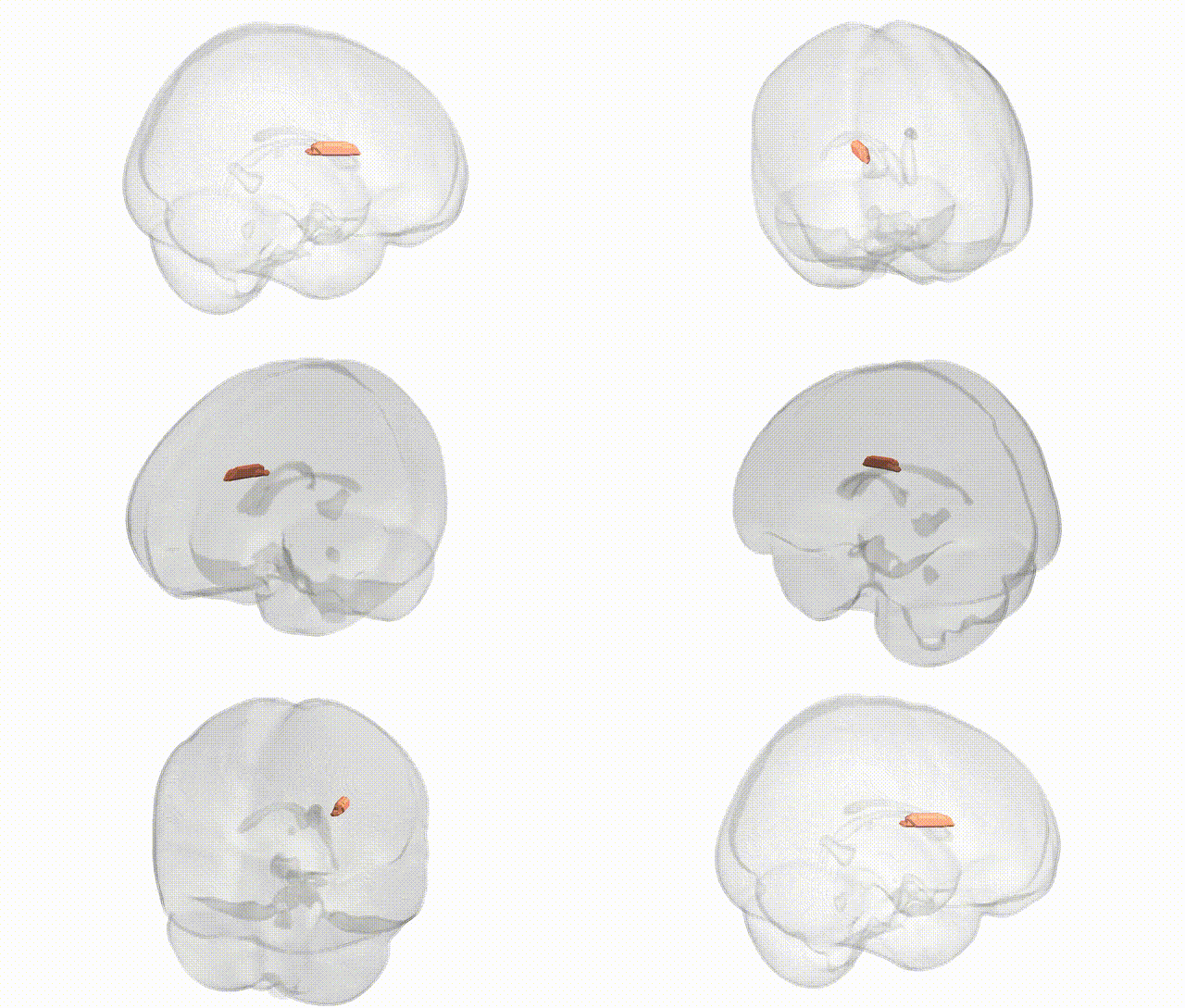
Full Quality Version: Download MP4
Wali Sidiqyar*, Gaurav Rudravaram*, Elyssa M. McMaster, Trent M. Schwartz, Adam M. Saunders, Kurt G. Schilling, Bennett A. Landman "Introducing SPINS: A Shared Public Visualization Library of Neuroanatomical Structures." Medical Imaging with Deep Learning- short paper
This resource is licensed under CC0 1.0 Universal (Public Domain).