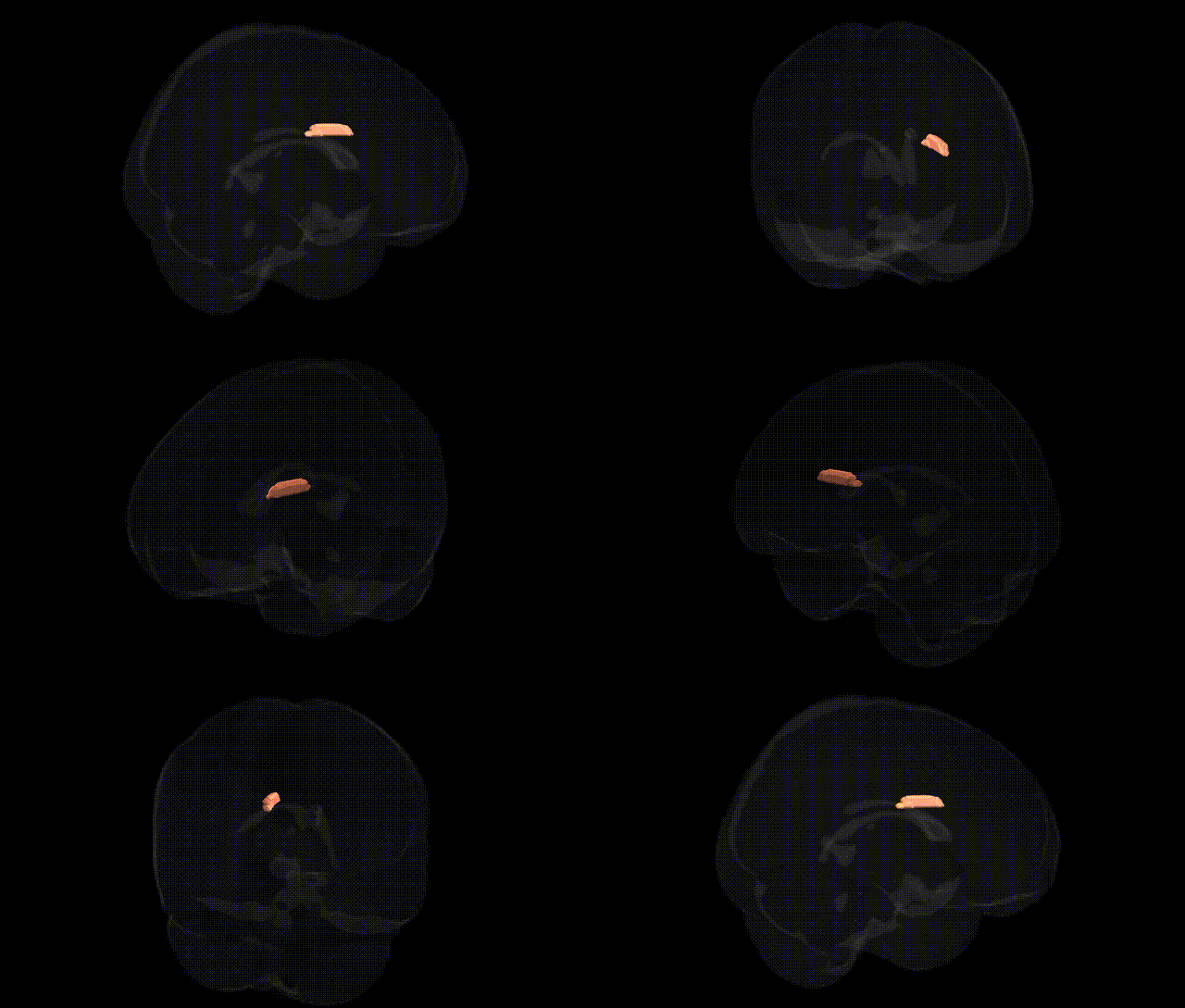
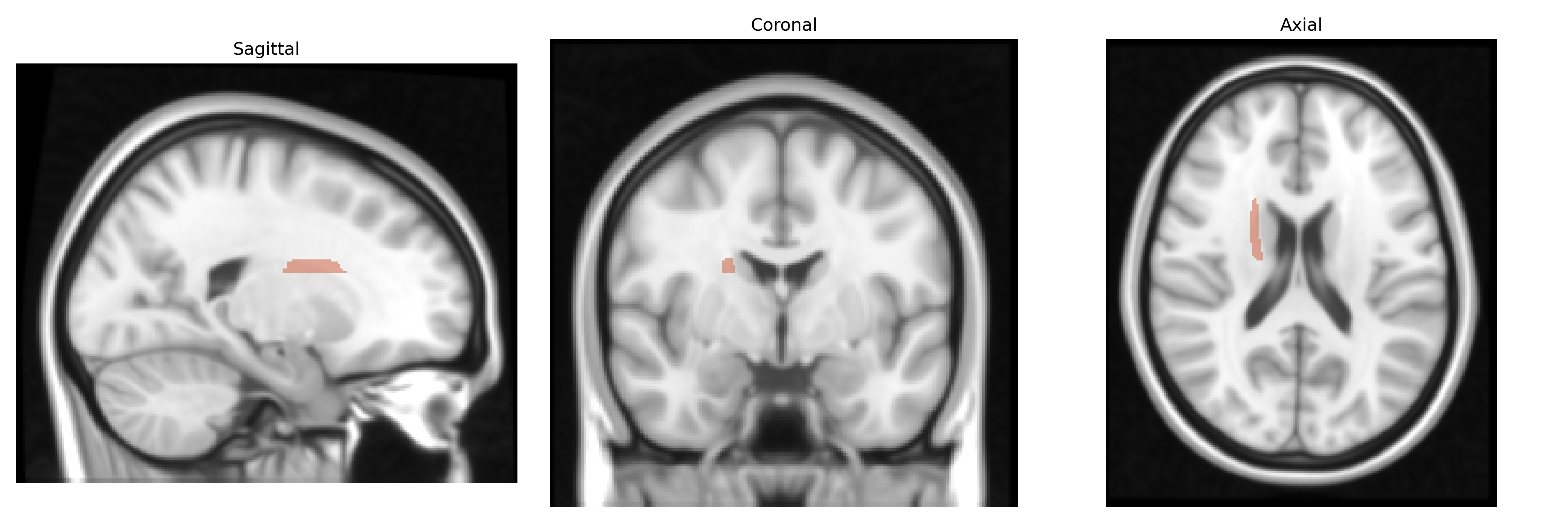
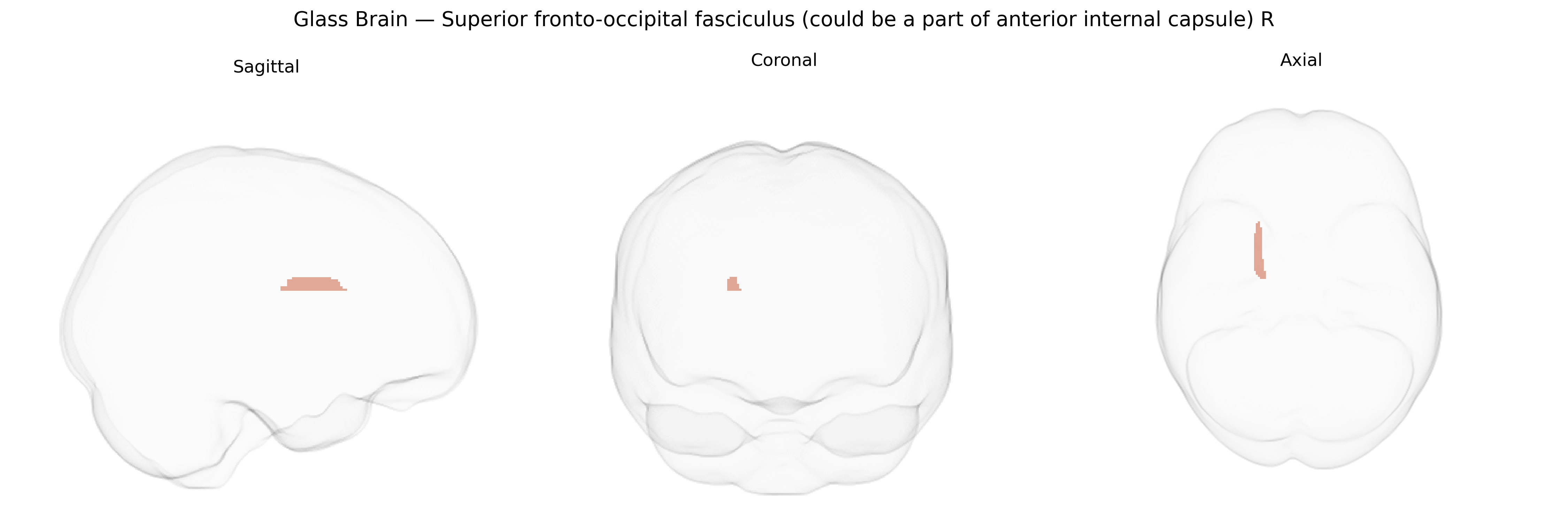
The bilateral Superior fronto-occipital fasciculus (could be a part of anterior internal capsule) R, as defined in the JHU ICBM labels 1 mm atlas, is a major associative white matter tract coursing longitudinally within the deep cerebral hemispheres and linking frontal regions with posterior parietal–occipital areas. Its fibers often traverse or lie adjacent to the anterior limb of the internal capsule, contributing to large-scale cortico-cortical communication pathways involved in higher-order cognitive functions such as visuospatial processing, attention, and executive integration. Anatomically, this fasciculus runs superior to the insula and lateral ventricles, forming part of the superior longitudinal fiber system that integrates multimodal information across distant cortical territories. There is no direct Wikipedia article for this tract; a closely related and encompassing structure is the Internal capsule.
The bilateral superior fronto-occipital fasciculus (SFOF), often overlapping with anterior internal capsule regions in the JHU ICBM 1 mm atlas, has been implicated in multiple genetic studies that link white matter microstructure to neuropsychiatric and cognitive traits. Twin and family-based heritability work and large diffusion MRI GWAS (such as ENIGMA and UK Biobank analyses) have shown that fractional anisotropy and other diffusion metrics in fronto-occipital and anterior internal capsule tracts are strongly heritable and associated with variants in genes involved in axon guidance, myelination, and neural development, including loci near or within genes such as BCAN, DCC, CNTN4/5, and various oligodendrocyte-related genes. Polygenic scores for schizophrenia, bipolar disorder, major depression, ADHD, and autism have been associated with altered integrity in fronto-occipital and internal capsule pathways, suggesting a genetically mediated vulnerability of this network to psychopathology. GWAS have also linked white matter properties in these tracts to general cognitive ability, educational attainment, and processing speed, as well as to risk factors such as blood pressure and small-vessel disease that influence deep white matter integrity. Moreover, rare variant and CNV studies in neurodevelopmental disorders and intellectual disability often show disrupted genes that broadly affect long-range association fibers, including the SFOF, although these findings are typically reported at the level of tract classes rather than specific atlas-defined labels. Overall, genetic evidence supports a substantial heritable component to structural variation in the superior fronto-occipital/anterior internal capsule region, with converging associations to cognition, neuropsychiatric disorders, and vascular risk traits.
Overview generated by GPT-4o (2026).
Region ID: 43
Hemisphere: bilateral
Atlas: JHU ICBM labels 1mm
Full Quality Version: Download MP4
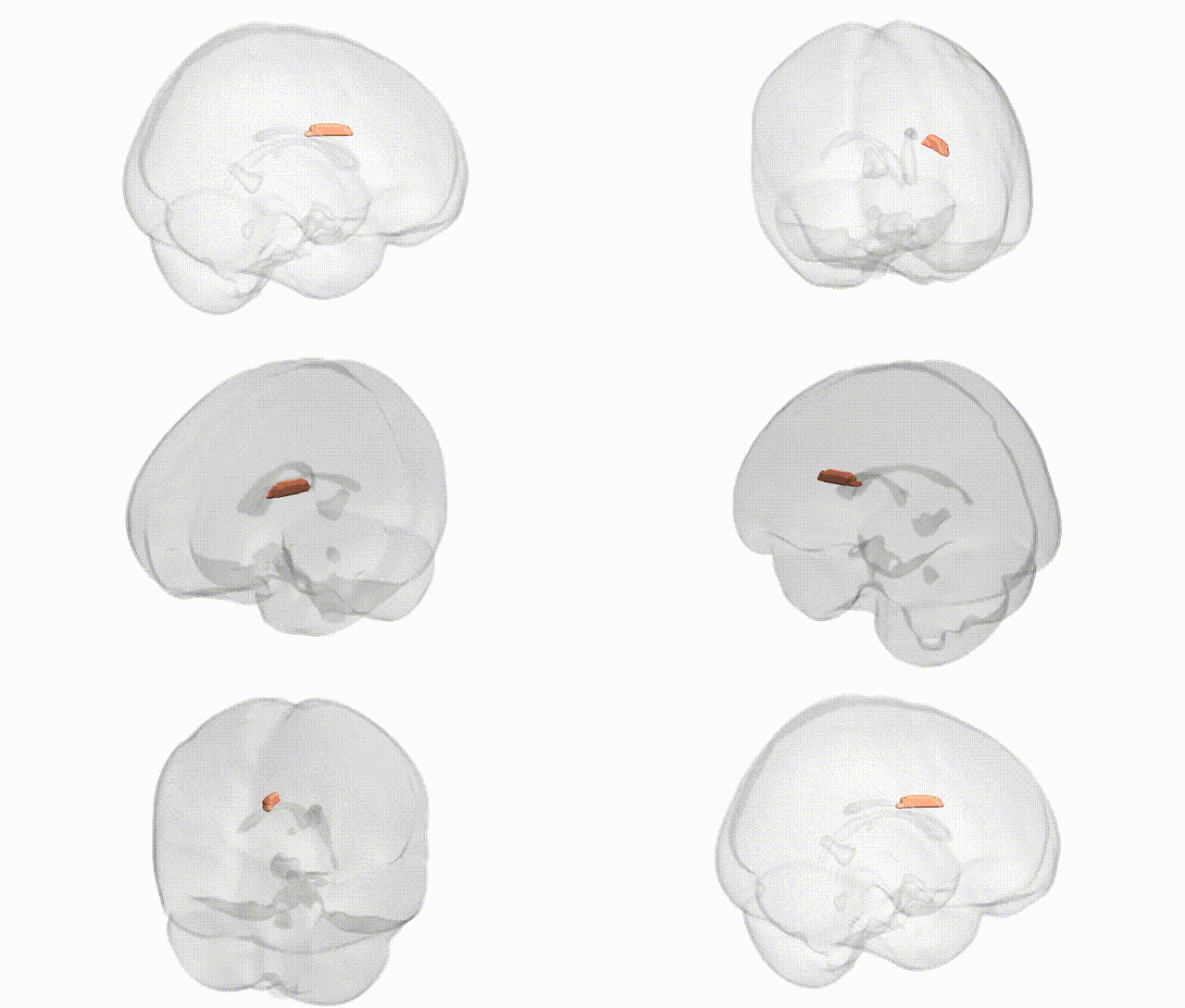
Full Quality Version: Download MP4
Wali Sidiqyar*, Gaurav Rudravaram*, Elyssa M. McMaster, Trent M. Schwartz, Adam M. Saunders, Kurt G. Schilling, Bennett A. Landman "Introducing SPINS: A Shared Public Visualization Library of Neuroanatomical Structures." Medical Imaging with Deep Learning- short paper
This resource is licensed under CC0 1.0 Universal (Public Domain).