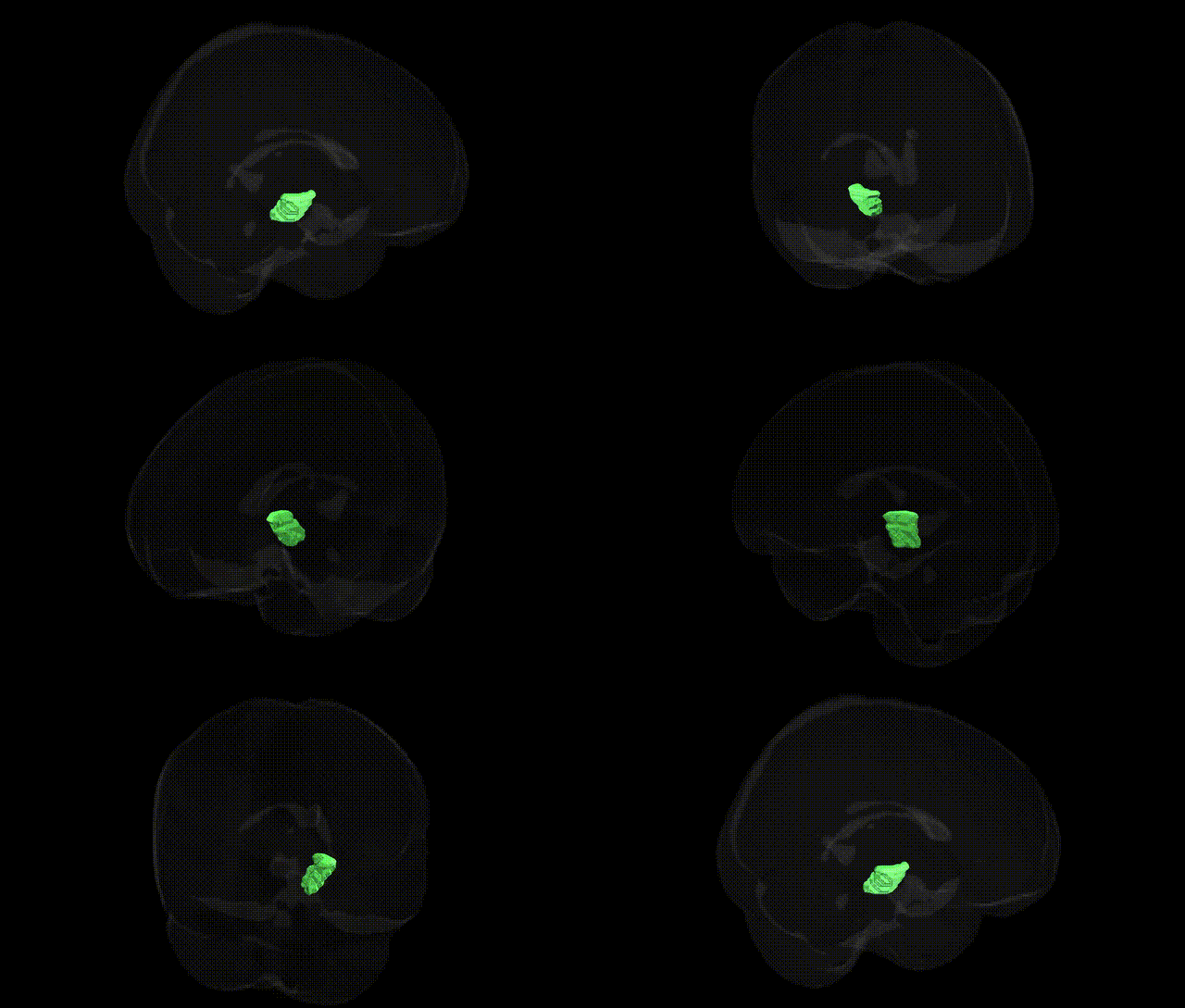
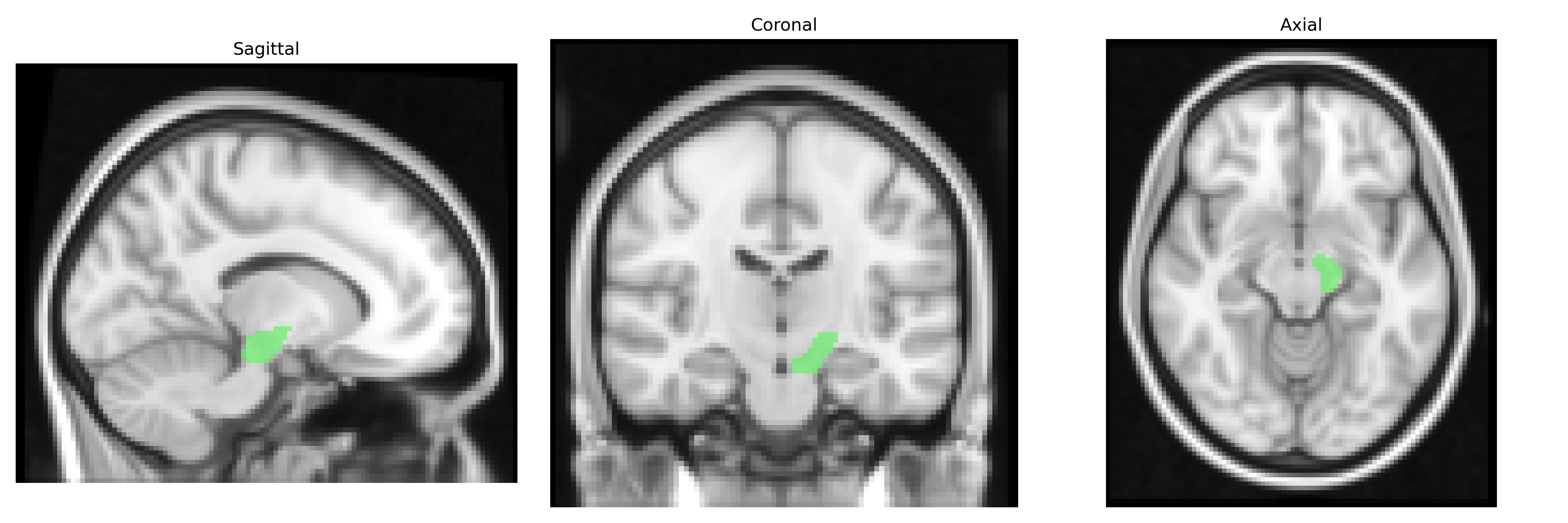
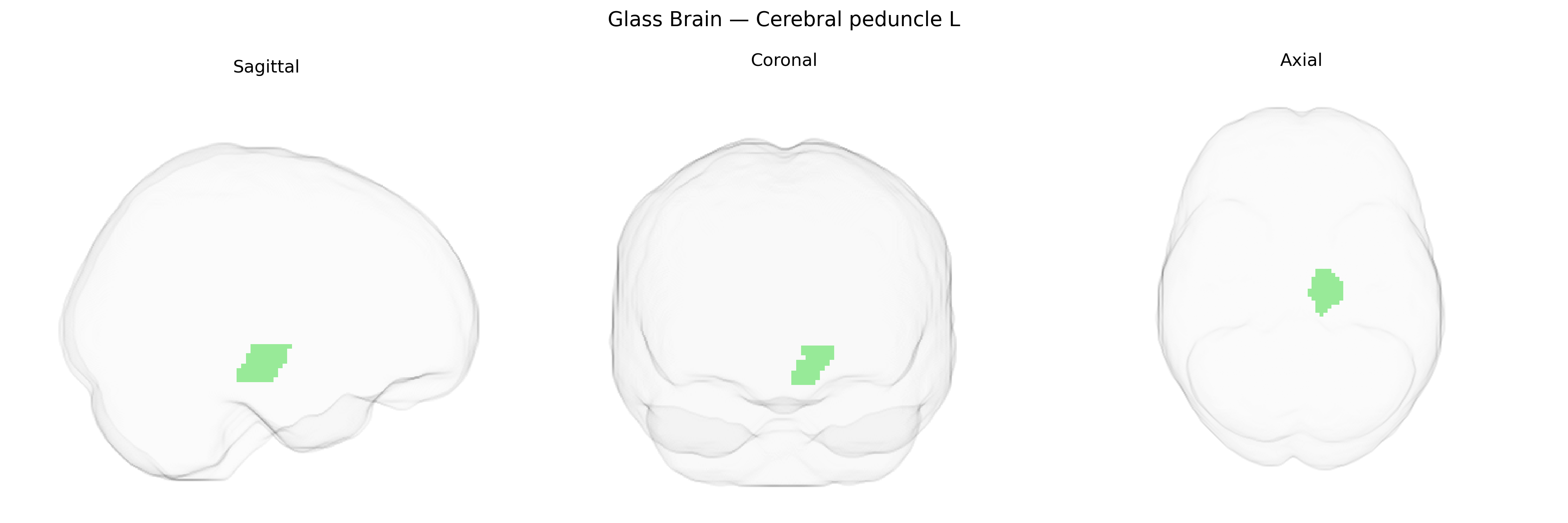
The bilateral cerebral peduncle (left) is a major white matter conduit in the midbrain that carries descending motor and associative fibers from the cerebral cortex to the brainstem and spinal cord. It consists primarily of the corticospinal, corticobulbar, and corticopontine tracts, which are topographically organized within the crus cerebri and continuous rostrally with the internal capsule and caudally with the basis pontis. Functionally, the cerebral peduncle is critical for voluntary motor control, modulation of muscle tone, and integration of cortical signals with subcortical motor circuits, and lesions in this region can result in contralateral motor deficits, including weakness and spasticity. Although there is no dedicated Wikipedia article for the “cerebral peduncle” as a whole, it is closely related to the Crus cerebri.
The bilateral cerebral peduncle (L) region in the JHU ICBM 2 mm atlas, comprising major descending motor pathways including corticospinal and corticobulbar tracts, has been implicated in genetic studies largely through white-matter integrity and neuroimaging GWAS rather than region-specific candidate-gene work. Diffusion tensor imaging GWAS have identified polygenic influences on fractional anisotropy and mean diffusivity in cerebral peduncles, with common variants in genes related to axon guidance, myelination, and oligodendrocyte function (e.g., loci near CNTN4, MAG, and myelin-related genes) contributing to interindividual variability in microstructure. In large consortia such as ENIGMA, cerebral peduncle measures have shown heritability and association with polygenic risk scores for schizophrenia and major depressive disorder, reflecting broader genetic vulnerability to psychiatric disease that affects fronto-striatal-thalamic and motor circuitry. Neurodegenerative and movement disorders with known genetic causes—such as spinocerebellar ataxias, hereditary spastic paraplegias, and certain leukodystrophies—often show structural or diffusion abnormalities in the cerebral peduncles, and GWAS or exome studies of these conditions highlight variants in genes regulating axonal transport and myelin stability that indirectly implicate this region. Additionally, neuroimaging genetics work on motor skill, general cognitive ability, and gait has reported associations between polygenic scores for education or intelligence and microstructural measures in motor tracts traversing the cerebral peduncles, suggesting that genetic influences on brain development and connectivity partly manifest in this atlas-defined region, albeit as part of distributed networks rather than in isolation.
Overview generated by GPT-4o (2026).
Region ID: 16
Hemisphere: bilateral
Atlas: JHU ICBM labels 2mm
Full Quality Version: Download MP4
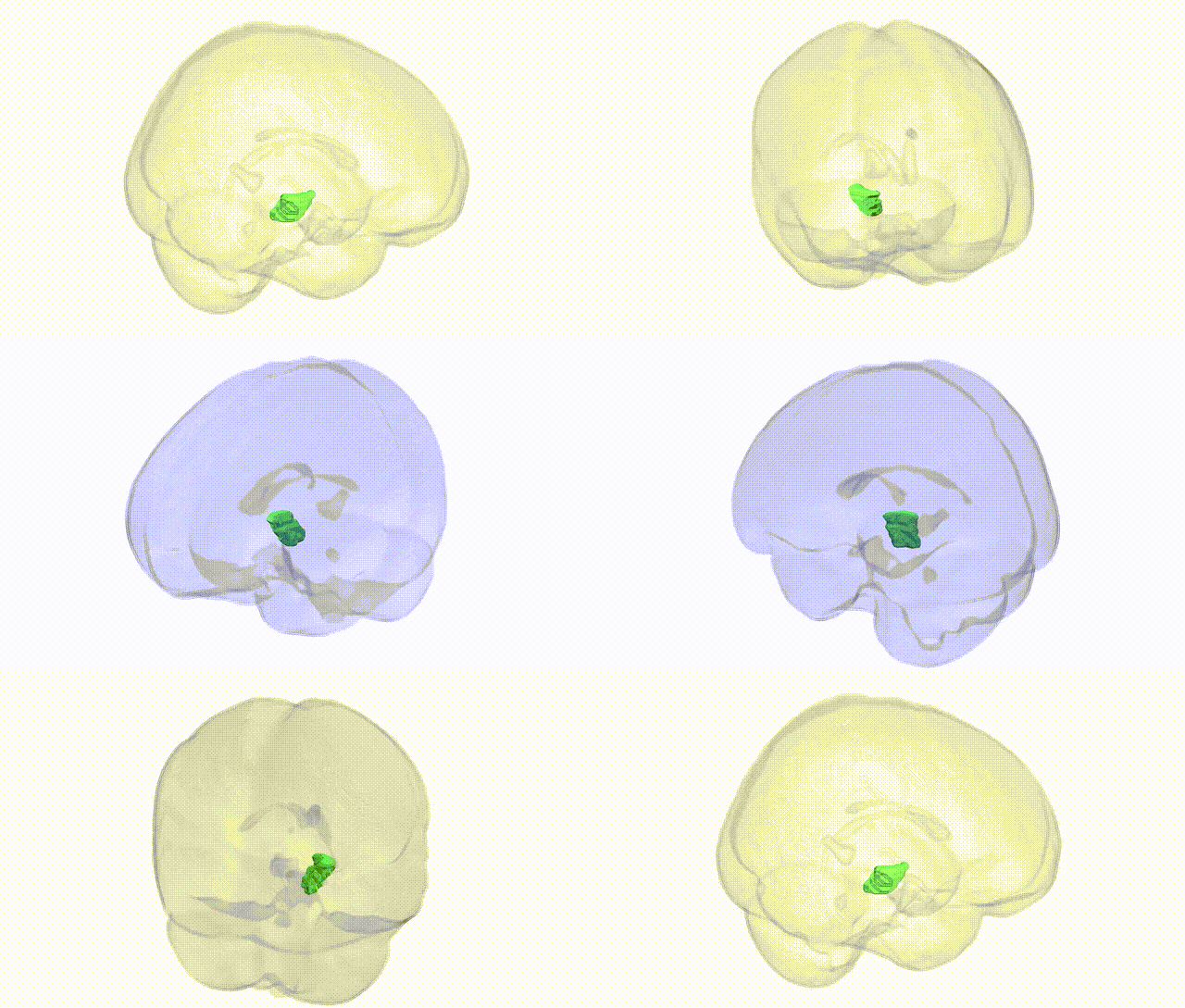
Full Quality Version: Download MP4
Wali Sidiqyar*, Gaurav Rudravaram*, Elyssa M. McMaster, Trent M. Schwartz, Adam M. Saunders, Kurt G. Schilling, Bennett A. Landman "Introducing SPINS: A Shared Public Visualization Library of Neuroanatomical Structures." Medical Imaging with Deep Learning- short paper
This resource is licensed under CC0 1.0 Universal (Public Domain).