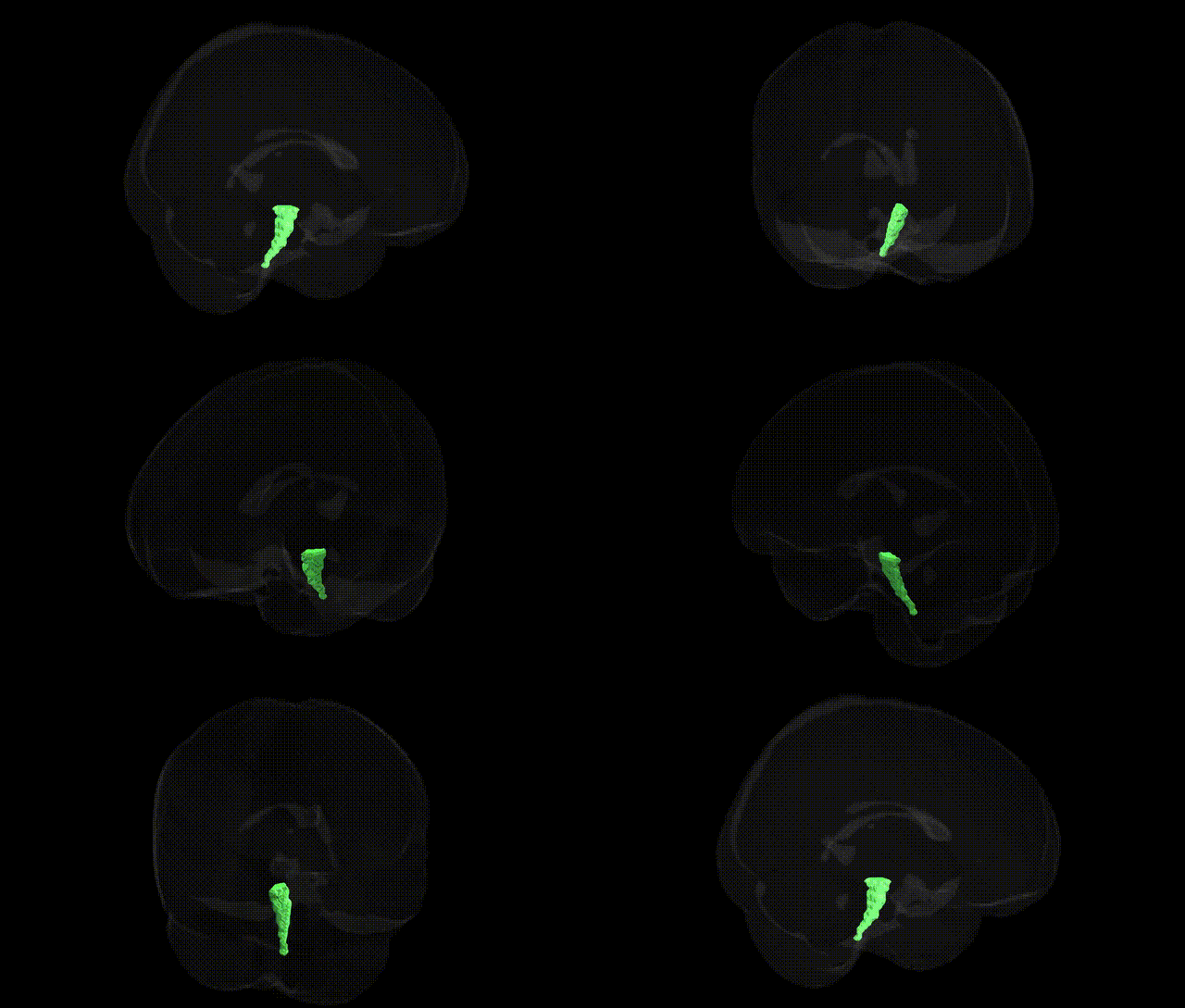
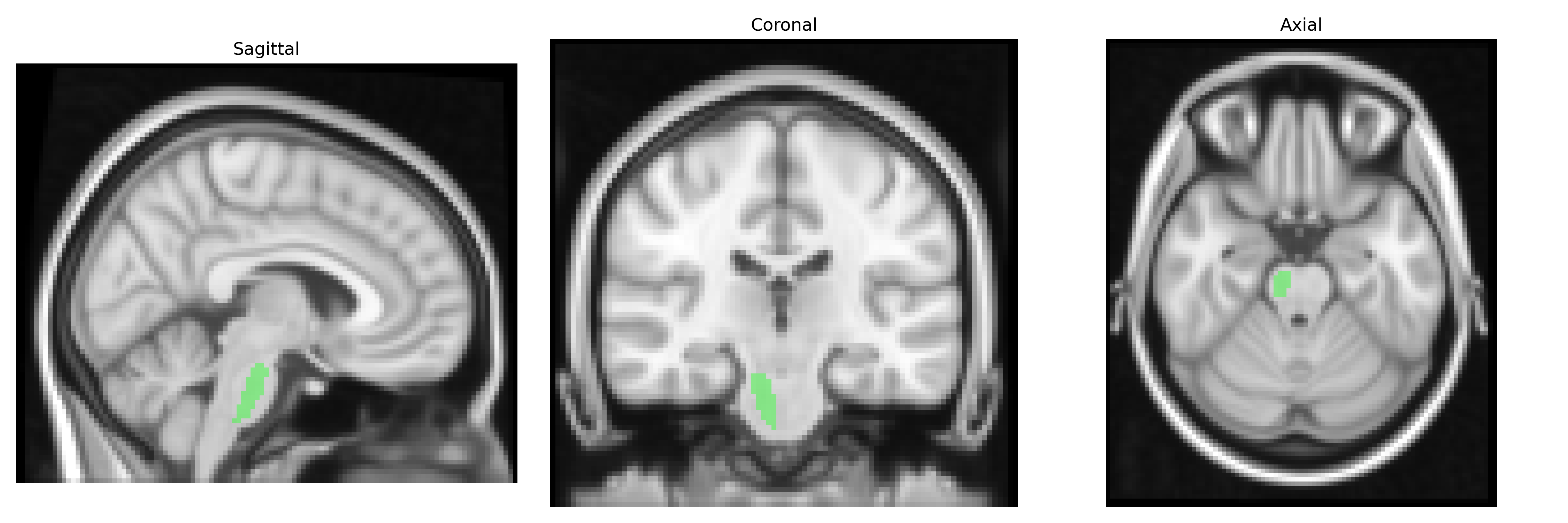
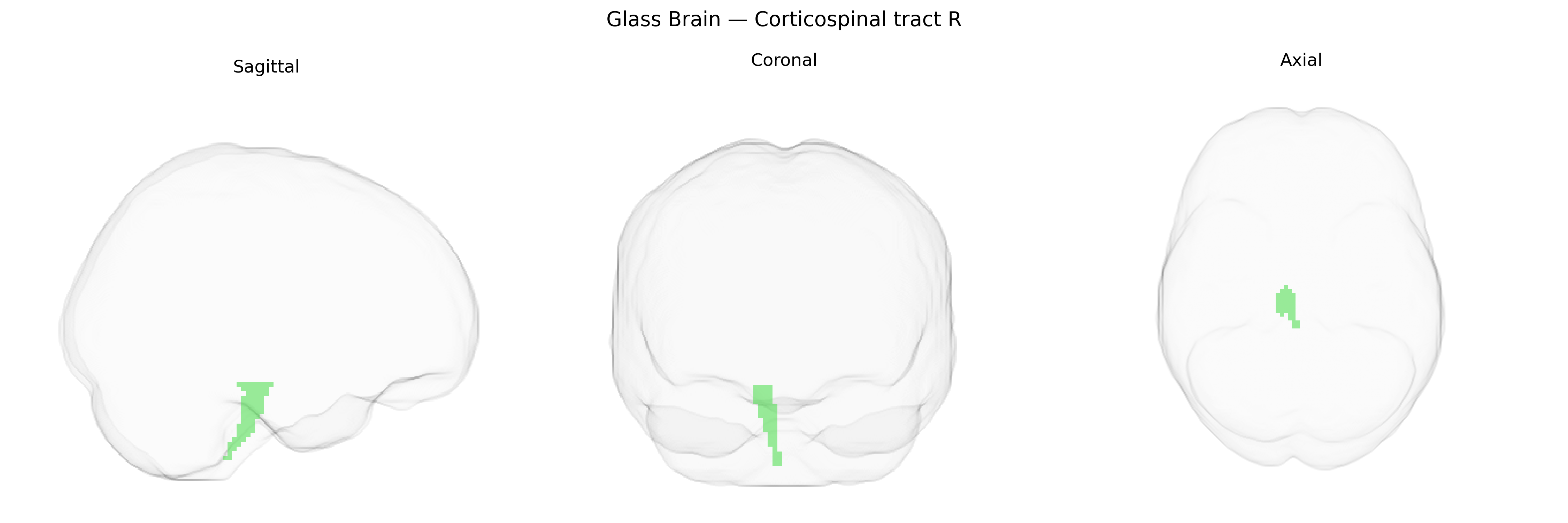
The bilateral corticospinal tract is a major descending white matter pathway that originates primarily from pyramidal neurons in layer V of the primary motor cortex, premotor cortex, and supplementary motor areas, then descends through the corona radiata, posterior limb of the internal capsule, cerebral peduncles, ventral pons, and medullary pyramids before undergoing partial decussation at the pyramidal decussation to form the lateral and anterior corticospinal tracts in the spinal cord. It carries motor commands essential for voluntary, especially fine and distal, movements of the limbs and trunk, with somatotopic organization that preserves a structured mapping of the body from cortex to spinal cord. In the JHU ICBM 2mm atlas, the “bilateral corticospinal tract R” label refers to the right-sided component of this bilateral projection system, segmented as a coherent right-hemisphere white matter bundle. There is no direct Wikipedia article for this exact atlas label; a closely related structure is the Corticospinal tract.
The bilateral corticospinal tract (CST) in the JHU ICBM 2 mm atlas, encompassing major descending motor pathways including the right-sided component, has been implicated in several genetic studies that link white matter microstructure to neurodevelopmental, neurodegenerative, and psychiatric traits. GWAS of diffusion tensor imaging (DTI) metrics (e.g., fractional anisotropy, mean diffusivity) in cohorts such as UK Biobank have identified common variants influencing CST integrity, notably in genes related to axon guidance, myelination, and cytoskeletal organization (including loci near CNTN4, NRG1, and MAG), though specific CST-focused hits often emerge as part of broader white matter factor structures. Variants in genes such as APOE, MAPT, and others associated with neurodegeneration have been associated with CST microstructural changes in conditions like amyotrophic lateral sclerosis, multiple sclerosis, and stroke, where CST damage mediates motor impairment. Polygenic risk for schizophrenia, bipolar disorder, and major depression has shown associations with altered white matter in motor tracts including CST, although these effects are generally modest and not highly tract-specific. Rare variant and candidate gene studies in hereditary spastic paraplegia, primary lateral sclerosis, and other motor neuron disorders highlight mutations in genes such as SPAST, ATL1, and KIF5A that lead to selective CST degeneration and thinning. Overall, genetic influences on the bilateral CST R region are best characterized through imaging-genetics frameworks showing that CST microstructure is heritable and shaped by polygenic architectures shared with broader brain development, motor function, and vulnerability to neurodegenerative and psychiatric disease, rather than by a single, uniquely CST-specific locus.
Overview generated by GPT-4o (2026).
Region ID: 7
Hemisphere: bilateral
Atlas: JHU ICBM labels 2mm
Full Quality Version: Download MP4
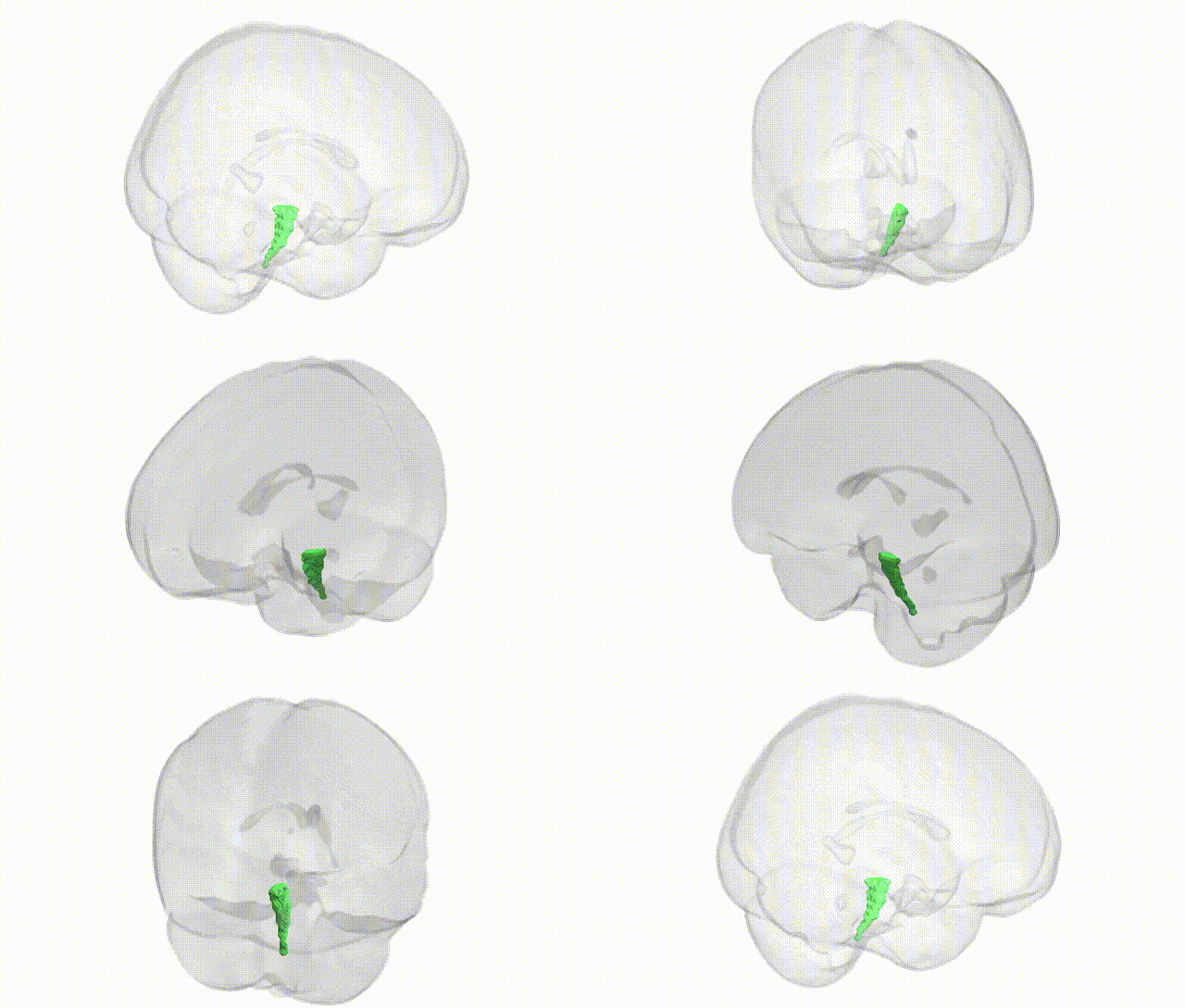
Full Quality Version: Download MP4
Wali Sidiqyar*, Gaurav Rudravaram*, Elyssa M. McMaster, Trent M. Schwartz, Adam M. Saunders, Kurt G. Schilling, Bennett A. Landman "Introducing SPINS: A Shared Public Visualization Library of Neuroanatomical Structures." Medical Imaging with Deep Learning- short paper
This resource is licensed under CC0 1.0 Universal (Public Domain).