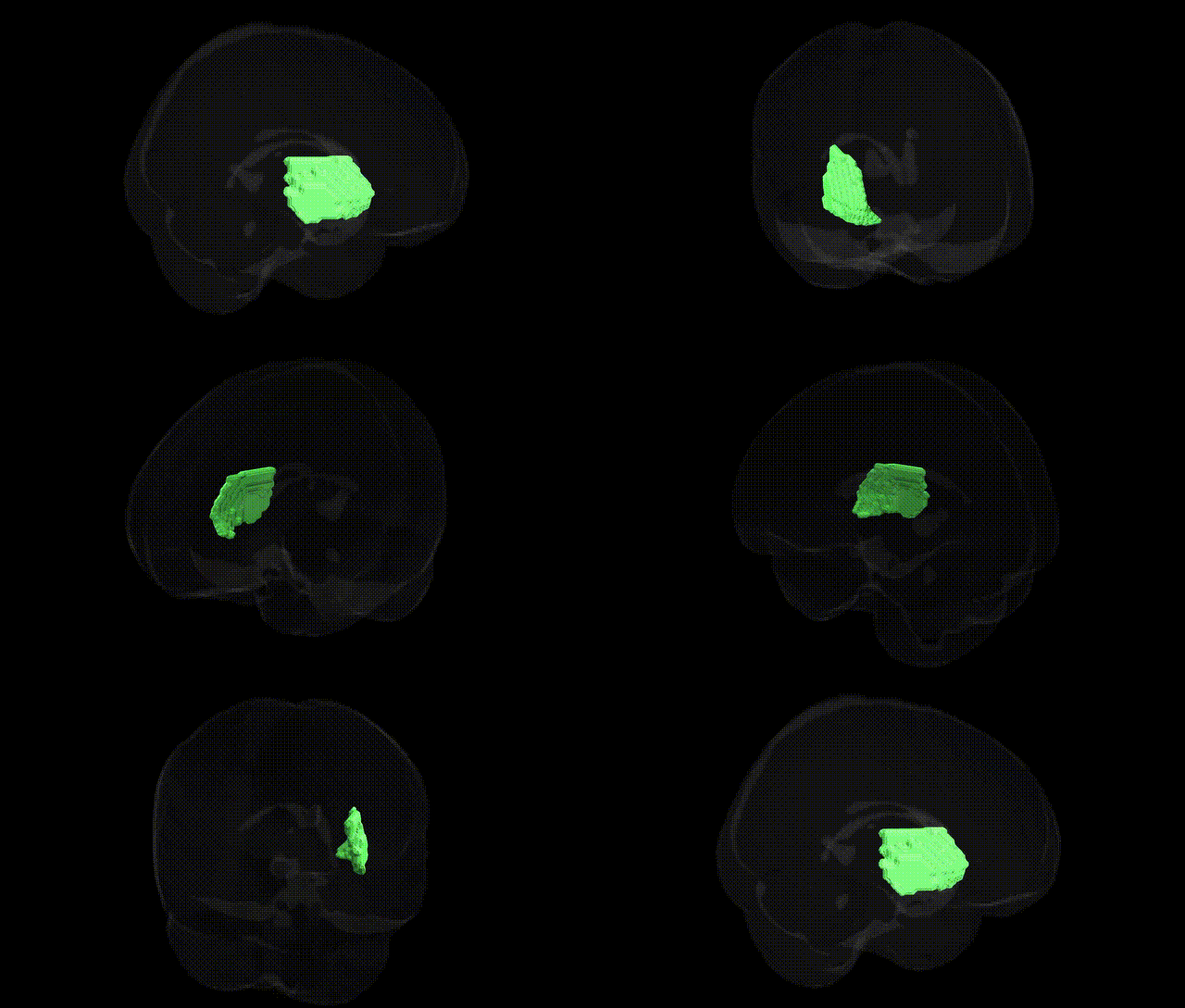
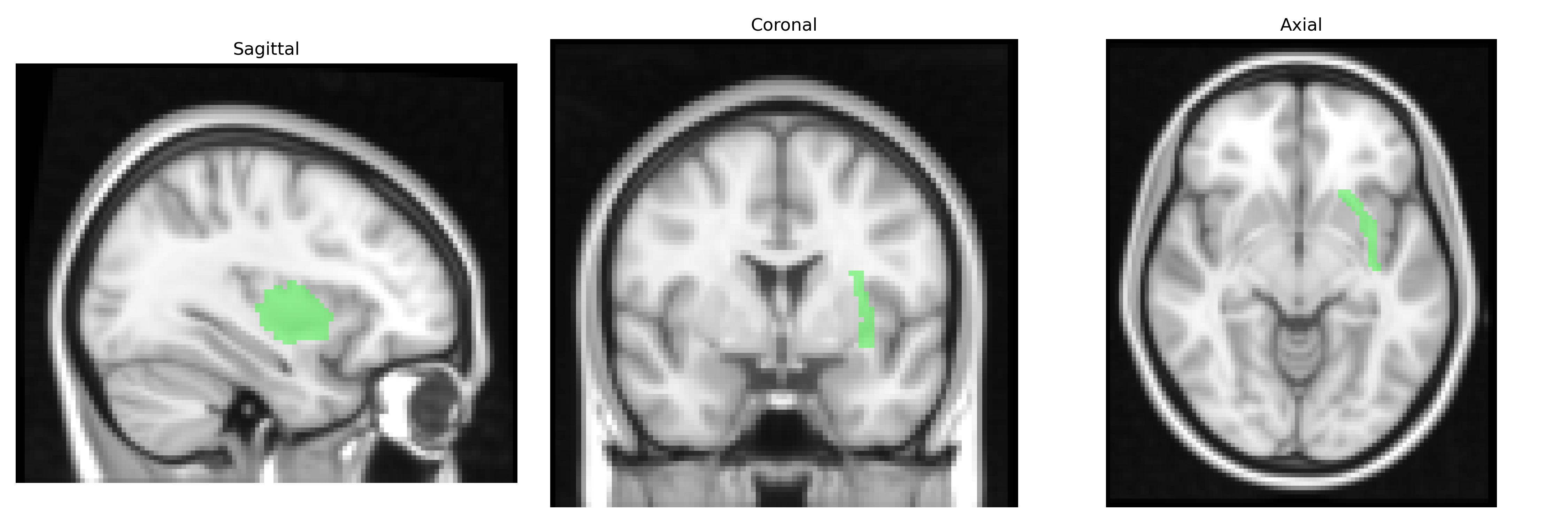
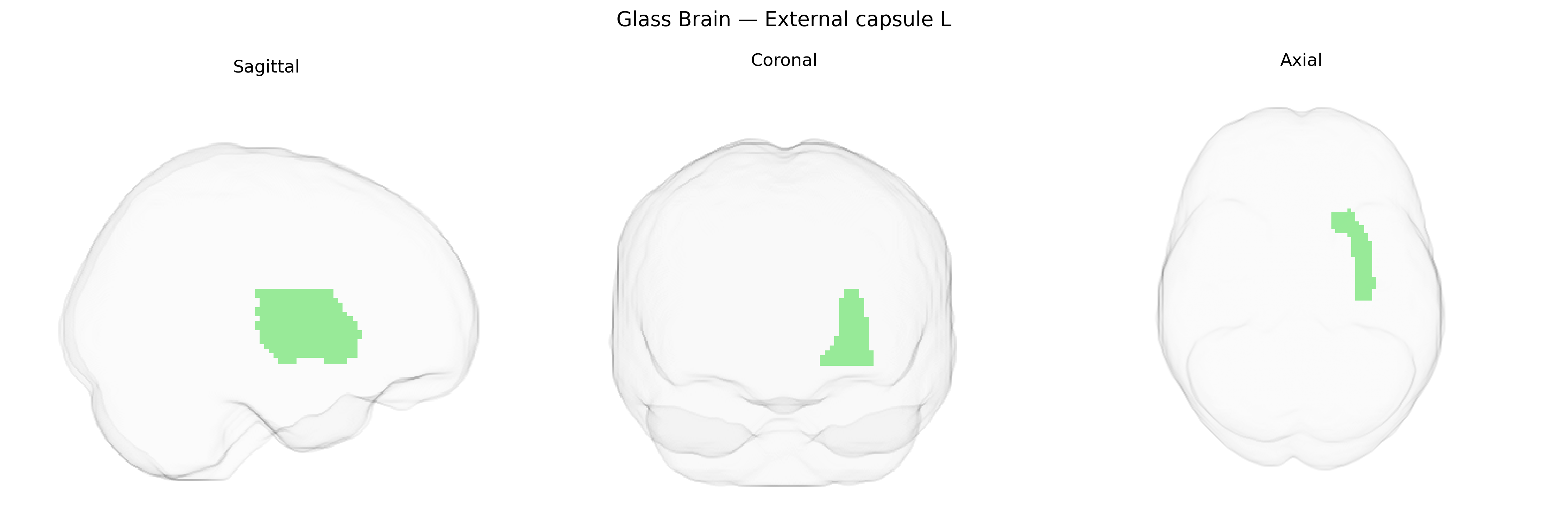
The bilateral External capsule L, as defined in the JHU ICBM 2 mm atlas, corresponds to the left external capsule, a sheet of white matter fibers situated between the putamen (laterally) and the claustrum (medially). It contains association fibers, notably cholinergic projections and corticocortical connections, that link regions of the cerebral cortex, including frontal, temporal, and parietal areas, and participates in networks underlying language, attention, and higher-order cognitive functions. The external capsule is part of the broader subcortical white matter system that includes the internal capsule and extreme capsule; together, these fiber tracts support communication between cortical regions and between cortex and subcortical nuclei. There is no direct link for the “external capsule of the brain” as a standalone article; a related structure and context can be found under the Internal capsule.
The bilateral external capsule, as defined in the JHU ICBM 2 mm atlas, has been implicated primarily through diffusion MRI–based GWAS and imaging–genetics studies that examine white matter microstructure (e.g., fractional anisotropy, mean diffusivity) as quantitative traits. Variants in genes involved in axon guidance, myelination, and oligodendrocyte function—such as those related to neuregulin/ErbB signaling, cell-adhesion molecules, and cytoskeletal organization—have shown associations with external capsule integrity, often as part of broader “global” or association-fiber white matter factors. Large consortia (e.g., ENIGMA, UK Biobank–based GWAS) report polygenic influences on external capsule metrics rather than single strong loci, with some overlap in genetic architecture shared with neurodevelopmental and psychiatric conditions including schizophrenia, major depressive disorder, and bipolar disorder, as well as general cognitive ability and educational attainment, suggesting that common variants affecting brain-wide white matter organization also modulate external capsule structure. However, region-specific associations uniquely and robustly tied to the external capsule L (or bilateral external capsule) remain limited, and current findings largely reflect distributed genetic effects on white matter networks rather than a distinct, well-characterized set of risk loci for this tract alone.
Overview generated by GPT-4o (2026).
Region ID: 34
Hemisphere: bilateral
Atlas: JHU ICBM labels 2mm
Full Quality Version: Download MP4
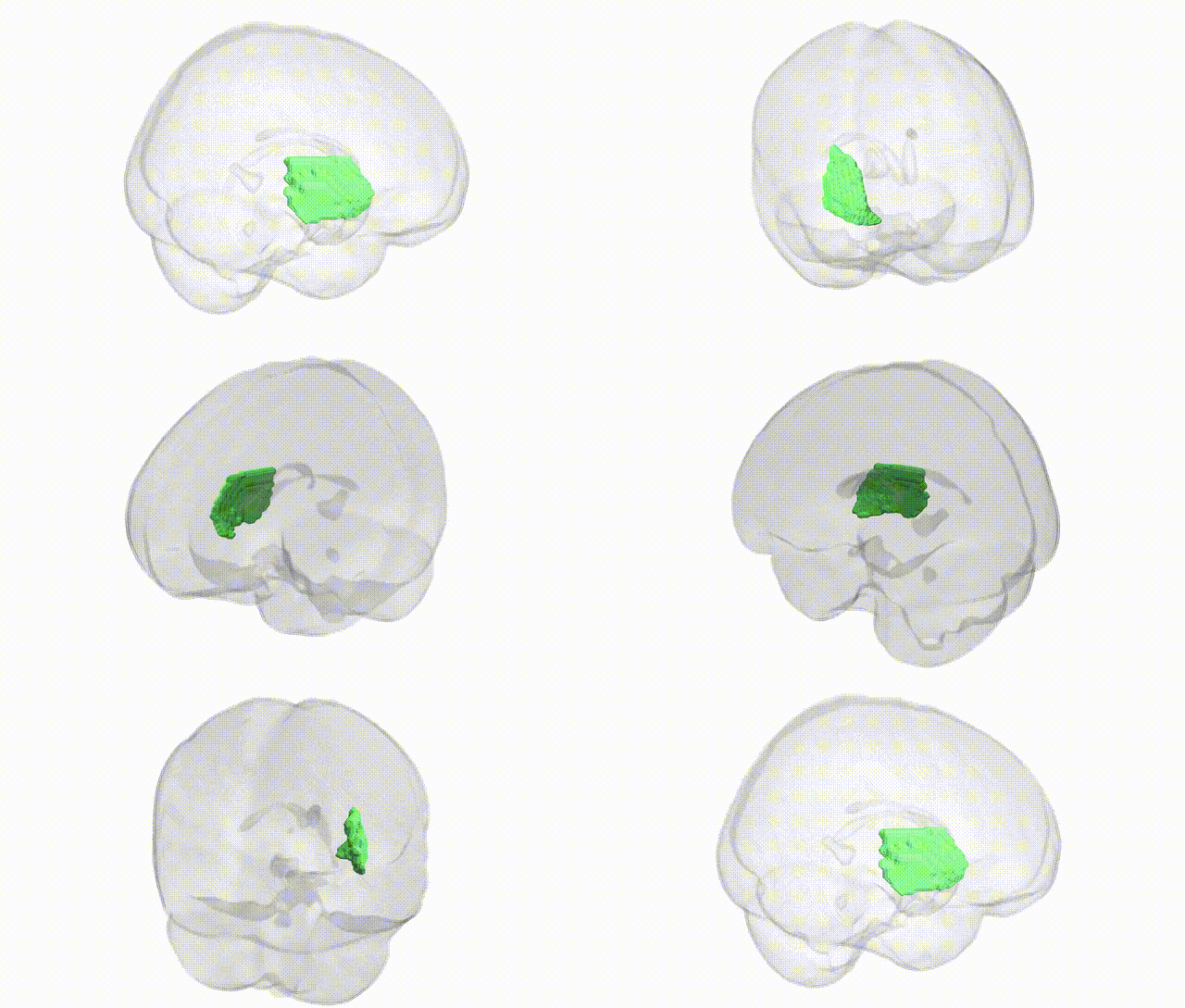
Full Quality Version: Download MP4
Wali Sidiqyar*, Gaurav Rudravaram*, Elyssa M. McMaster, Trent M. Schwartz, Adam M. Saunders, Kurt G. Schilling, Bennett A. Landman "Introducing SPINS: A Shared Public Visualization Library of Neuroanatomical Structures." Medical Imaging with Deep Learning- short paper
This resource is licensed under CC0 1.0 Universal (Public Domain).