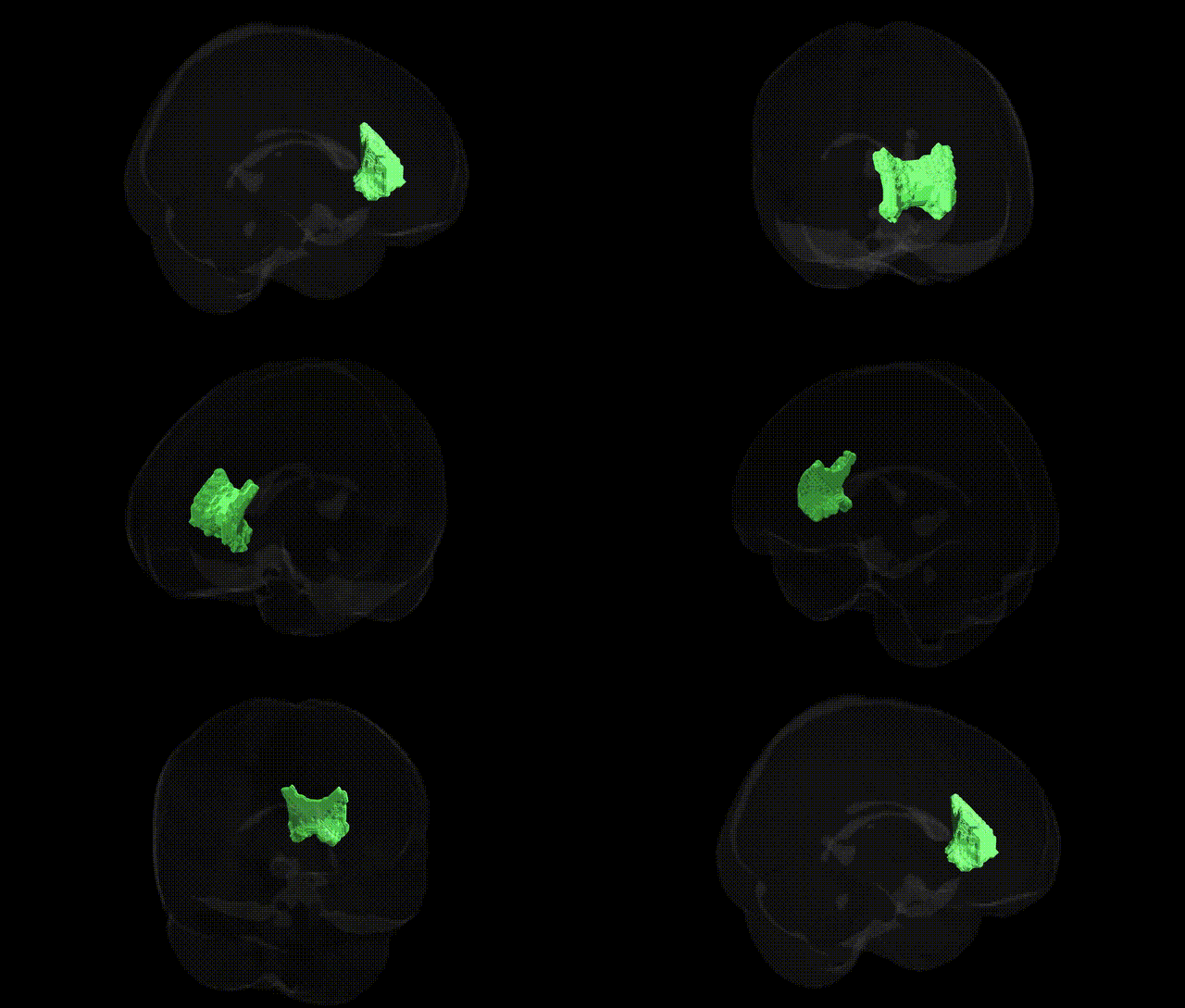
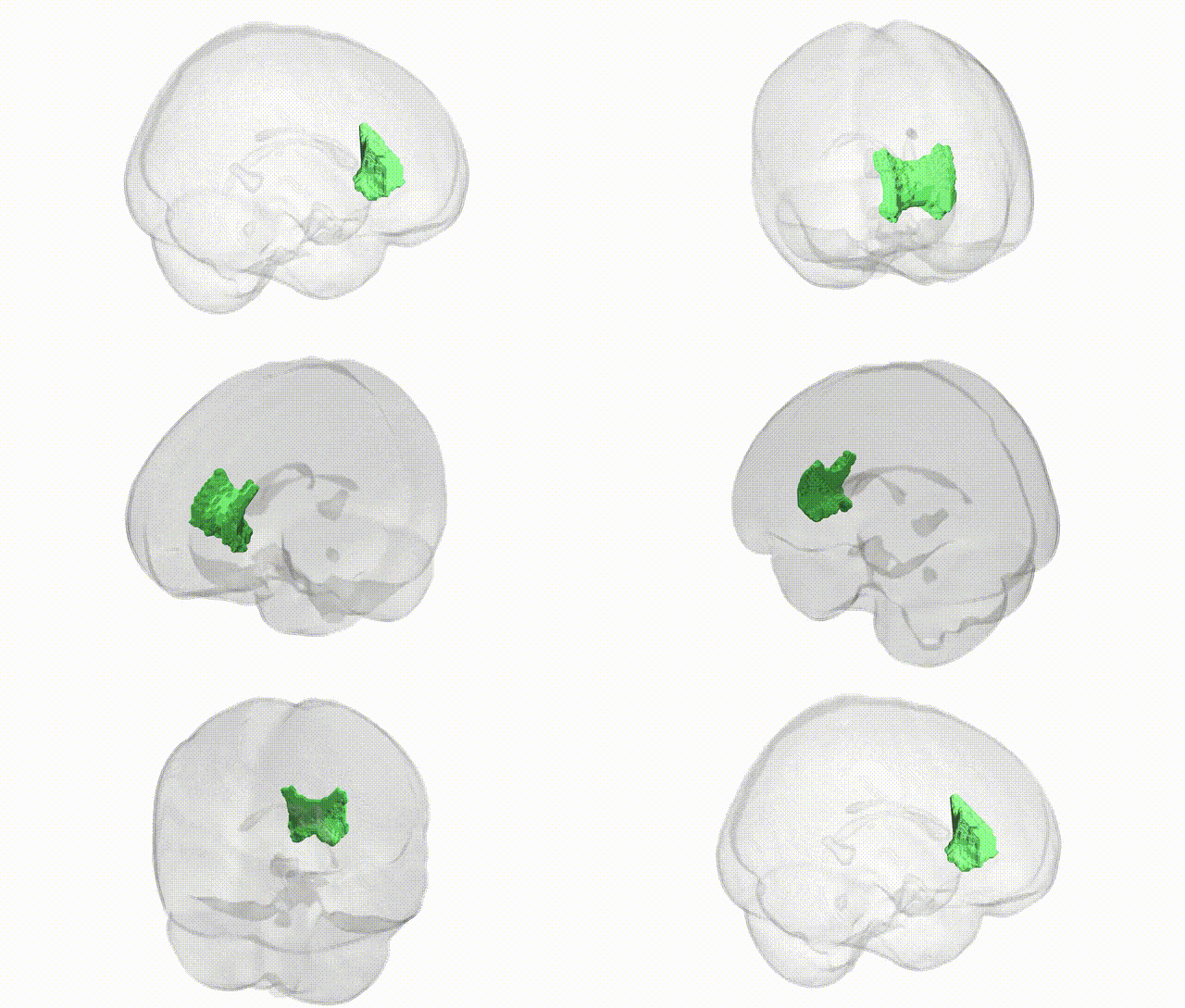
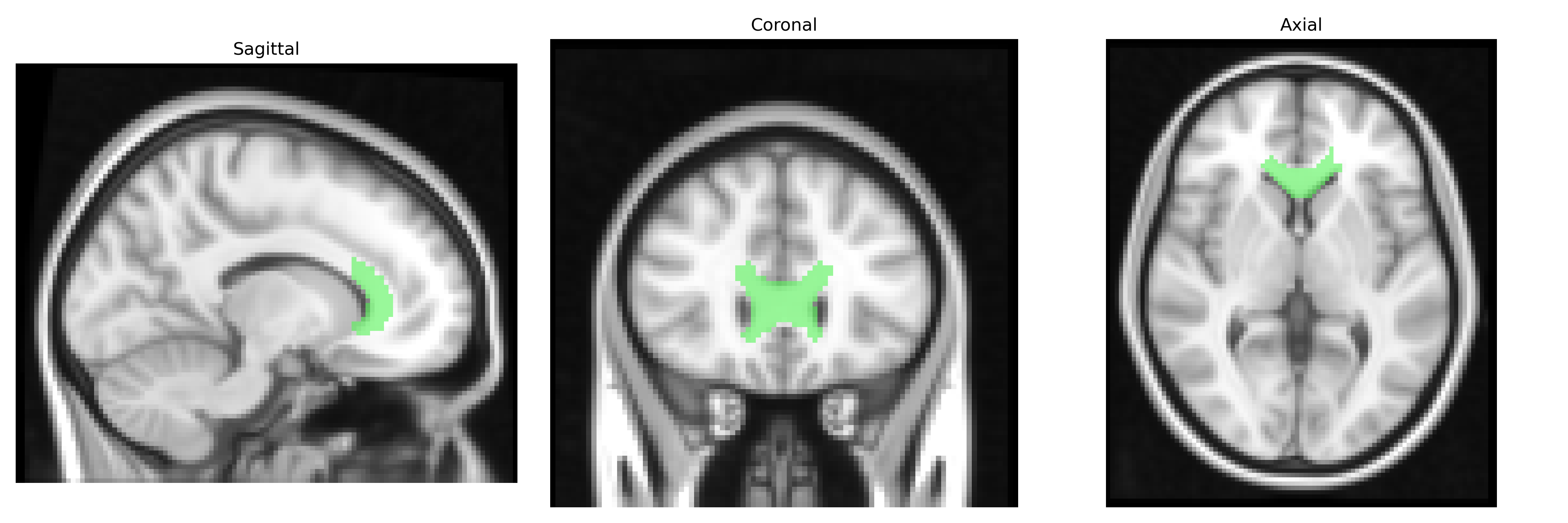
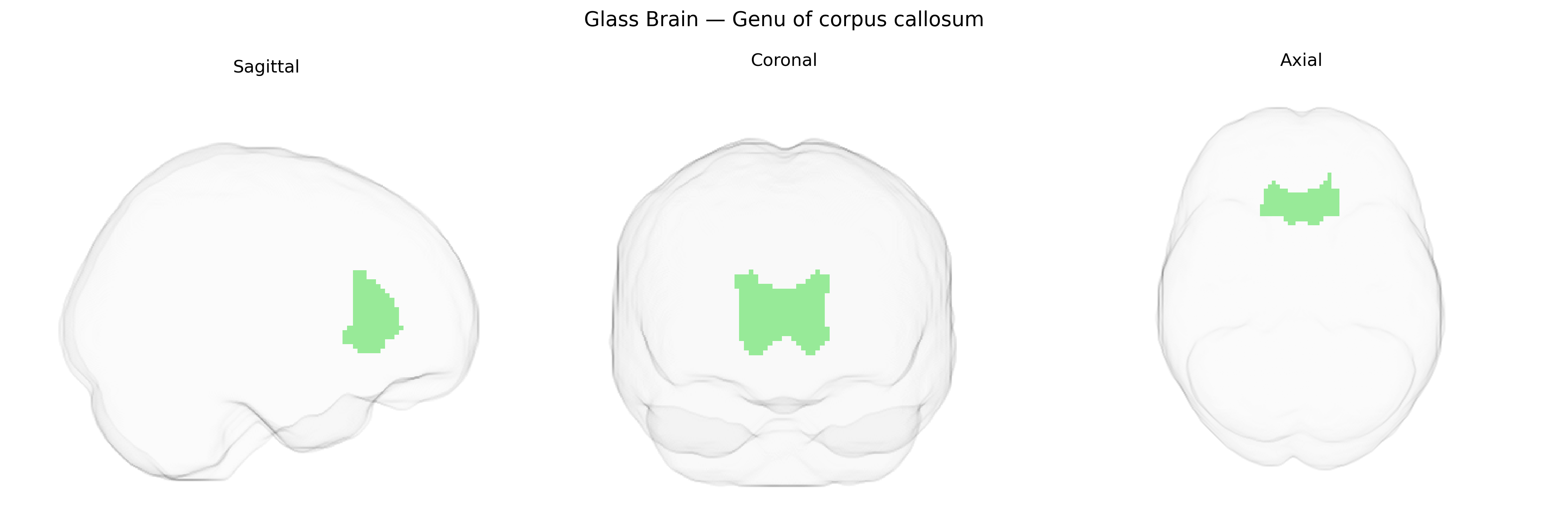
The bilateral genu of the corpus callosum is the anterior portion of the corpus callosum, a major white matter commissural tract that interconnects homologous regions of the frontal lobes across the two cerebral hemispheres. Composed predominantly of heavily myelinated axons, the genu facilitates rapid interhemispheric transfer of information involved in higher-order cognitive processes, including executive function, attention, working memory, and aspects of emotional regulation. Its fibers curve anteriorly and then laterally to enter the frontal white matter, forming an essential pathway for integration of frontal cortical activity and coordination of complex behaviors. In the JHU ICBM labels 2mm Atlas, the bilateral genu is delineated as a discrete white matter region enabling quantitative analysis of structural connectivity and integrity in neuroimaging studies. There is no direct Wikipedia article for the “Genu of corpus callosum” label in this atlas; a closely related structure entry is Corpus callosum.
Genetic associations involving the bilateral genu of the corpus callosum, as defined in the JHU ICBM labels 2 mm atlas, largely derive from imaging-genetics and GWAS of callosal microstructure (often via diffusion MRI metrics such as fractional anisotropy and mean diffusivity) and from disorder-focused studies implicating this region’s integrity. Several large-scale GWAS and ENIGMA-based imaging-genetics consortia have reported heritable variation in callosal measures, with loci in or near genes such as CNTNAP2, ROBO1/ROBO2, NTRK1/2, and other axon guidance, myelination, and neuronal adhesion genes associated with white matter integrity across midline tracts that include the genu; however, associations specifically and exclusively mapped to the bilateral genu are less consistently replicated. Genetic variants linked to neurodevelopmental and psychiatric conditions—such as schizophrenia, autism spectrum disorder, attention-deficit/hyperactivity disorder, and bipolar disorder—have been associated with altered genu morphology or microstructure, often in the context of broader callosal or frontal white matter abnormalities, and polygenic risk scores for these disorders sometimes correlate with genu measures in imaging cohorts. Additionally, genes involved in oligodendrocyte function and myelin (e.g., variants in MBP-related pathways, ERBB/NRG signaling, and general white matter GWAS hits) have been tied to callosal integrity, with the genu frequently highlighted because of its high vulnerability to developmental and degenerative processes. Overall, while numerous genetic loci modulate corpus callosum structure and related disorders, the literature typically implicates the genu as part of larger callosal or frontal white-matter networks rather than as a uniquely and independently mapped genetic target.
Overview generated by GPT-4o (2026).
Region ID: 3
Hemisphere: bilateral
Atlas: JHU ICBM labels 2mm
Full Quality Version: Download MP4
Full Quality Version: Download MP4
Wali Sidiqyar*, Gaurav Rudravaram*, Elyssa M. McMaster, Trent M. Schwartz, Adam M. Saunders, Kurt G. Schilling, Bennett A. Landman "Introducing SPINS: A Shared Public Visualization Library of Neuroanatomical Structures." Medical Imaging with Deep Learning- short paper
This resource is licensed under CC0 1.0 Universal (Public Domain).