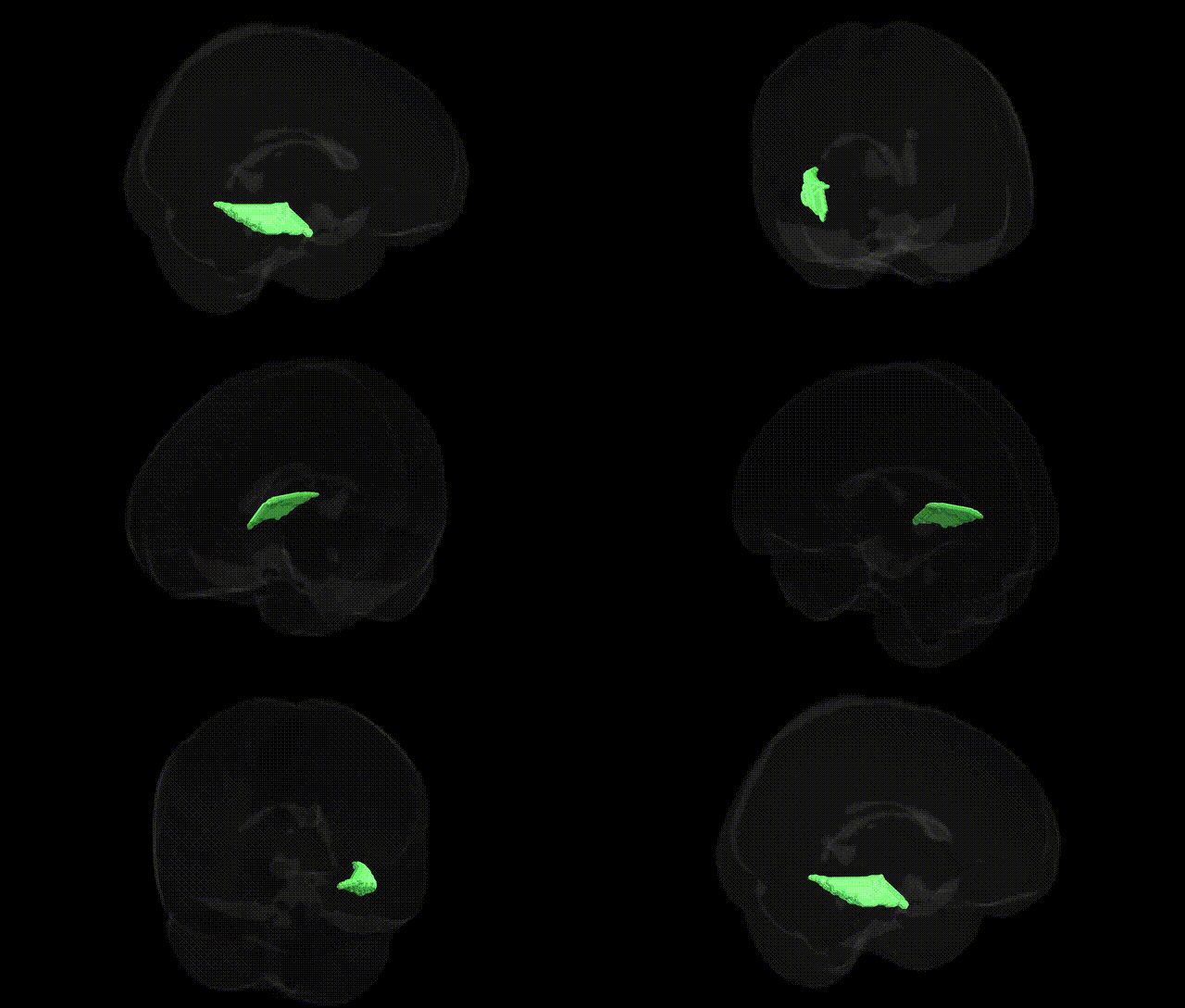
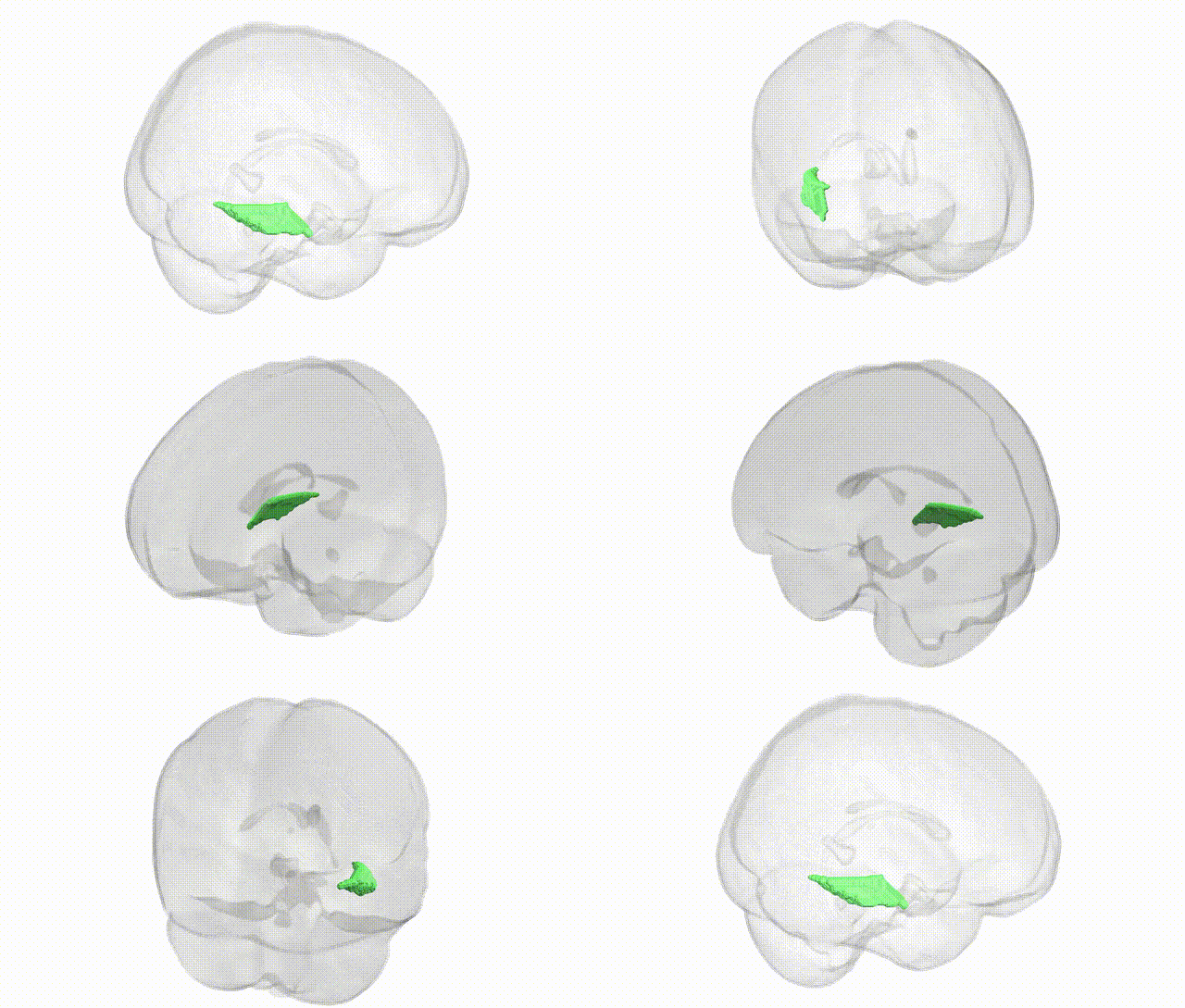
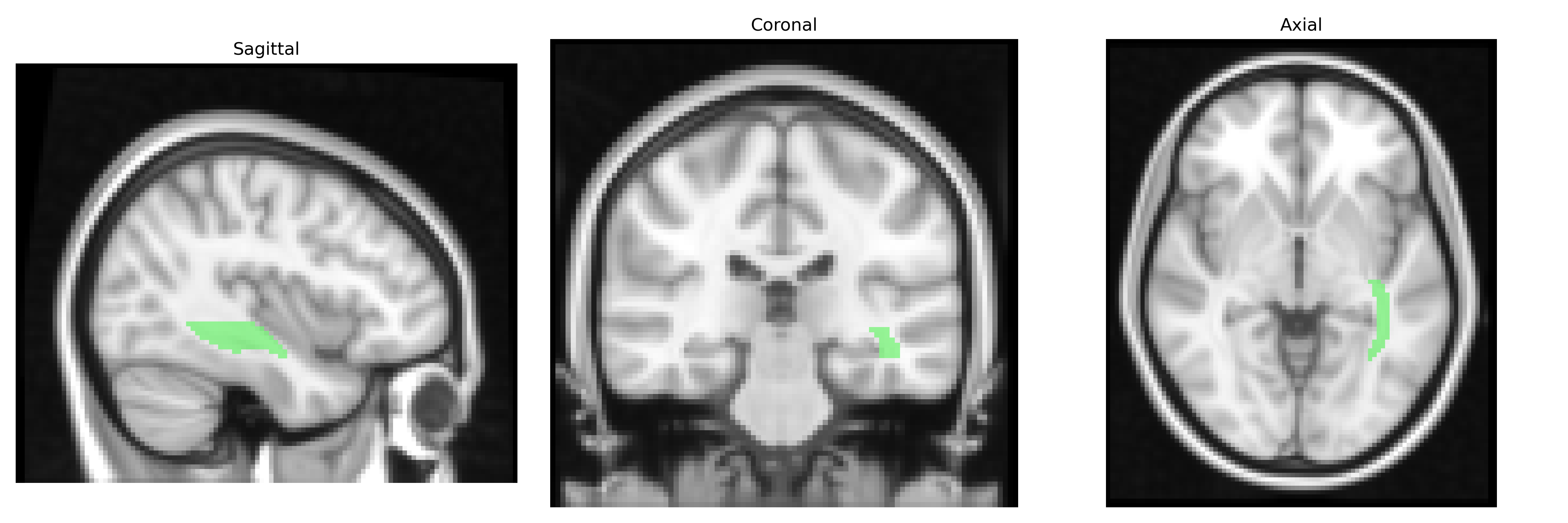
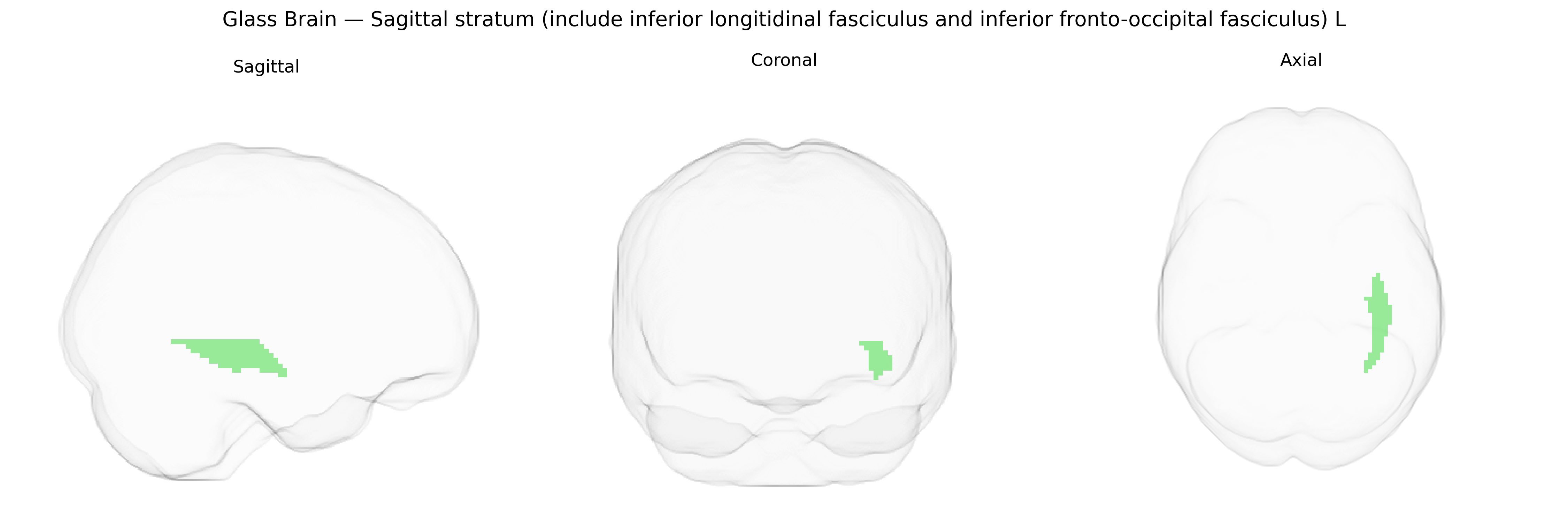
The bilateral sagittal stratum (including the inferior longitudinal fasciculus and inferior fronto-occipital fasciculus) is a major deep white matter structure situated in the posteroinferior cerebrum, coursing lateral to the atrium of the lateral ventricle and deep to the temporal and occipital lobes. It consists of long association fiber bundles that interconnect occipital cortices with temporal and frontal regions, supporting visual information transfer for object recognition, semantic processing, and higher-order visual–cognitive integration. The inferior longitudinal fasciculus links occipital visual areas with anterior temporal regions involved in memory and visual object representation, while the inferior fronto-occipital fasciculus connects occipital and posterior temporal regions to frontal association cortices, contributing to language, attention, and executive functions. In the JHU ICBM 2 mm atlas, this region is defined probabilistically and is often investigated in diffusion MRI studies of visual cognition, language pathways, and disconnection syndromes. There is no direct Wikipedia article for the “Sagittal stratum” as defined in this atlas; related structures include the Inferior longitudinal fasciculus and the Inferior fronto-occipital fasciculus.
The bilateral sagittal stratum (including the inferior longitudinal fasciculus and inferior fronto-occipital fasciculus as defined in the JHU ICBM 2 mm atlas) shows substantial heritability of white matter microstructure in twin and SNP-based studies, with numerous genome-wide association studies (GWAS) identifying common variants that influence diffusion metrics such as fractional anisotropy and mean diffusivity in this region. Large imaging-genetics consortia (e.g., ENIGMA, UK Biobank analyses) have implicated loci near or within genes involved in axonal guidance, myelination, and oligodendrocyte function (such as NRG1, MAG, LINGO1, and genes in the ROBO/SLIT and semaphorin pathways) as contributors to interindividual variability in sagittal stratum and ILF/IFOF integrity, though specific lead SNPs and effect sizes differ across datasets and analytic pipelines. Genetically influenced alterations in this tract system have been associated with a range of neurodevelopmental and psychiatric conditions—including schizophrenia, bipolar disorder, autism spectrum disorder, and attention-deficit/hyperactivity disorder—as well as neurodegenerative diseases such as Alzheimer’s disease, often in the context of polygenic risk scores linking higher genetic liability to reduced anisotropy or altered connectivity in ventral temporal–occipital and fronto-occipital pathways. Additional associations have been reported between variants in myelin- and lipid-related genes (e.g., in APOE, PLP1, and other white matter–relevant loci) and tract properties in posterior and inferior association fibers, with downstream relationships to cognitive traits such as processing speed, reading and language performance, and general intelligence, although these effects are typically modest and highly polygenic.
Overview generated by GPT-4o (2026).
Region ID: 32
Hemisphere: bilateral
Atlas: JHU ICBM labels 2mm
Full Quality Version: Download MP4
Full Quality Version: Download MP4
Wali Sidiqyar*, Gaurav Rudravaram*, Elyssa M. McMaster, Trent M. Schwartz, Adam M. Saunders, Kurt G. Schilling, Bennett A. Landman "Introducing SPINS: A Shared Public Visualization Library of Neuroanatomical Structures." Medical Imaging with Deep Learning- short paper
This resource is licensed under CC0 1.0 Universal (Public Domain).