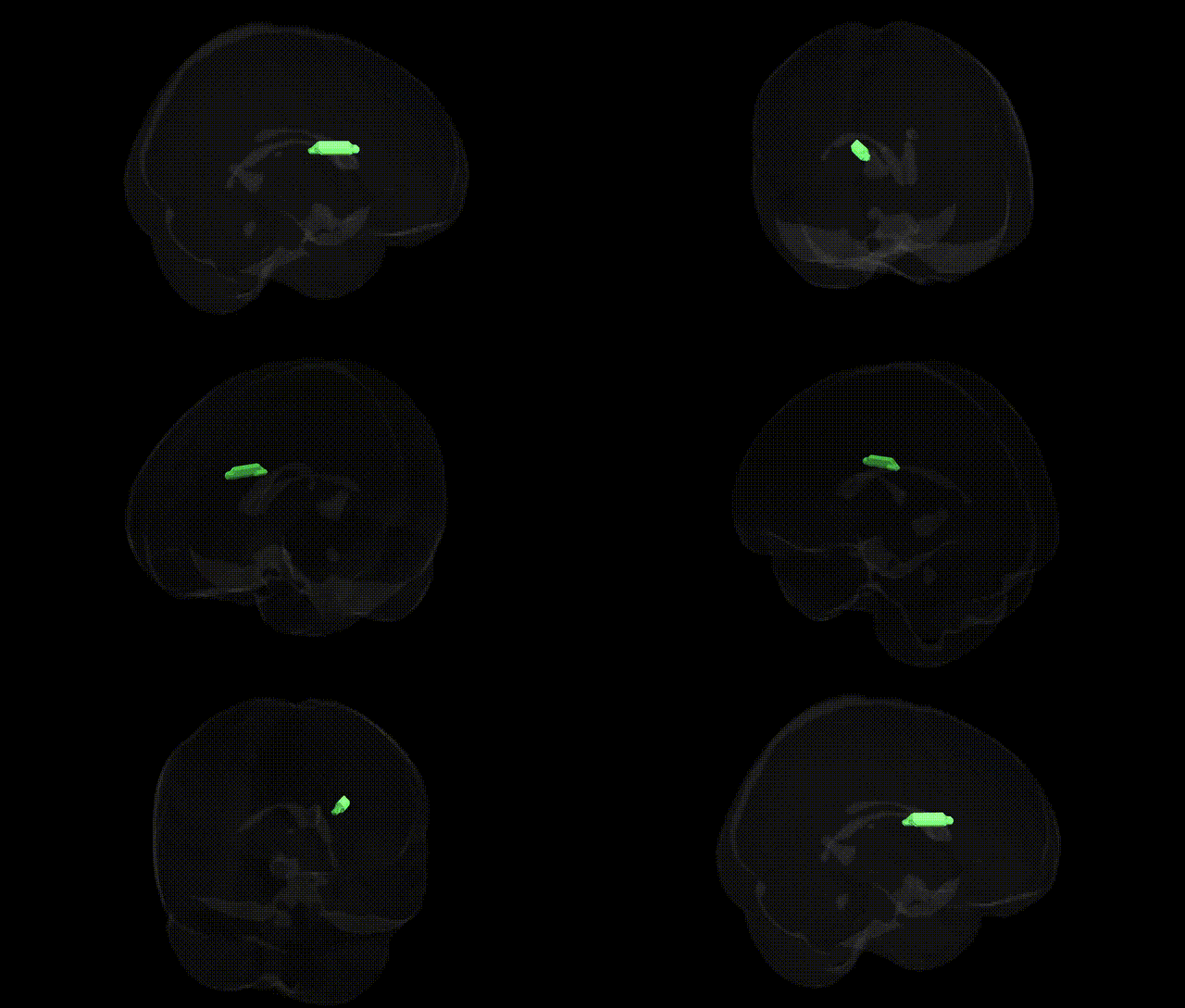
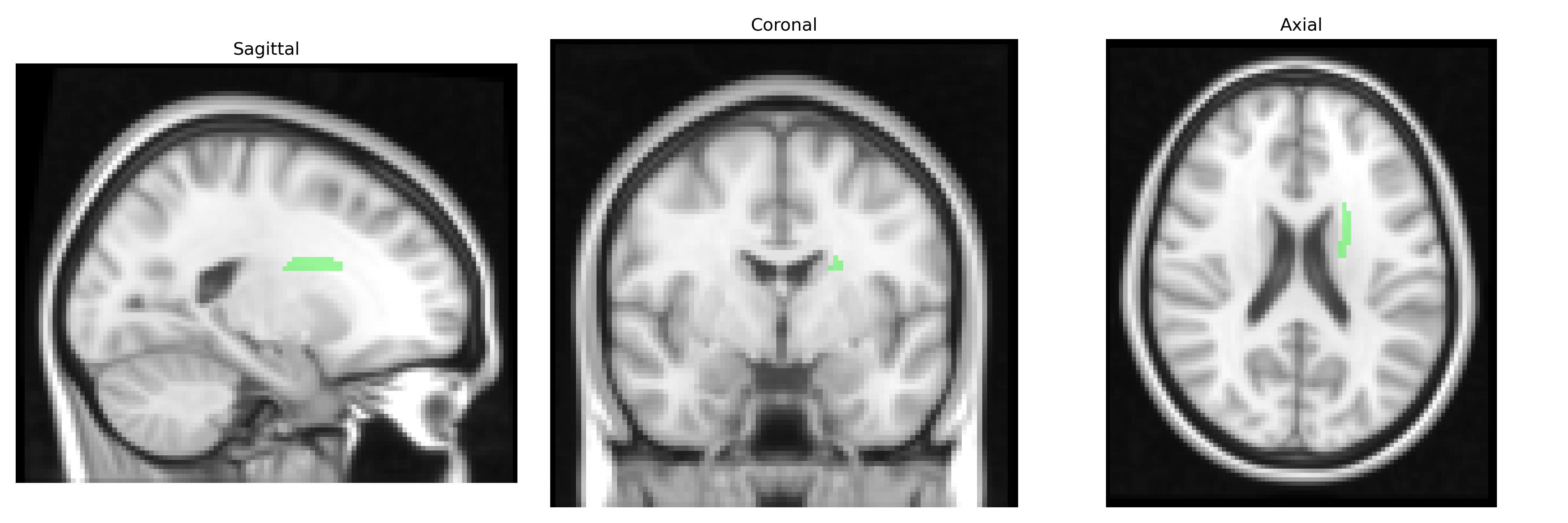
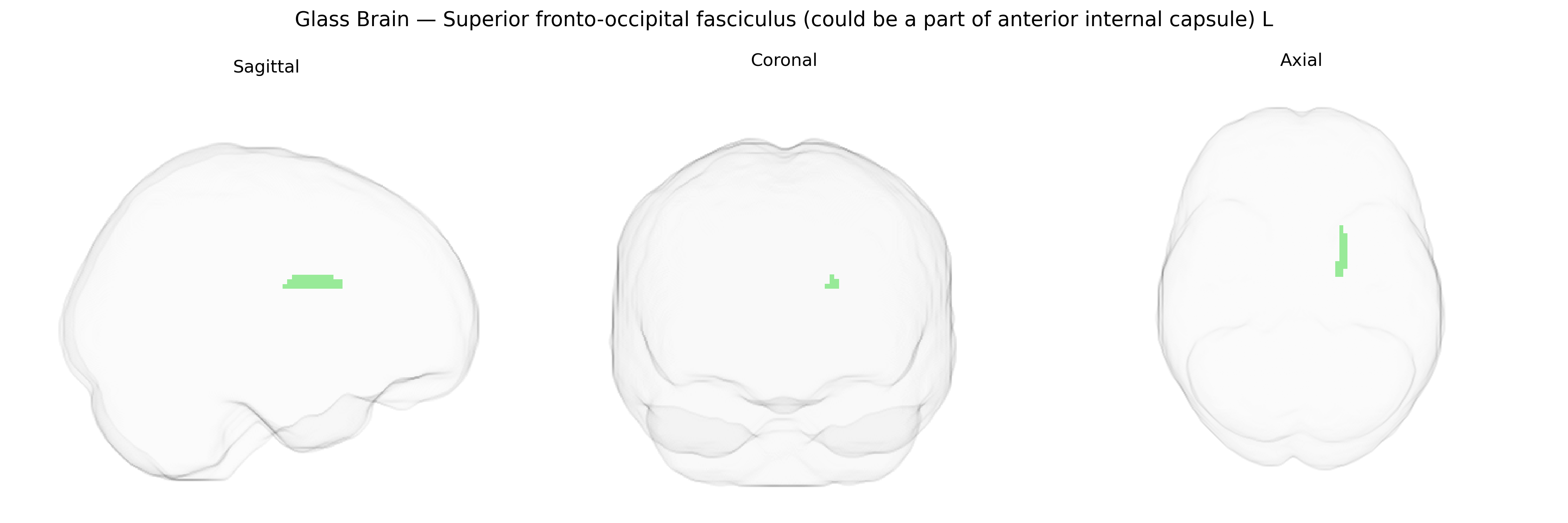
The bilateral Superior fronto-occipital fasciculus (could be a part of anterior internal capsule) L, as defined in the JHU ICBM labels 2mm Atlas, is a long association white-matter tract that courses anteroposteriorly between frontal and posterior cortical regions, traversing superior to the insula and adjacent to components of the internal capsule. It is thought to link portions of the frontal lobe with occipital and parietal areas, thereby contributing to integrative functions such as visuospatial processing, higher-order visual cognition, and possibly executive control of visual information, although its exact anatomical definition and existence as a discrete bundle remain debated in contemporary tractography and dissection studies. In many descriptions, fibers attributed to this fasciculus overlap with or are incorporated into the anterior limb of the internal capsule and other association systems, reflecting ongoing uncertainty in its parcellation in human neuroanatomy. There is no direct Wikipedia article for the superior fronto-occipital fasciculus; a closely related structure is the Internal capsule.
The bilateral superior fronto-occipital fasciculus (SFOF)—whose anterior segment overlaps the anterior limb of the internal capsule—has been implicated in multiple imaging–genetics and GWAS-based endophenotype studies, particularly those examining white matter microstructure via diffusion MRI. Large-scale neuroimaging GWAS (e.g., UK Biobank–based) have identified associations between common variants in genes involved in axon guidance, myelination, and neurodevelopment (including loci near or within CNTN4, NRG1, MAG, and various cell-adhesion and oligodendroglial genes) and diffusion metrics such as fractional anisotropy and mean diffusivity in fronto-occipital and internal capsule tracts. These microstructural measures in the SFOF/anterior internal capsule have, in turn, been genetically correlated with psychiatric and cognitive traits, including schizophrenia, major depressive disorder, bipolar disorder, and general cognitive performance, suggesting that genetic influences on white matter integrity in this region contribute to polygenic liability for these conditions. Additionally, imaging–genetics studies of attention-deficit/hyperactivity disorder, autism spectrum disorder, and neuroticism have reported polygenic and candidate-gene associations with fronto-striatal and fronto-occipital white matter pathways that overlap JHU-defined SFOF territory, though specific tract-level loci are often not uniquely resolved and findings remain largely at the level of network or global white matter measures rather than this tract alone.
Overview generated by GPT-4o (2026).
Region ID: 44
Hemisphere: bilateral
Atlas: JHU ICBM labels 2mm
Full Quality Version: Download MP4
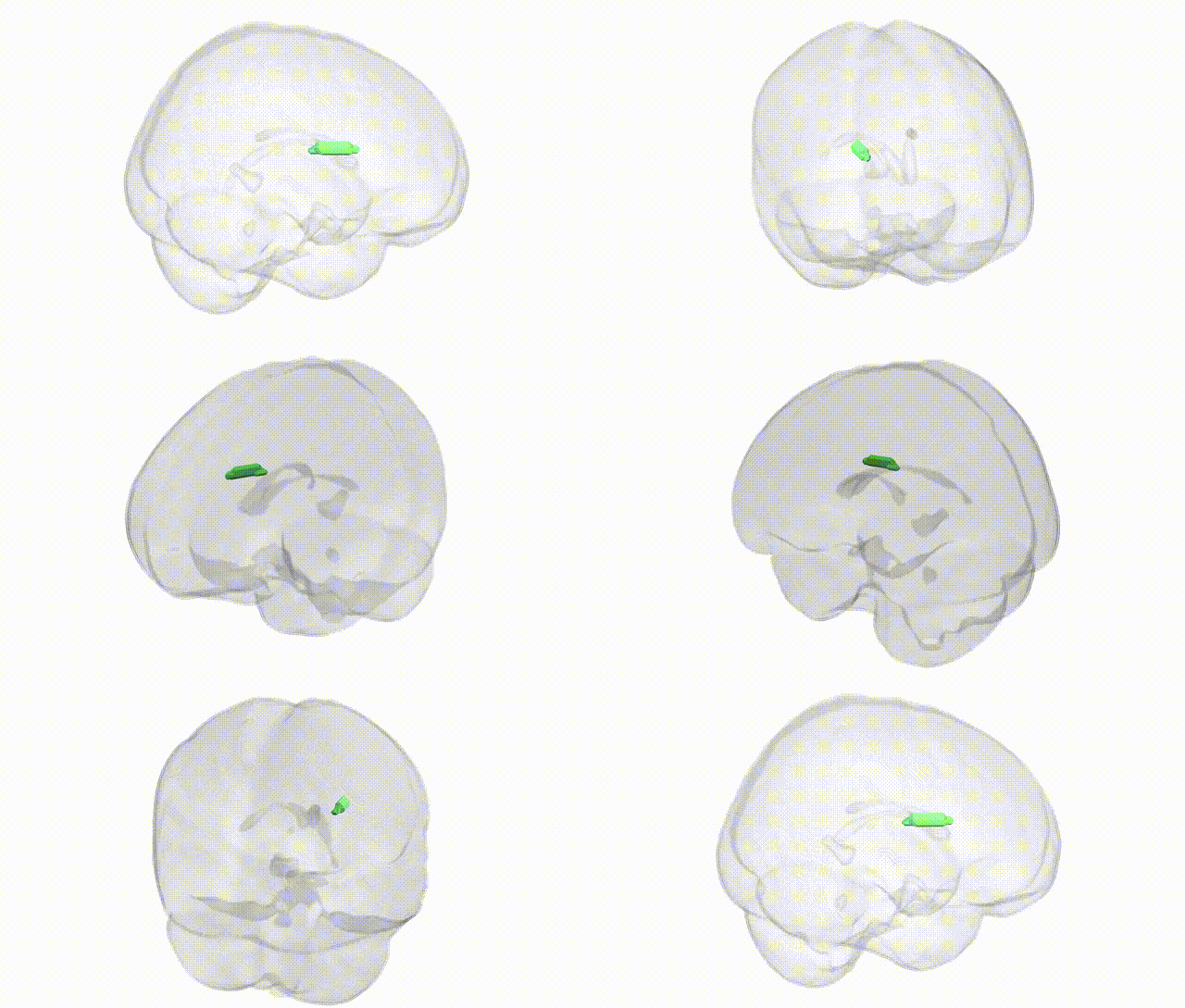
Full Quality Version: Download MP4
Wali Sidiqyar*, Gaurav Rudravaram*, Elyssa M. McMaster, Trent M. Schwartz, Adam M. Saunders, Kurt G. Schilling, Bennett A. Landman "Introducing SPINS: A Shared Public Visualization Library of Neuroanatomical Structures." Medical Imaging with Deep Learning- short paper
This resource is licensed under CC0 1.0 Universal (Public Domain).