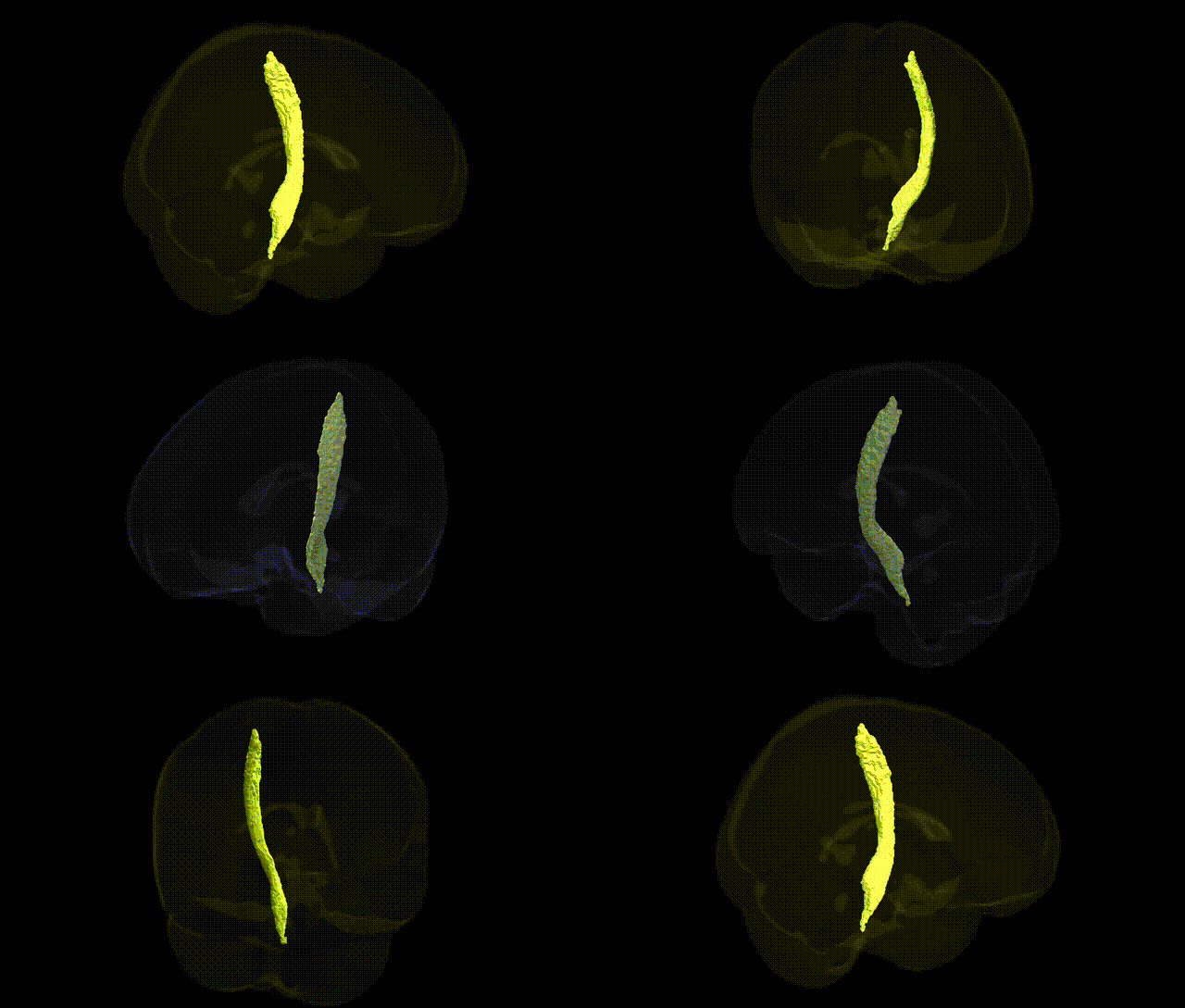
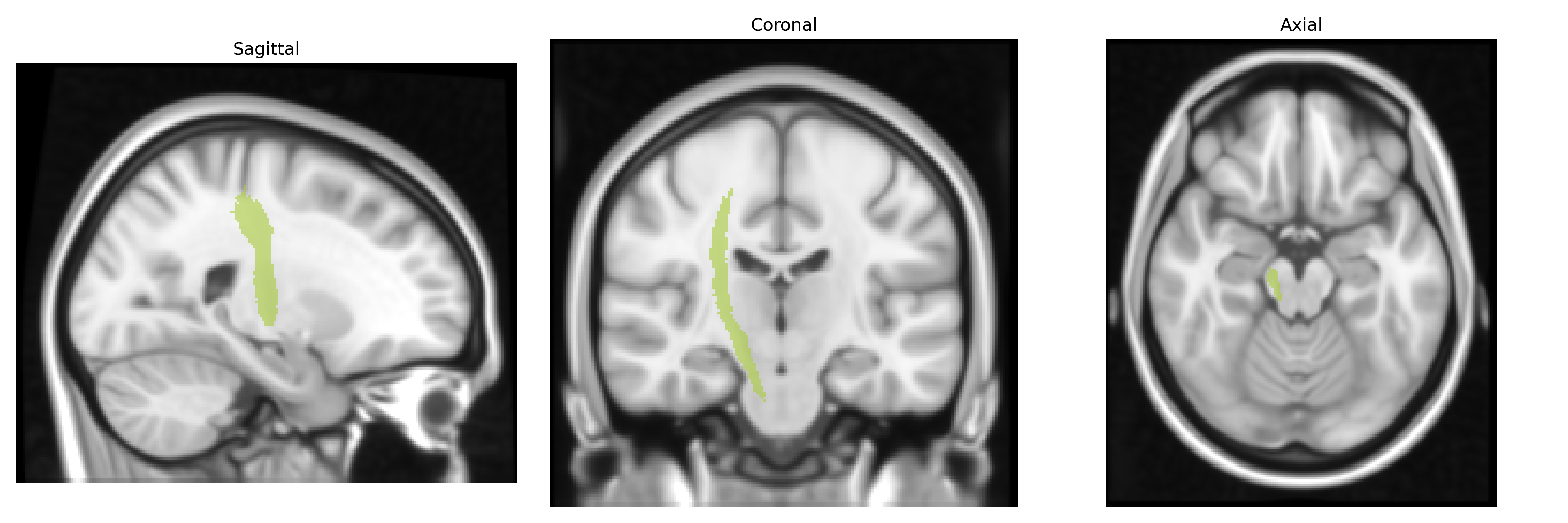
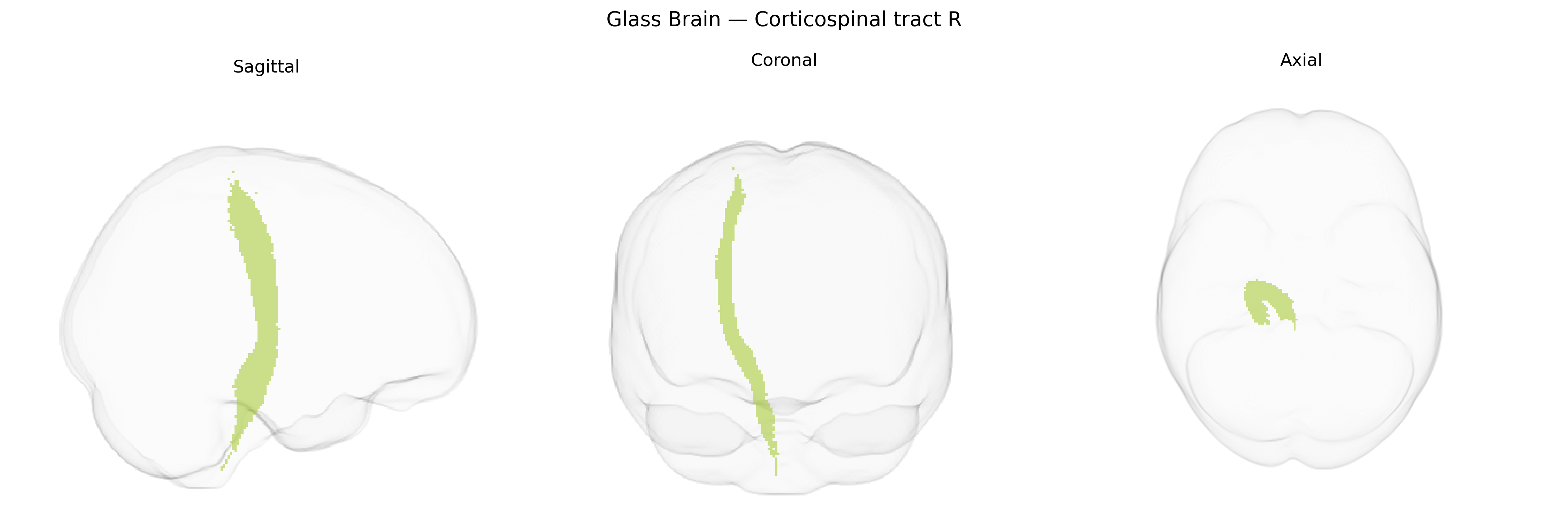
The bilateral corticospinal tract is a major descending white matter pathway that originates primarily from the motor cortex, descends through the internal capsule, cerebral peduncles, brainstem, and continues into the spinal cord to synapse on motor neurons and interneurons that control voluntary movement. In the JHU ICBM tracts maxprob thr25 1mm Atlas, this tract is defined probabilistically across both hemispheres, capturing the most likely spatial extent of the fibers that convey fine motor control, particularly of distal limb musculature. Its integrity is essential for precise, fractionated movements, and it is commonly studied in neuroimaging and clinical neurology to assess motor pathway damage in conditions such as stroke, multiple sclerosis, and traumatic brain injury. Corticospinal tract
The bilateral corticospinal tract (CST), including the right CST as defined in the JHU ICBM tracts maxprob thr25 1mm atlas, has been implicated in multiple genetic studies that link white matter microstructure and motor pathway integrity to specific loci and polygenic architectures. Diffusion tensor imaging GWAS have shown that common variants in genes involved in axon guidance, myelination, and cytoskeletal organization (e.g., CNTNAP2, NRG1, MAG, and microtubule-related loci) are associated with CST fractional anisotropy and mean diffusivity, reflecting genetically influenced variability in tract structure. CST metrics have also appeared in large neuroimaging-genetics consortia (such as ENIGMA) as heritable endophenotypes associated with polygenic risk for neurodevelopmental and neuropsychiatric conditions, including schizophrenia, ADHD, and autism spectrum disorder, although effects are generally small and distributed across the genome. Clinical genetics and candidate gene studies in motor neuron disease, hereditary spastic paraplegia, and cerebral palsy have linked mutations in genes such as SPAST, KIF5A, ATL1, and PLP1 to degeneration or abnormal development of CST fibers, supporting a genetic contribution to tract-specific motor dysfunction. In addition, CST integrity has been associated in GWAS and polygenic score analyses with traits like general cognitive performance, motor skill learning, and recovery after stroke, indicating that common genetic variation shaping CST structure is relevant to both neurological disease and normal interindividual differences in motor and cognitive function, although no single locus has been established as uniquely specific to the right CST in isolation.
Overview generated by GPT-4o (2026).
Region ID: 4
Hemisphere: bilateral
Atlas: JHU ICBM tracts maxprob thr25 1mm
Full Quality Version: Download MP4
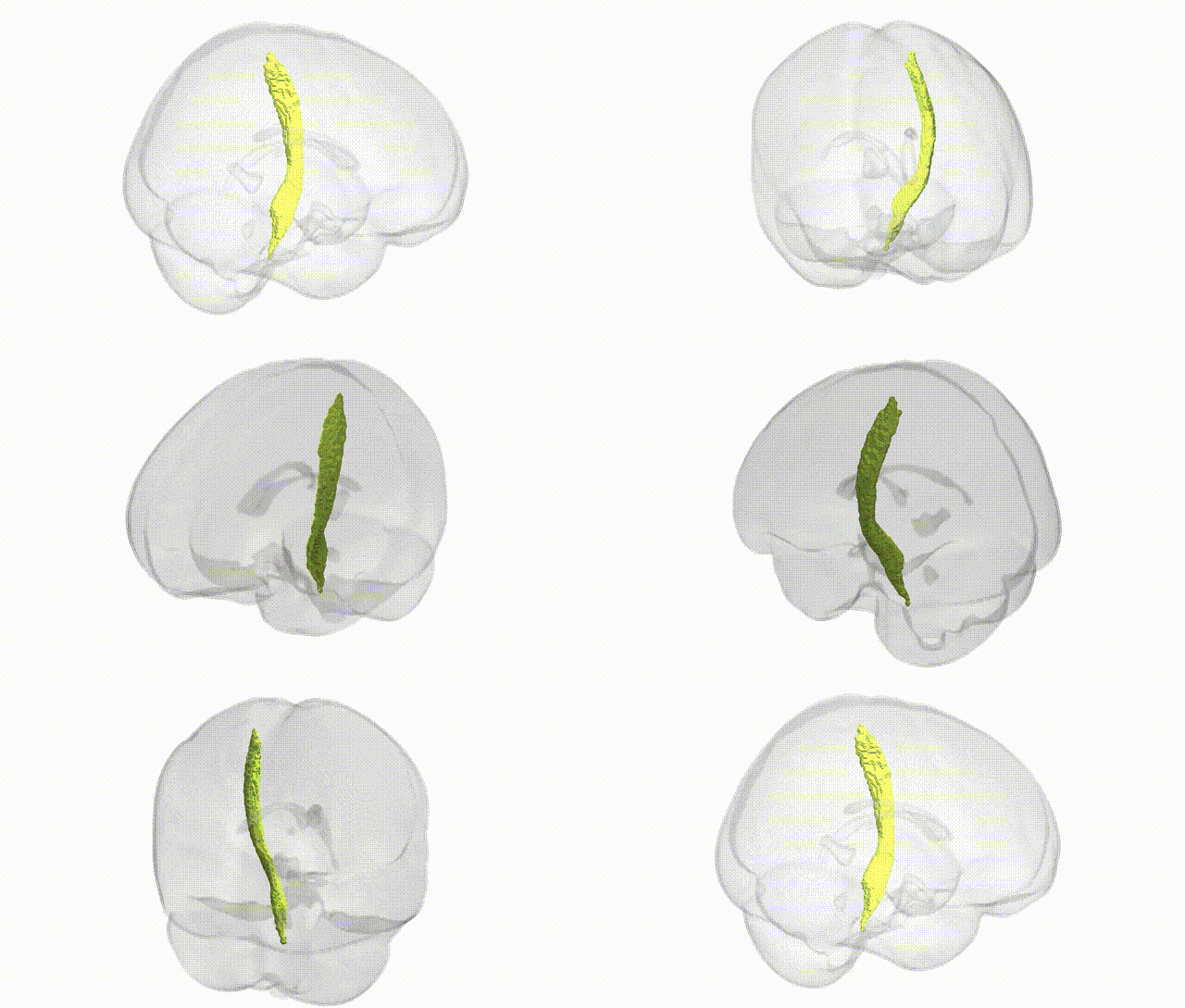
Full Quality Version: Download MP4
Wali Sidiqyar*, Gaurav Rudravaram*, Elyssa M. McMaster, Trent M. Schwartz, Adam M. Saunders, Kurt G. Schilling, Bennett A. Landman "Introducing SPINS: A Shared Public Visualization Library of Neuroanatomical Structures." Medical Imaging with Deep Learning- short paper
This resource is licensed under CC0 1.0 Universal (Public Domain).