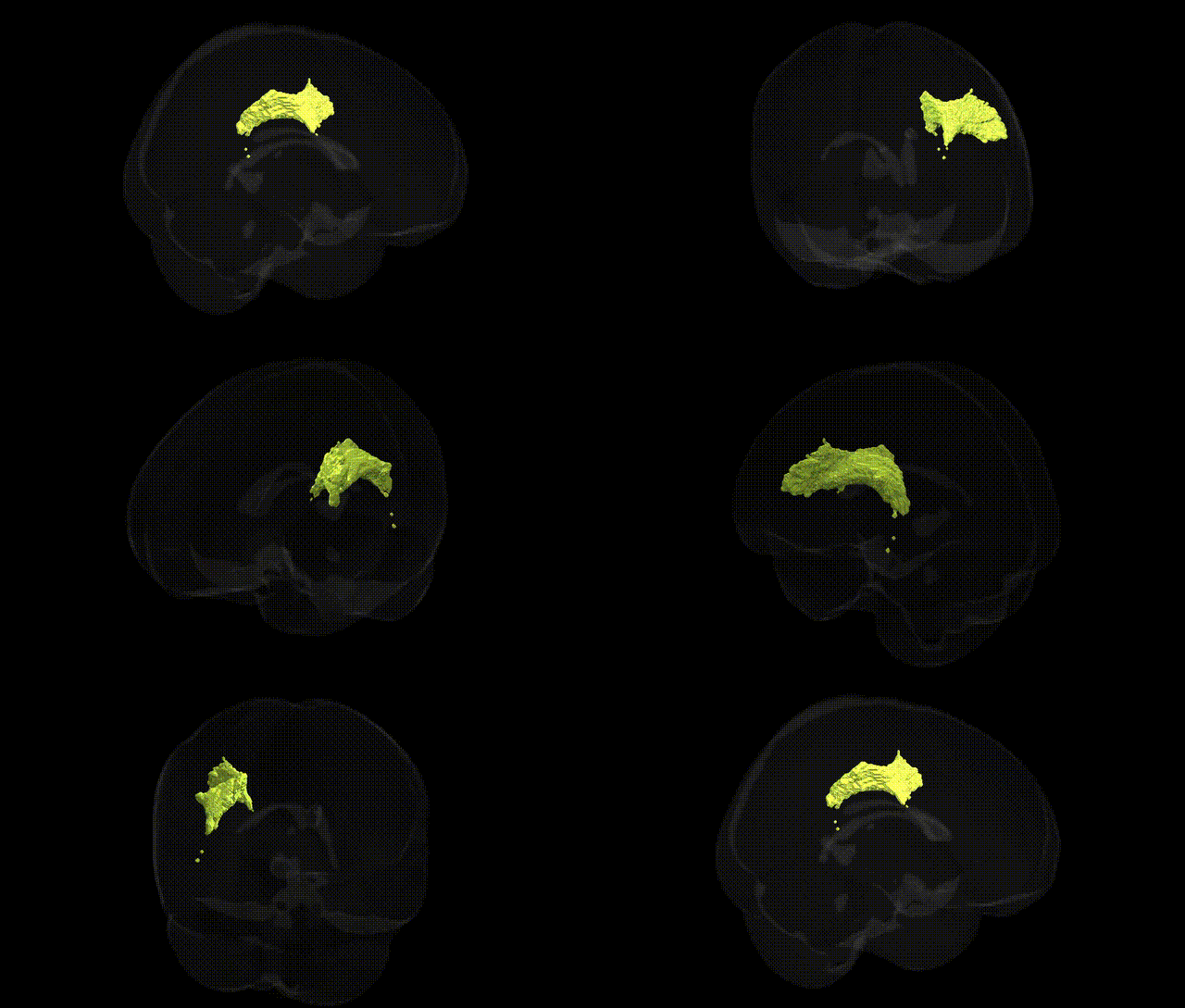
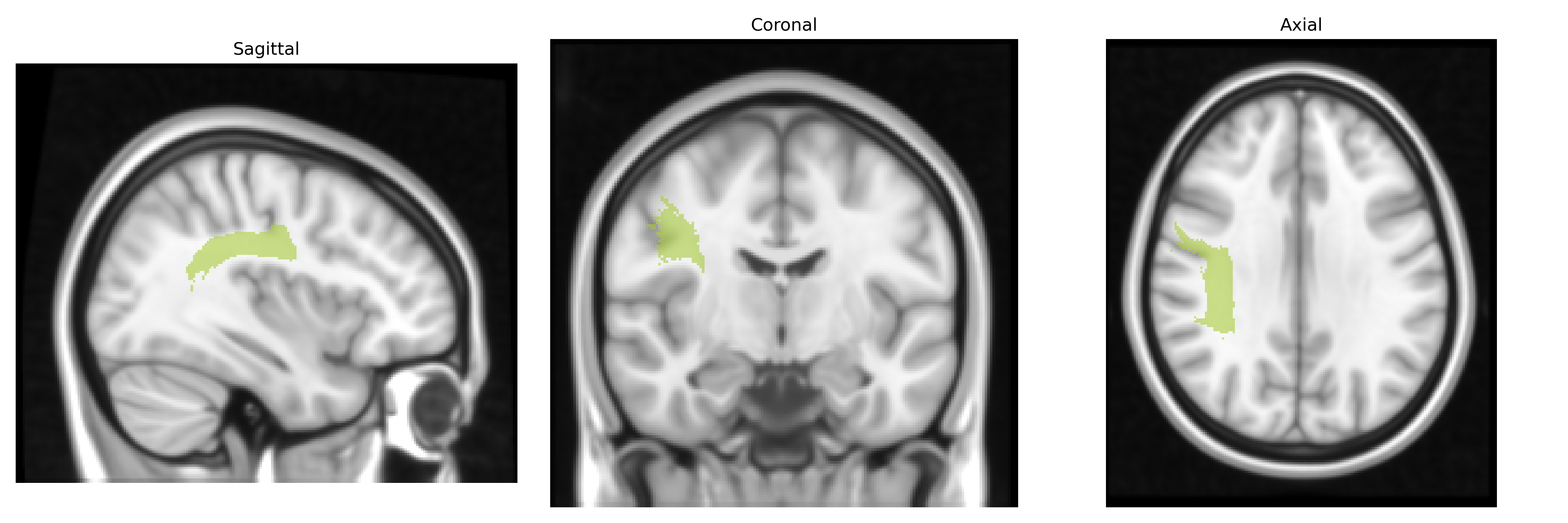
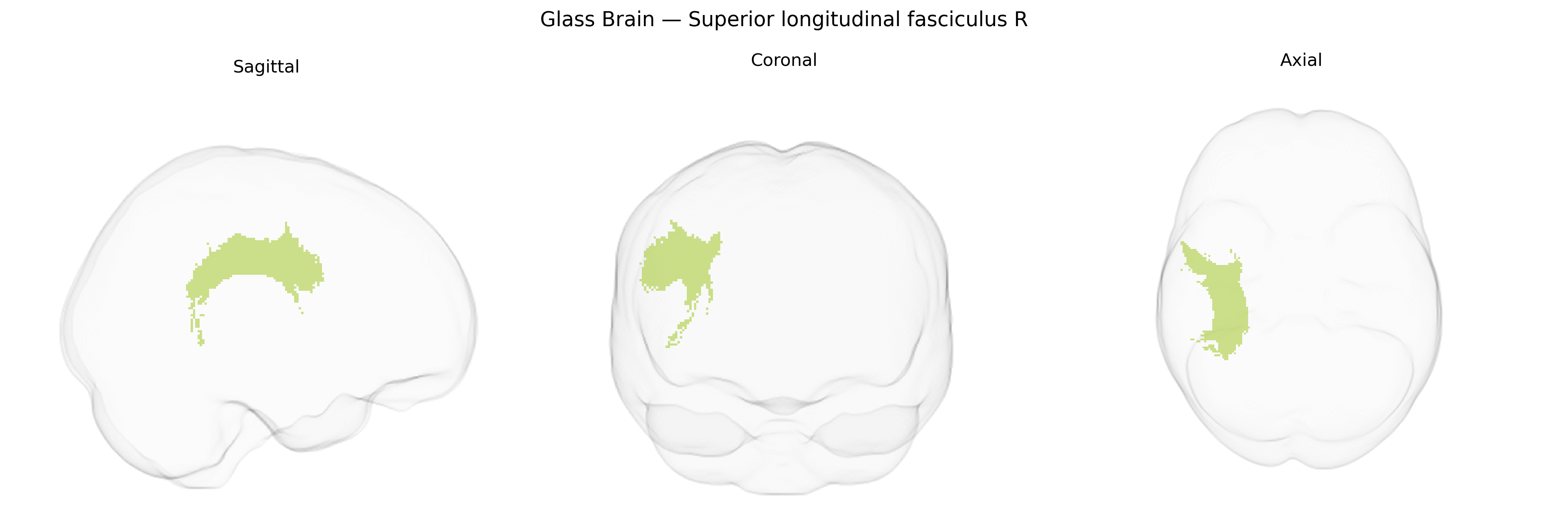
The bilateral Superior longitudinal fasciculus R, as defined in the JHU ICBM tracts maxprob thr25 1mm Atlas, is a major association white matter pathway in the right hemisphere that interconnects frontal, parietal, and temporal cortical regions. It courses dorsolaterally beneath the cortical surface, linking areas involved in attention, visuospatial processing, language, and higher-order cognitive integration. Structurally, it comprises long-range myelinated fibers that support coordinated information transfer across fronto-parietal and fronto-temporal networks, contributing to functions such as working memory, cortical feedback, and sensorimotor integration. In clinical and research contexts, alterations in the superior longitudinal fasciculus have been associated with disorders of language, neglect, and other cognitive deficits. There is no direct Wikipedia article for this specific labeled tract; a closely related structure is the Superior longitudinal fasciculus.
The bilateral superior longitudinal fasciculus (SLF), as defined in the JHU ICBM tracts maxprob thr25 1mm atlas, has been repeatedly implicated in imaging genetics studies focusing on white matter microstructure, particularly via diffusion tensor imaging (DTI) measures such as fractional anisotropy (FA) and mean diffusivity. GWAS of white matter integrity have linked common variants in genes involved in axonal guidance, myelination, and neurodevelopment—such as CNTNAP2, NTRK1/2, and ROBO/SLIT pathway genes—to variation in SLF structure, although specific findings often differ across cohorts and analytic methods. Large-scale consortia (e.g., ENIGMA) have reported polygenic influences on SLF FA and volume, with aggregate schizophrenia, bipolar disorder, and major depression risk scores showing associations with reduced integrity in SLF segments, suggesting that genetic liability for severe psychiatric disorders partly manifests through altered fronto-parietal connectivity. Imaging genetics work in attention-deficit/hyperactivity disorder, autism spectrum disorder, and dyslexia has highlighted SLF-related tracts as mediators of language, executive function, and attentional control, with candidate gene and polygenic risk studies reporting correlations between variants in dopaminergic (e.g., DRD2, DAT1/SLC6A3) and glutamatergic pathways and SLF microstructural differences. Additionally, GWAS of cognitive traits (general intelligence, working memory, processing speed) have found that polygenic scores for higher cognitive performance correlate with increased integrity of SLF fibers, consistent with the tract’s role in fronto-parietal and fronto-temporal networks; however, these associations are largely polygenic and nonspecific, reflecting broadly distributed genetic effects on brain connectivity rather than single-gene influences uniquely tied to the superior longitudinal fasciculus.
Overview generated by GPT-4o (2026).
Region ID: 16
Hemisphere: bilateral
Atlas: JHU ICBM tracts maxprob thr25 1mm
Full Quality Version: Download MP4
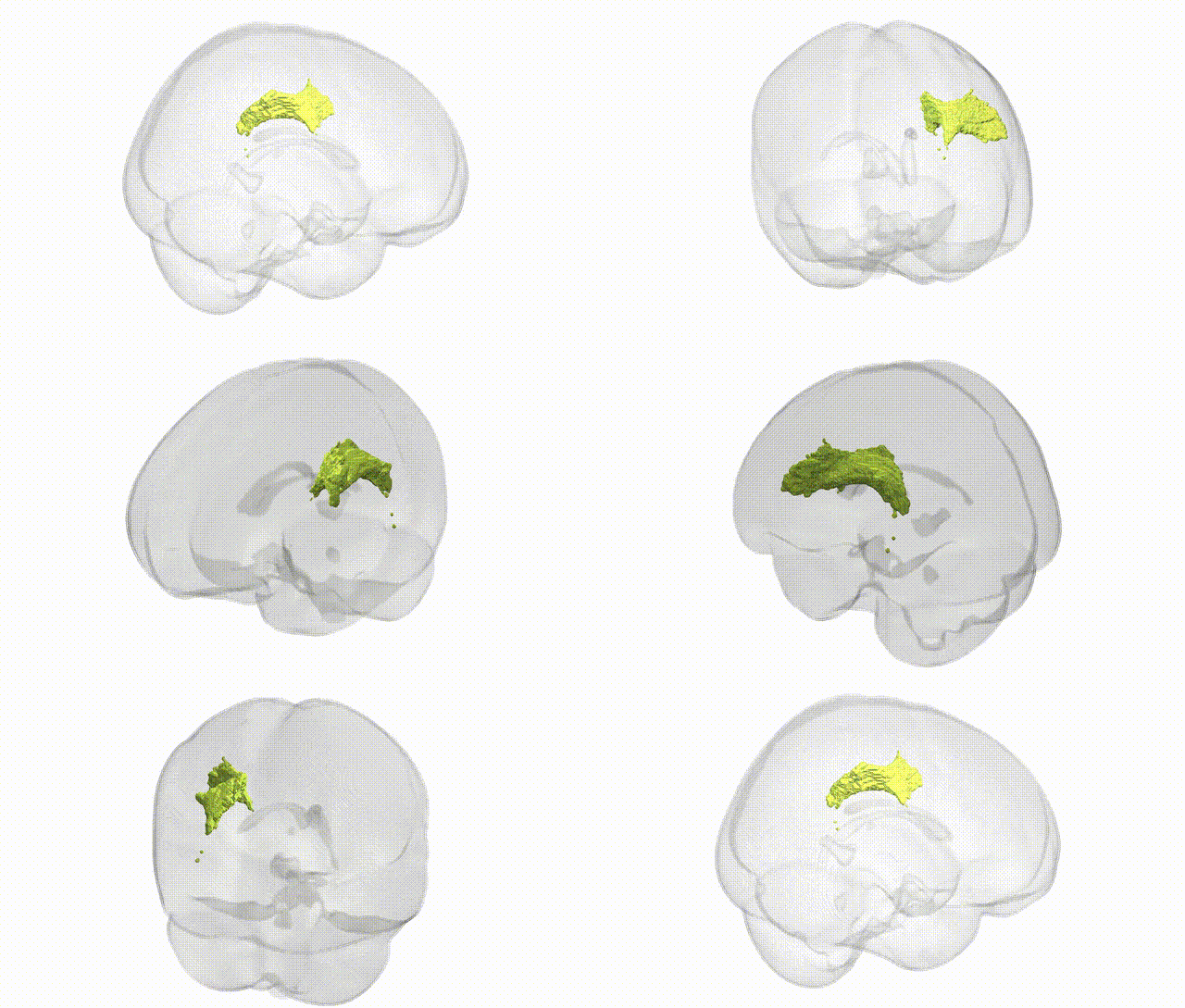
Full Quality Version: Download MP4
Wali Sidiqyar*, Gaurav Rudravaram*, Elyssa M. McMaster, Trent M. Schwartz, Adam M. Saunders, Kurt G. Schilling, Bennett A. Landman "Introducing SPINS: A Shared Public Visualization Library of Neuroanatomical Structures." Medical Imaging with Deep Learning- short paper
This resource is licensed under CC0 1.0 Universal (Public Domain).