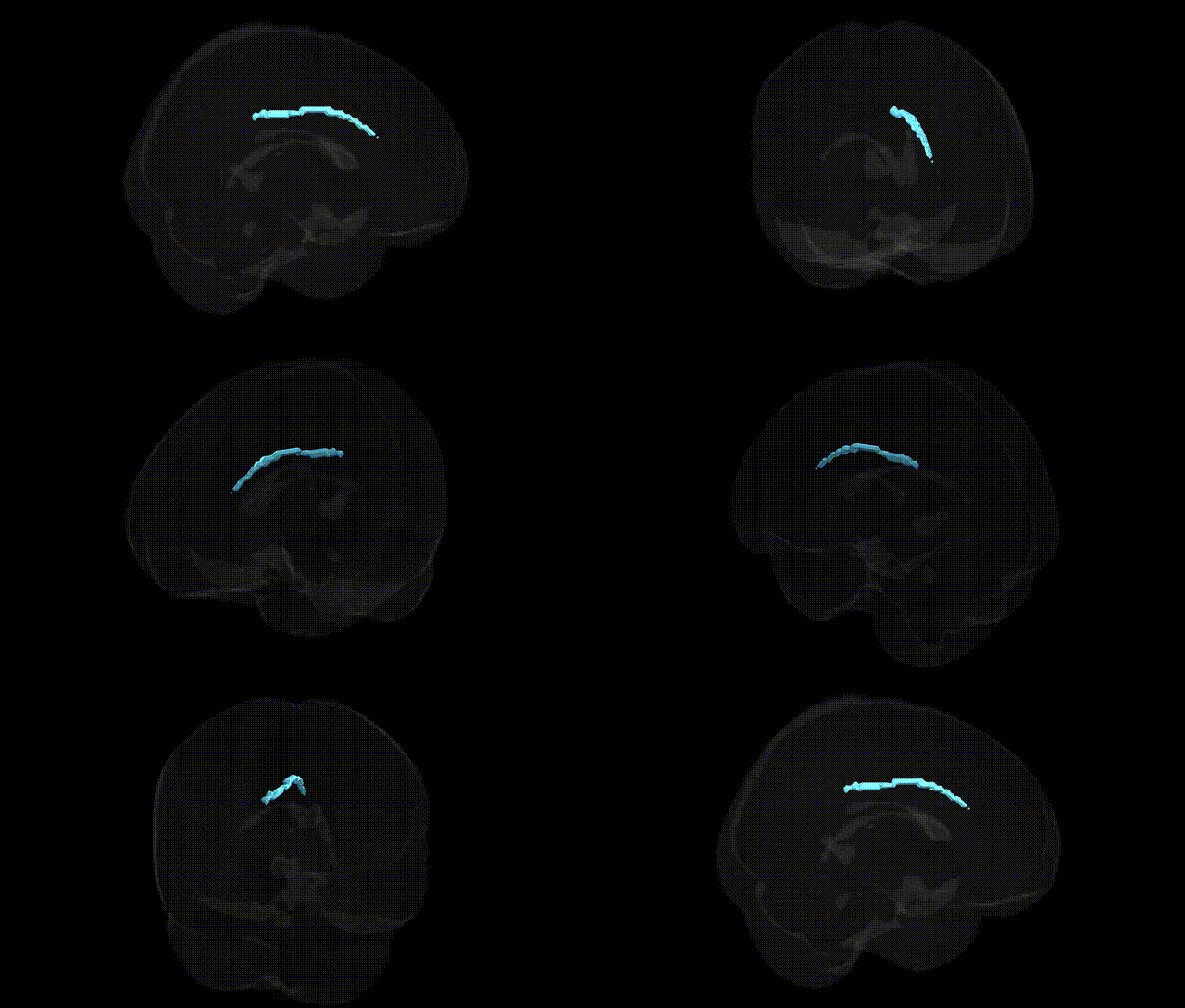
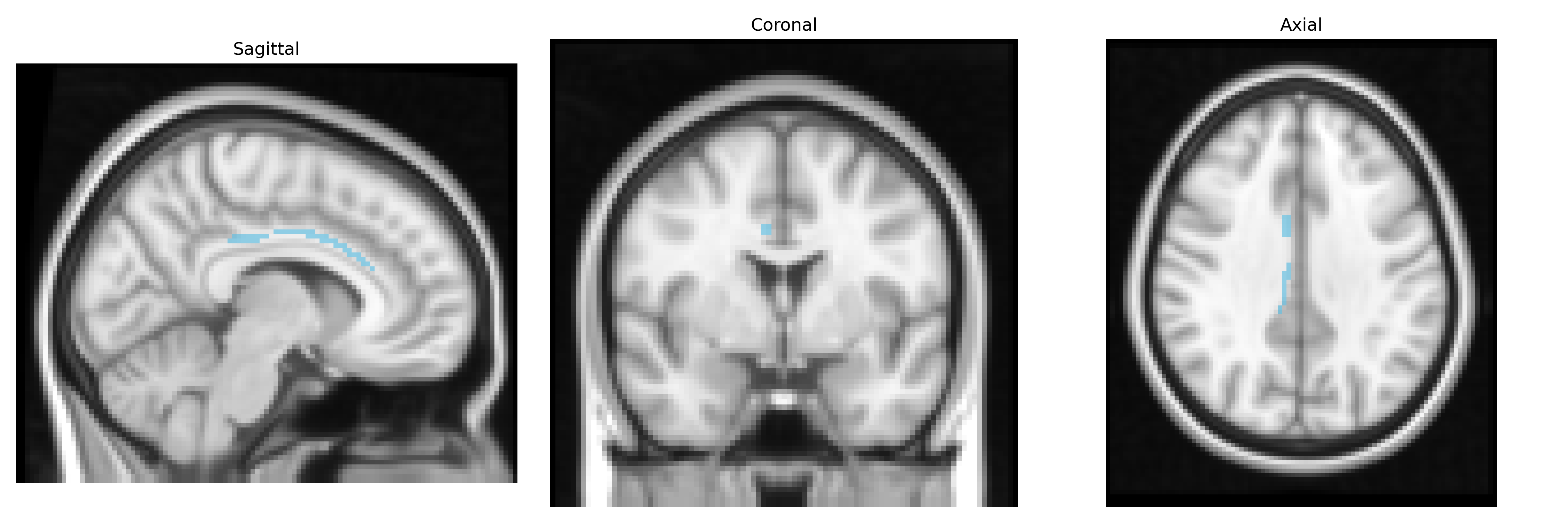
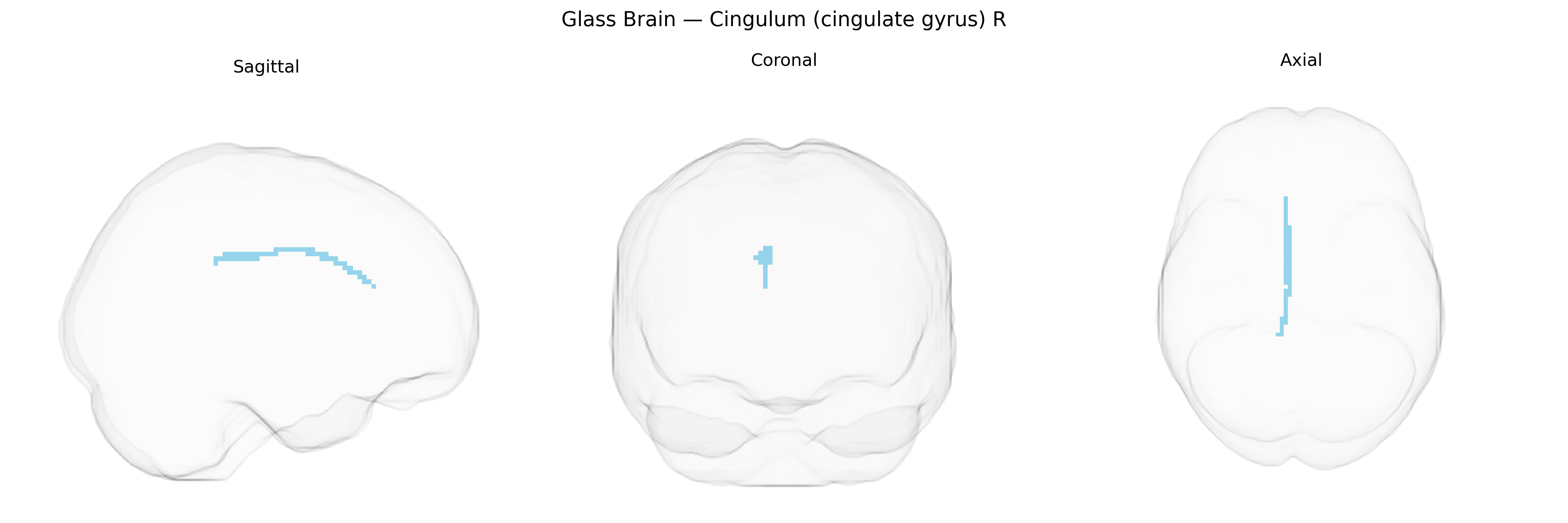
The bilateral cingulum (cingulate gyrus) R, as defined in the JHU ICBM tracts maxprob thr25 2mm Atlas, is a major white matter association bundle coursing within the cingulate gyrus along the medial aspect of the cerebral hemispheres. It connects components of the limbic system, including the cingulate cortex, hippocampal formation, and parahippocampal regions, and contributes to networks subserving emotion, attention, memory, and executive control. Structurally, the cingulum runs parallel to the corpus callosum, forming a curved tract that links frontal, parietal, and temporal lobes, thereby integrating cognitive and affective processing. The designation “R” indicates right-hemisphere localization within the atlas, though the tract exists bilaterally and is often studied in terms of hemispheric asymmetries and connectivity patterns. There is no direct Wikipedia article for this specific tract label; a closely related structure is the Cingulum (brain).
The bilateral cingulum (cingulate gyrus) R tract from the JHU ICBM white-matter atlas has been implicated in numerous genetic imaging and GWAS studies, with variants influencing its fractional anisotropy (FA), mean diffusivity (MD), and related diffusion metrics linked to neuropsychiatric and cognitive traits. Large imaging-genetics consortia (e.g., ENIGMA) have reported common SNPs in genes involved in myelination, axonal guidance, and neurodevelopment (such as variants near NTRK1/2, BDNF, and cell-adhesion or semaphorin-pathway genes) that modulate cingulum microstructure, which in turn has been associated with major depressive disorder, schizophrenia, bipolar disorder, attention-deficit/hyperactivity disorder, and autism spectrum conditions. Polygenic risk scores for schizophrenia, depression, and Alzheimer’s disease show associations with reduced cingulum integrity, and APOE ε4 status has been related to altered cingulum diffusion properties and memory performance. GWAS of white-matter tracts also indicate that cingulum microstructure shares genetic architecture with general cognitive ability, educational attainment, neuroticism, and brain aging measures, suggesting that genetic influences on this tract contribute to a broad spectrum of affective, psychotic, and cognitive phenotypes.
Overview generated by GPT-4o (2026).
Region ID: 6
Hemisphere: bilateral
Atlas: JHU ICBM tracts maxprob thr25 2mm
Full Quality Version: Download MP4
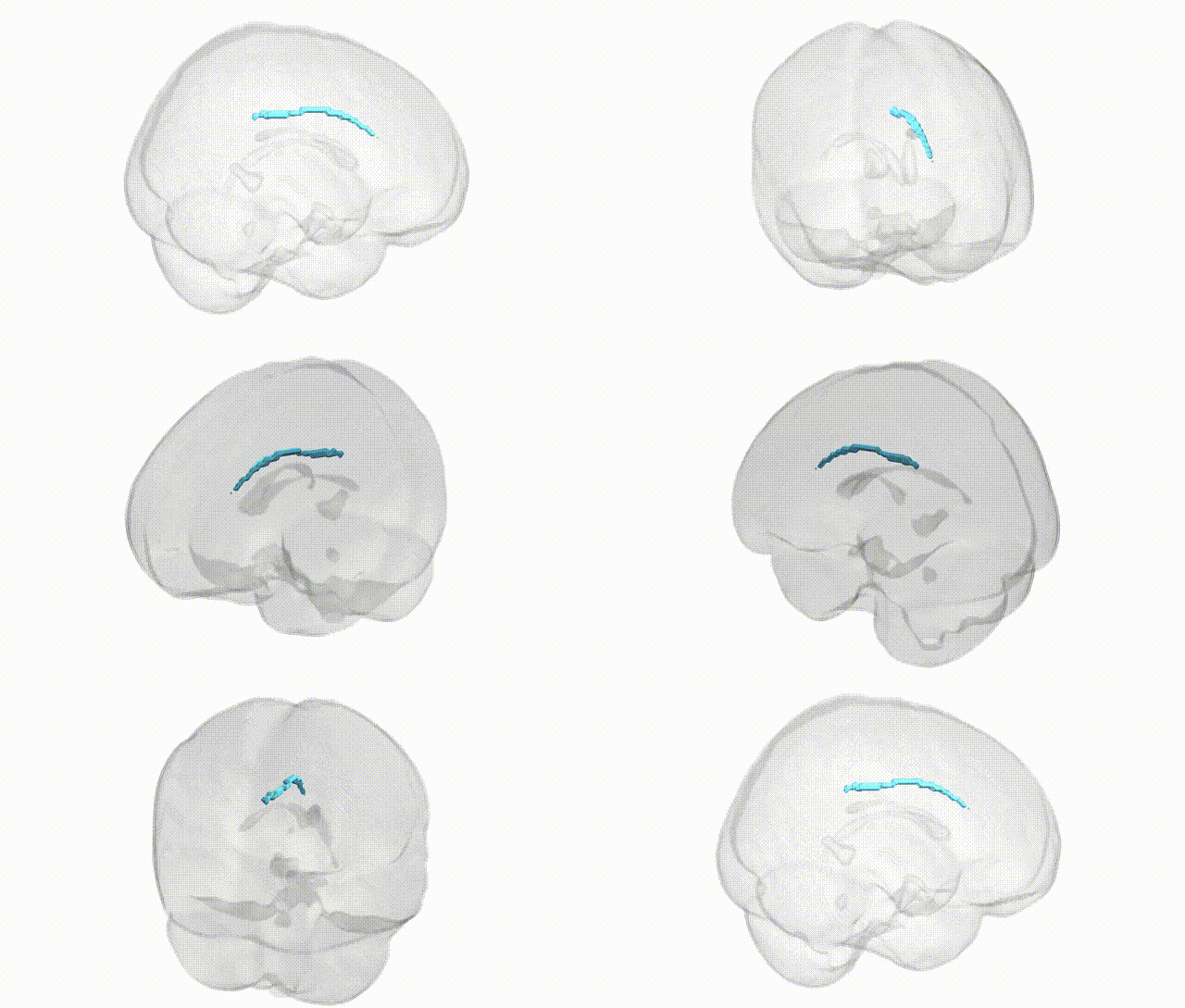
Full Quality Version: Download MP4
Wali Sidiqyar*, Gaurav Rudravaram*, Elyssa M. McMaster, Trent M. Schwartz, Adam M. Saunders, Kurt G. Schilling, Bennett A. Landman "Introducing SPINS: A Shared Public Visualization Library of Neuroanatomical Structures." Medical Imaging with Deep Learning- short paper
This resource is licensed under CC0 1.0 Universal (Public Domain).