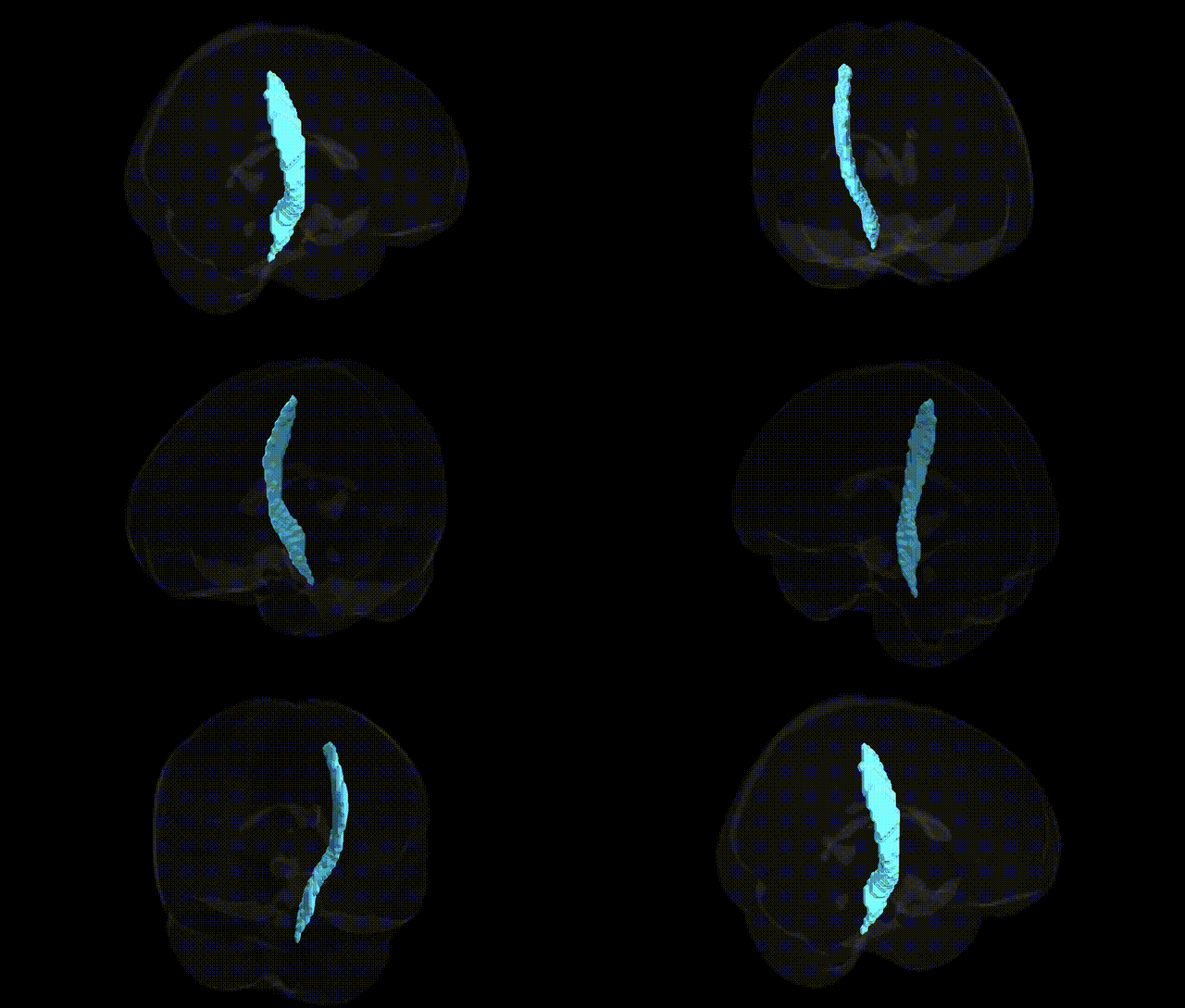
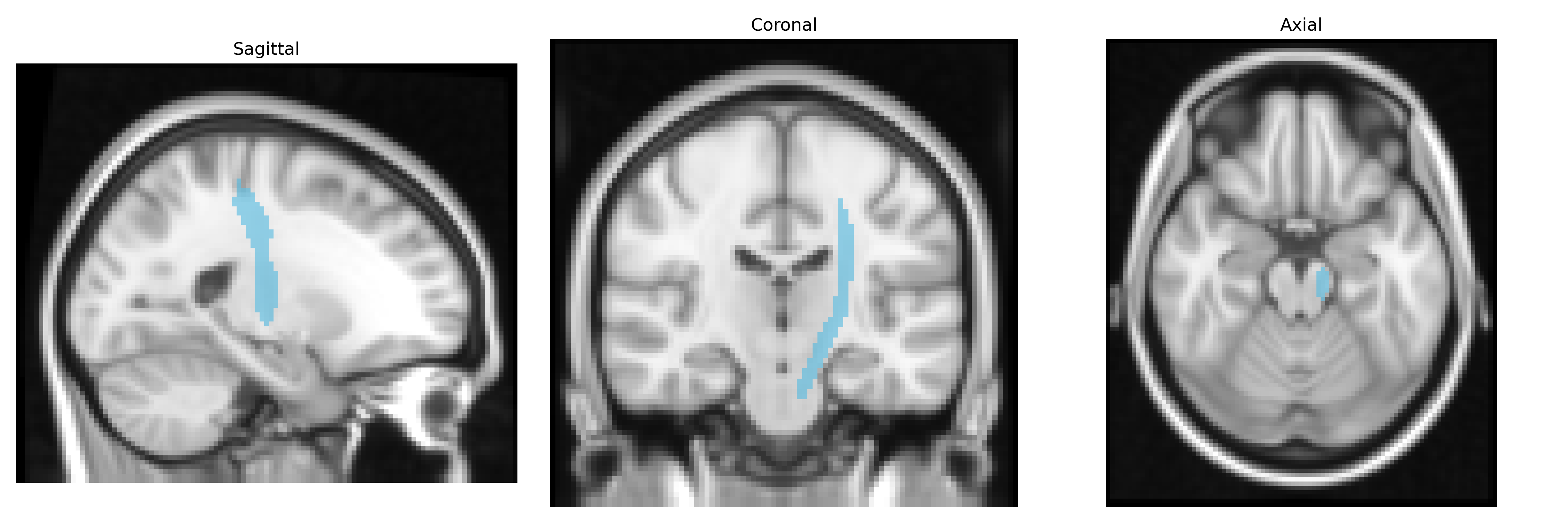
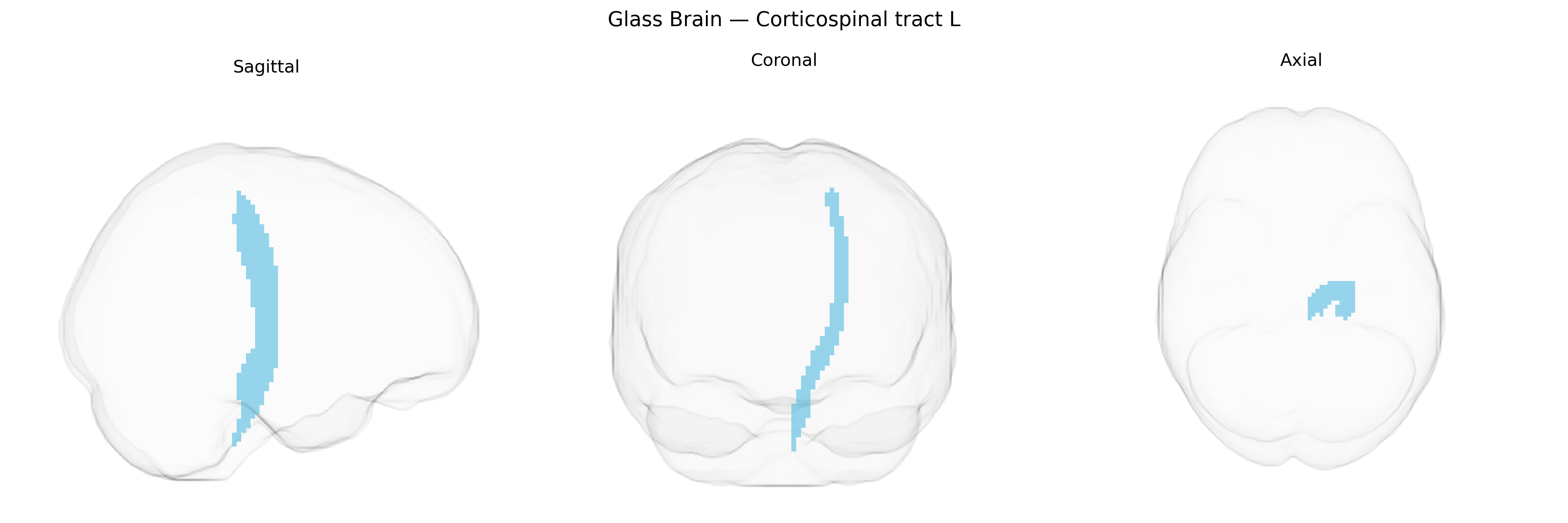
The bilateral corticospinal tract (L) is a major descending white matter pathway that originates primarily from the motor cortex and other frontal and parietal cortical areas, coursing through the corona radiata and posterior limb of the internal capsule, then descending via the cerebral peduncles in the midbrain, the ventral pons, and the medullary pyramids, where the majority of fibers decussate to form the lateral corticospinal tract in the spinal cord. This tract conveys upper motor neuron signals essential for the initiation, modulation, and precise control of voluntary movement, particularly of distal limb muscles. In the JHU ICBM tracts maxprob thr25 2mm Atlas, the bilateral corticospinal tract (L) label corresponds to probabilistic regions encompassing these descending fibers on the left side, reflecting their course from the cerebral cortex to the spinal cord. There is no dedicated Wikipedia article for this exact atlas-defined label; see the related structure Corticospinal tract.
Genetic associations involving the bilateral corticospinal tract, including the left tract as defined in the JHU ICBM tracts maxprob thr25 2mm atlas, largely derive from diffusion MRI GWAS and imaging–genetics studies that treat white-matter microstructure (e.g., fractional anisotropy, mean diffusivity) as quantitative endophenotypes. Variants in genes implicated in neuronal development, axon guidance, and myelination—such as those in pathways involving NTRK1/2, CNTN4/6, MAG, and other oligodendrocyte-related loci—have been associated with corticospinal tract integrity, though most findings are polygenic and distributed rather than region-specific. In large consortia (e.g., ENIGMA-type studies), common variants influencing overall intracranial volume, white matter integrity, and motor-related networks show effects that extend to the corticospinal tract, supporting its role as a structural mediator of genetic influences on motor function. Clinically, rare and common variants in genes causing or modulating hereditary spastic paraplegia (e.g., SPAST, ATL1, KIF5A), motor neuron diseases (e.g., SOD1, C9orf72), and certain leukodystrophies affect corticospinal tract integrity, as evidenced by tract-specific DTI changes, linking these genetic disruptions to degeneration or abnormal development of this pathway. GWAS of stroke, cerebral small vessel disease, and related vascular traits have also been associated with microstructural damage in the corticospinal tract, although findings typically reflect global white-matter vulnerability rather than tract-specific loci, and left–right distinctions in genetic effects are generally not strongly supported in current literature.
Overview generated by GPT-4o (2026).
Region ID: 3
Hemisphere: bilateral
Atlas: JHU ICBM tracts maxprob thr25 2mm
Full Quality Version: Download MP4
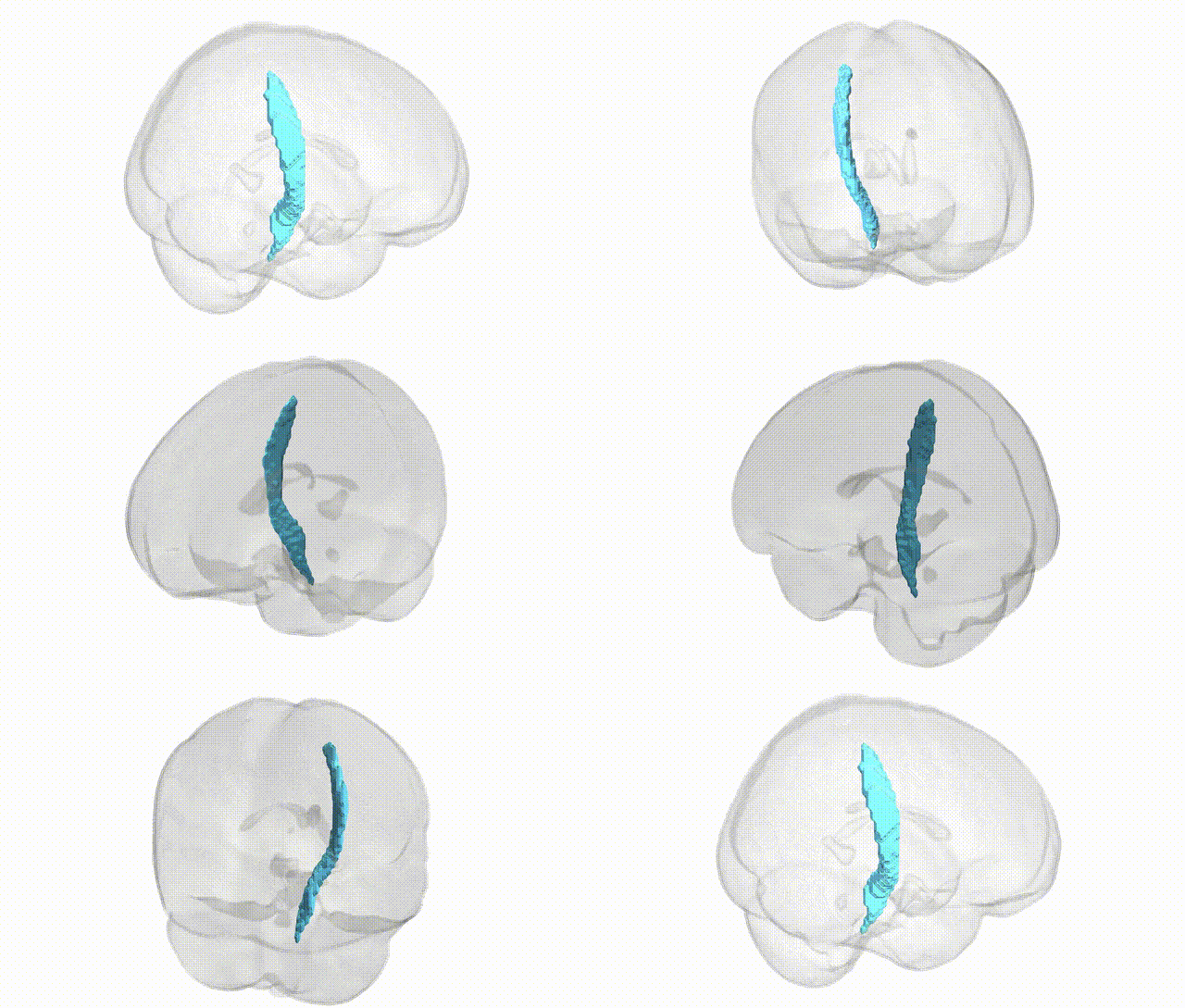
Full Quality Version: Download MP4
Wali Sidiqyar*, Gaurav Rudravaram*, Elyssa M. McMaster, Trent M. Schwartz, Adam M. Saunders, Kurt G. Schilling, Bennett A. Landman "Introducing SPINS: A Shared Public Visualization Library of Neuroanatomical Structures." Medical Imaging with Deep Learning- short paper
This resource is licensed under CC0 1.0 Universal (Public Domain).