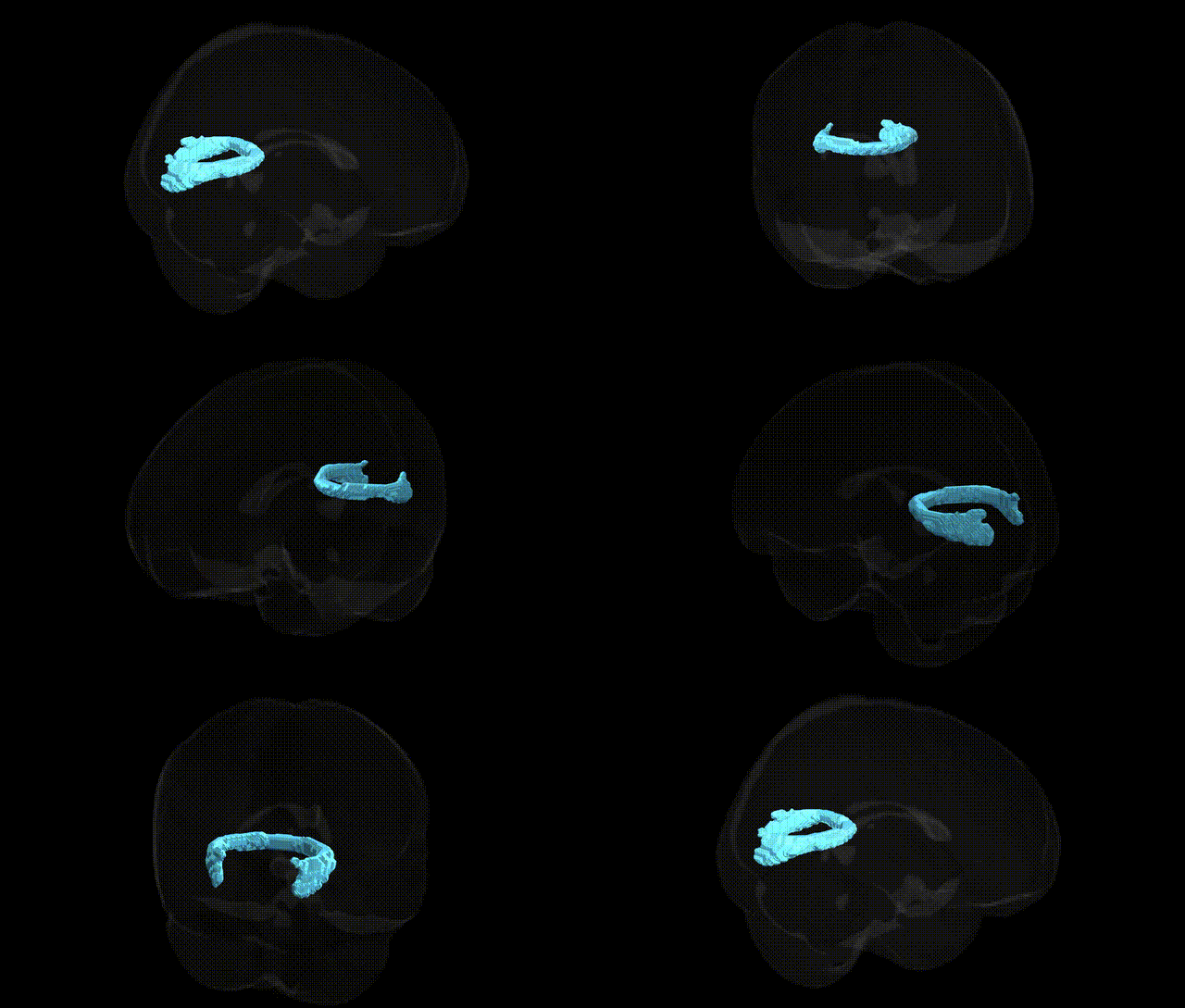
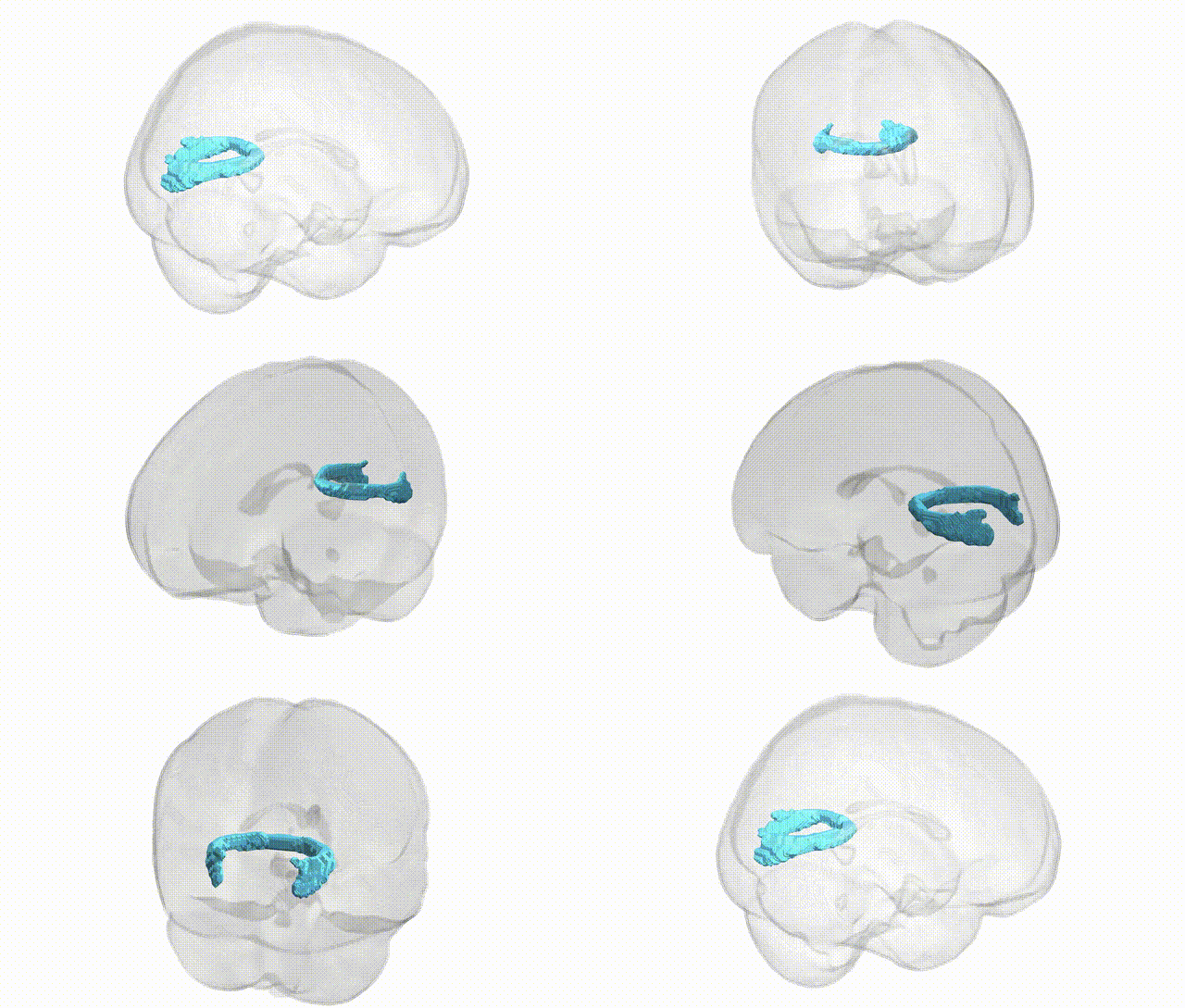
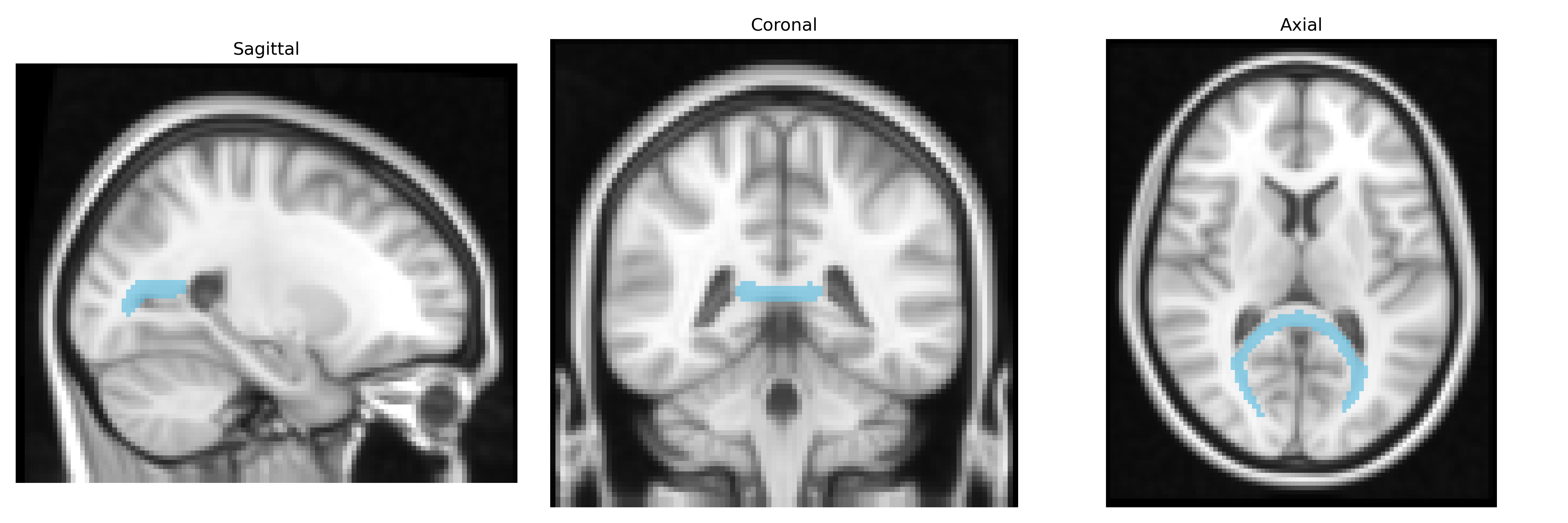
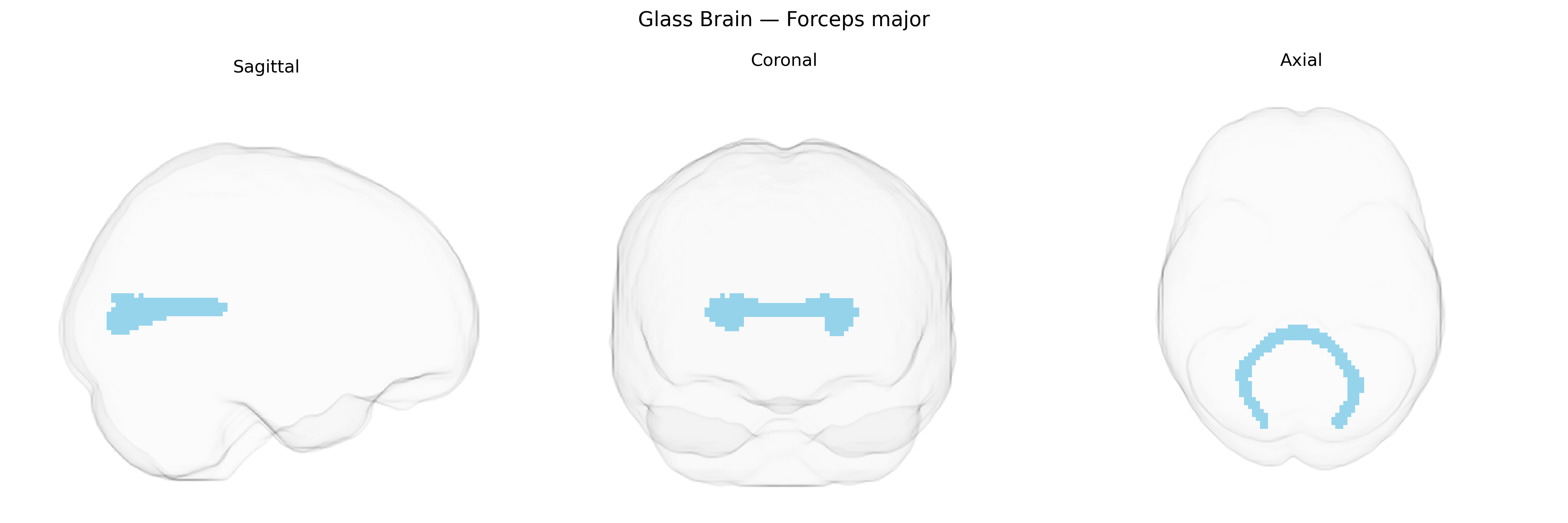
The bilateral Forceps major, as defined in the JHU ICBM tracts maxprob thr25 2mm Atlas, is a prominent commissural white matter tract composed of fibers of the splenium of the corpus callosum that curve posteriorly to interconnect homologous regions of the occipital lobes across the midline. Functionally, this tract supports interhemispheric integration of visual information, including coordination of visual perception, visuospatial processing, and higher-order visual cognition between the two cerebral hemispheres. The Forceps major forms part of the broader callosal system and is critical for synchronizing activity between bilateral visual cortices, thereby contributing to coherent binocular vision and unified visual awareness. There is no direct Wikipedia article for the Forceps major; a closely related structure is the Corpus callosum.
The bilateral Forceps major, a corpus callosum tract connecting occipital lobes and indexed in the JHU ICBM tracts maxprob thr25 2mm atlas, has been implicated in several genetic imaging and GWAS studies, though typically under broader corpus callosum or white-matter microstructure phenotypes rather than as an isolated tract. Variants in genes involved in myelination and axonal integrity—such as NTRK1, CNTN4, CNTNAP2, and loci near OLIG2 and MAG—have been associated with callosal white-matter measures (e.g., fractional anisotropy and tract volume) that include or overlap the Forceps major. Large-scale imaging genetics consortia (e.g., ENIGMA, UK Biobank analyses) report that common variants at multiple loci (including 3p21, 5q23–q31, 10q24, and 17q21) influence global and regional diffusion metrics of the corpus callosum; these, in turn, are linked to neurodevelopmental and psychiatric conditions such as schizophrenia, autism spectrum disorder, ADHD, and major depression, as well as cognitive traits like processing speed and general intelligence. In addition, rare callosal dysgenesis syndromes with known genetic causes (e.g., L1CAM, DCC, ARX mutations) affect posterior callosal fibers encompassing the Forceps major. However, published GWAS typically report associations at the level of corpus callosum subregions or global callosal integrity, so genetic findings for the Forceps major are best viewed as part of a broader pattern of callosal and posterior white-matter genetic influences rather than as tract-specific associations.
Overview generated by GPT-4o (2026).
Region ID: 9
Hemisphere: bilateral
Atlas: JHU ICBM tracts maxprob thr25 2mm
Full Quality Version: Download MP4
Full Quality Version: Download MP4
Wali Sidiqyar*, Gaurav Rudravaram*, Elyssa M. McMaster, Trent M. Schwartz, Adam M. Saunders, Kurt G. Schilling, Bennett A. Landman "Introducing SPINS: A Shared Public Visualization Library of Neuroanatomical Structures." Medical Imaging with Deep Learning- short paper
This resource is licensed under CC0 1.0 Universal (Public Domain).