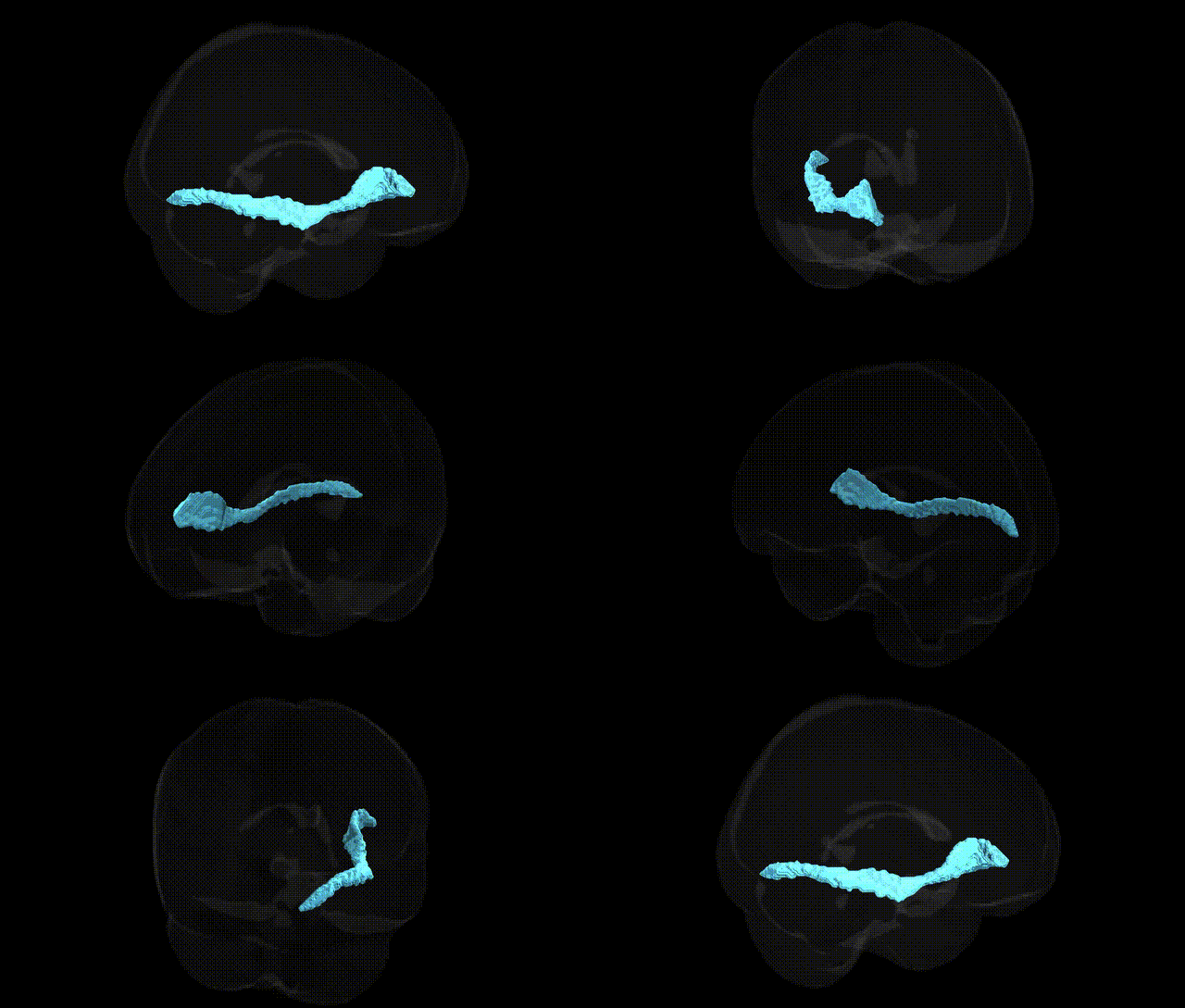
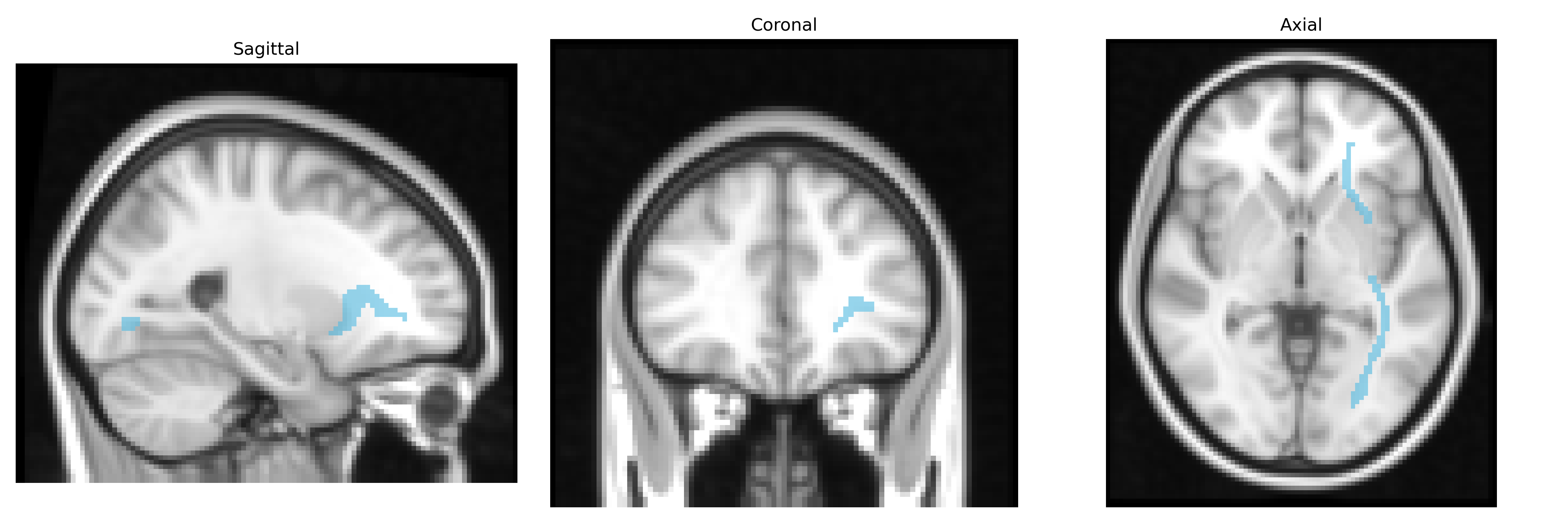
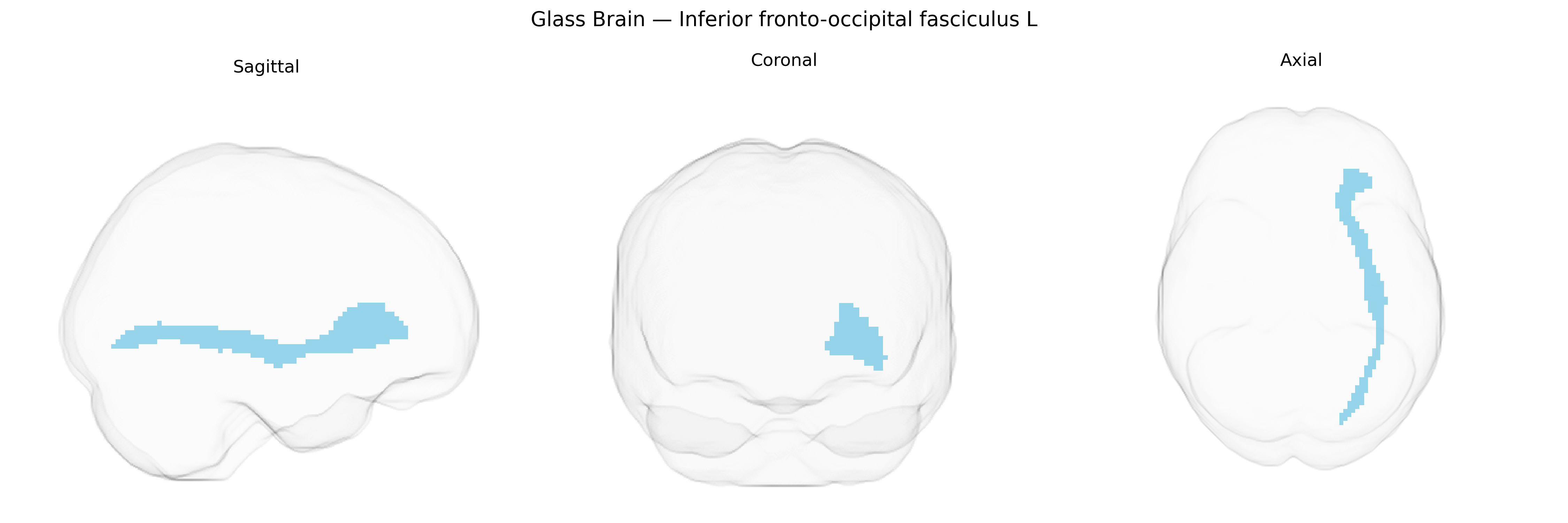
The bilateral Inferior fronto-occipital fasciculus (IFOF) is a major associative white matter tract that connects occipital and posterior temporal regions with the frontal lobe, coursing through the ventral part of the external and extreme capsules. In the left hemisphere, it plays a key role in semantic processing, language comprehension, and higher-order visual integration, contributing to the dorsal and ventral language networks as well as executive functions that depend on fronto-posterior communication. Structurally, the IFOF links visual and multimodal association cortices to prefrontal areas, supporting the integration of visual, linguistic, and cognitive information. In the JHU ICBM tracts maxprob thr25 2mm Atlas, this tract is delineated probabilistically, reflecting inter-individual variability while emphasizing its consistent anatomical pathway and functional relevance in supramodal cognition and language. There is no direct Wikipedia article for the Inferior fronto-occipital fasciculus; a related structure is the Association fiber.
The bilateral inferior fronto-occipital fasciculus (IFOF), as defined in the JHU ICBM tracts maxprob thr25 2mm Atlas, has been implicated in multiple genetic association studies through diffusion MRI–based GWAS of white matter microstructure, though findings typically reference IFOF diffusivity or fractional anisotropy measures rather than this atlas label specifically. Large consortia such as ENIGMA and UK Biobank have identified common variants in genes involved in axon guidance, myelination, and neural development (e.g., CNTN4, ROBO1/2, NRG1, MAG, and oligodendrocyte-related loci) that show significant associations with IFOF integrity metrics, and polygenic scores for general cognitive ability, educational attainment, and schizophrenia risk have been linked to variation in IFOF microstructure. In psychiatric and neurodevelopmental GWAS-informed imaging studies, the IFOF has emerged as a tract in which genetically driven alterations in connectivity are observed in schizophrenia, bipolar disorder, major depressive disorder, autism spectrum disorder, and ADHD, often in the context of genes related to synaptic plasticity and glutamatergic signaling (such as CACNA1C, ZNF804A, and GRM genes). Neurodegeneration-related genetic risk, including APOE ε4 in Alzheimer’s disease and variants influencing small-vessel disease burden, has also been associated with reduced IFOF integrity, suggesting a vascular and inflammatory genetic contribution to this tract’s vulnerability. Overall, genetic studies converge on the IFOF as a key association pathway whose microstructural variation is partly heritable and systematically related to polygenic liability for cognitive traits and multiple brain disorders, even though few loci are uniquely specific to the IFOF as opposed to broader white matter networks.
Overview generated by GPT-4o (2026).
Region ID: 11
Hemisphere: bilateral
Atlas: JHU ICBM tracts maxprob thr25 2mm
Full Quality Version: Download MP4
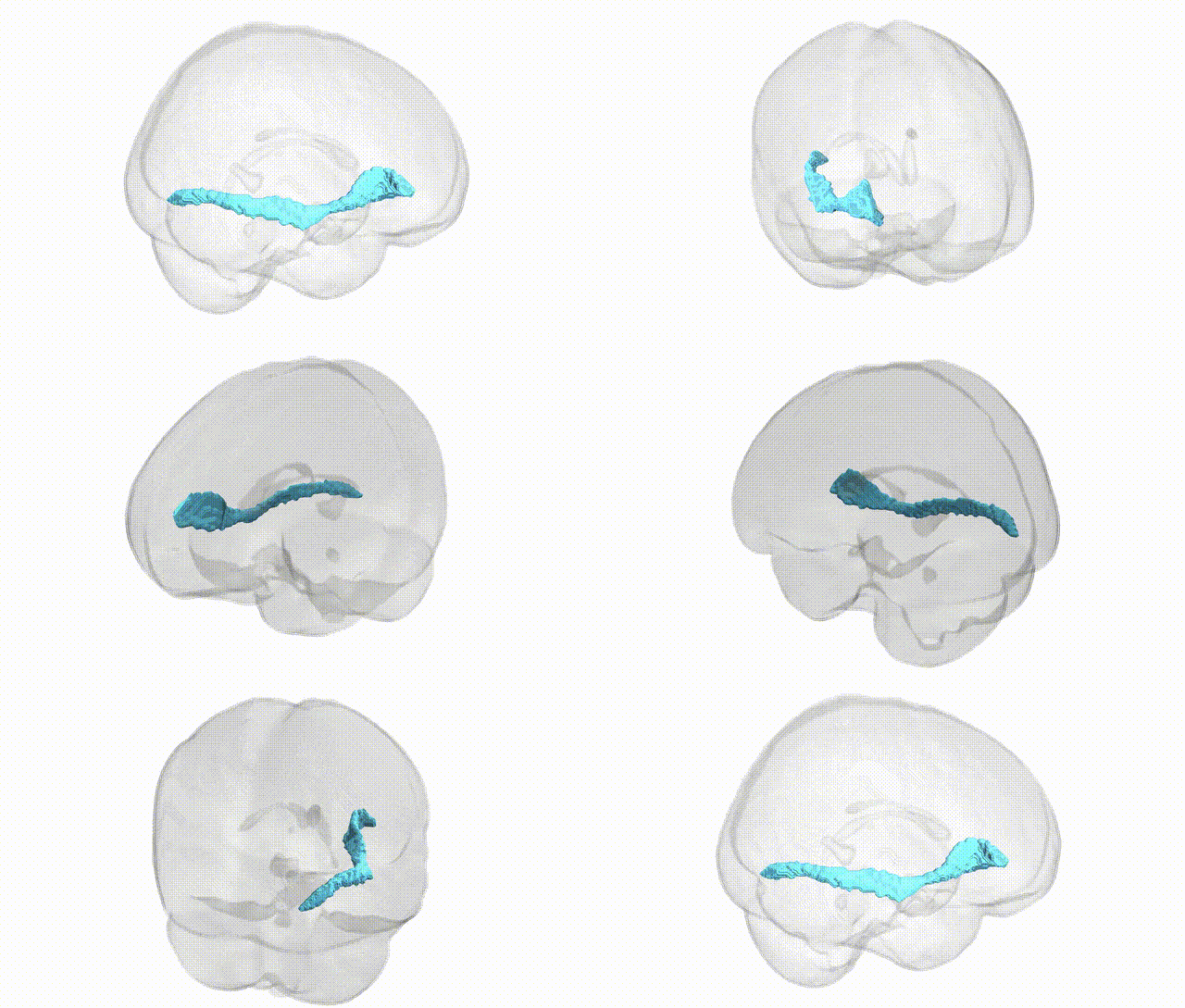
Full Quality Version: Download MP4
Wali Sidiqyar*, Gaurav Rudravaram*, Elyssa M. McMaster, Trent M. Schwartz, Adam M. Saunders, Kurt G. Schilling, Bennett A. Landman "Introducing SPINS: A Shared Public Visualization Library of Neuroanatomical Structures." Medical Imaging with Deep Learning- short paper
This resource is licensed under CC0 1.0 Universal (Public Domain).