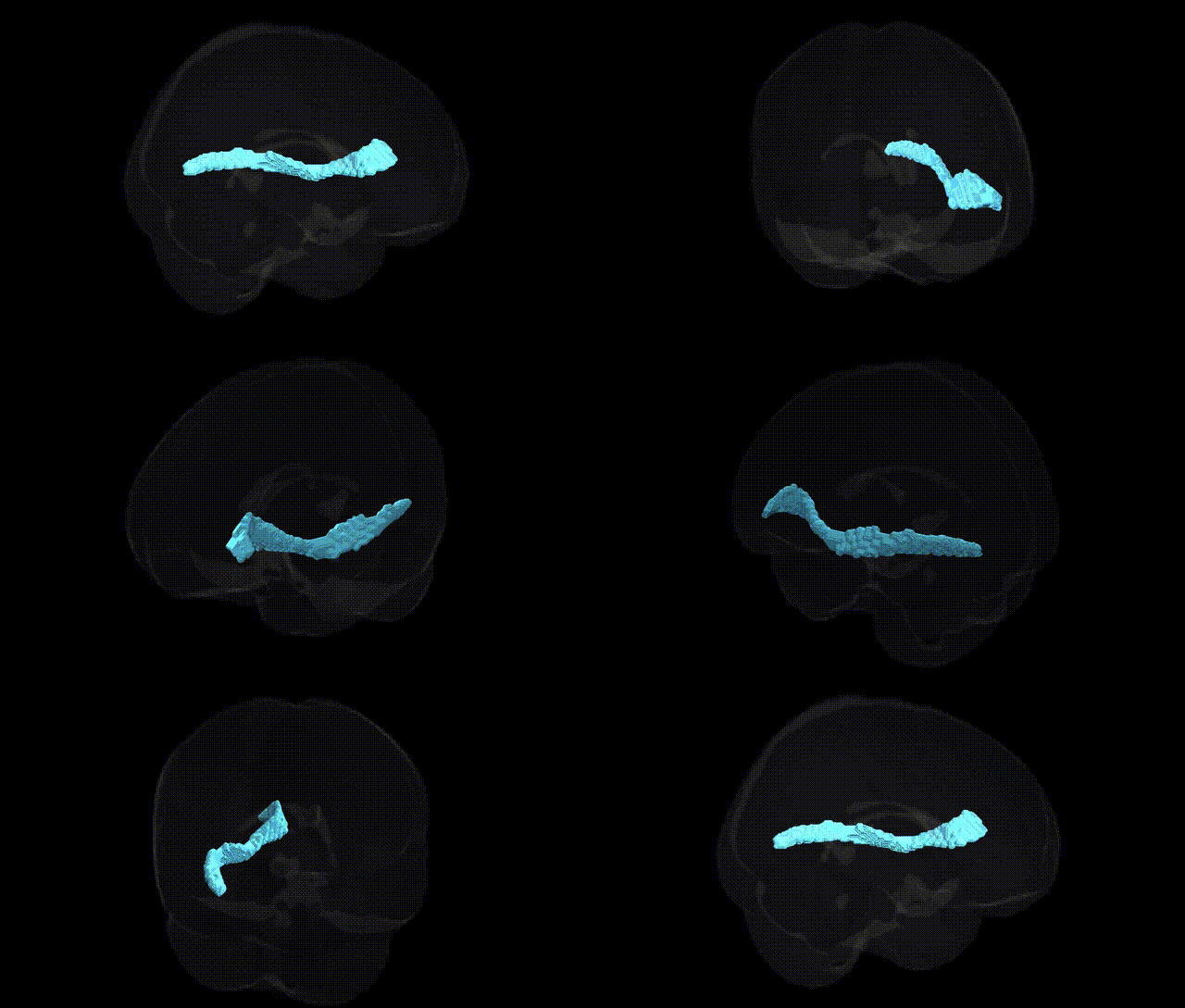
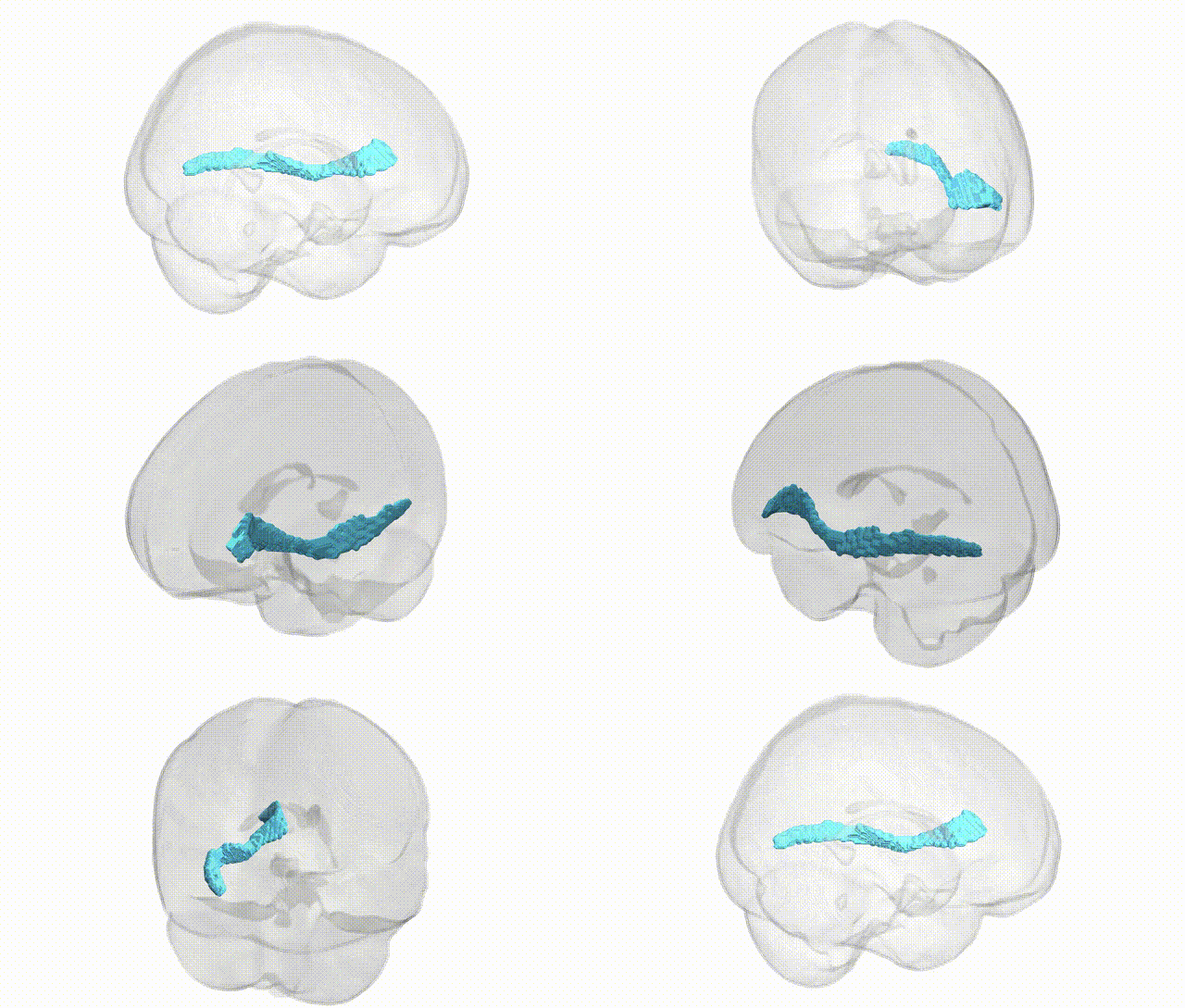
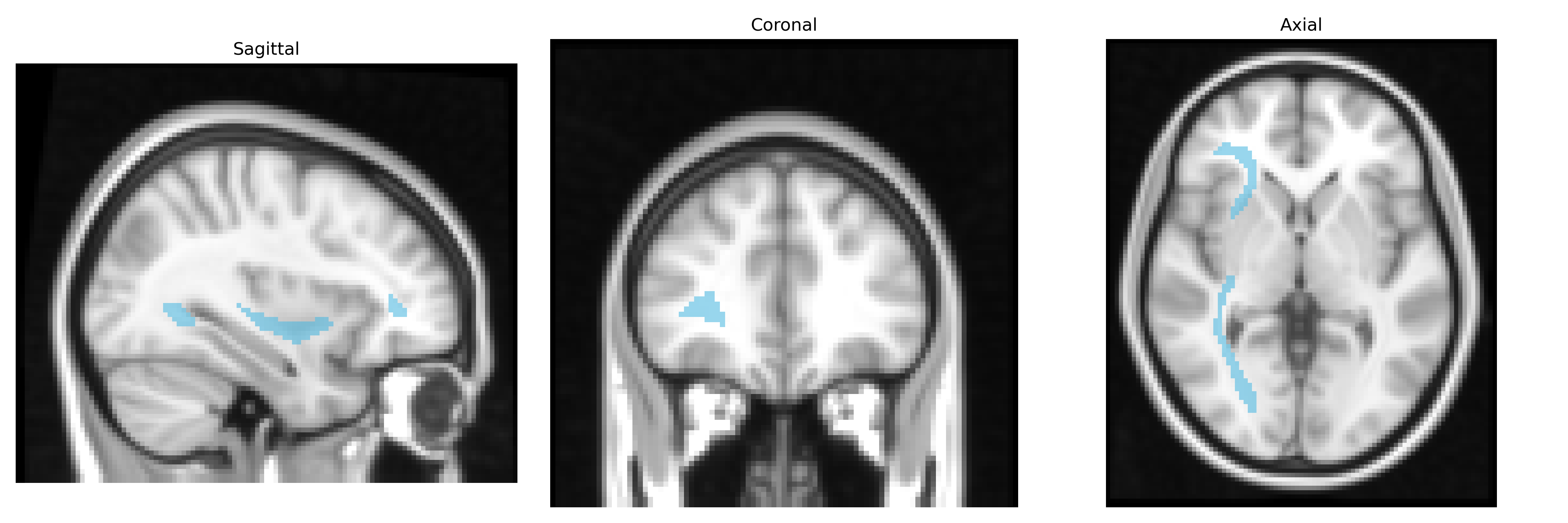
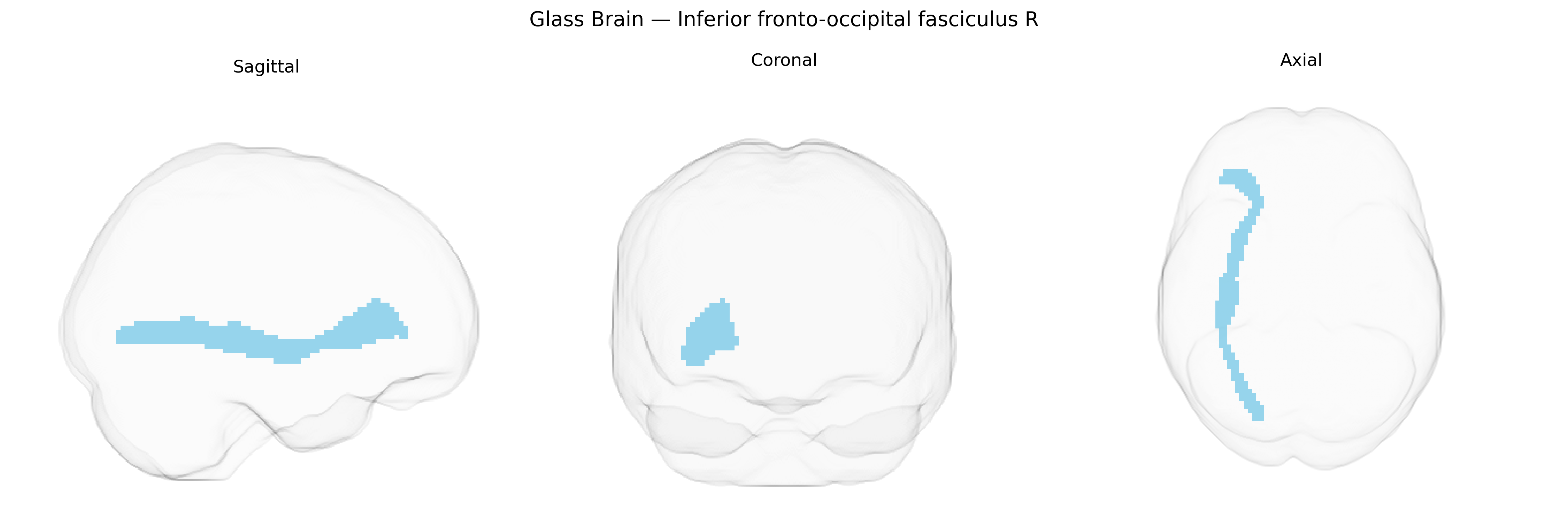
The bilateral inferior fronto-occipital fasciculus (IFOF) is a major associative white matter tract that connects frontal regions with occipital and posterior temporal cortices, coursing through the ventral portion of the external and extreme capsules and the lateral aspect of the basal ganglia. In the JHU ICBM tracts maxprob thr25 2mm Atlas, this tract is delineated probabilistically, reflecting its characteristic path from the frontal lobe, through the anterior floor of the external capsule and temporal stem, to the occipital lobe. The IFOF is implicated in higher-order cognitive functions, including semantic processing, visual information integration, language, and aspects of attention, and it plays a key role in large-scale brain networks that support visuospatial and language-related behaviors. There is no direct Wikipedia article specifically for the “Inferior fronto-occipital fasciculus”; a closely related structure is the Fronto-occipital fasciculus.
The inferior fronto-occipital fasciculus (IFOF), as defined in the JHU ICBM tracts maxprob thr25 2mm atlas (including the right-sided/bilateral IFOF R label), has been implicated in multiple genetic and GWAS-based findings that broadly map to white-matter microstructure rather than this tract alone, with associations typically captured via diffusion MRI metrics such as fractional anisotropy and mean diffusivity. Large-scale imaging–genetics consortia (e.g., ENIGMA, UK Biobank–based GWAS) have reported that common variants in genes involved in axon guidance, myelination, and neurodevelopment (including loci near or within genes such as NTRK3, MAG, and other oligodendrocyte- and cell-adhesion–related genes) contribute to inter-individual variability in IFOF white-matter integrity, although individual loci often do not remain specific to the IFOF when corrected across the full white-matter skeleton. Polygenic architectures linked to schizophrenia, bipolar disorder, major depressive disorder, and autism spectrum disorder show enrichment in tracts that include the IFOF, with case–control and PRS (polygenic risk score) analyses repeatedly identifying reduced IFOF integrity as part of broader fronto-temporal and fronto-occipital dysconnectivity, particularly in psychotic and mood disorders. In addition, GWAS of cognitive traits (e.g., general intelligence, processing speed, educational attainment) and language-related abilities have shown that genetic variants associated with higher cognitive performance also predict higher integrity or larger volume in association tracts that include the IFOF, suggesting that pleiotropic neurodevelopmental loci influence both cognitive outcomes and the structure of this pathway. Overall, genetic influences on the IFOF R appear to be highly polygenic, shared with other association tracts, and mediated by genes affecting neurodevelopment, axonal organization, and myelin biology rather than by variants uniquely targeting this specific tract.
Overview generated by GPT-4o (2026).
Region ID: 12
Hemisphere: bilateral
Atlas: JHU ICBM tracts maxprob thr25 2mm
Full Quality Version: Download MP4
Full Quality Version: Download MP4
Wali Sidiqyar*, Gaurav Rudravaram*, Elyssa M. McMaster, Trent M. Schwartz, Adam M. Saunders, Kurt G. Schilling, Bennett A. Landman "Introducing SPINS: A Shared Public Visualization Library of Neuroanatomical Structures." Medical Imaging with Deep Learning- short paper
This resource is licensed under CC0 1.0 Universal (Public Domain).