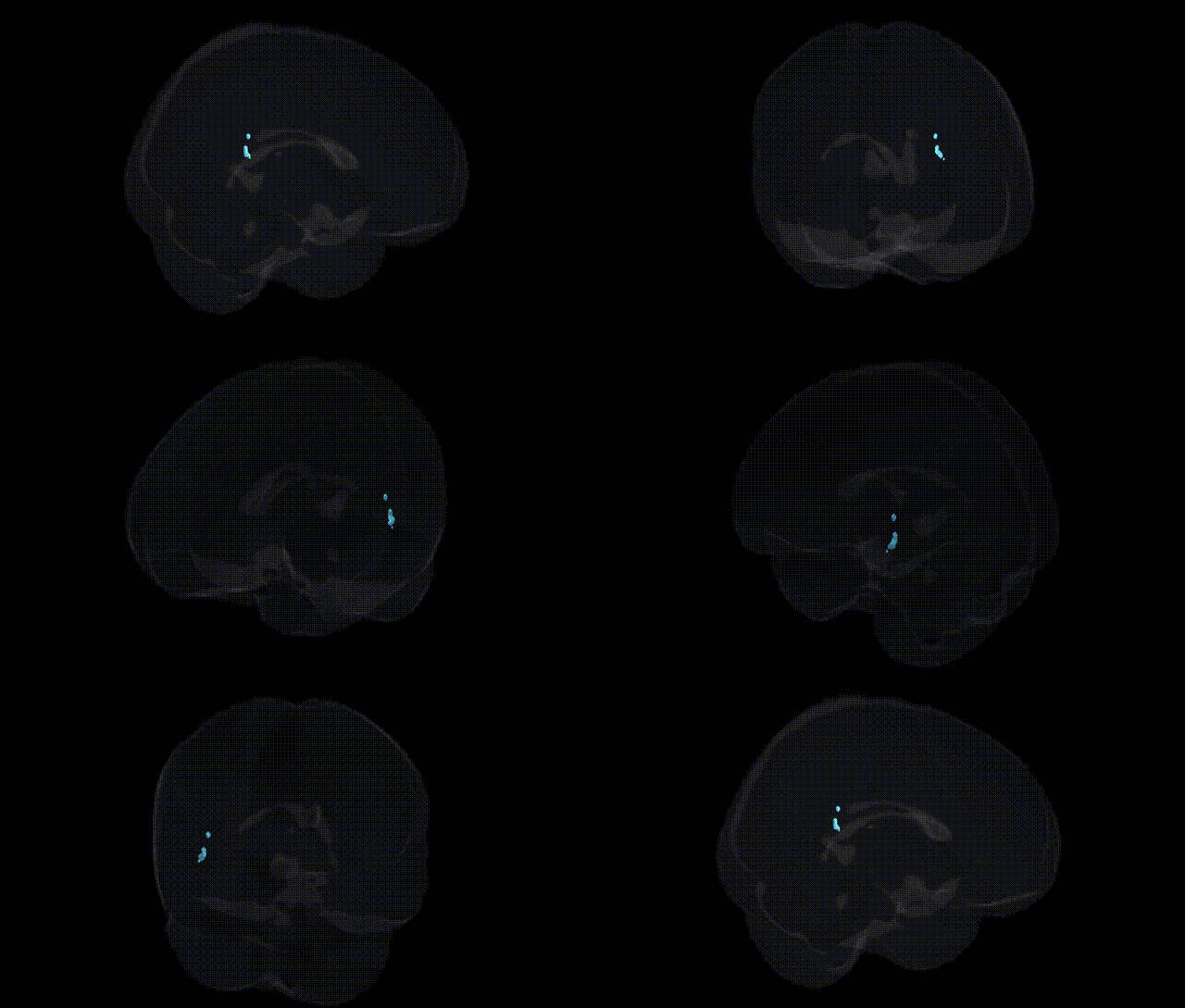
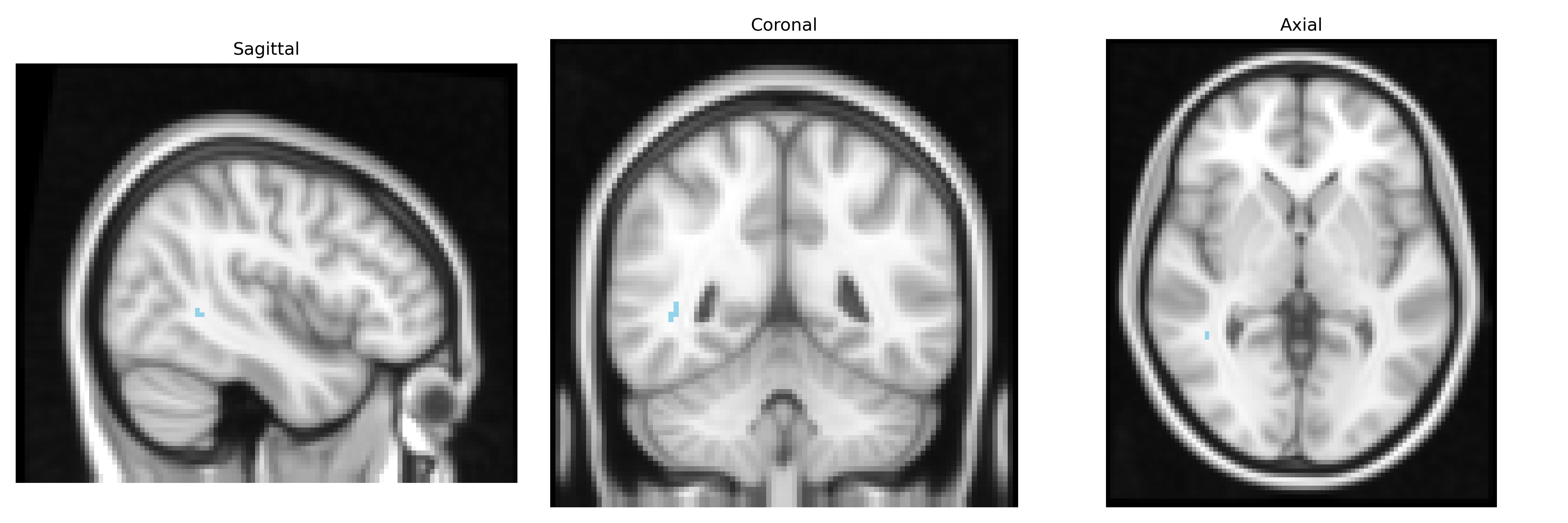
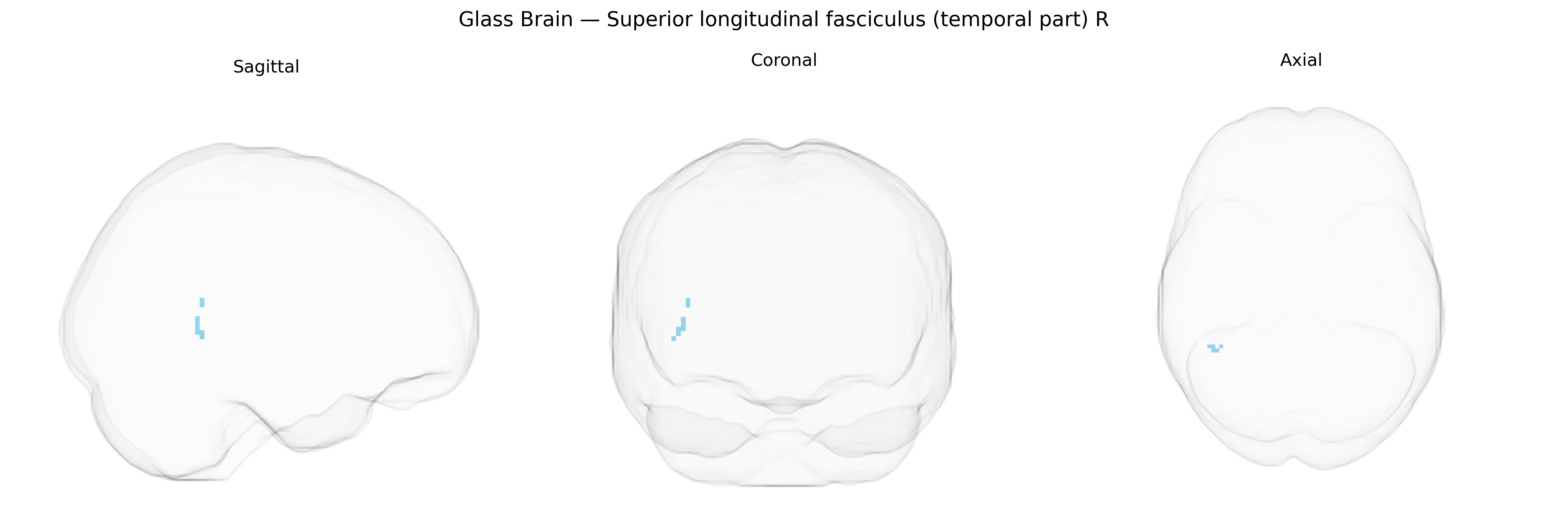
The bilateral Superior longitudinal fasciculus (temporal part) R, as defined in the JHU ICBM tracts maxprob thr25 2mm Atlas, is a major right-hemispheric association fiber pathway linking posterior temporal regions with frontal and parietal cortices. Running deep to the lateral sulcus and arching within the white matter, this temporal segment forms part of the broader superior longitudinal fasciculus system involved in language, auditory–motor integration, and higher-order cognitive processing. It contributes to the coordination of receptive language areas in the posterior temporal lobe with frontal executive and speech production regions, supporting functions such as verbal working memory, semantic processing, and aspects of attention. There is no direct link for this specific subcomponent; a related structure is the Superior longitudinal fasciculus.
The bilateral superior longitudinal fasciculus (temporal part) R, as defined in the JHU ICBM tracts atlas, is part of a major fronto-temporo-parietal association pathway whose microstructural properties (typically indexed by diffusion MRI measures such as fractional anisotropy and mean diffusivity) show moderate heritability in twin and family studies and have been associated in GWAS with common variants influencing neurodevelopment, axon guidance, and myelination (including loci near genes such as CNTNAP2, NRG1/3, and various cell-adhesion and oligodendrocyte-related genes, though often at tract-level rather than segment-specific resolution). Large imaging-genetics consortia (e.g., ENIGMA-related studies) have identified polygenic influences on SLF integrity that overlap with genetic architectures for cognitive performance, educational attainment, general intelligence, and language-related abilities, consistent with the tract’s role in dorsal language and attention networks. Altered structure or connectivity of the SLF, including temporal portions, has been repeatedly implicated in neurodevelopmental and psychiatric disorders such as schizophrenia, ADHD, autism spectrum disorder, and dyslexia, where risk variants and polygenic risk scores for these conditions correlate with SLF diffusion metrics; in schizophrenia and bipolar disorder, for example, genetic liability is associated with reduced SLF integrity in fronto-temporal segments, and in dyslexia and language impairment, variants affecting cortical development and axonal connectivity show associations with SLF language-pathway microstructure. In neurodegenerative conditions such as Alzheimer’s disease, GWAS-derived polygenic risk scores and APOE-related risk have also been linked to accelerated white matter changes in long association tracts including the SLF, suggesting that common genetic variation contributes to vulnerability of this temporal segment as part of broader network-level white matter pathology rather than as an isolated region.
Overview generated by GPT-4o (2026).
Region ID: 20
Hemisphere: bilateral
Atlas: JHU ICBM tracts maxprob thr25 2mm
Full Quality Version: Download MP4
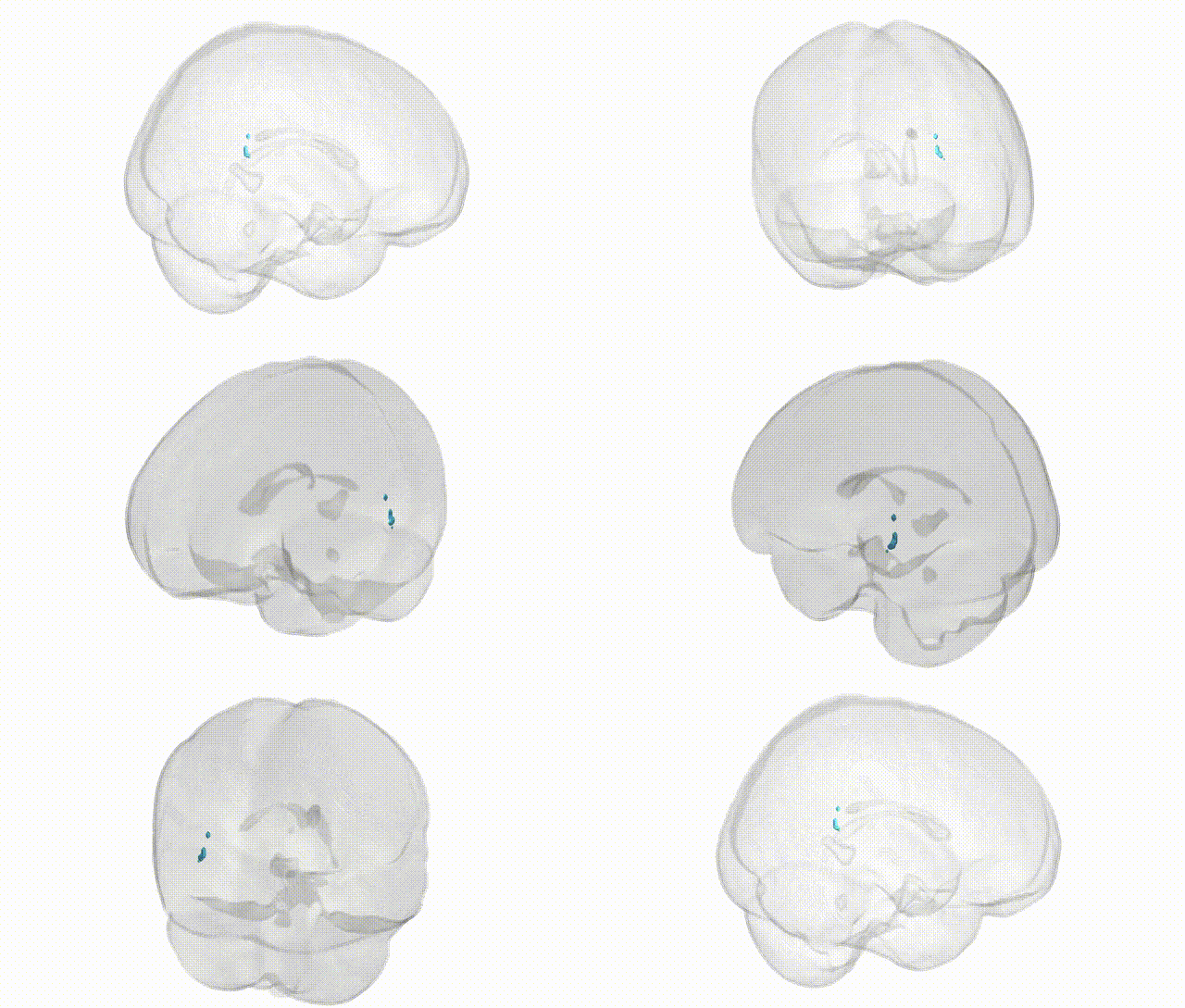
Full Quality Version: Download MP4
Wali Sidiqyar*, Gaurav Rudravaram*, Elyssa M. McMaster, Trent M. Schwartz, Adam M. Saunders, Kurt G. Schilling, Bennett A. Landman "Introducing SPINS: A Shared Public Visualization Library of Neuroanatomical Structures." Medical Imaging with Deep Learning- short paper
This resource is licensed under CC0 1.0 Universal (Public Domain).