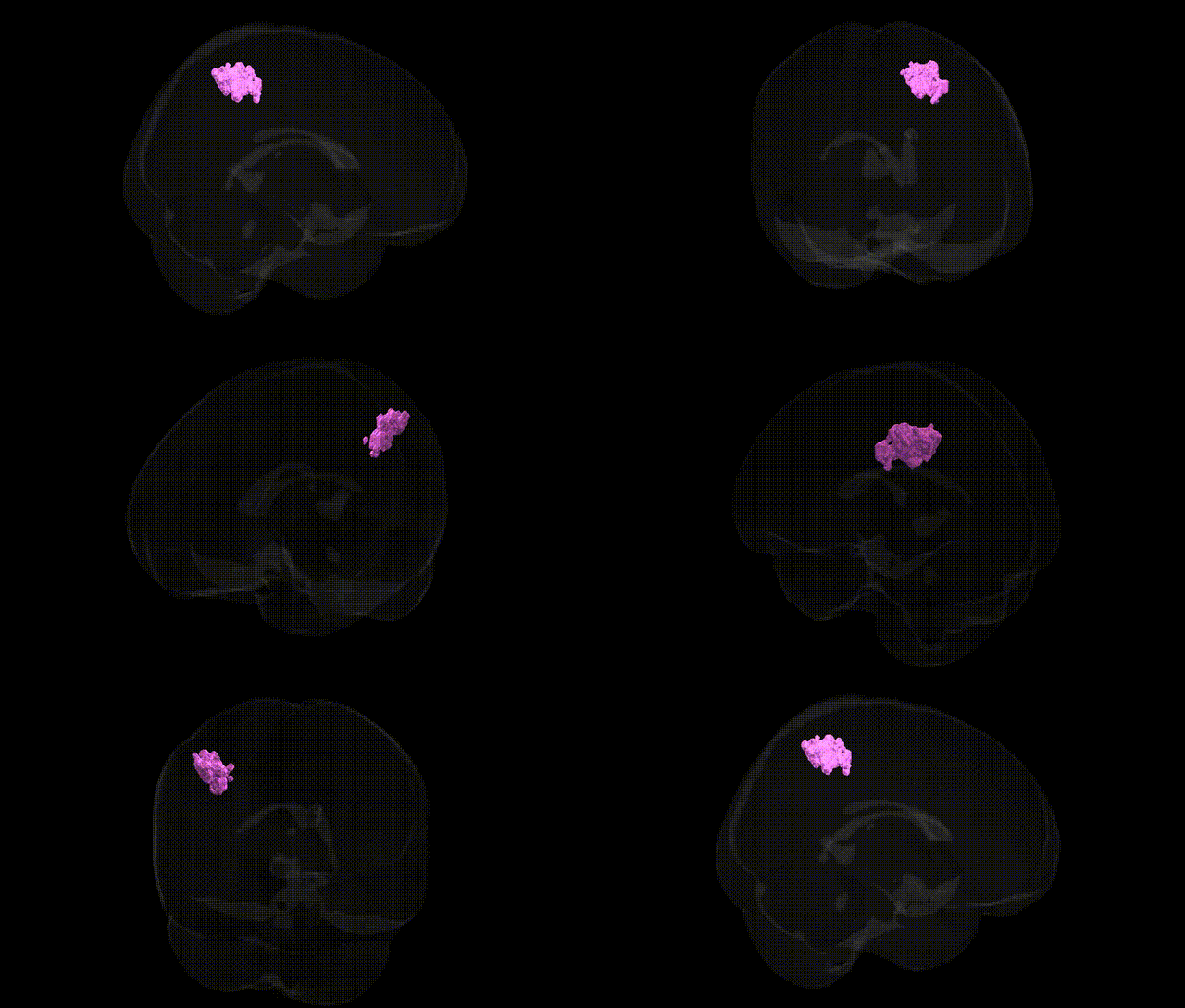
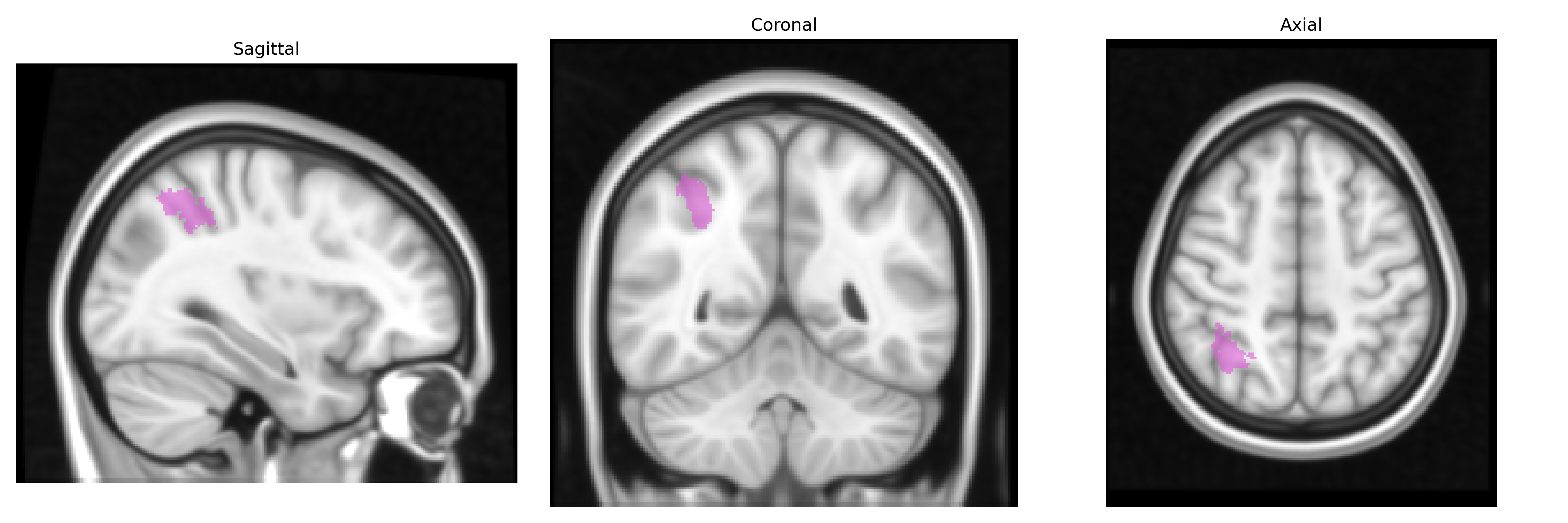
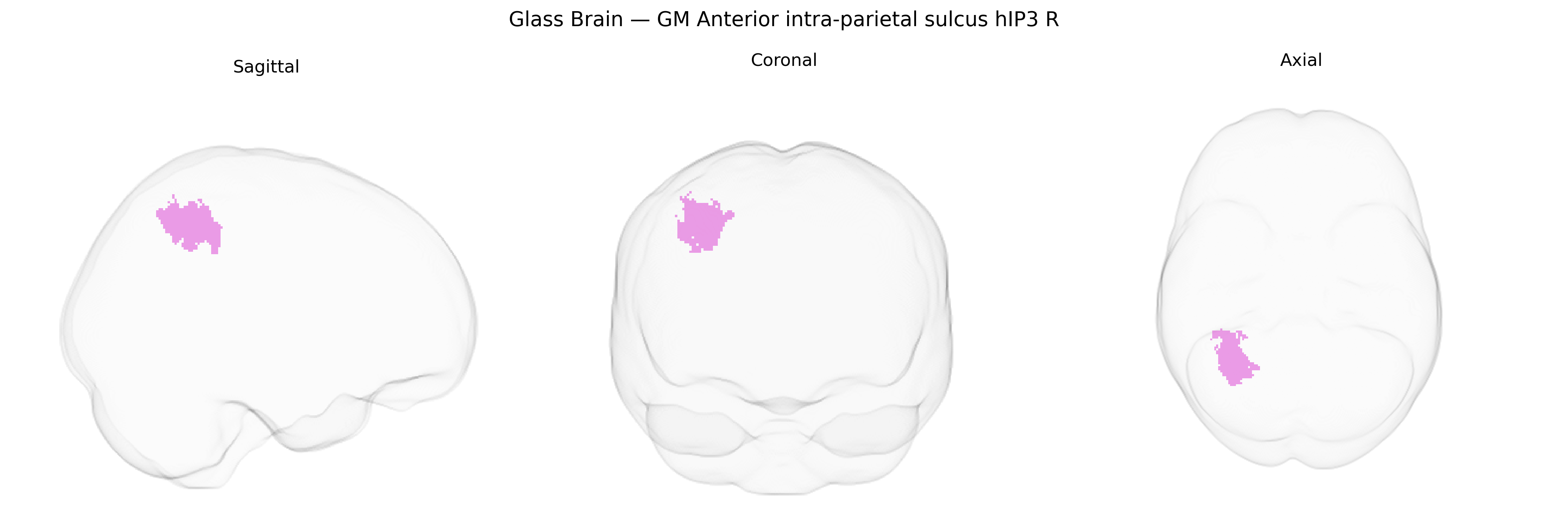
The bilateral GM Anterior intra-parietal sulcus hIP3 R region, defined in the Juelich maxprob thr25 1mm Atlas, corresponds to a cytoarchitectonically and functionally specialized subregion of the human intraparietal sulcus within the posterior parietal cortex. It is implicated in visuomotor integration, object-directed actions, and higher-order aspects of attention and visuospatial processing, often associated with tasks requiring grasp planning, sensorimotor transformations, and manipulation of objects in peripersonal space. This area forms part of a broader intraparietal network that interacts with dorsal visual and premotor regions to support goal-directed behavior and spatial cognition. There is no direct Wikipedia article for hIP3; a related structure is the Intraparietal sulcus.
The bilateral GM Anterior intra-parietal sulcus hIP3 R region, part of the intraparietal sulcus implicated in visuomotor integration, numeric and magnitude processing, and attention, has been indirectly linked to several genetic associations through imaging-genetics and GWAS-based brain mapping rather than region-specific single-gene findings. Large-scale neuroimaging GWAS (e.g., ENIGMA, UK Biobank) have identified SNPs in genes related to synaptic plasticity, neurodevelopment, and axon guidance (such as variants near genes involved in Wnt signaling, cell adhesion, and glutamatergic function) that influence parietal cortical thickness, surface area, and sulcal morphology, encompassing the anterior intraparietal sulcus. Polygenic risk scores for neurodevelopmental and psychiatric disorders—including schizophrenia, attention-deficit/hyperactivity disorder, autism spectrum disorder, and major depressive disorder—have been associated with structural and functional alterations in intraparietal regions involved in working memory, attention, and cognitive control, which overlap anatomically with hIP3. In addition, GWAS of cognitive traits such as general intelligence, mathematical ability, working memory, and educational attainment have shown that higher polygenic scores are associated with increased functional activation and/or structural differences in intraparietal cortex during number processing and visuospatial tasks. While no single genetic variant has been uniquely and conclusively tied specifically to the Juelich hIP3 R parcel, convergent evidence indicates that common polygenic architectures for cognition, neurodevelopmental disorders, and psychiatric conditions modulate the structure and function of this anterior intraparietal region.
Overview generated by GPT-4o (2026).
Region ID: 6
Hemisphere: bilateral
Atlas: Juelich maxprob thr25 1mm
Full Quality Version: Download MP4
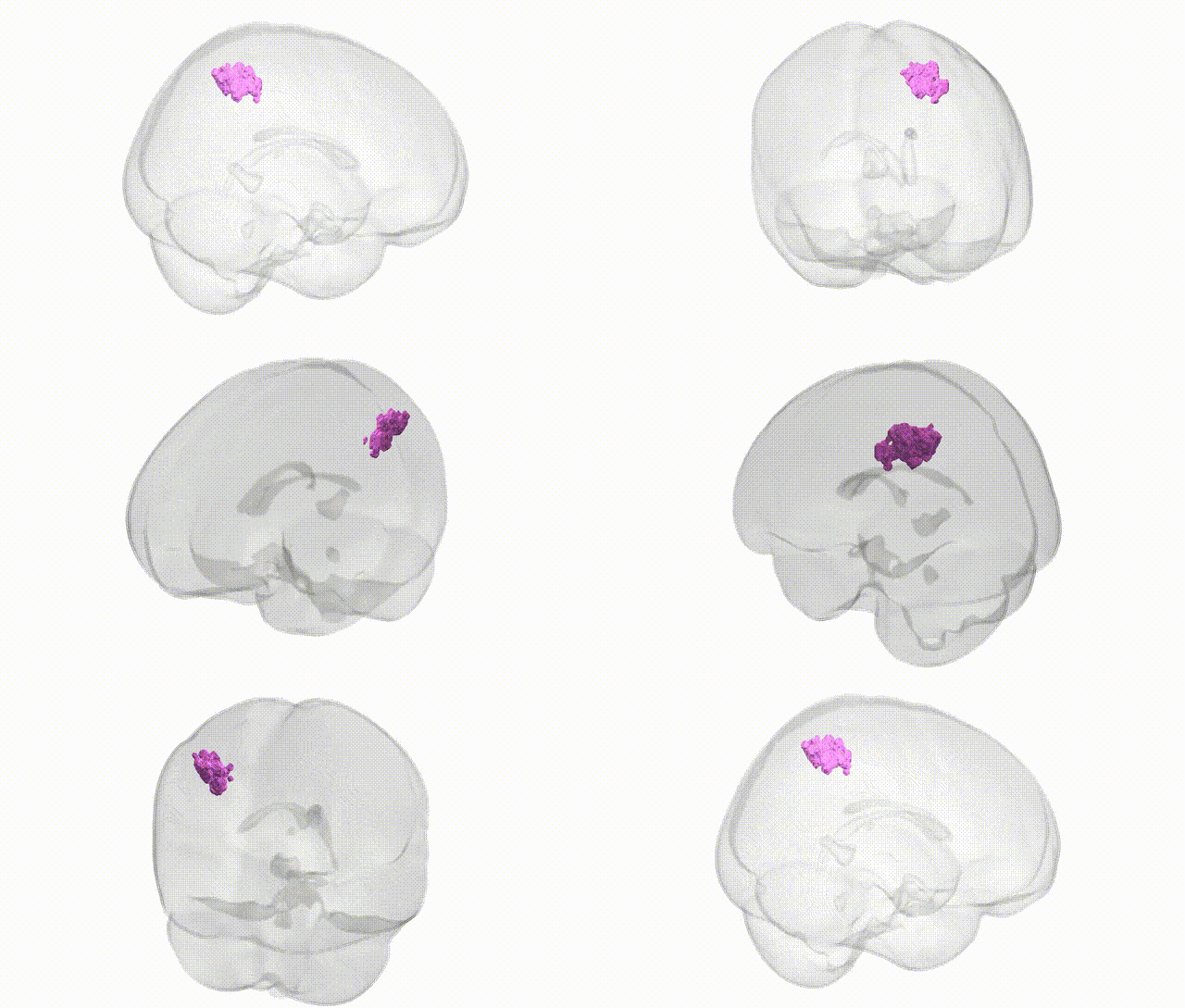
Full Quality Version: Download MP4
Wali Sidiqyar*, Gaurav Rudravaram*, Elyssa M. McMaster, Trent M. Schwartz, Adam M. Saunders, Kurt G. Schilling, Bennett A. Landman "Introducing SPINS: A Shared Public Visualization Library of Neuroanatomical Structures." Medical Imaging with Deep Learning- short paper
This resource is licensed under CC0 1.0 Universal (Public Domain).