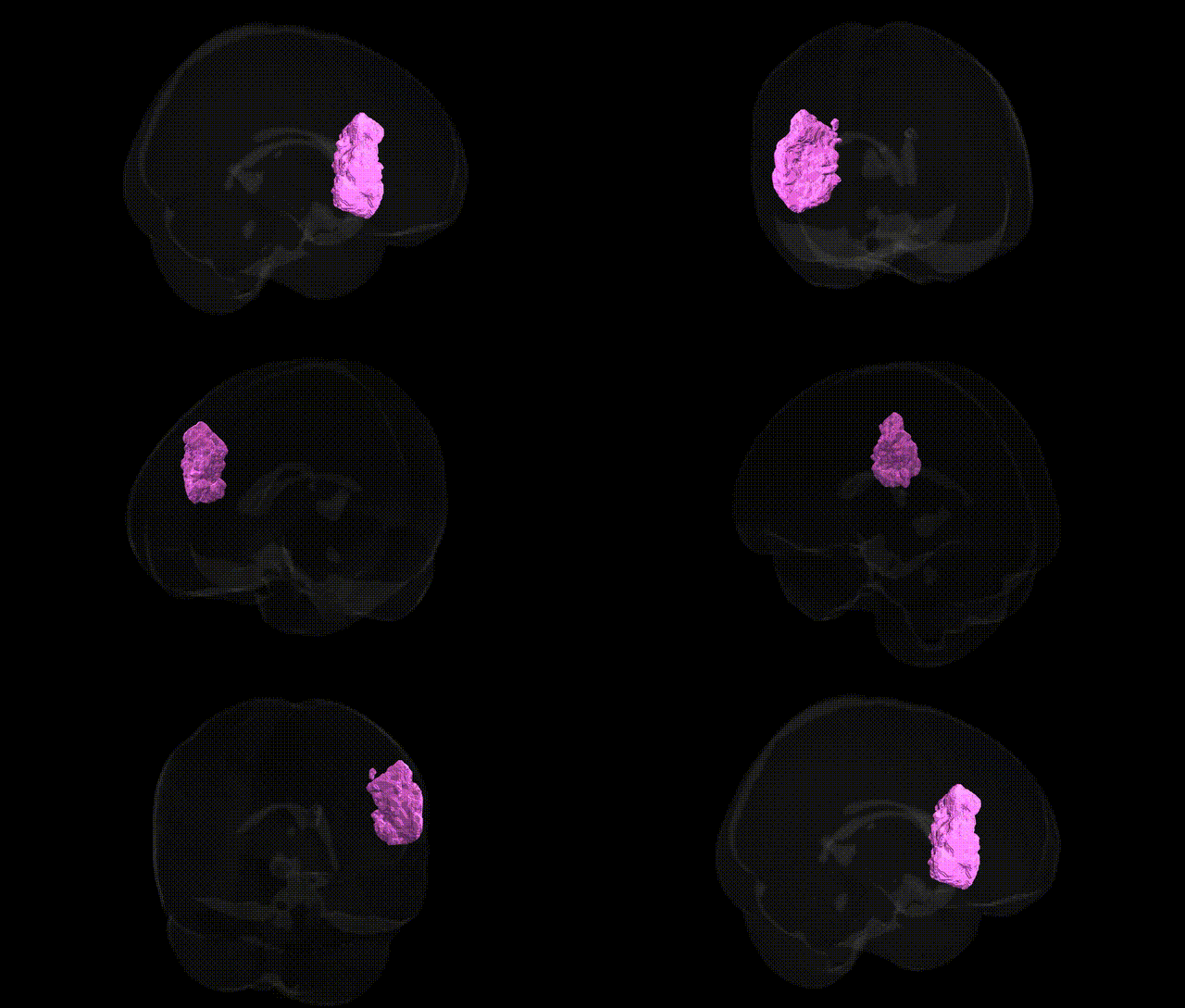
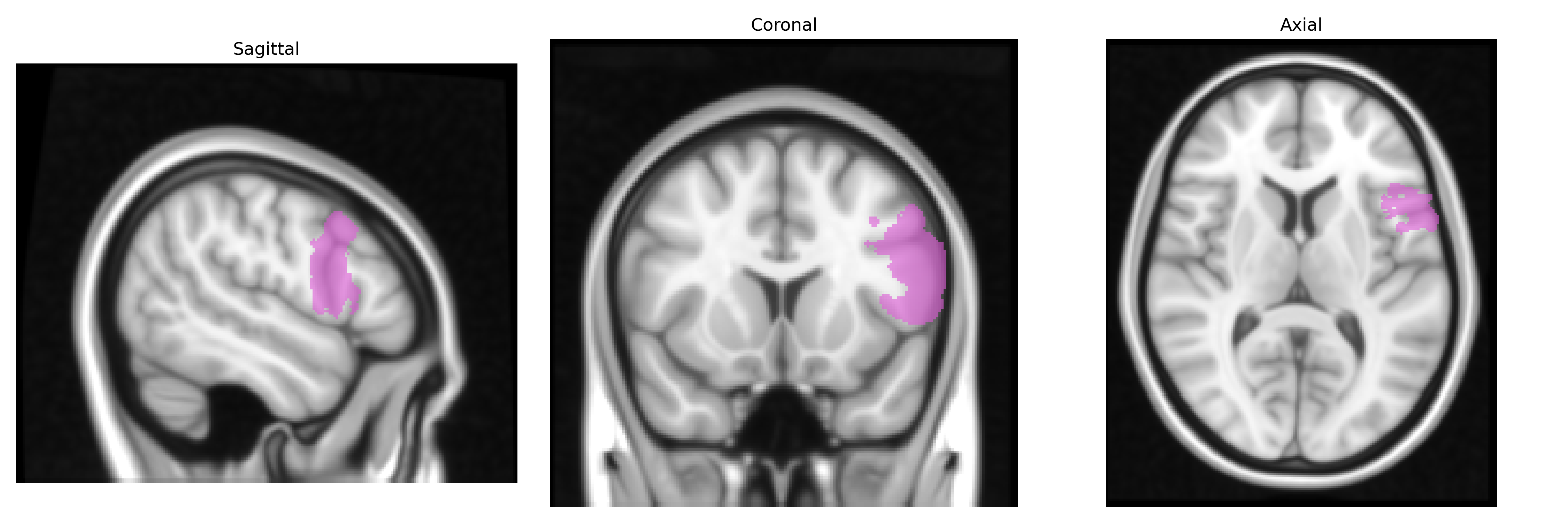
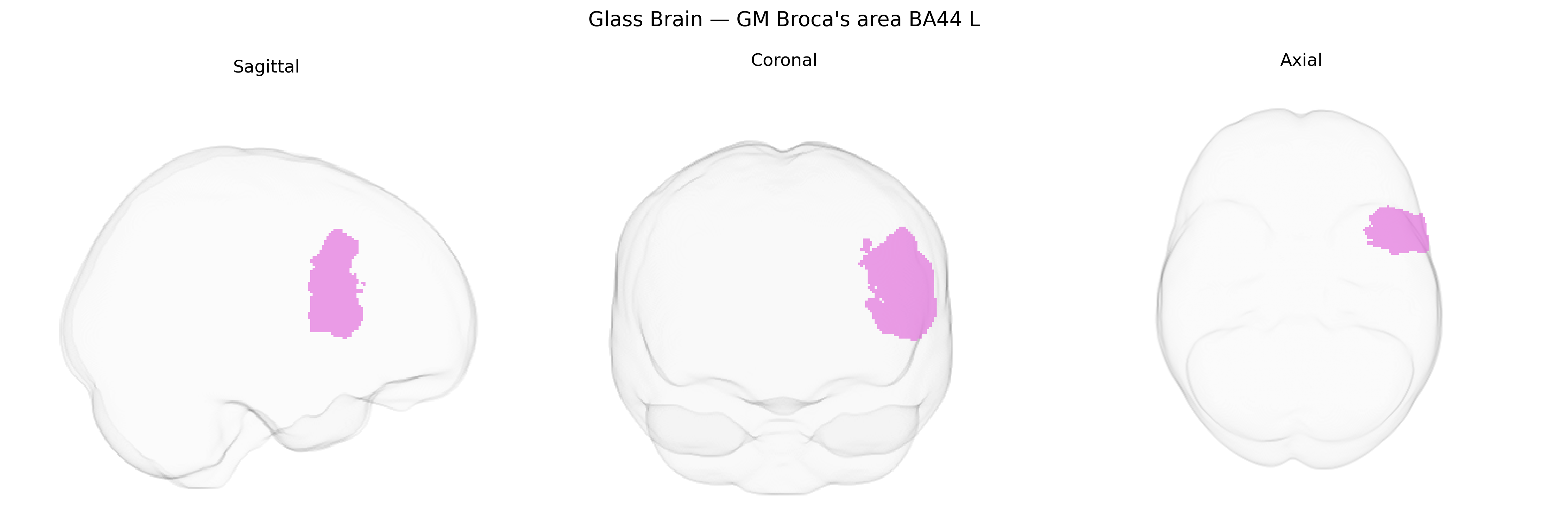
The bilateral GM Broca’s area BA44 L, defined in the Juelich maxprob thr25 1 mm atlas, corresponds to the left cytoarchitectonic subdivision of Brodmann area 44, a key component of Broca’s region in the inferior frontal gyrus (pars opercularis). This cortical field is characterized by its agranular frontal cytoarchitecture and dense connectivity with premotor, motor, temporal, and parietal cortices, as well as subcortical structures via major white‑matter tracts (e.g., arcuate fasciculus, frontal aslant tract). Functionally, BA44 is critically involved in speech and language production, syntactic and phonological processing, and aspects of verbal working memory and action sequencing. In the left hemisphere, it plays a dominant role in the motor planning of articulation and higher‑order linguistic operations, integrating sensorimotor representations with linguistic information. There is no direct Wikipedia article for “BA44” or “Broca’s area BA44 L”; a closely related entry is Broca’s area.
Genetic associations involving the left Broca’s area (BA44) as defined in the Juelich maxprob atlas largely derive from imaging genetics and GWAS linking structural or functional variation in this region to language, cognition, and neuropsychiatric traits. Variants in FOXP2, a key speech and language gene, have been repeatedly related to altered activation and connectivity of Broca’s area during language tasks, while common polymorphisms near CNTNAP2 and KIAA0319 (language and dyslexia-related genes) have been associated with differences in cortical structure or language performance implicating BA44. Large-scale GWAS of brain morphology (e.g., ENIGMA and UK Biobank studies) have identified loci influencing cortical thickness and surface area in inferior frontal regions overlapping Broca’s area, with some of these loci also linked to educational attainment, general cognitive ability, and reading/spelling skills. Moreover, schizophrenia, autism spectrum disorder, and developmental language disorder GWAS and candidate-gene studies have shown that risk variants affecting synaptic function, neuronal migration, and transcriptional regulation can modulate activity and connectivity in left inferior frontal gyrus, including BA44, contributing to abnormalities in speech production, verbal fluency, and social communication that converge on Broca’s circuitry.
Overview generated by GPT-4o (2026).
Region ID: 13
Hemisphere: bilateral
Atlas: Juelich maxprob thr25 1mm
Full Quality Version: Download MP4
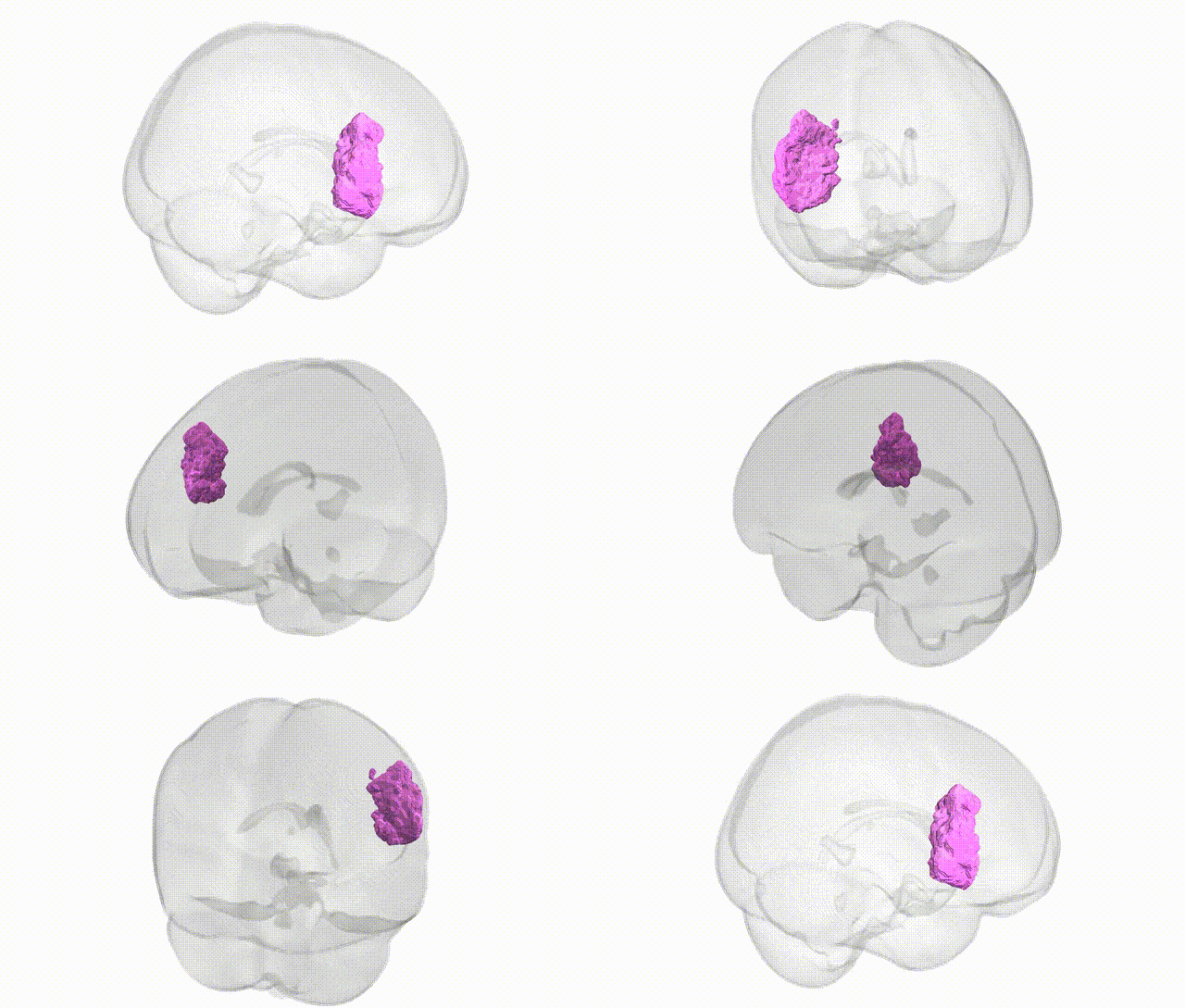
Full Quality Version: Download MP4
Wali Sidiqyar*, Gaurav Rudravaram*, Elyssa M. McMaster, Trent M. Schwartz, Adam M. Saunders, Kurt G. Schilling, Bennett A. Landman "Introducing SPINS: A Shared Public Visualization Library of Neuroanatomical Structures." Medical Imaging with Deep Learning- short paper
This resource is licensed under CC0 1.0 Universal (Public Domain).