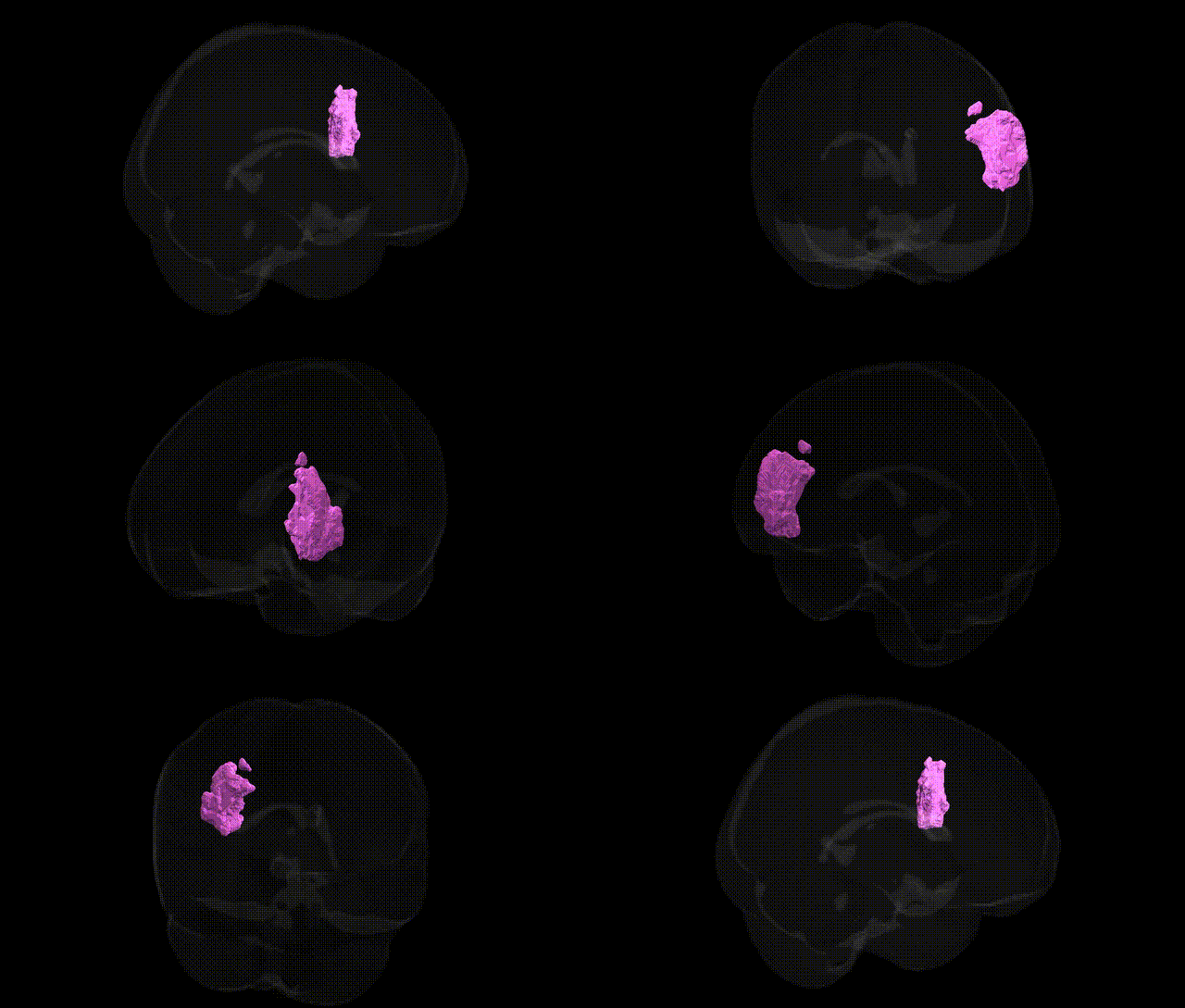
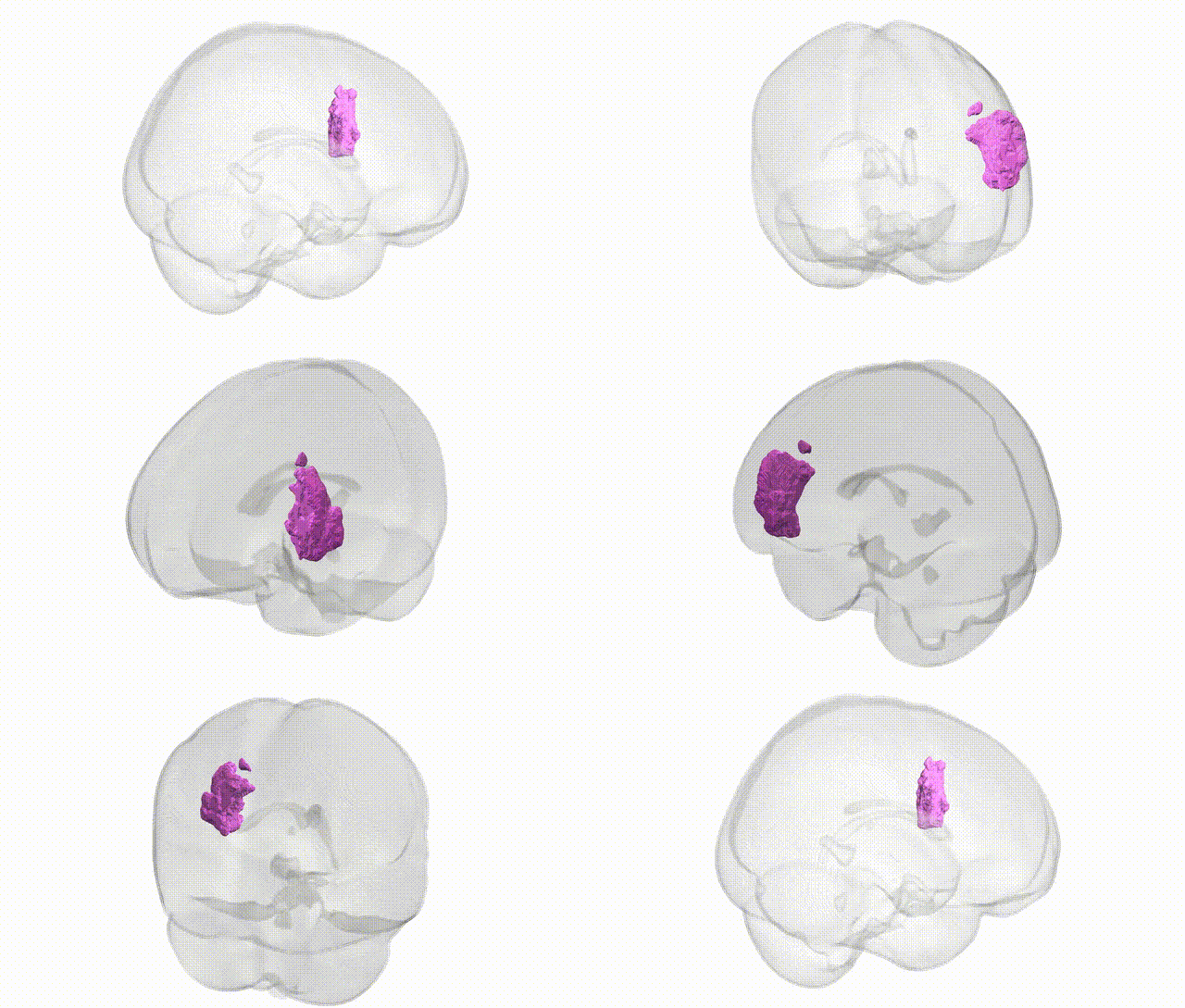
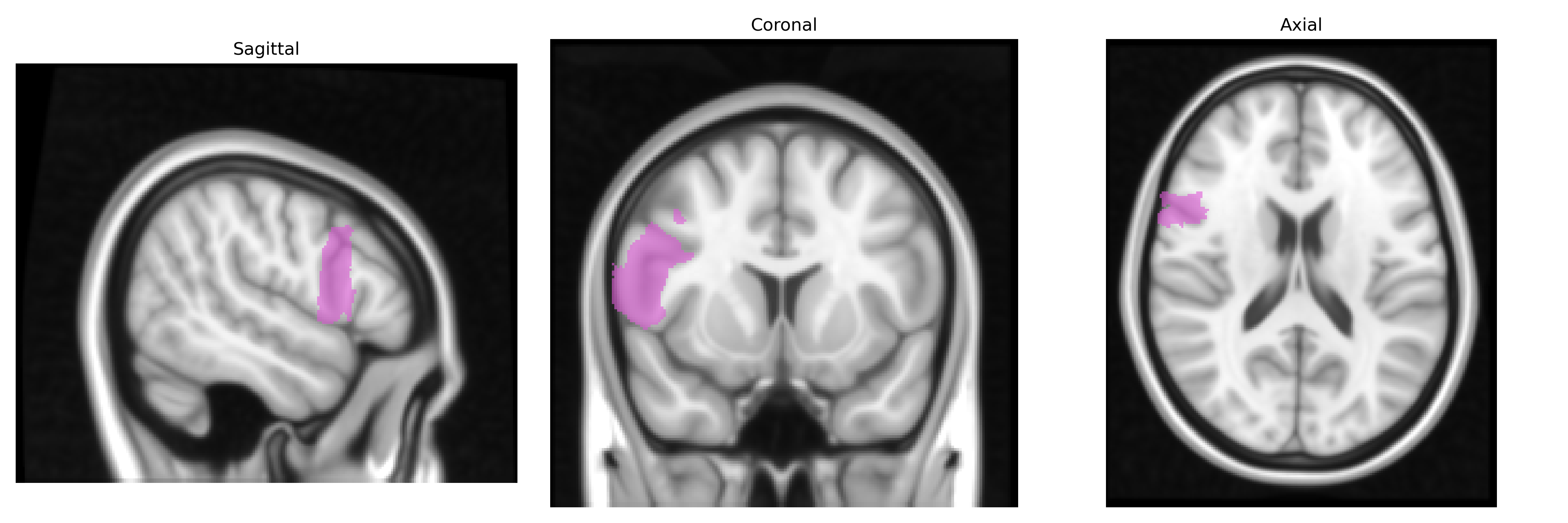
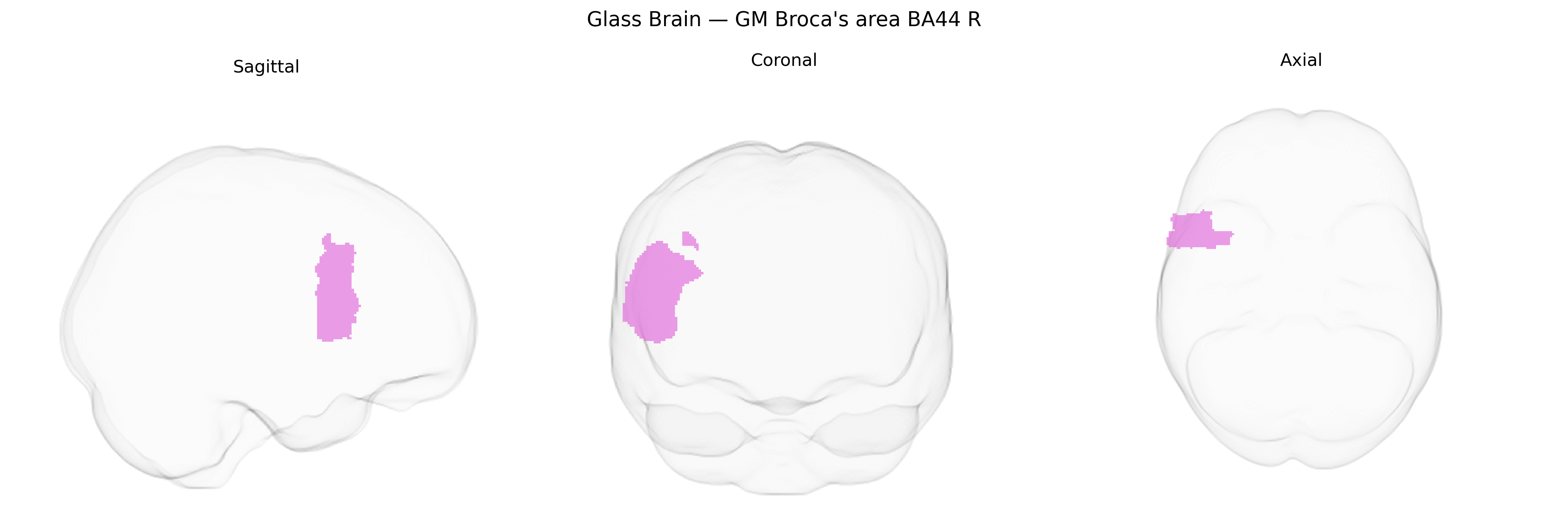
Bilateral GM Broca’s area BA44 R (right-hemispheric homolog of Brodmann area 44) in the Juelich maxprob thr25 1 mm atlas is a cytoarchitectonically defined subdivision of the inferior frontal gyrus, typically encompassing portions of the pars opercularis. This region consists of granular frontal cortex with distinct lamination and is implicated in higher-order motor-related and cognitive functions, including aspects of speech and language processing, motor planning, action observation, and syntactic and phonological processing, with the right hemisphere particularly associated with prosody and broader aspects of communicative and cognitive control. Broca’s area BA44 exhibits dense connectivity with adjacent inferior frontal regions (e.g., BA45), premotor cortex, superior temporal regions, and subcortical structures, forming part of the frontotemporal language and action networks.
The bilateral Broca’s area BA44 (inferior frontal gyrus) from the Juelich maxprob atlas has been repeatedly implicated in genetic studies of language, speech, and broader neurodevelopmental traits, though most associations are indirect via structural or functional endophenotypes. Twin and family studies show high heritability of BA44 volume and cortical thickness, with common variants in genes involved in synaptic development and axon guidance (e.g., FOXP2-regulated networks, CNTNAP2, ROBO1/2, DCDC2, KIAA0319) associated with language abilities, phonological processing, and dyslexia-related traits that recruit BA44 during task fMRI. GWAS of brain structure and connectivity (e.g., ENIGMA and UK Biobank–based studies) have linked loci near genes such as MIR124-1, LINGO1, CAMKMT, and others to inferior frontal morphology, cortical surface area, and white-matter tracts connecting BA44 to temporal language regions, suggesting polygenic influences on this language network. Functionally, BA44 activation and connectivity show genetic correlations with educational attainment, general cognitive ability, and reading skill, and polygenic risk scores for autism spectrum disorder, attention-deficit/hyperactivity disorder, and schizophrenia exhibit associations with altered inferior frontal structure or activation, aligning with the role of this region in social communication and cognitive control. In stuttering and primary progressive aphasia, rare and common variants in FOXP2-pathway and synaptic genes have been linked to abnormal development or degeneration of left inferior frontal language regions, including BA44, although the specificity to this exact Brodmann area remains probabilistic due to imaging and atlas limitations.
Overview generated by GPT-4o (2026).
Region ID: 14
Hemisphere: bilateral
Atlas: Juelich maxprob thr25 1mm
Full Quality Version: Download MP4
Full Quality Version: Download MP4
Wali Sidiqyar*, Gaurav Rudravaram*, Elyssa M. McMaster, Trent M. Schwartz, Adam M. Saunders, Kurt G. Schilling, Bennett A. Landman "Introducing SPINS: A Shared Public Visualization Library of Neuroanatomical Structures." Medical Imaging with Deep Learning- short paper
This resource is licensed under CC0 1.0 Universal (Public Domain).