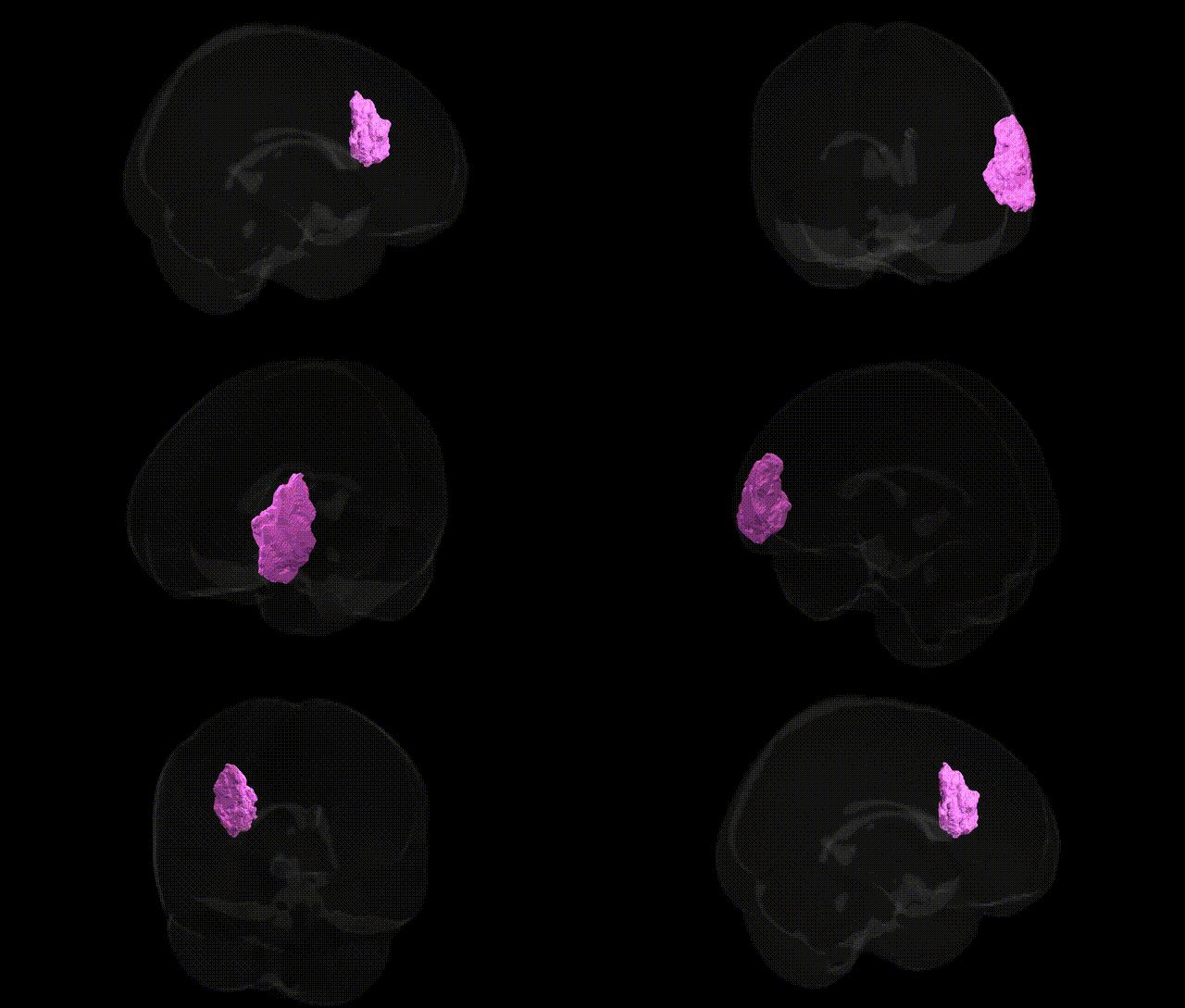
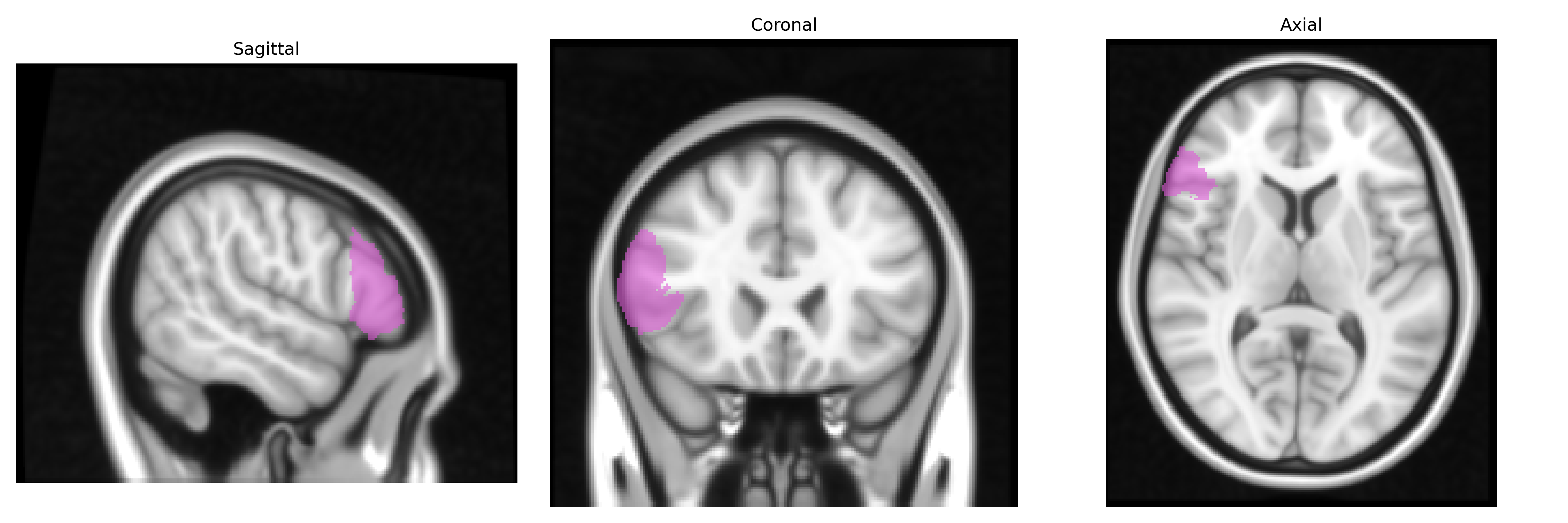
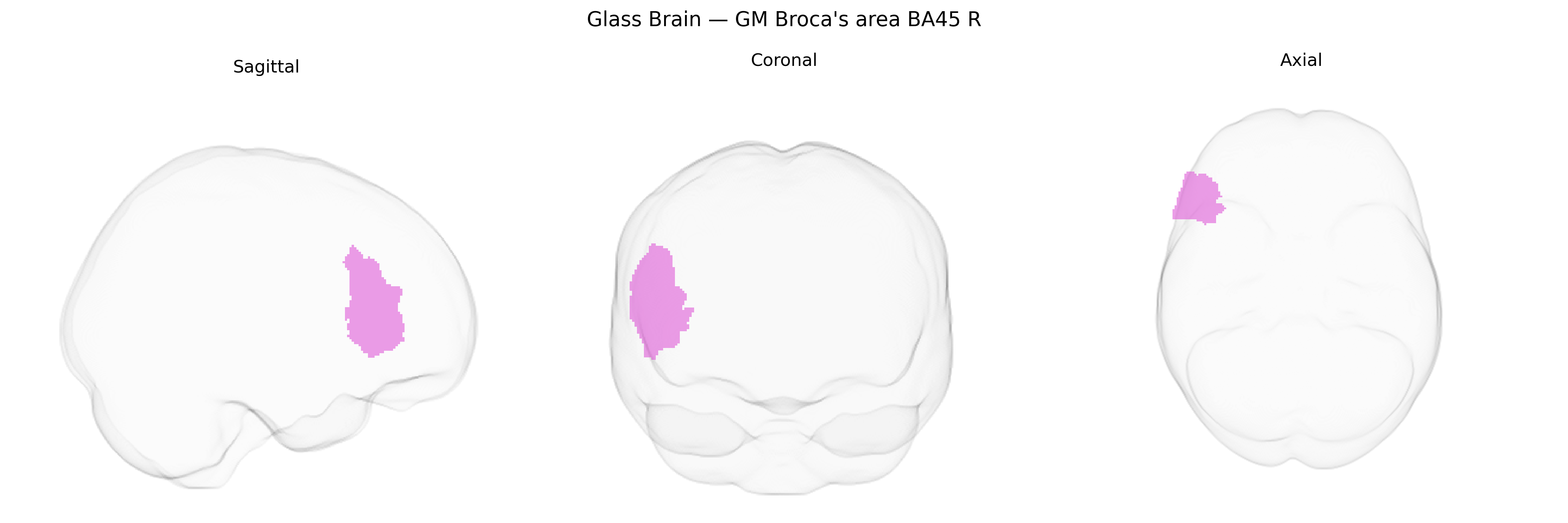
Bilateral GM Broca’s area BA45 R, as defined in the Juelich maxprob thr25 1mm atlas, corresponds to the right-hemispheric gray matter portion of Brodmann area 45 within the inferior frontal gyrus, typically encompassing parts of the pars triangularis. This region is histologically characterized by granular cortex with distinct laminar organization and is implicated in higher-order language and cognitive functions, including semantic processing, controlled retrieval of verbal information, and aspects of discourse-level integration. Functionally, BA45 is often co-activated with adjacent inferior frontal and temporal regions during tasks involving language comprehension, working memory, and executive control over linguistic operations, and it forms part of the broader fronto-temporal language network with hemispheric specialization that complements, but is less dominant than, the left-hemisphere homolog for core speech production. There is no direct Wikipedia article for “Broca’s area BA45”; see the related entry on Broca’s area.
Genetic associations involving Broca’s area BA45, a key region for language processing, have been identified through GWAS and imaging–genetics studies that link variation in this region’s structure and function to language-related traits and several neuropsychiatric conditions. Common variants in FOXP2 and related language-network genes (such as CNTNAP2 and DCDC2) have been associated with morphometry and activation of left inferior frontal gyrus regions including BA45, particularly in tasks involving phonological processing and verbal fluency. Large-scale GWAS of brain imaging phenotypes (e.g., UK Biobank) have identified loci associated with cortical thickness and surface area in inferior frontal regions overlapping BA45, including variants near genes involved in neurodevelopment (such as KIAA0586, TBR1, and MAPT), some of which also show pleiotropic associations with general cognitive ability and educational attainment. BA45 has been repeatedly implicated in genetic studies of developmental language disorder and dyslexia, where risk alleles in genes like ROBO1, KIAA0319, and ATP2C2 are linked to altered activation or structural differences in this region during reading and speech tasks. Additionally, imaging–genetic work in schizophrenia, autism spectrum disorder, and bipolar disorder reports that risk alleles (for example in CACNA1C, ZNF804A, and NRG1) are associated with abnormal functional connectivity or task-related activation involving BA45, consistent with broader disruptions in frontotemporal language and social cognition networks. Finally, polygenic scores for intelligence, reading ability, and educational attainment show modest but reliable correlations with BA45 volume and activation, suggesting that genetic influences on higher cognitive and language skills partially converge on this Broca’s subregion, though specific, robustly replicated BA45-targeted GWAS hits remain limited and generally reflect distributed effects across the fronto-temporal language network.
Overview generated by GPT-4o (2026).
Region ID: 16
Hemisphere: bilateral
Atlas: Juelich maxprob thr25 1mm
Full Quality Version: Download MP4
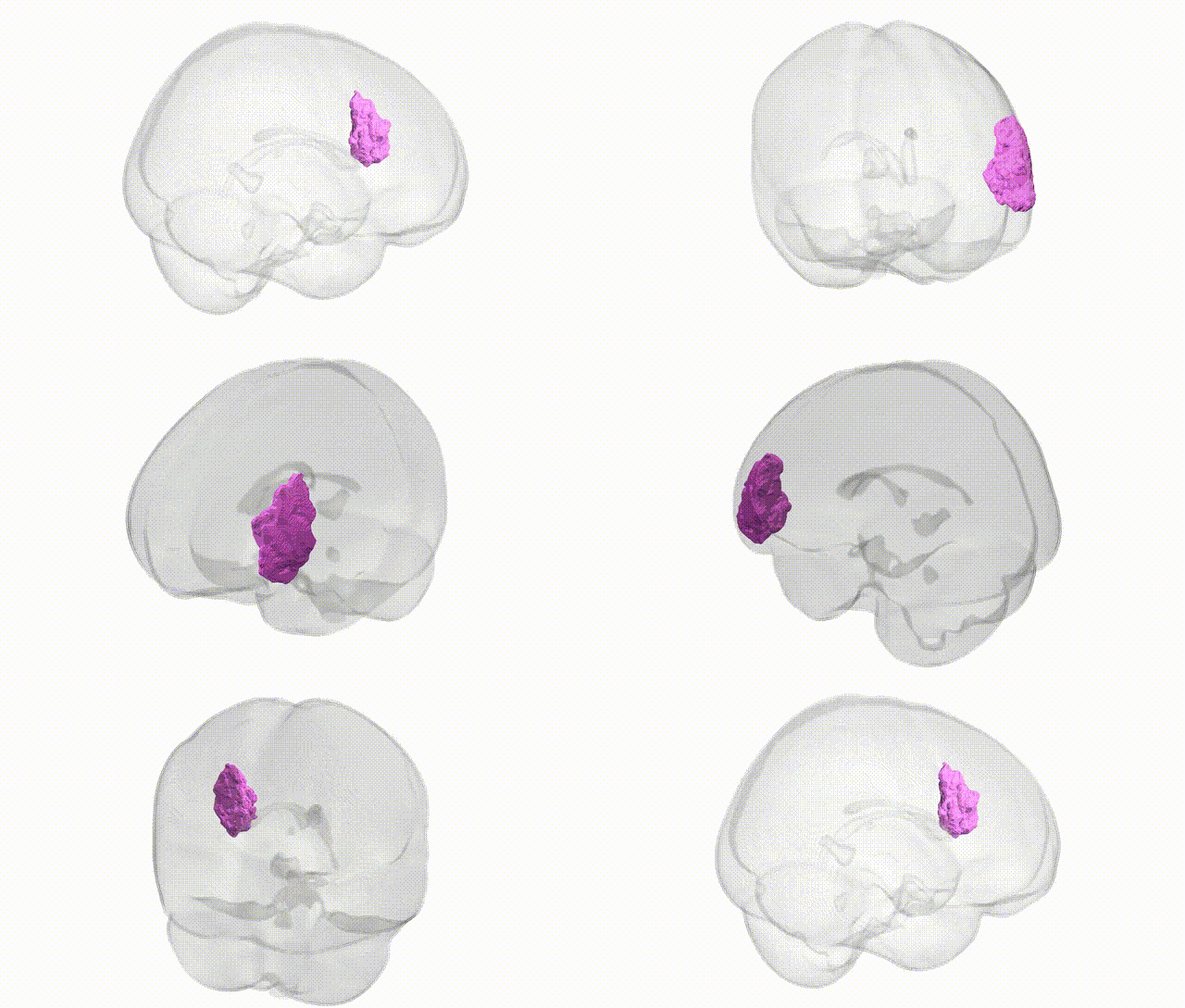
Full Quality Version: Download MP4
Wali Sidiqyar*, Gaurav Rudravaram*, Elyssa M. McMaster, Trent M. Schwartz, Adam M. Saunders, Kurt G. Schilling, Bennett A. Landman "Introducing SPINS: A Shared Public Visualization Library of Neuroanatomical Structures." Medical Imaging with Deep Learning- short paper
This resource is licensed under CC0 1.0 Universal (Public Domain).