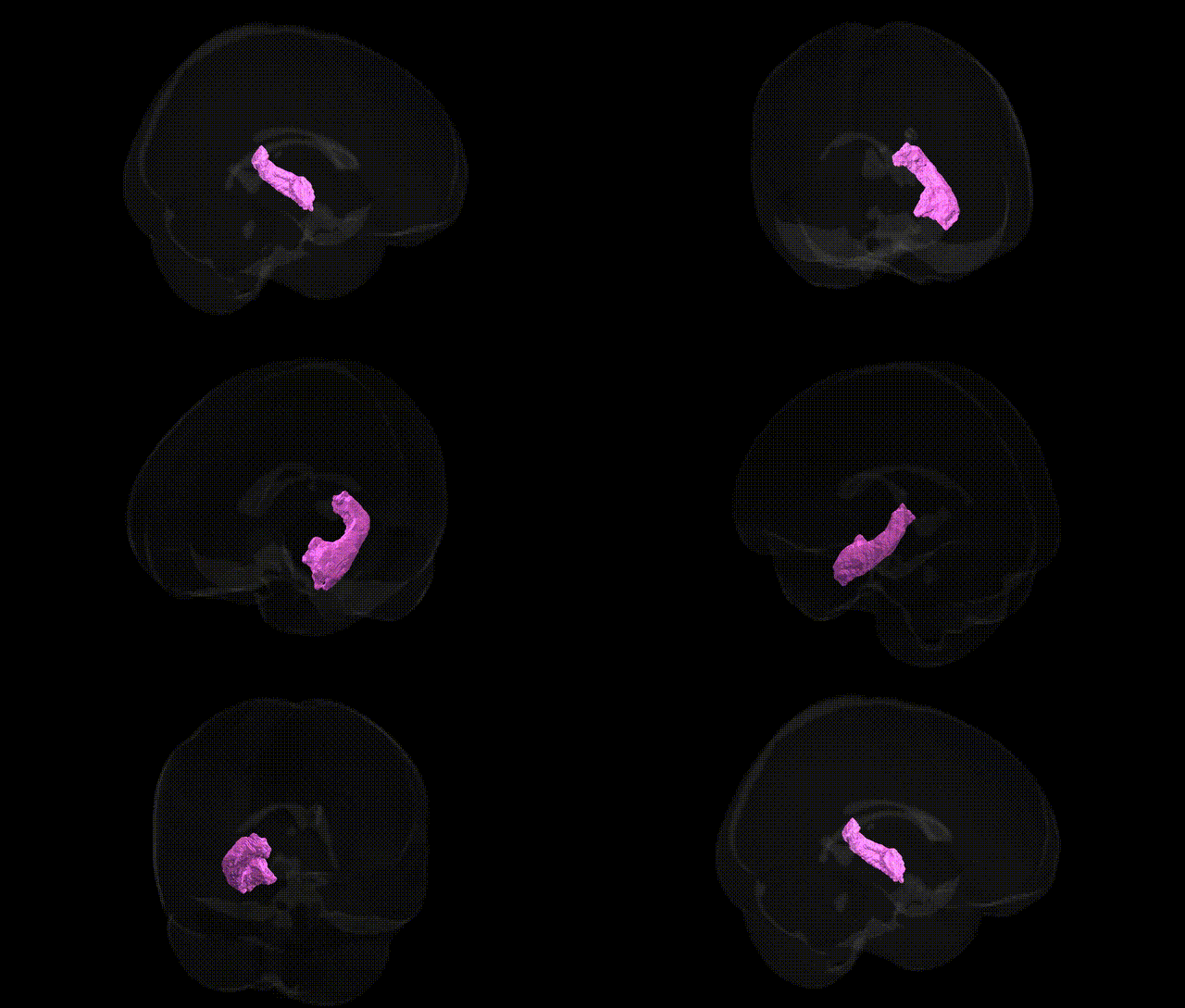
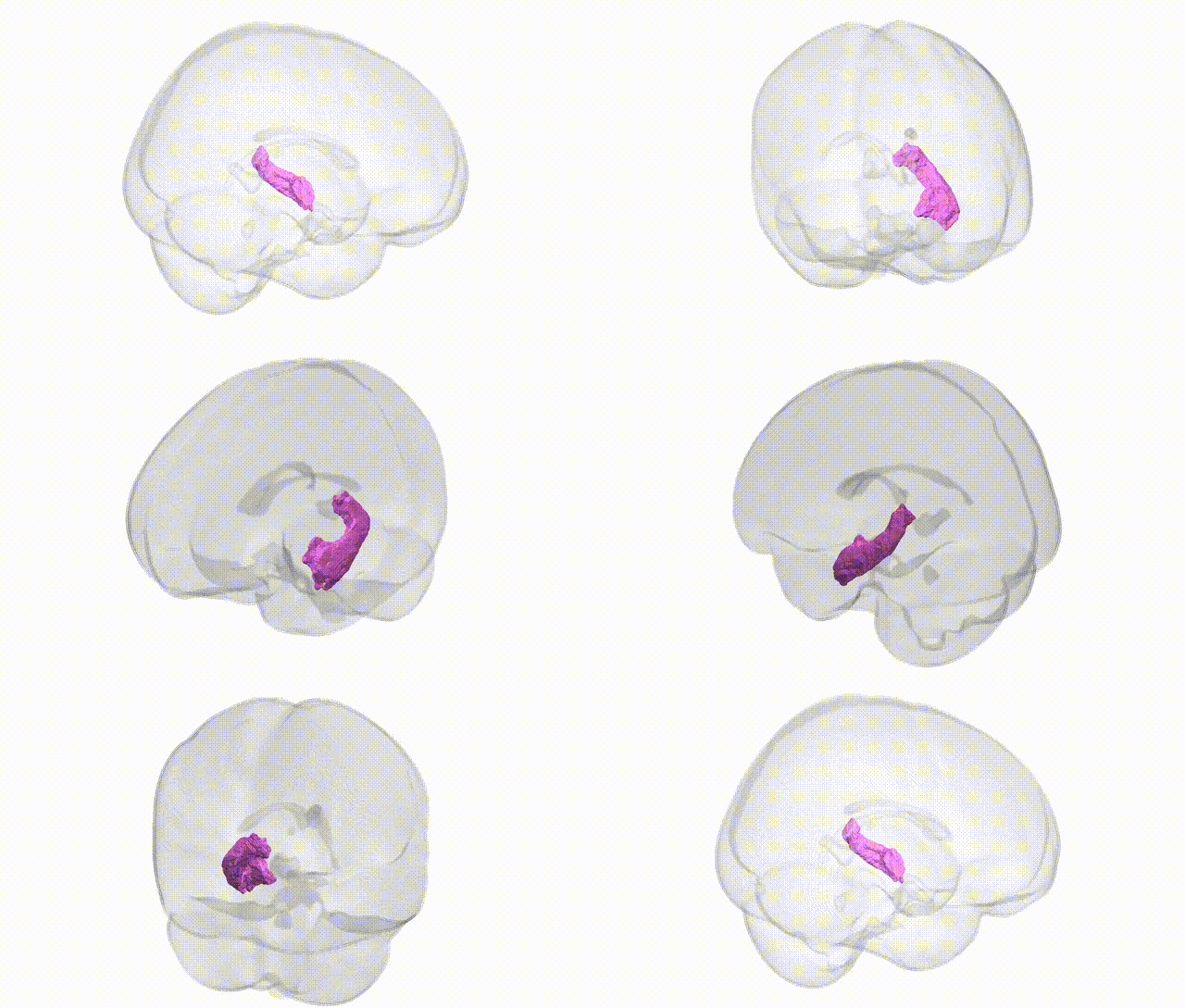
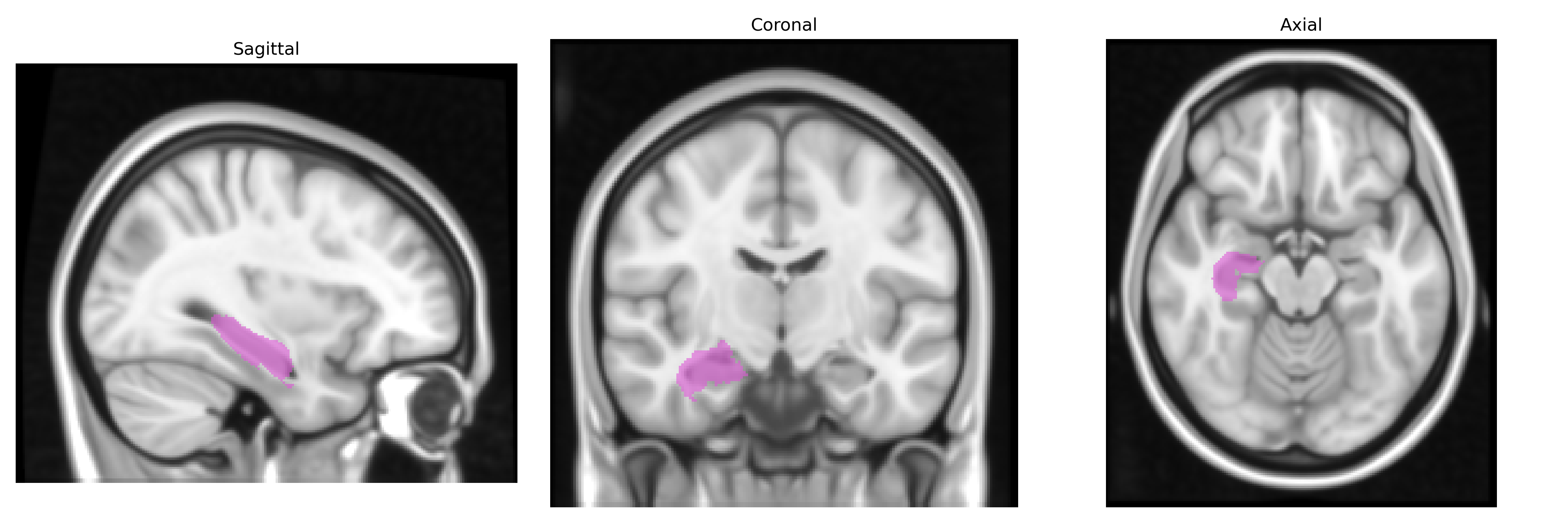
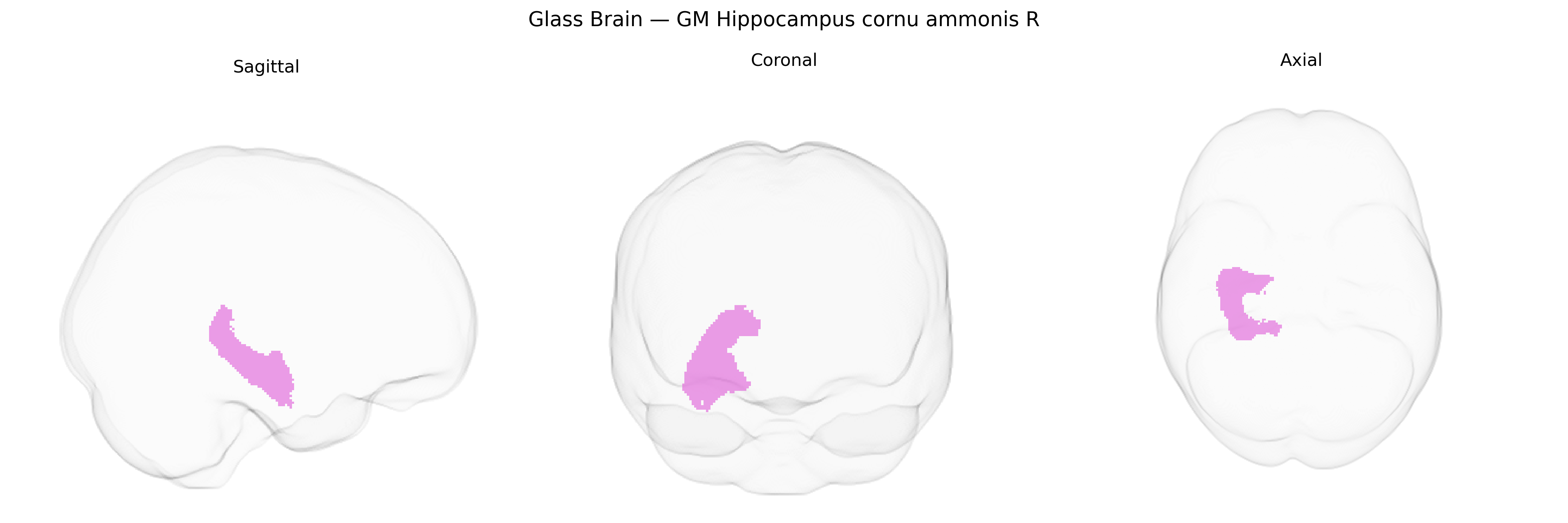
The bilateral GM Hippocampus cornu ammonis R in the Juelich maxprob thr25 1mm atlas corresponds to the right cornu ammonis (CA) fields of the hippocampal formation, a key allocortical structure in the medial temporal lobe involved in episodic memory encoding, consolidation, and spatial navigation. Histologically, it comprises distinct CA subfields (e.g., CA1–CA3) characterized by densely packed pyramidal neurons receiving afferent input primarily from the entorhinal cortex via the perforant path and dentate gyrus, and projecting to subiculum and other limbic and cortical targets. Functionally, this region participates in pattern separation and completion, contextual memory processing, and integration of multimodal information, and is highly vulnerable to hypoxia, neurodegenerative processes (such as in Alzheimer’s disease), and stress-related glucocorticoid effects. There is no direct Wikipedia article for “Hippocampus cornu ammonis” as a standalone entry; a closely related structure is described at Hippocampus.
The bilateral grey matter of the hippocampal cornu ammonis (CA) fields, as defined in the Juelich maxprob thr25 1mm atlas, shows robust genetic influences on volume, microstructure, and function, with heritability estimates often exceeding 50% and multiple loci identified in large neuroimaging GWAS meta-analyses (e.g., ENIGMA, UK Biobank). Common variants in and around genes such as BDNF, APOE, SORL1, CLU, CR1, TOMM40, and BIN1 have been associated with hippocampal CA subfield volumes and atrophy, particularly in the context of Alzheimer’s disease risk and progression, while loci in genes related to neurodevelopment and synaptic plasticity (e.g., DLG2, GRIN2B, KIBRA/WFS1, and CADM2) have been linked to CA morphology and memory performance. GWAS of hippocampal subfields report that CA1 and CA3 are especially implicated in genetic risk for major depressive disorder, post-traumatic stress disorder, and schizophrenia, with overlapping risk variants in genes involved in stress response (FKBP5, NR3C1), glutamatergic and GABAergic signaling (GRM3, GAD1), and immune/inflammatory pathways (MHC region, complement genes). Polygenic scores for educational attainment, intelligence, and general cognitive performance correlate with CA volumes and structural integrity, suggesting that genetic architectures underlying cognition and neuropsychiatric vulnerability partially converge on hippocampal CA subfields, which act as a key anatomical substrate for episodic memory, emotional regulation, and stress-related pathology.
Overview generated by GPT-4o (2026).
Region ID: 18
Hemisphere: bilateral
Atlas: Juelich maxprob thr25 1mm
Full Quality Version: Download MP4
Full Quality Version: Download MP4
Wali Sidiqyar*, Gaurav Rudravaram*, Elyssa M. McMaster, Trent M. Schwartz, Adam M. Saunders, Kurt G. Schilling, Bennett A. Landman "Introducing SPINS: A Shared Public Visualization Library of Neuroanatomical Structures." Medical Imaging with Deep Learning- short paper
This resource is licensed under CC0 1.0 Universal (Public Domain).