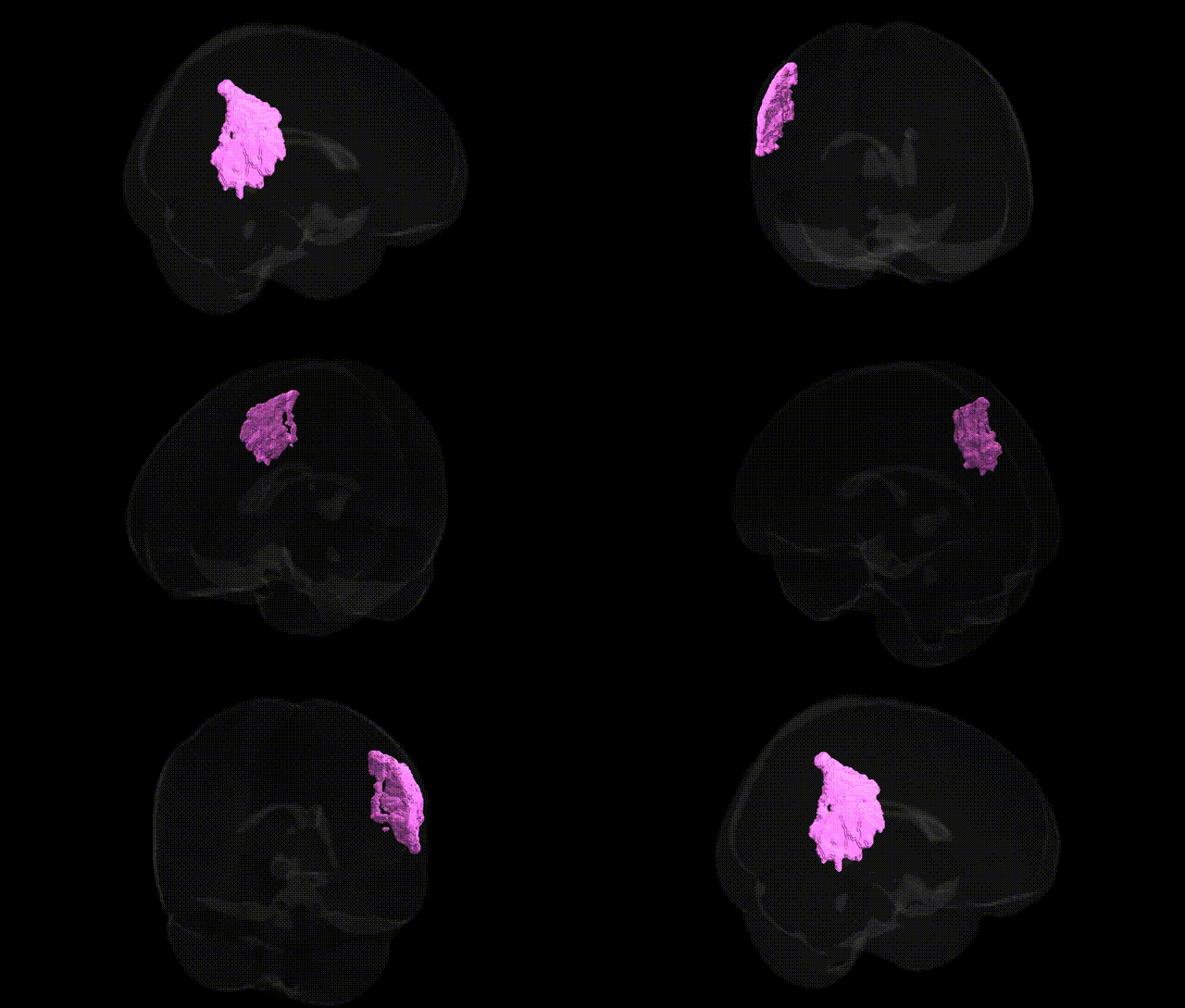
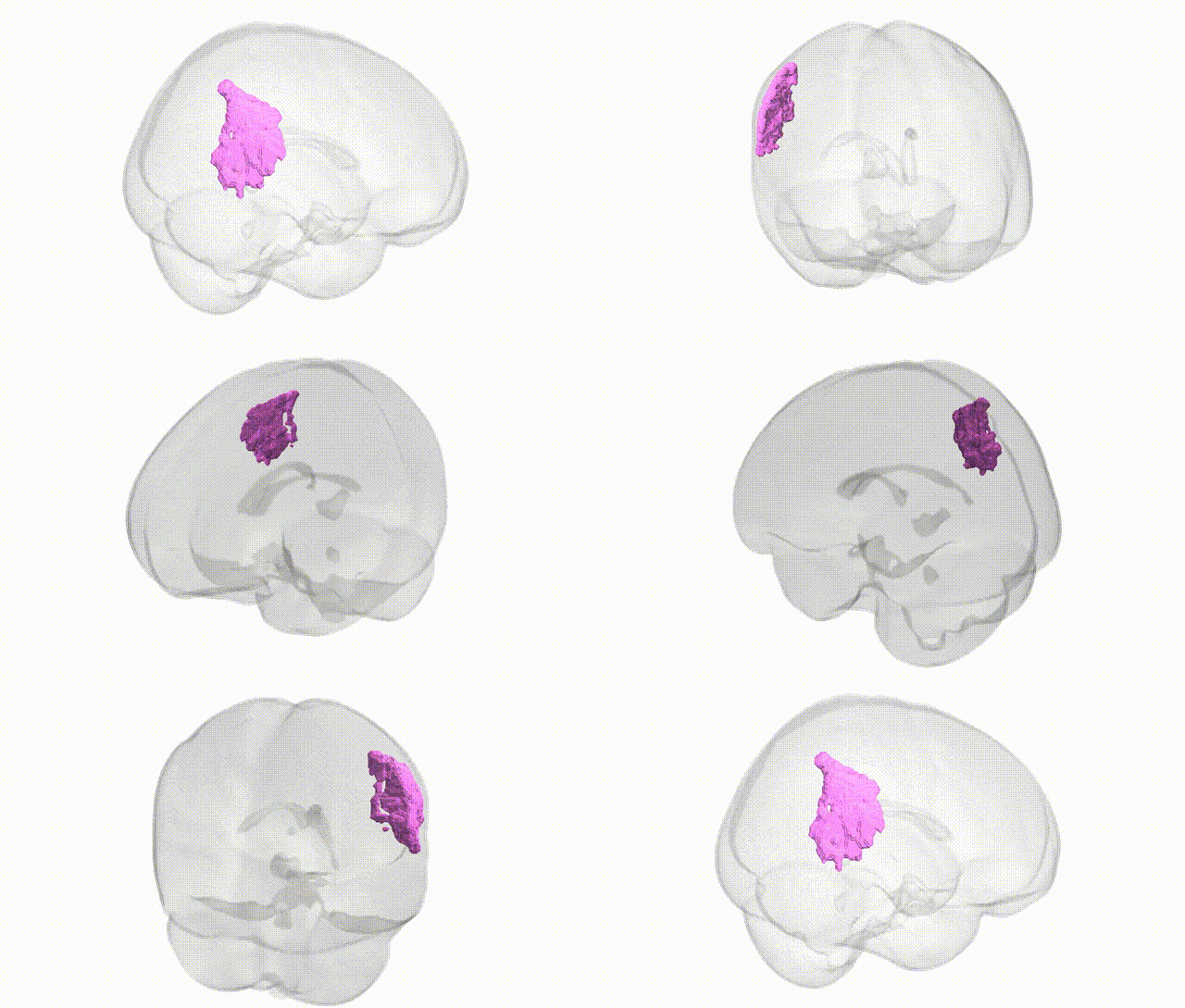
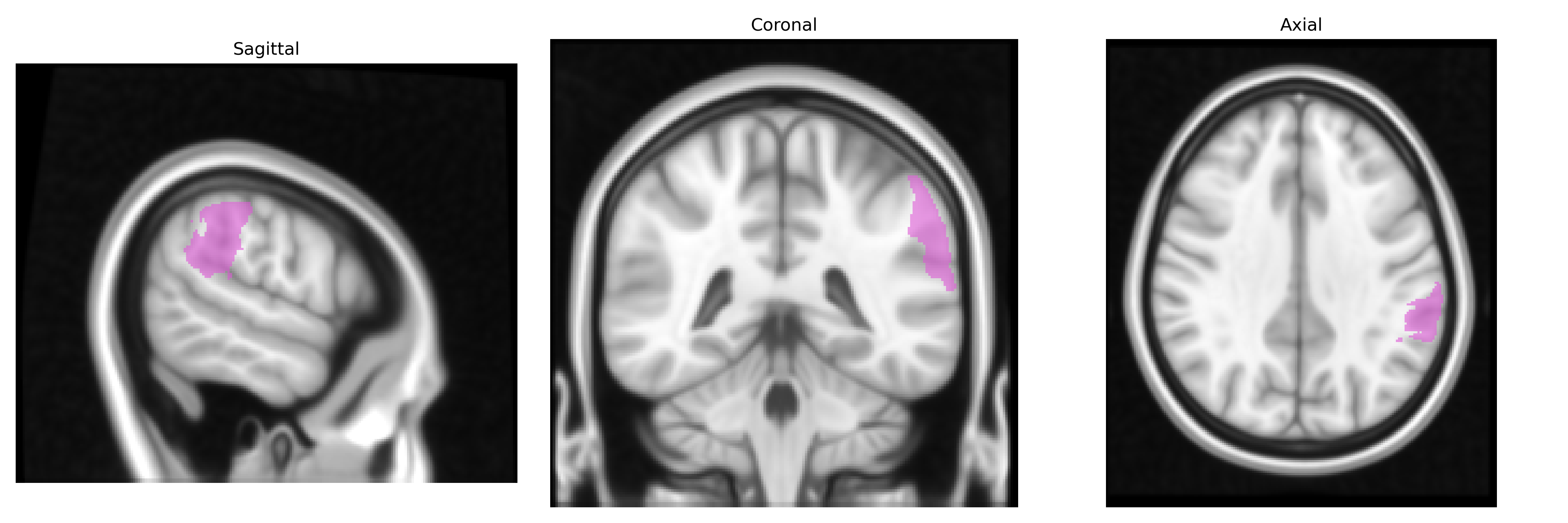
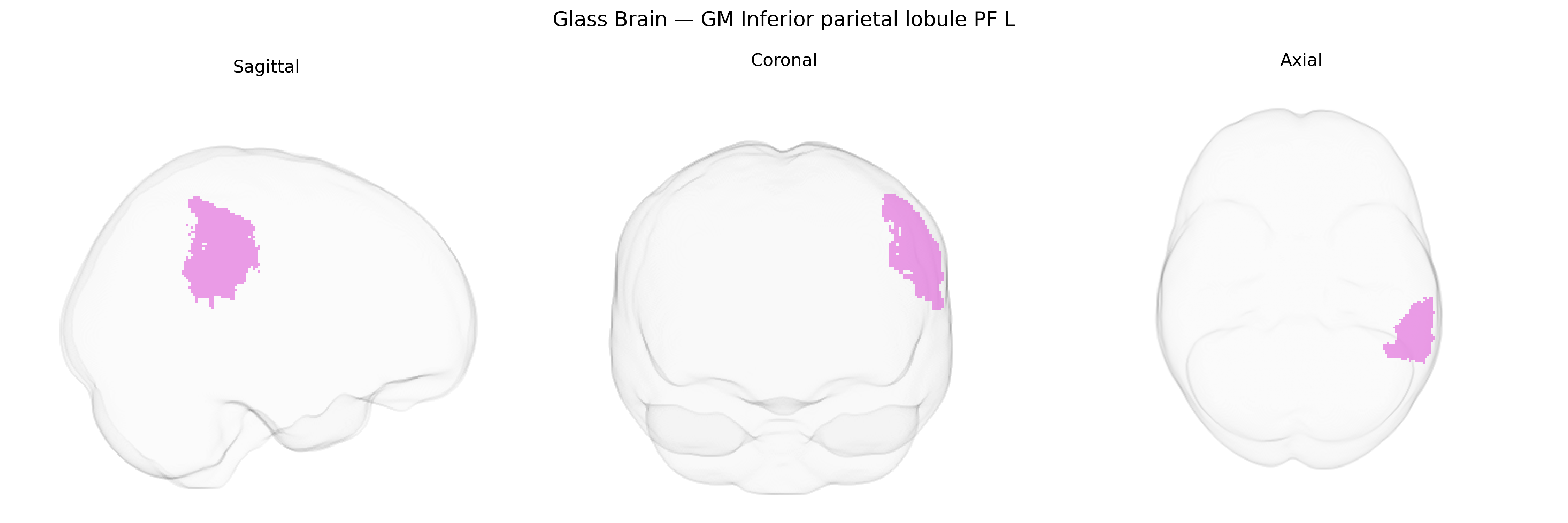
The bilateral GM Inferior parietal lobule PF L, as defined in the Juelich maxprob thr25 1mm atlas, corresponds to a cytoarchitectonic subregion within the inferior parietal lobule, located in the posterior parietal cortex at the junction of the parietal, temporal, and occipital lobes. This area is implicated in multimodal integration, receiving convergent input from visual, auditory, and somatosensory systems, and contributes to higher-order functions such as spatial attention, sensorimotor transformation, body representation, and aspects of language and social cognition. PF L belongs to the supramarginal gyrus portion of the inferior parietal lobule and participates in fronto-parietal networks involved in action observation and imitation, as well as in the re-mapping of sensory information into motor coordinates. There is no direct Wikipedia article for “Inferior parietal lobule PF L”; a closely related structure is the Inferior parietal lobule.
The bilateral GM Inferior parietal lobule PF L (as defined in the Juelich maxprob thr25 1mm atlas) lies within the inferior parietal cortex, a heteromodal association region repeatedly implicated in imaging–genetics and GWAS-based brain mapping. Large-scale neuroimaging GWAS (e.g., ENIGMA, UK Biobank, ABCD) have identified polygenic influences on cortical surface area and thickness in the inferior parietal lobule, with significant contributions from loci near or within genes involved in neurodevelopment, synaptic function, and axon guidance (such as variants in or near genes like HMGA2, MIRLET7BHG, KIAA0586, and others reported for parietal cortical measures), although few associations are specific to the PF L subfield as opposed to broader inferior parietal or supramarginal/angular parcels. Genetically, this region contributes to polygenic architectures underlying general cognitive ability, educational attainment, and mathematical performance, consistent with its role in attention and numerical processing, and structural or functional alterations in overlapping inferior parietal territories have been linked to schizophrenia, major depression, autism spectrum disorder, attention-deficit/hyperactivity disorder, and Alzheimer’s disease in GWAS or imaging–genetics studies that examine cortical metrics or connectivity rather than region PF L specifically. Overall, the genetic landscape for the PF L area appears highly polygenic and shared with neighboring parietal association cortex, with common variants influencing its structure and function primarily through broad neurodevelopmental and cognitive-related pathways, and disorder associations reflecting these general polygenic liabilities rather than region-specific genetic effects.
Overview generated by GPT-4o (2026).
Region ID: 27
Hemisphere: bilateral
Atlas: Juelich maxprob thr25 1mm
Full Quality Version: Download MP4
Full Quality Version: Download MP4
Wali Sidiqyar*, Gaurav Rudravaram*, Elyssa M. McMaster, Trent M. Schwartz, Adam M. Saunders, Kurt G. Schilling, Bennett A. Landman "Introducing SPINS: A Shared Public Visualization Library of Neuroanatomical Structures." Medical Imaging with Deep Learning- short paper
This resource is licensed under CC0 1.0 Universal (Public Domain).