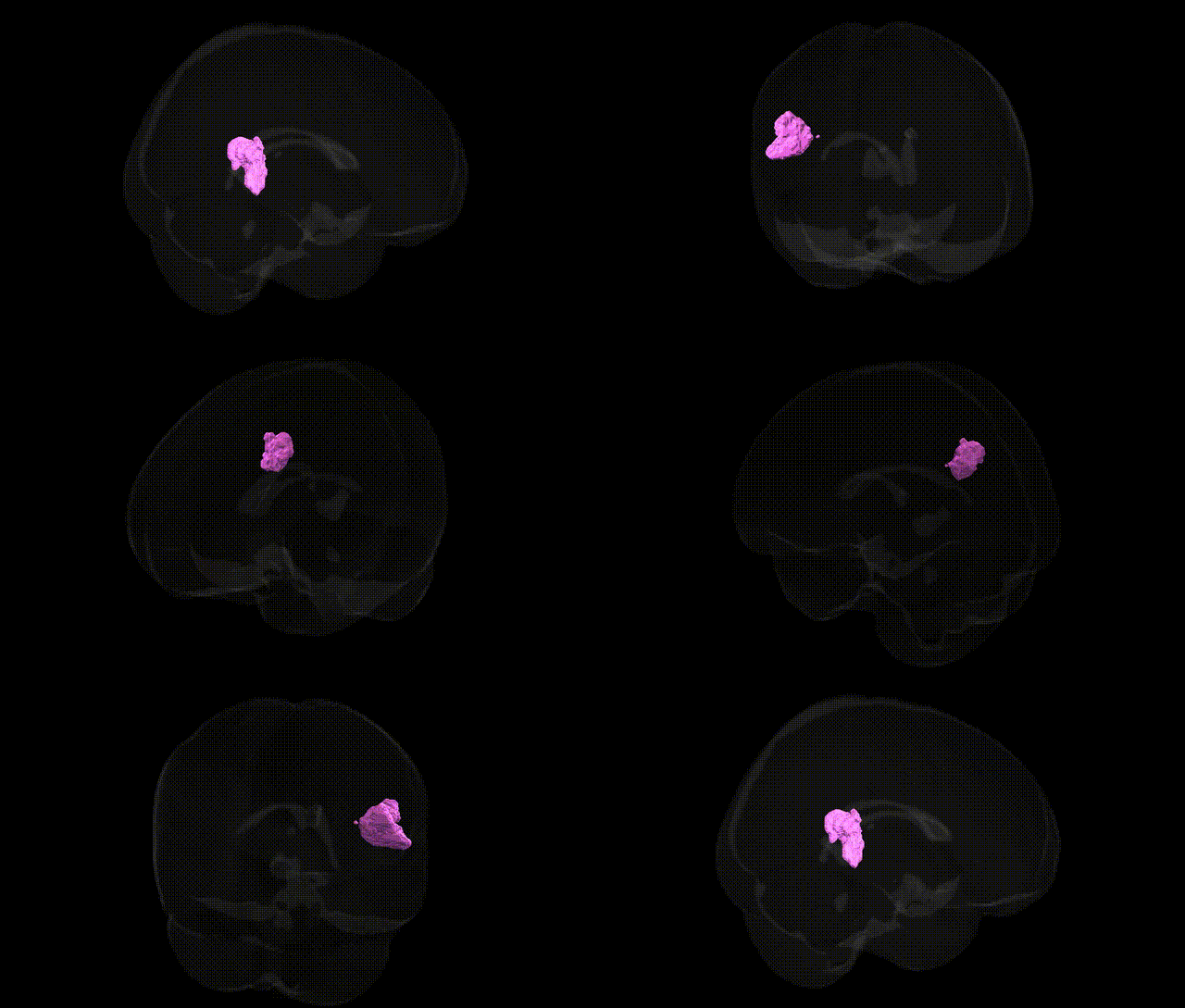
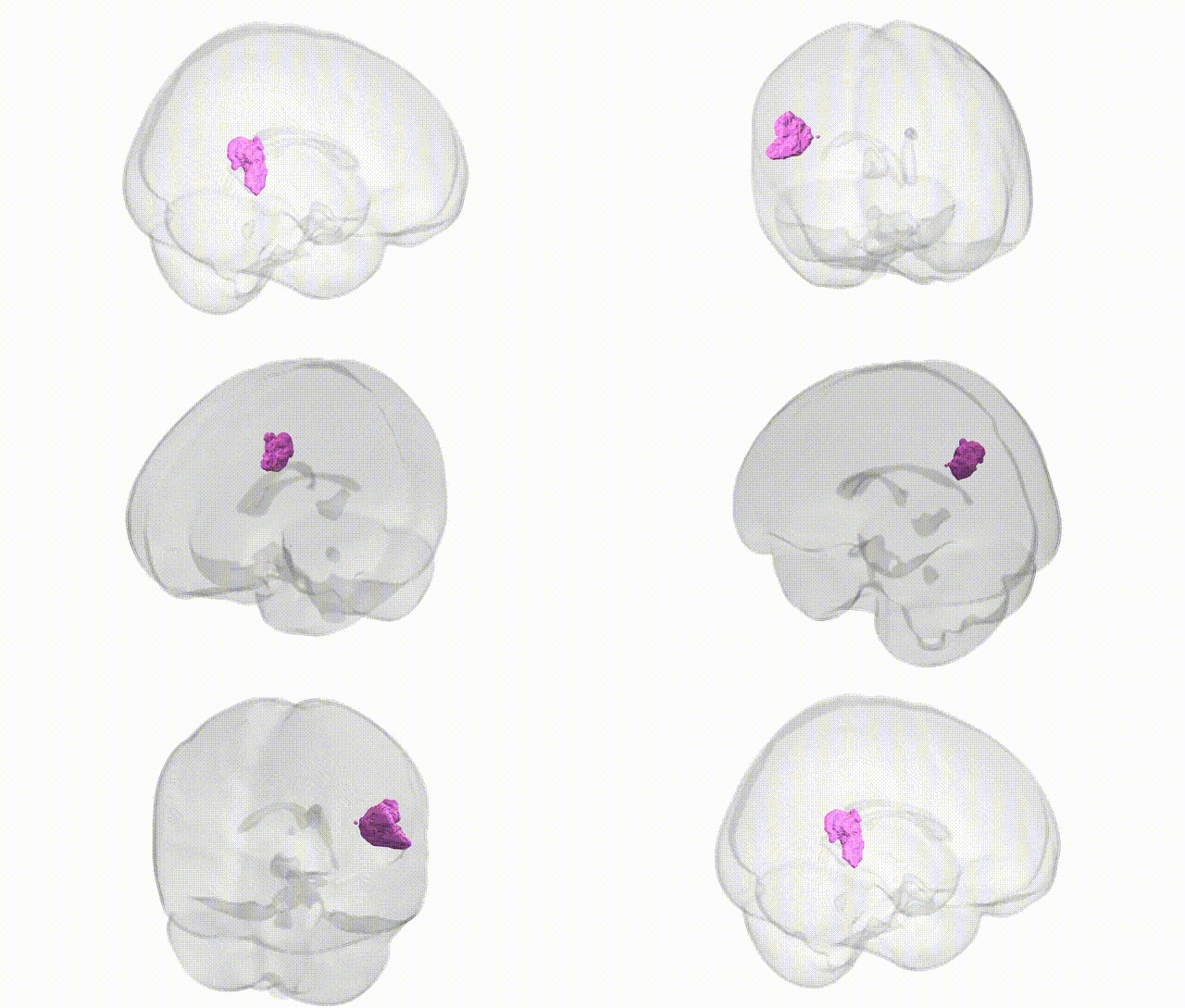
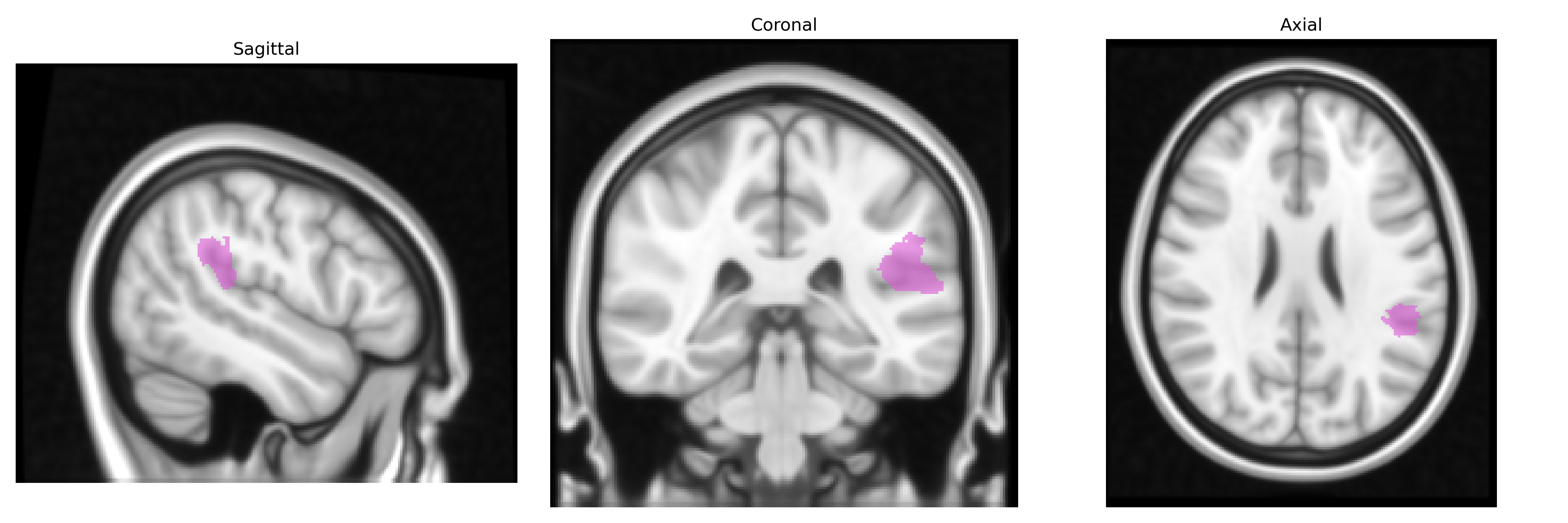
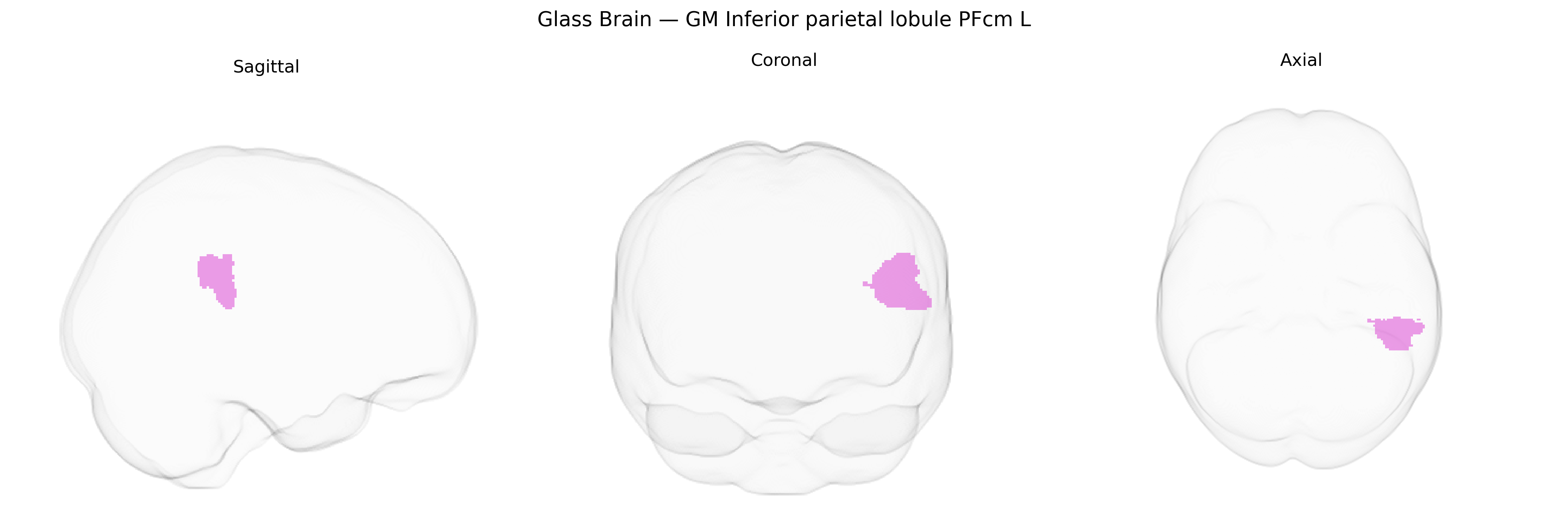
The bilateral GM Inferior parietal lobule PFcm L (Juelich maxprob thr25 1mm Atlas) corresponds to a cytoarchitectonic subregion of the inferior parietal lobule (IPL), located at the posterior part of the parietal cortex and bordering the superior temporal and occipital areas. This region is associated with higher-order multimodal integration, combining visual, auditory, and somatosensory information, and is implicated in functions such as attention reorientation, spatial processing, action observation, and aspects of social cognition and language-related processes. PFcm belongs to the broader inferior parietal cortex, which is part of the dorsal attention and frontoparietal control networks, and shows strong connectivity with frontal premotor, prefrontal, and superior temporal areas. There is no direct link for PFcm itself; a related structure is the inferior parietal lobule: Inferior parietal lobule.
The bilateral inferior parietal lobule (IPL), including the PFcm subdivision in the Juelich maxprob atlas, has been implicated in a range of genetic associations primarily via large-scale imaging–genetics and GWAS studies of cortical morphology and functional networks, although PFcm-specific data remain sparse and most findings concern the broader IPL or adjacent inferior parietal regions. Variants in genes involved in synaptic plasticity, axon guidance, and neurodevelopment (for example, BDNF, NRG1, CNTNAP2, DISC1, and several glutamatergic and GABAergic pathway genes) have been associated with gray-matter volume or cortical thickness in the inferior parietal cortex, often in the context of cognition- and language-related traits, working memory, and attentional control; polygenic scores for general cognitive ability and educational attainment also show associations with IPL structure. GWAS meta-analyses of brain morphology (e.g., ENIGMA and UK Biobank–based studies) report significant loci influencing parietal cortical thickness and surface area in inferior parietal territories, linking genes involved in neuronal differentiation, myelination, and cell adhesion to interindividual variability in this region. Clinically, genetic risk for schizophrenia, bipolar disorder, major depression, and autism spectrum disorder has been associated with altered IPL gray matter or connectivity, and several disorder-specific risk variants (including those in complement pathway genes such as C4, and in calcium-channel or synaptic genes like CACNA1C and GRIN family members) have shown downstream effects on parietal association cortices in imaging–genetics analyses. Additional associations connect inferior parietal morphology or activation with genetic risk for Alzheimer’s disease (including APOE ε4 and other AD GWAS loci), attention-deficit/hyperactivity disorder, dyslexia and language impairment, and traits such as numerical ability, social cognition, and mind-wandering propensity, indicating that the PFcm-containing inferior parietal territory serves as a convergent substrate for polygenic influences on higher-order cognitive and neuropsychiatric phenotypes rather than being tied to a single gene or disorder.
Overview generated by GPT-4o (2026).
Region ID: 29
Hemisphere: bilateral
Atlas: Juelich maxprob thr25 1mm
Full Quality Version: Download MP4
Full Quality Version: Download MP4
Wali Sidiqyar*, Gaurav Rudravaram*, Elyssa M. McMaster, Trent M. Schwartz, Adam M. Saunders, Kurt G. Schilling, Bennett A. Landman "Introducing SPINS: A Shared Public Visualization Library of Neuroanatomical Structures." Medical Imaging with Deep Learning- short paper
This resource is licensed under CC0 1.0 Universal (Public Domain).