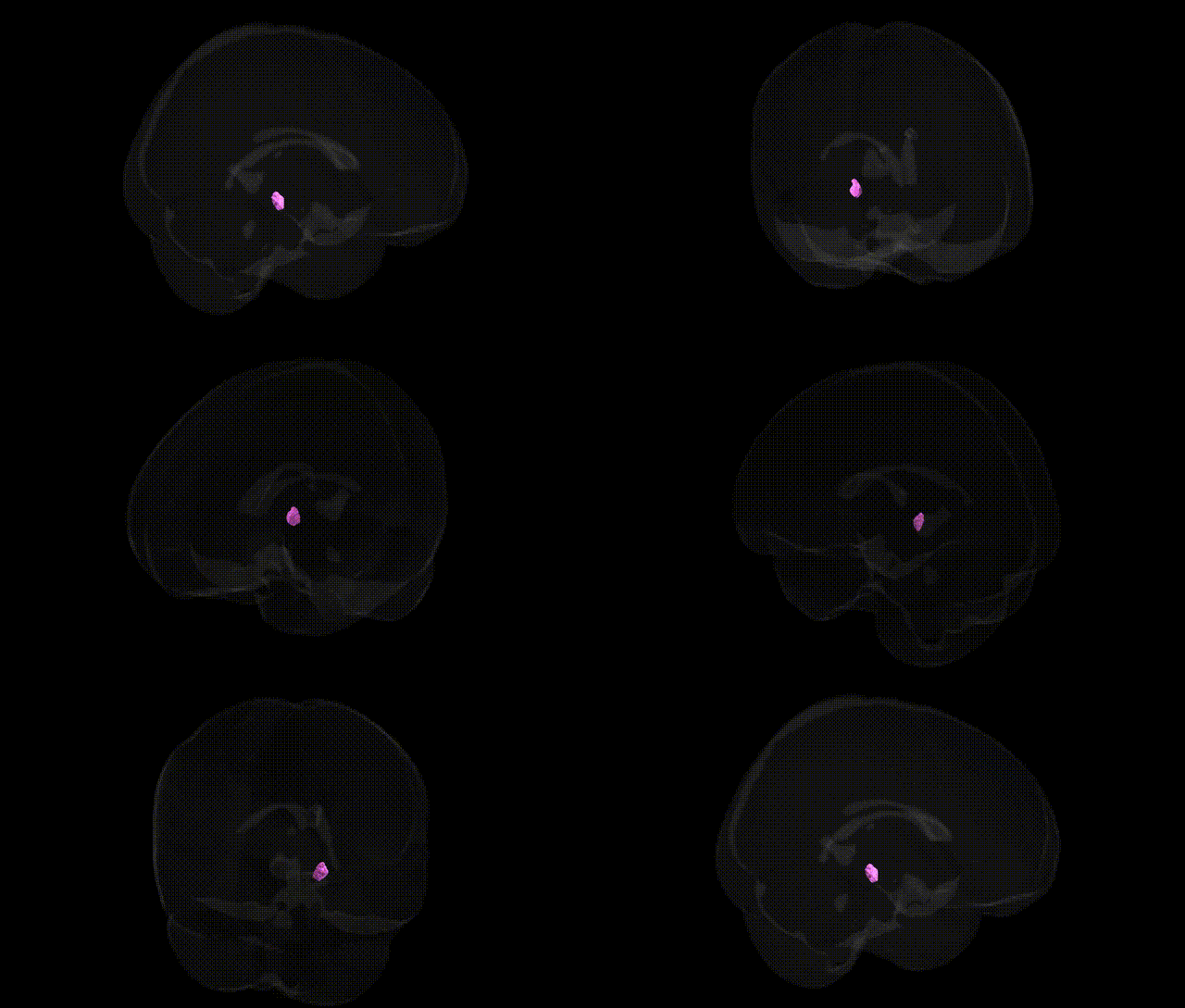
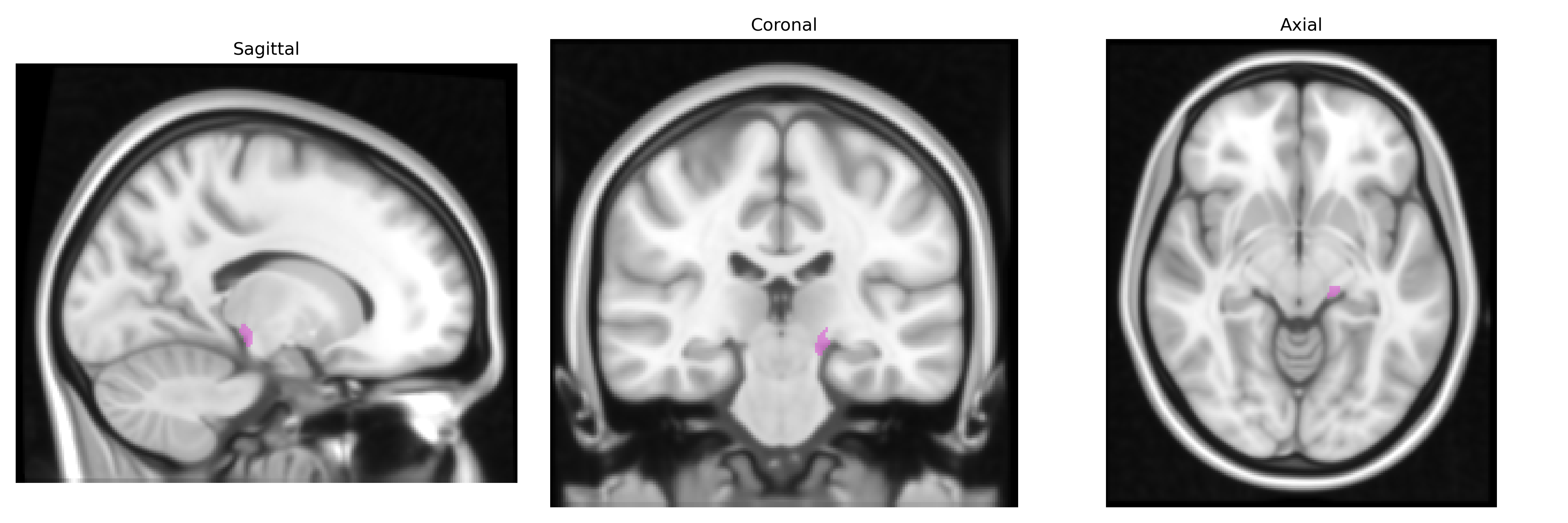
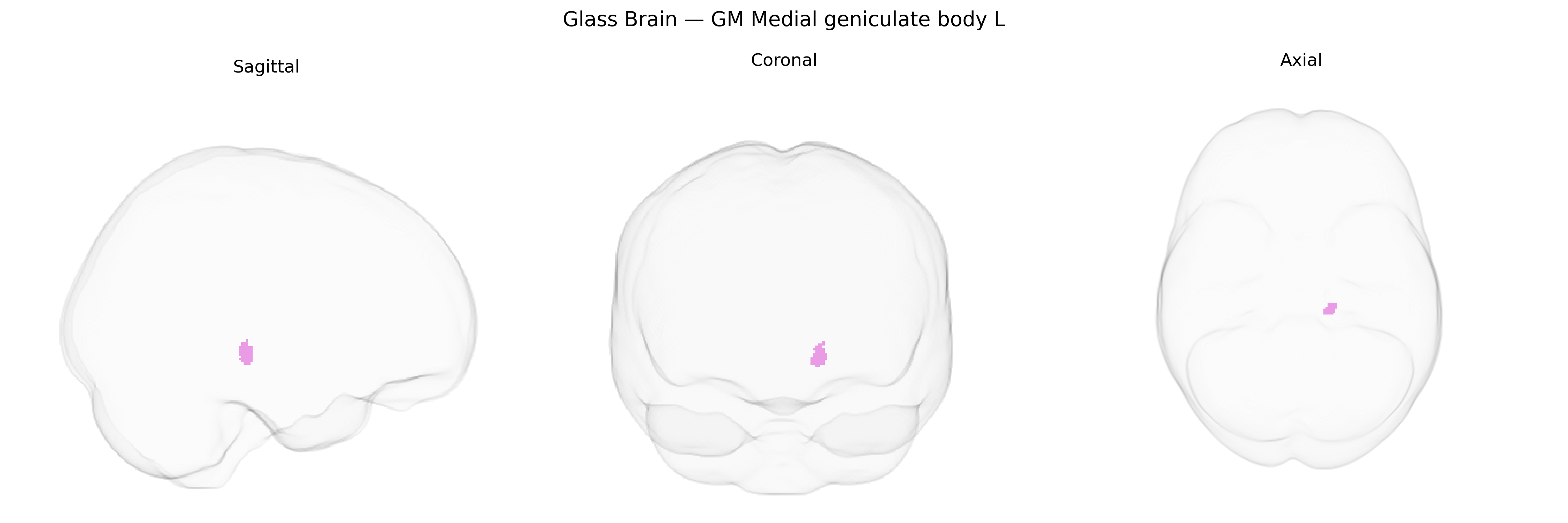
The bilateral GM Medial geniculate body L from the Juelich maxprob thr25 1mm Atlas corresponds to gray matter of the left medial geniculate nucleus (MGN) of the thalamus, a key relay station in the auditory pathway. It receives ascending input primarily from the inferior colliculus and projects to the primary auditory cortex in the temporal lobe, participating in the processing and integration of auditory information such as sound frequency, intensity, and temporal patterns. The medial geniculate body contributes to auditory attention, sound localization, and aspects of complex sound perception, including speech and music, through its distinct subdivisions (ventral, dorsal, and medial), which differ in cytoarchitecture and connectivity and support both lemniscal (precise, tonotopic) and non-lemniscal (integrative, multimodal) auditory processing. Medial geniculate nucleus
The medial geniculate body (MGB), the thalamic auditory relay nucleus corresponding to the GM Medial geniculate body L region in the Juelich maxprob atlas, has indirect genetic associations primarily through imaging genetics and disorder-focused studies rather than region-specific GWAS. Large neuroimaging GWAS (e.g., ENIGMA, UK Biobank) have identified heritable variation in thalamic nuclei volumes and microstructure, but typically analyze the thalamus as a whole or its major subdivisions, with no robust, replicated SNPs uniquely tied to MGB volume or function. Genetic links to traits involving auditory processing—which critically depends on the MGB—include risk variants for schizophrenia (e.g., in CACNA1C, GRIN2A), autism spectrum disorder (genes involved in synaptic and sensory processing such as CNTNAP2, SHANK3), and developmental language or reading disorders (FOXP2, DCDC2), where neuroimaging sometimes shows altered thalamic and auditory pathway structure or connectivity, implicating MGB circuitry without isolating it genetically. Similarly, genetic susceptibility to tinnitus and hyperacusis has been associated with genes involved in synaptic transmission, neuroinflammation, and ion channels (e.g., KCNE1, GDNF), and functional imaging points to thalamocortical auditory network changes encompassing the MGB. However, to date, no major GWAS has reported genome-wide significant associations specifically annotated to the medial geniculate body L region in the Juelich atlas, so current genetic knowledge is inferred from broader thalamic, auditory system, and neuropsychiatric disorder genetics rather than direct locus-specific findings.
Overview generated by GPT-4o (2026).
Region ID: 107
Hemisphere: bilateral
Atlas: Juelich maxprob thr25 1mm
Full Quality Version: Download MP4
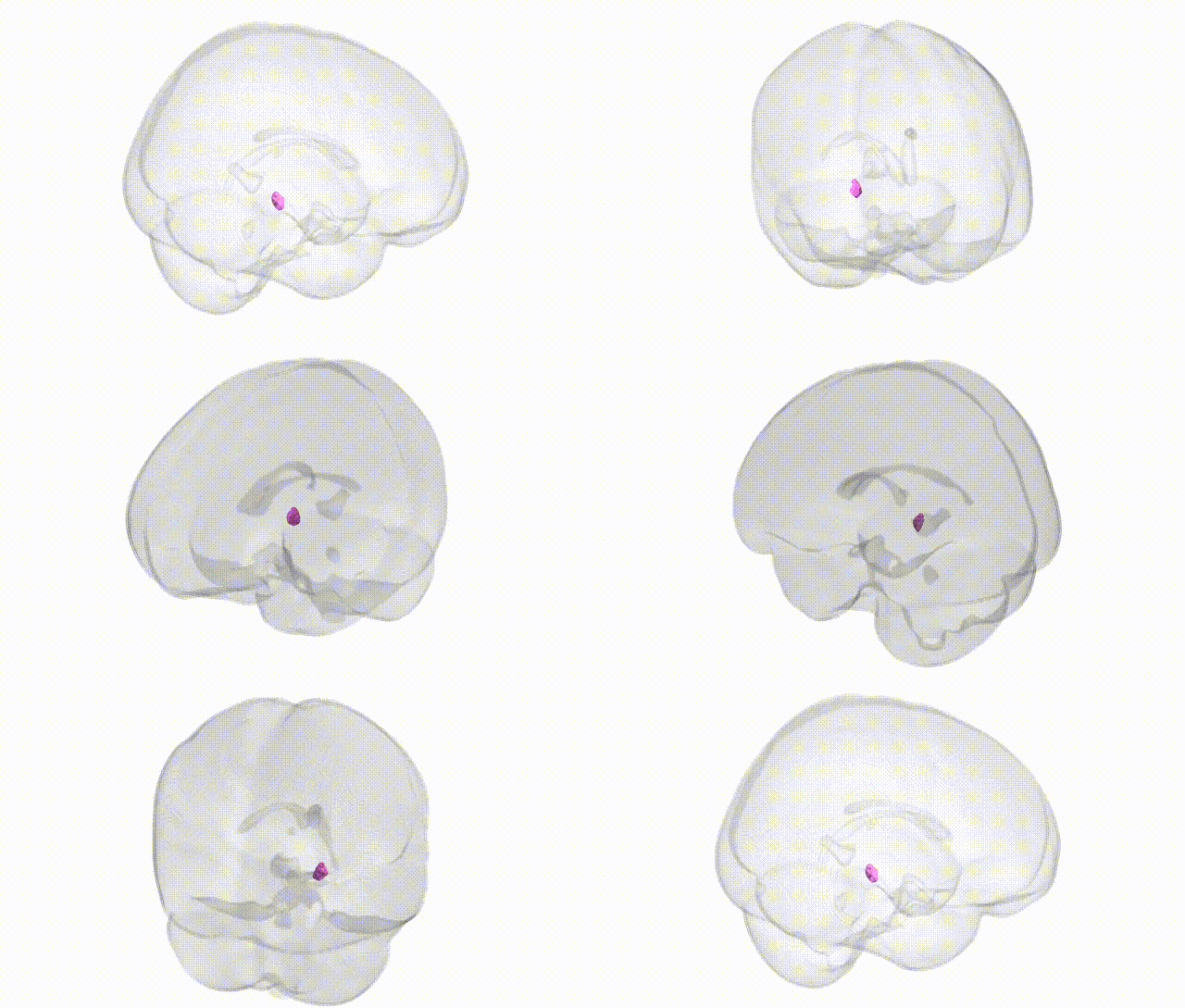
Full Quality Version: Download MP4
Wali Sidiqyar*, Gaurav Rudravaram*, Elyssa M. McMaster, Trent M. Schwartz, Adam M. Saunders, Kurt G. Schilling, Bennett A. Landman "Introducing SPINS: A Shared Public Visualization Library of Neuroanatomical Structures." Medical Imaging with Deep Learning- short paper
This resource is licensed under CC0 1.0 Universal (Public Domain).