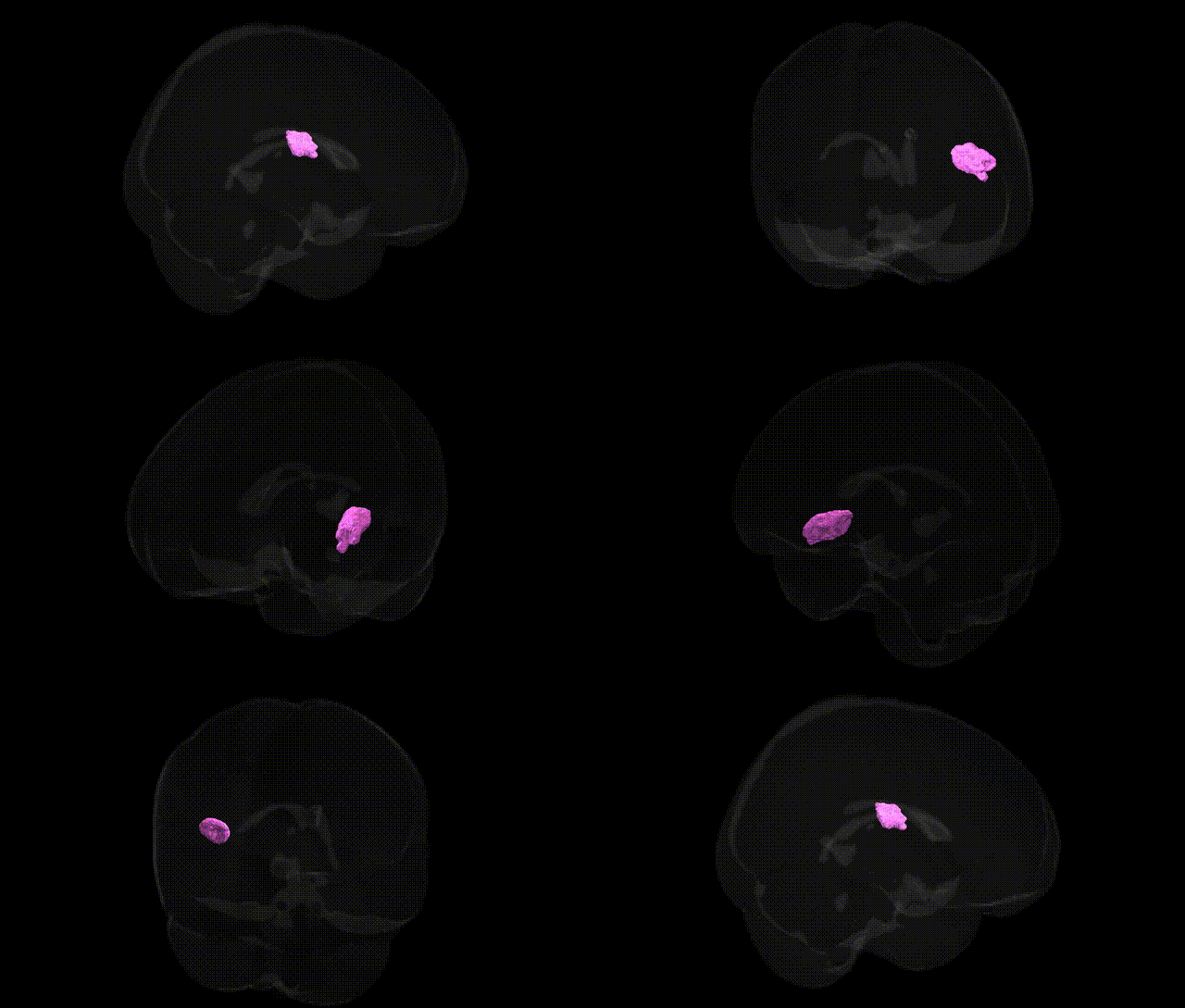
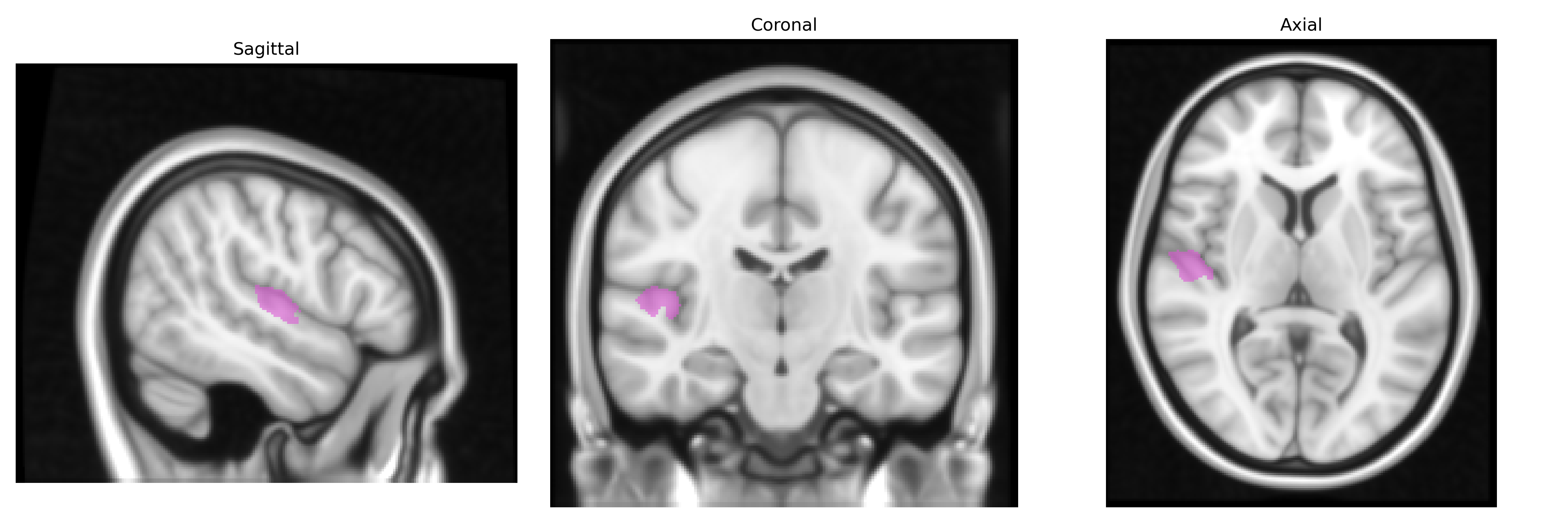
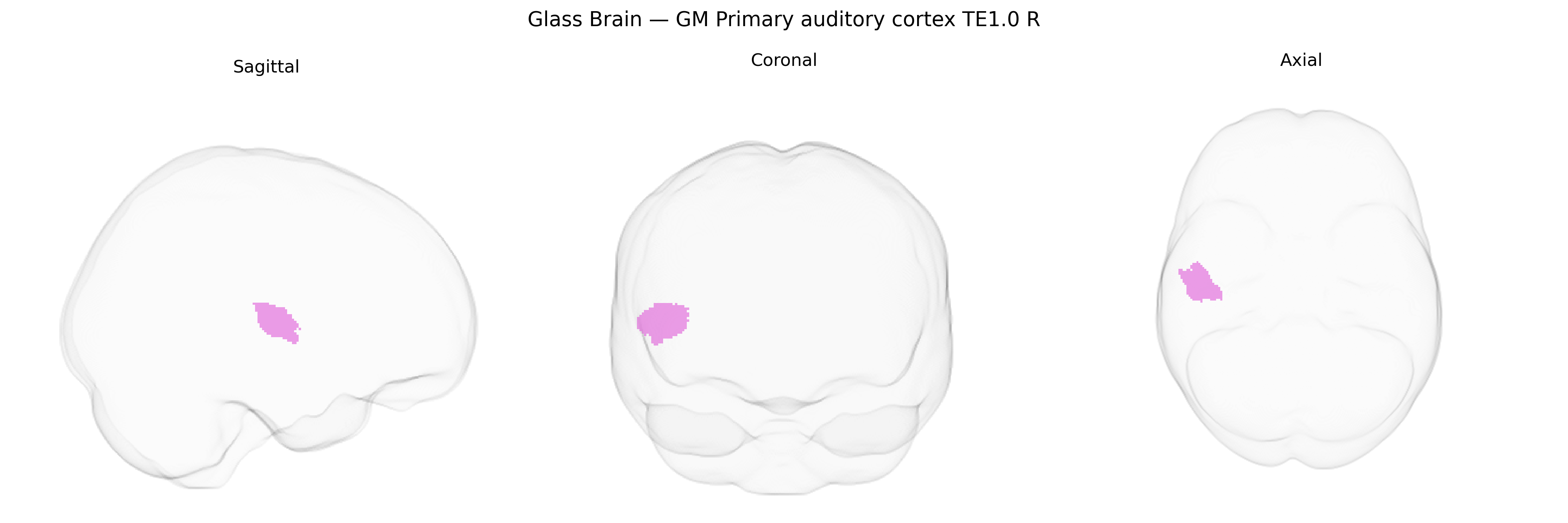
The bilateral GM Primary auditory cortex TE1.0 R, as defined in the Juelich maxprob thr25 1 mm atlas, corresponds to the core primary auditory field located on the superior temporal plane within Heschl’s gyrus, predominantly in the posterior portion of the transverse temporal gyrus of the temporal lobe. This region is characterized cytoarchitectonically by dense granular layers and a clear laminar organization typical of primary sensory cortices, and it receives direct thalamocortical input from the medial geniculate body of the thalamus. Functionally, TE1.0 supports basic acoustic feature processing, including sound frequency, intensity, and temporal pattern encoding, forming the earliest cortical stage of auditory perception and serving as a critical hub for transmitting processed auditory information to surrounding non-primary auditory association areas. There is no direct Wikipedia article for TE1.0; a related structure is Primary auditory cortex.
The bilateral gray matter primary auditory cortex TE1.0 (R) from the Juelich atlas corresponds to the core auditory cortex in Heschl’s gyrus, a region whose structure and function show heritable variation but for which few loci have been linked with high regional specificity. Large imaging genetics GWAS from consortia such as ENIGMA and UK Biobank have identified multiple common variants (including loci near genes like PAX6, TCF4, FOXP2, DCDC2, GRIN2B, and CACNA1C) that influence auditory cortex thickness, surface area, or activation patterns, often in the context of broader temporal lobe measures rather than TE1.0 alone. Genetic studies of traits dependent on primary auditory processing—such as language and speech perception, musical aptitude, tinnitus, and susceptibility to noise-induced hearing loss—implicate genes involved in synaptic transmission, cortical development, and auditory pathway function, with convergent effects on Heschl’s gyrus anatomy and activation. Neurodevelopmental and psychiatric GWAS (e.g., for schizophrenia, autism spectrum disorder, and dyslexia) have identified risk variants that are associated with altered microstructure or volume of primary auditory cortex and aberrant early auditory evoked responses, though these findings typically reference Heschl’s gyrus or superior temporal cortex as a whole rather than TE1.0 specifically. Overall, genetic associations to TE1.0 R are best understood as part of polygenic influences on temporal lobe and auditory system organization, with multiple small-effect variants collectively shaping anatomy and function rather than any single, strongly TE1.0-specific locus.
Overview generated by GPT-4o (2026).
Region ID: 42
Hemisphere: bilateral
Atlas: Juelich maxprob thr25 1mm
Full Quality Version: Download MP4
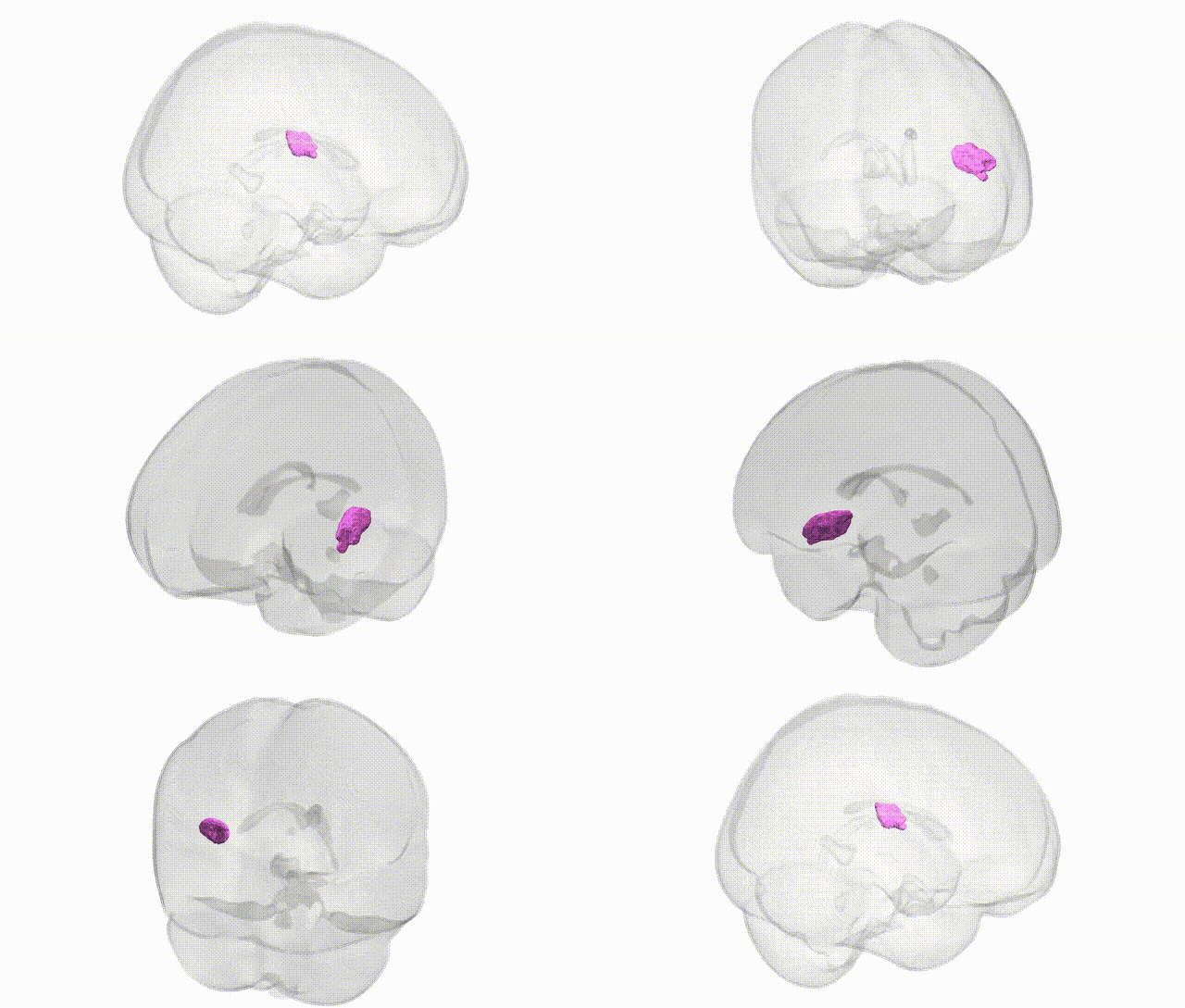
Full Quality Version: Download MP4
Wali Sidiqyar*, Gaurav Rudravaram*, Elyssa M. McMaster, Trent M. Schwartz, Adam M. Saunders, Kurt G. Schilling, Bennett A. Landman "Introducing SPINS: A Shared Public Visualization Library of Neuroanatomical Structures." Medical Imaging with Deep Learning- short paper
This resource is licensed under CC0 1.0 Universal (Public Domain).