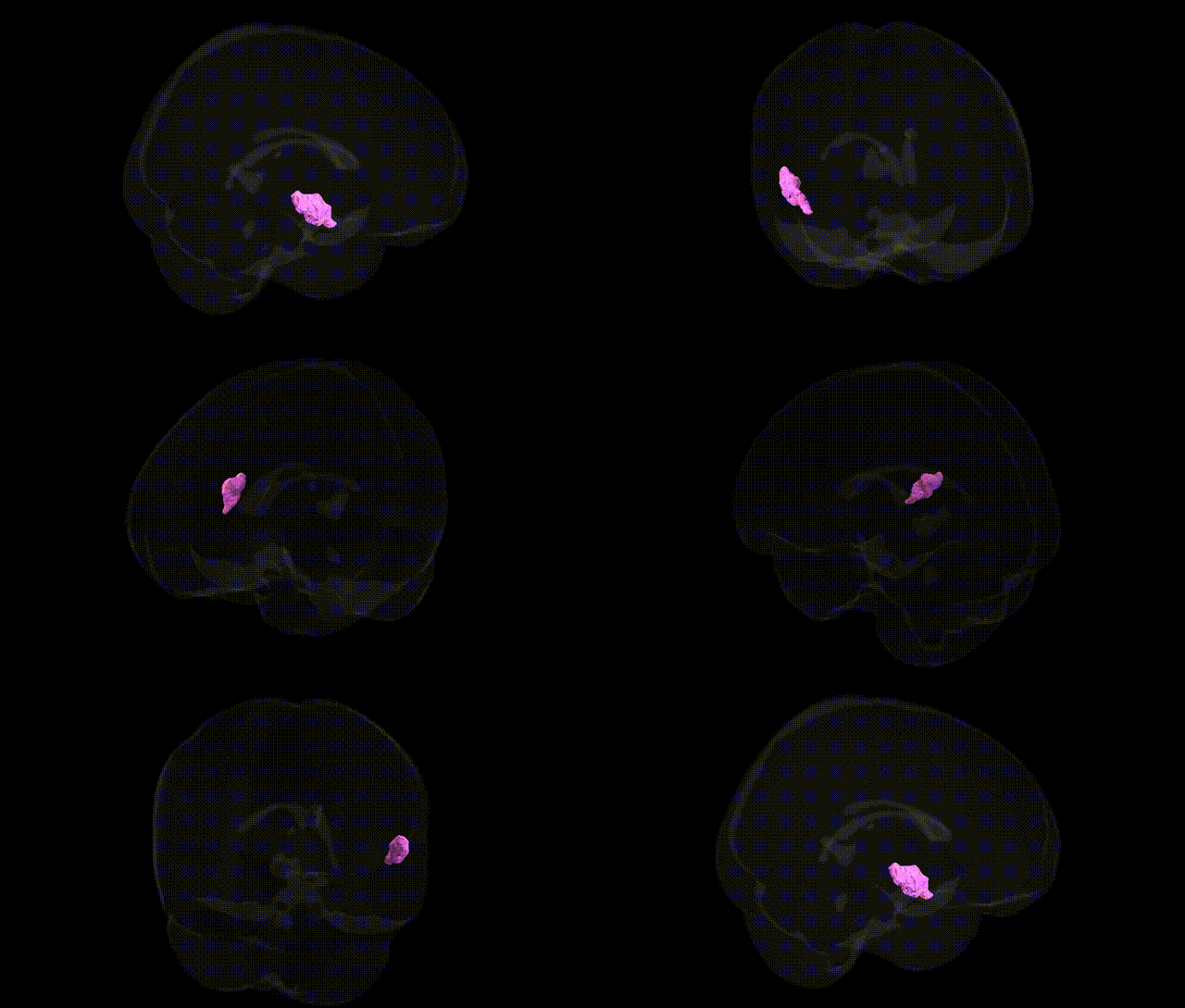
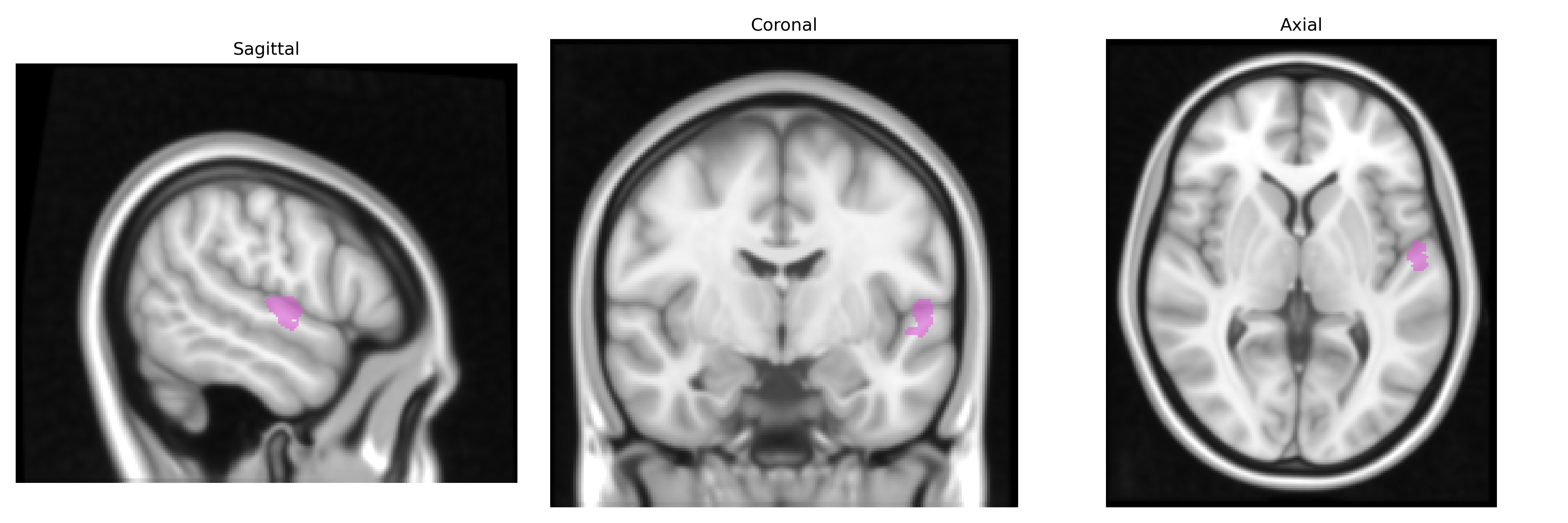
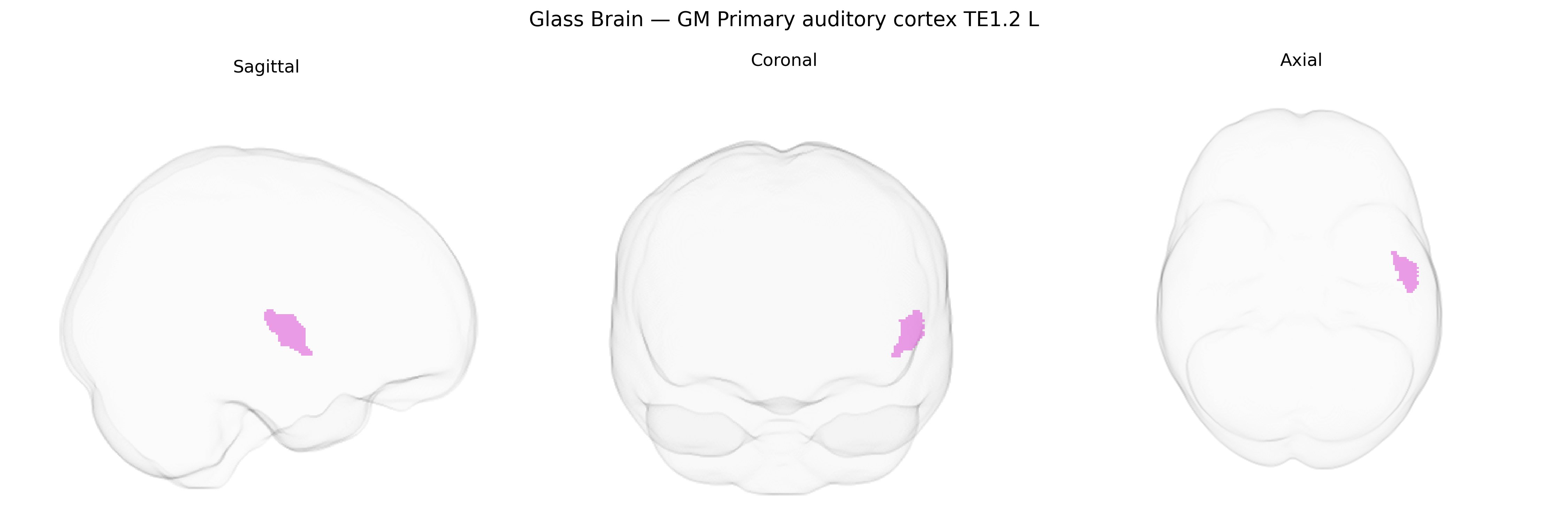
The bilateral GM Primary auditory cortex TE1.2 L, as defined in the Juelich maxprob thr25 1mm Atlas, corresponds to a cytoarchitectonically defined subregion of the primary auditory cortex located on the superior temporal plane within Heschl’s gyrus of the left hemisphere. It forms part of the TE1 complex (TE1.0, TE1.1, TE1.2), which collectively encompasses the human core auditory cortex, characterized by dense granular layers and sharply tuned frequency representations. TE1.2 is generally situated more laterally and/or caudally within Heschl’s gyrus compared with other TE1 subdivisions and participates in the early cortical processing of acoustic features such as frequency, intensity, and temporal patterns of sounds, including speech-related signals. This region is embedded within the broader superior temporal lobe auditory network and is interconnected with adjacent auditory belt and parabelt fields, as well as higher-order temporal and frontal regions involved in auditory object recognition and language processing. There is no direct link; see Heschl’s gyrus.
The bilateral primary auditory cortex TE1.2 (left hemisphere) from the Juelich maxprob thr25 1 mm atlas lies within Heschl’s gyrus and overlapping superior temporal cortex, regions repeatedly implicated in genetic studies of auditory processing, language, and neuropsychiatric risk. GWAS and imaging‑genetics studies have linked cortical thickness, surface area, and gyrification in primary and secondary auditory cortices and adjacent superior temporal areas to common variants influencing neuronal development and synaptic signaling, including loci near genes such as GRIN2A, FOXP2, and DCDC2 that have broader roles in speech, language, and reading, although effects are generally small and not specific to TE1.2 alone. Polygenic risk scores for schizophrenia, bipolar disorder, autism spectrum disorder, and major depression show associations with structural and functional alterations in superior temporal and primary auditory regions, consistent with auditory hallucinations and social‑communication deficits, while variants affecting myelination and axonal organization (e.g., in genes related to oligodendrocyte and white‑matter biology) have been associated with microstructural measures in temporal auditory pathways. Additional GWAS have tied superior temporal and Heschl’s gyrus morphology or activation to musical aptitude, pitch perception, and tinnitus susceptibility, indicating that genetic variation in auditory cortex structure and function contributes to inter‑individual differences in auditory and language abilities and to vulnerability for psychiatric and sensory disorders, though precise TE1.2‑specific loci remain incompletely defined and are usually inferred from broader superior temporal/Heschl’s gyrus parcels rather than this atlas region alone.
Overview generated by GPT-4o (2026).
Region ID: 45
Hemisphere: bilateral
Atlas: Juelich maxprob thr25 1mm
Full Quality Version: Download MP4
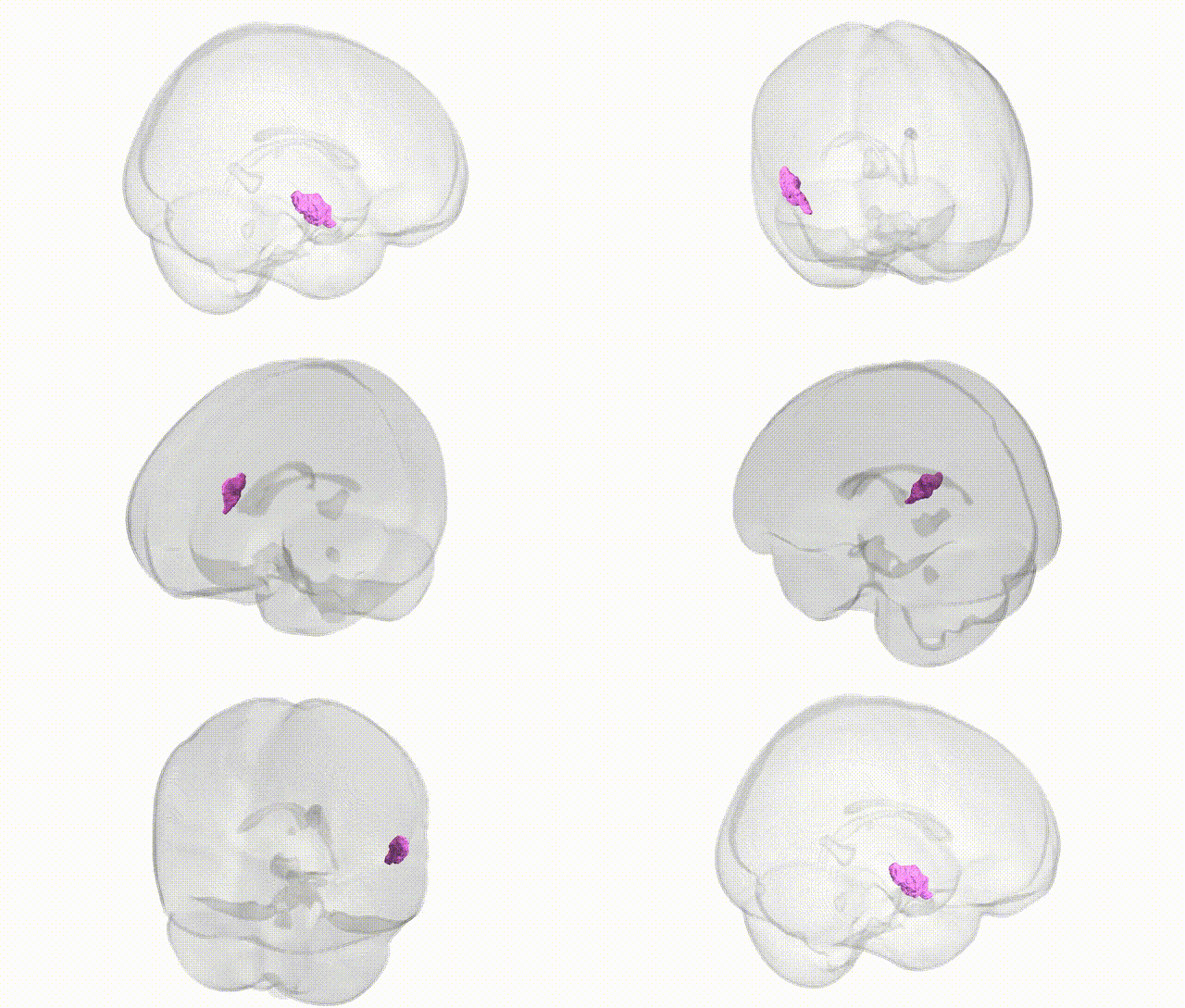
Full Quality Version: Download MP4
Wali Sidiqyar*, Gaurav Rudravaram*, Elyssa M. McMaster, Trent M. Schwartz, Adam M. Saunders, Kurt G. Schilling, Bennett A. Landman "Introducing SPINS: A Shared Public Visualization Library of Neuroanatomical Structures." Medical Imaging with Deep Learning- short paper
This resource is licensed under CC0 1.0 Universal (Public Domain).