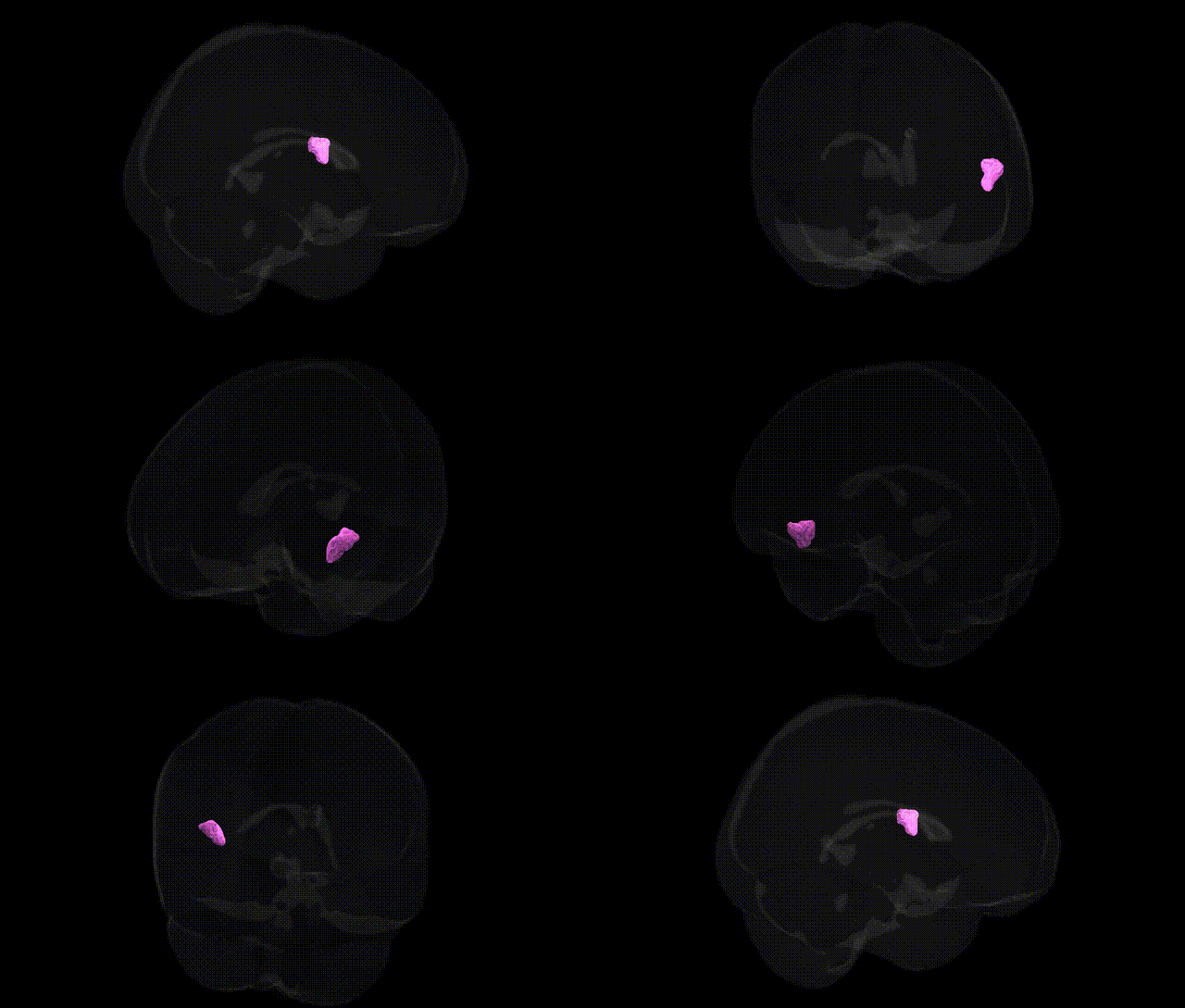
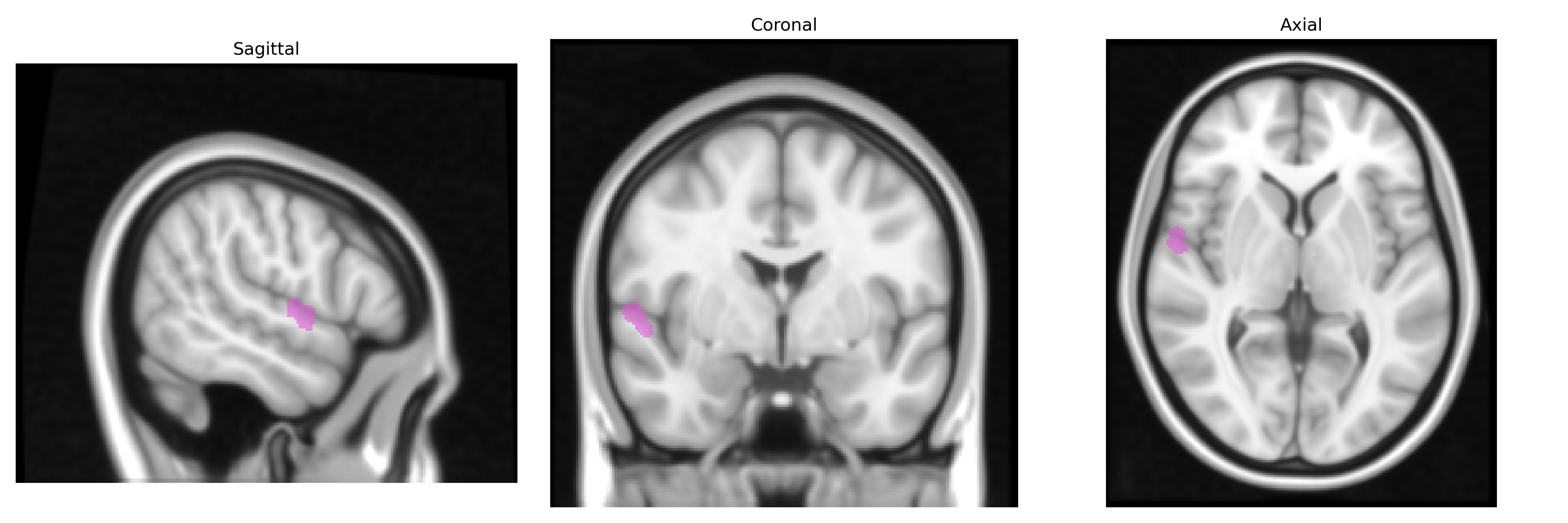
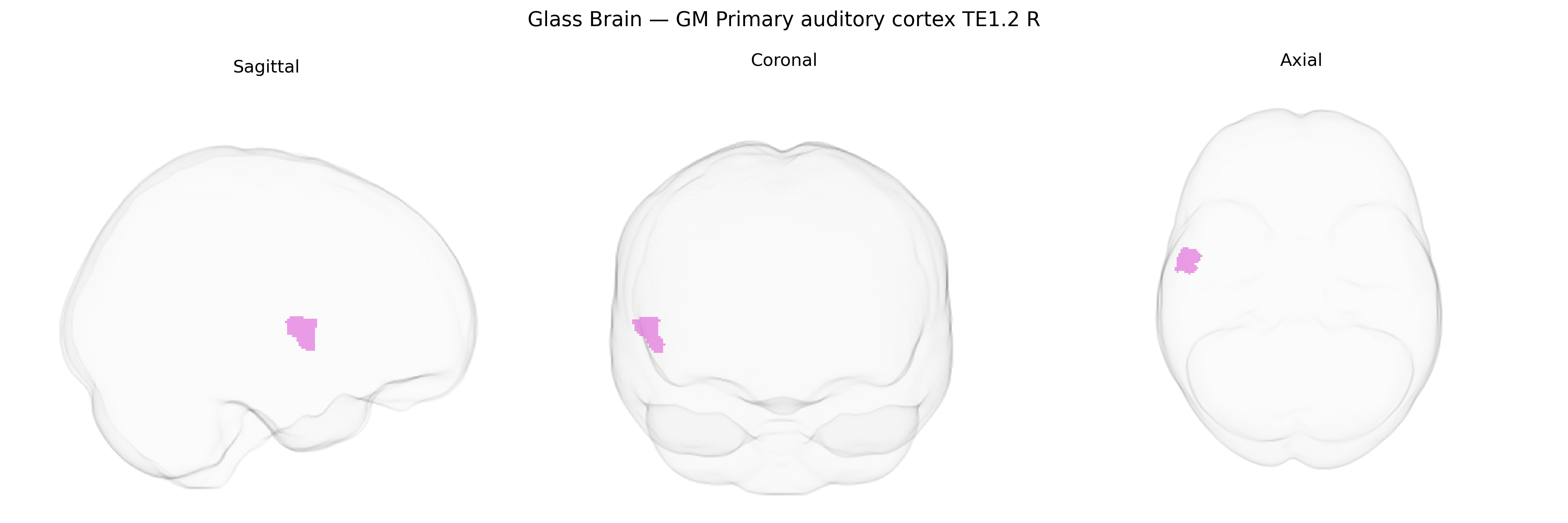
The bilateral GM Primary auditory cortex TE1.2 R, as defined in the Juelich maxprob thr25 1 mm atlas, corresponds to a cytoarchitectonically defined subregion of the human primary auditory cortex located on the superior temporal plane within the transverse temporal (Heschl’s) gyrus. This area is part of the Te1 complex of core auditory cortex, characterized by a granular koniocortical architecture, dense thalamocortical input from the medial geniculate body, and a prominent laminar organization specialized for precise encoding of acoustic information such as basic frequency, intensity, and temporal features. TE1.2 is typically situated medially to centrally within Heschl’s gyrus, with bilateral symmetry across hemispheres, and participates in early-stage tonotopic processing that provides foundational representations for higher-order auditory areas in the superior temporal cortex. There is no direct Wikipedia article for TE1.2; a related entry for its broader anatomical context is Heschl’s gyrus.
The bilateral primary auditory cortex TE1.2 (right hemisphere) in the Juelich maxprob atlas corresponds to core auditory areas (largely Heschl’s gyrus) implicated in genetically influenced individual differences in auditory processing, language, and psychosis-related traits. Twin and heritability studies indicate moderate to high genetic control over cortical thickness and surface area in primary auditory regions, and GWAS of brain structure (e.g., ENIGMA and UK Biobank) have identified multiple common variants—often near genes involved in neurodevelopment, synaptic function, and myelination (such as variants in or near CACNA1C, GRIN2A, FOXP2, and genes in axon guidance pathways)—that associate with volume or morphology of temporal auditory cortices, though TE1.2-specific loci are rarely isolated. GWAS of schizophrenia, bipolar disorder, and autism spectrum disorder have linked polygenic risk to structural and functional alterations in bilateral auditory cortex, including right TE1.2, particularly in hallucination-prone and language-impaired subgroups, while genetic risk for developmental language disorder, dyslexia, and stuttering has been associated with atypical asymmetry and microstructure in primary and secondary auditory areas encompassing TE1.2. Large-scale imaging genetics also suggests that polygenic scores for educational attainment, cognitive performance, and musical aptitude relate to variability in auditory cortex anatomy and activation patterns, indicating that TE1.2 participates in a broader genetically mediated network for speech, music, and higher-order auditory cognition, even though fine-grained atlas parcels like TE1.2 R have not yet been the direct focus of highly specific GWAS.
Overview generated by GPT-4o (2026).
Region ID: 46
Hemisphere: bilateral
Atlas: Juelich maxprob thr25 1mm
Full Quality Version: Download MP4
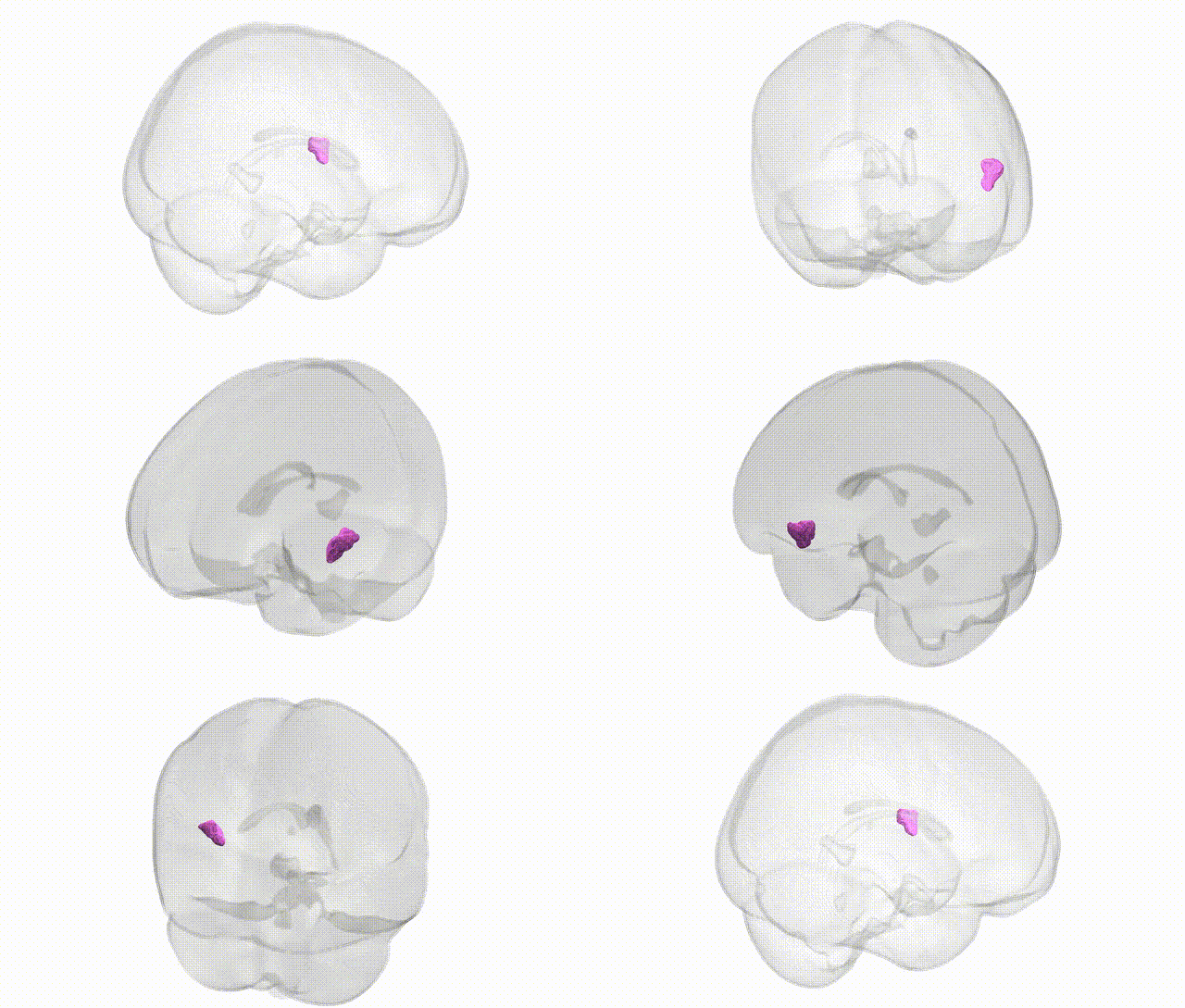
Full Quality Version: Download MP4
Wali Sidiqyar*, Gaurav Rudravaram*, Elyssa M. McMaster, Trent M. Schwartz, Adam M. Saunders, Kurt G. Schilling, Bennett A. Landman "Introducing SPINS: A Shared Public Visualization Library of Neuroanatomical Structures." Medical Imaging with Deep Learning- short paper
This resource is licensed under CC0 1.0 Universal (Public Domain).