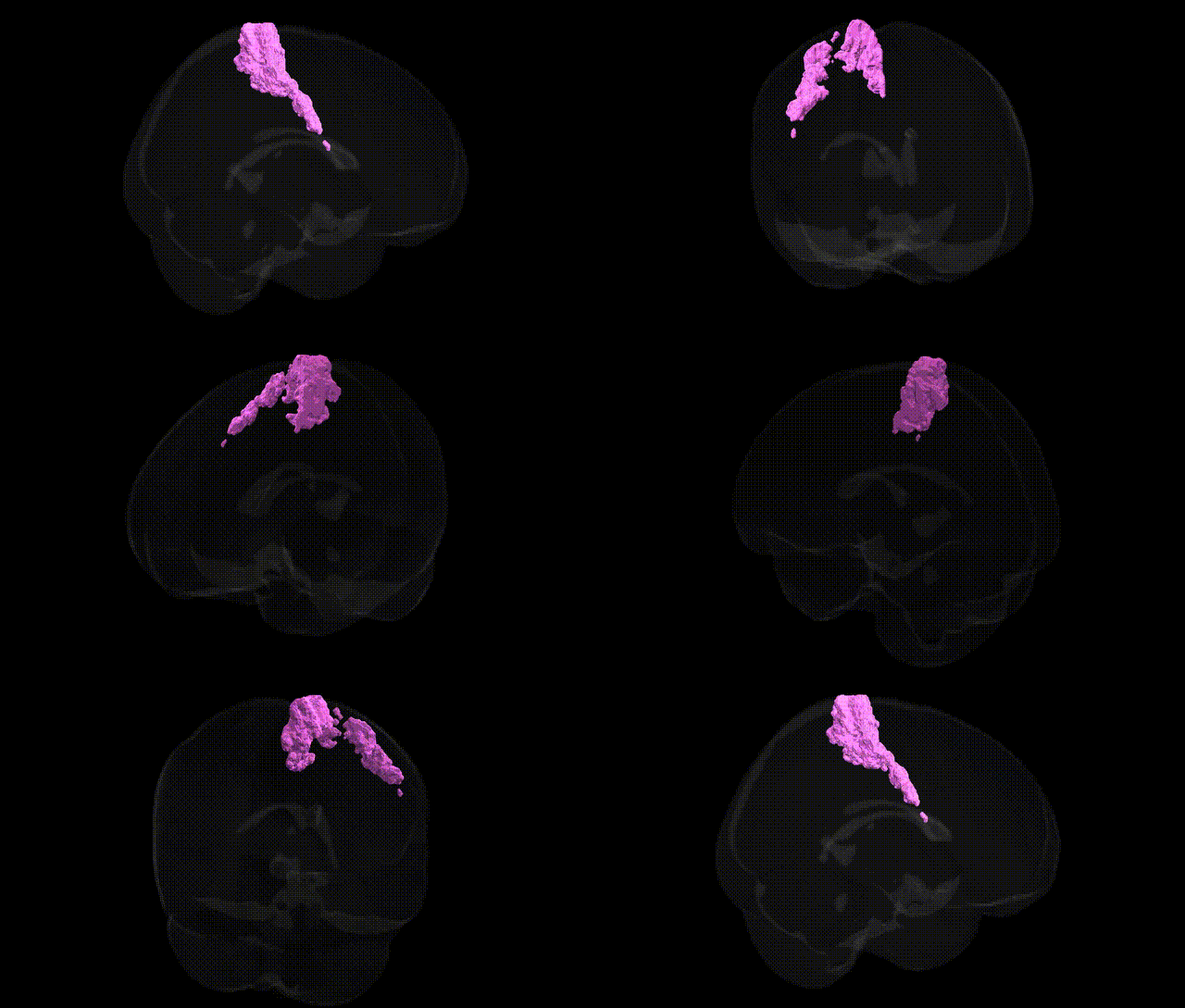
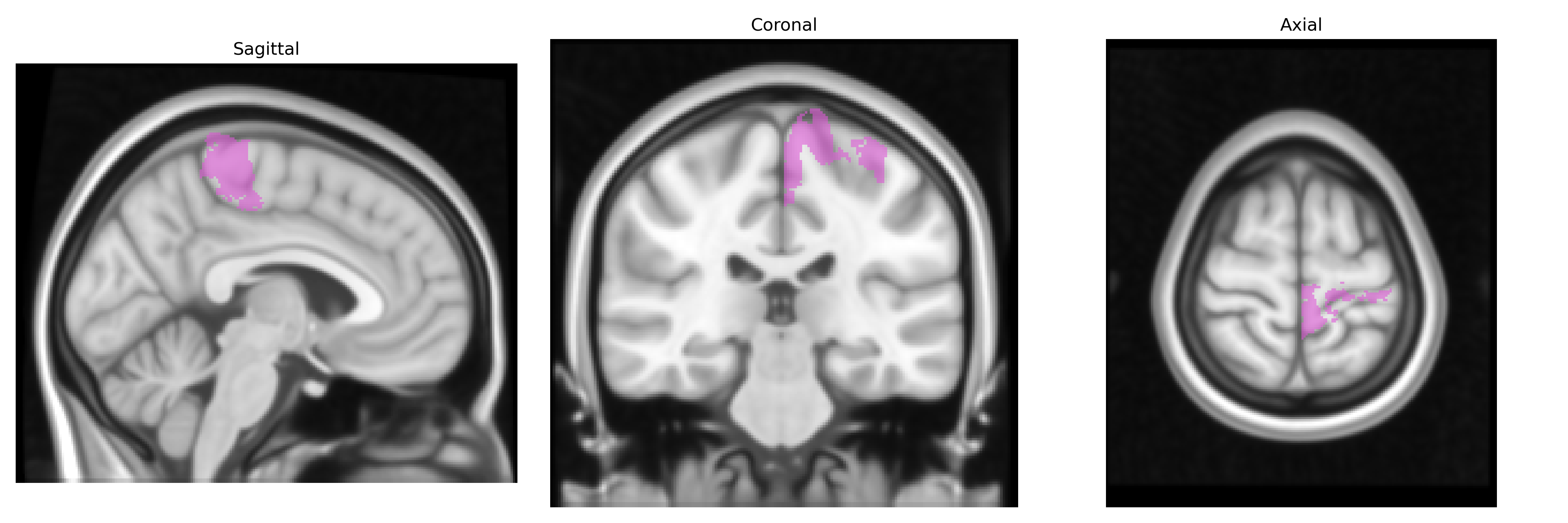
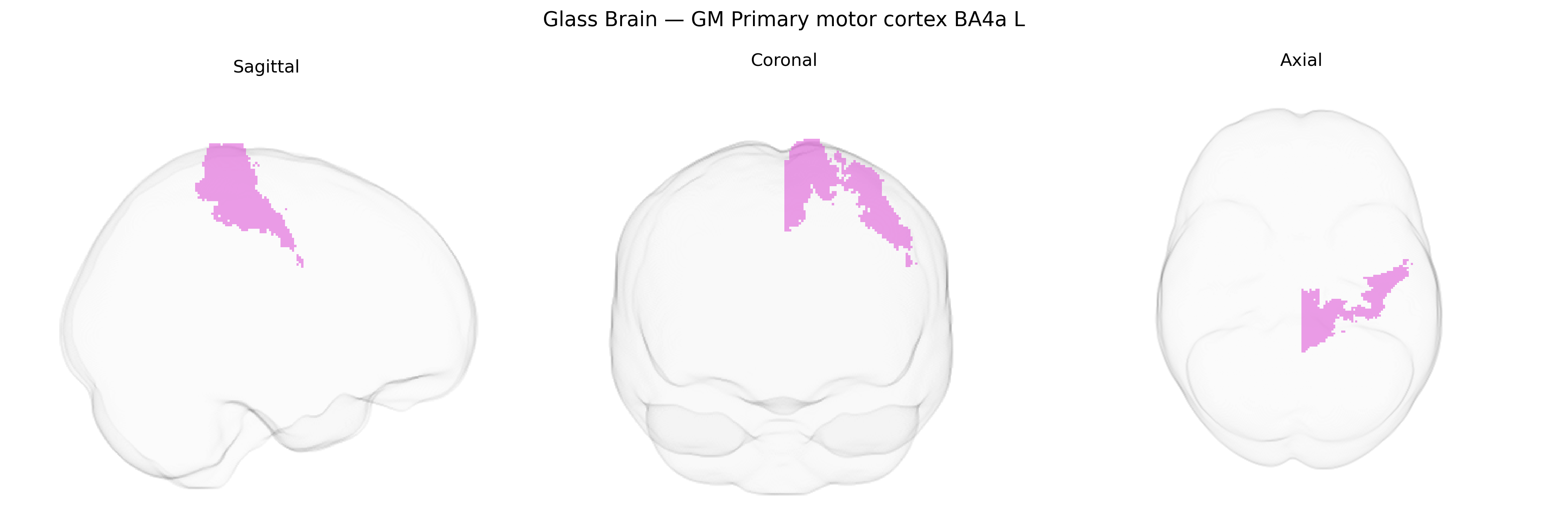
The bilateral GM Primary Motor Cortex BA4a L, as defined in the Juelich maxprob thr25 1mm atlas, corresponds to the granular portion of Brodmann area 4 located in the left hemisphere, forming part of the precentral gyrus within the frontal lobe. This region contains large pyramidal neurons, including Betz cells, whose axons contribute prominently to the corticospinal tract and are critical for the initiation and execution of voluntary somatic motor commands, especially fine, fractionated movements of the contralateral body. Functionally, BA4a participates in motor output, sensorimotor integration, and modulation by premotor and supplementary motor areas, receiving thalamocortical input and projecting to spinal motor circuits and brainstem motor nuclei. Cytoarchitectonically, BA4a is distinguished from adjacent premotor and primary somatosensory areas by its specific laminar organization and high neuronal density in layer V. There is no direct Wikipedia article for “BA4a,” but it is a subregion of the broader Primary Motor Cortex.
The bilateral GM primary motor cortex BA4a (left hemisphere) from the Juelich maxprob atlas is a core region for voluntary motor execution, and genetic associations largely emerge from imaging-genetics and GWAS studies linking cortical structure and function of the precentral gyrus/primary motor cortex to specific variants. Common variants near genes involved in neurodevelopment and synaptic function (e.g., BDNF, CNTNAP2, NRXN1, GRIN2B, and FOXP2-related networks) have been associated with motor cortex morphology, excitability, and plasticity, often measured via MRI or TMS. Large-scale GWAS of cortical thickness and surface area (such as ENIGMA and UK Biobank analyses) have identified loci influencing precentral gyrus/primary motor cortex metrics, with some overlap with genes implicated in neuropsychiatric and neurodevelopmental conditions, including schizophrenia, autism spectrum disorder, attention-deficit/hyperactivity disorder, and developmental coordination disorder. Motor cortex involvement is also genetically linked to movement disorders such as dystonia and Parkinson’s disease through variants affecting basal ganglia–cortical circuits (e.g., in genes like LRRK2, GBA, and THAP1), and to post-stroke motor recovery via polymorphisms in BDNF and other plasticity-related genes. Additionally, GWAS of handedness and fine motor skill performance show associations with loci affecting motor network organization, indirectly implicating BA4a-related regions in lateralization and motor trait variability. Direct region-specific GWAS targeting Juelich BA4a are limited, but convergent evidence from cortical GWAS, neurodevelopmental and movement-disorder genetics, and imaging-genetics studies supports a role for multiple neuroplasticity, axon guidance, and synaptic genes in shaping structure and function of this primary motor area.
Overview generated by GPT-4o (2026).
Region ID: 47
Hemisphere: bilateral
Atlas: Juelich maxprob thr25 1mm
Full Quality Version: Download MP4
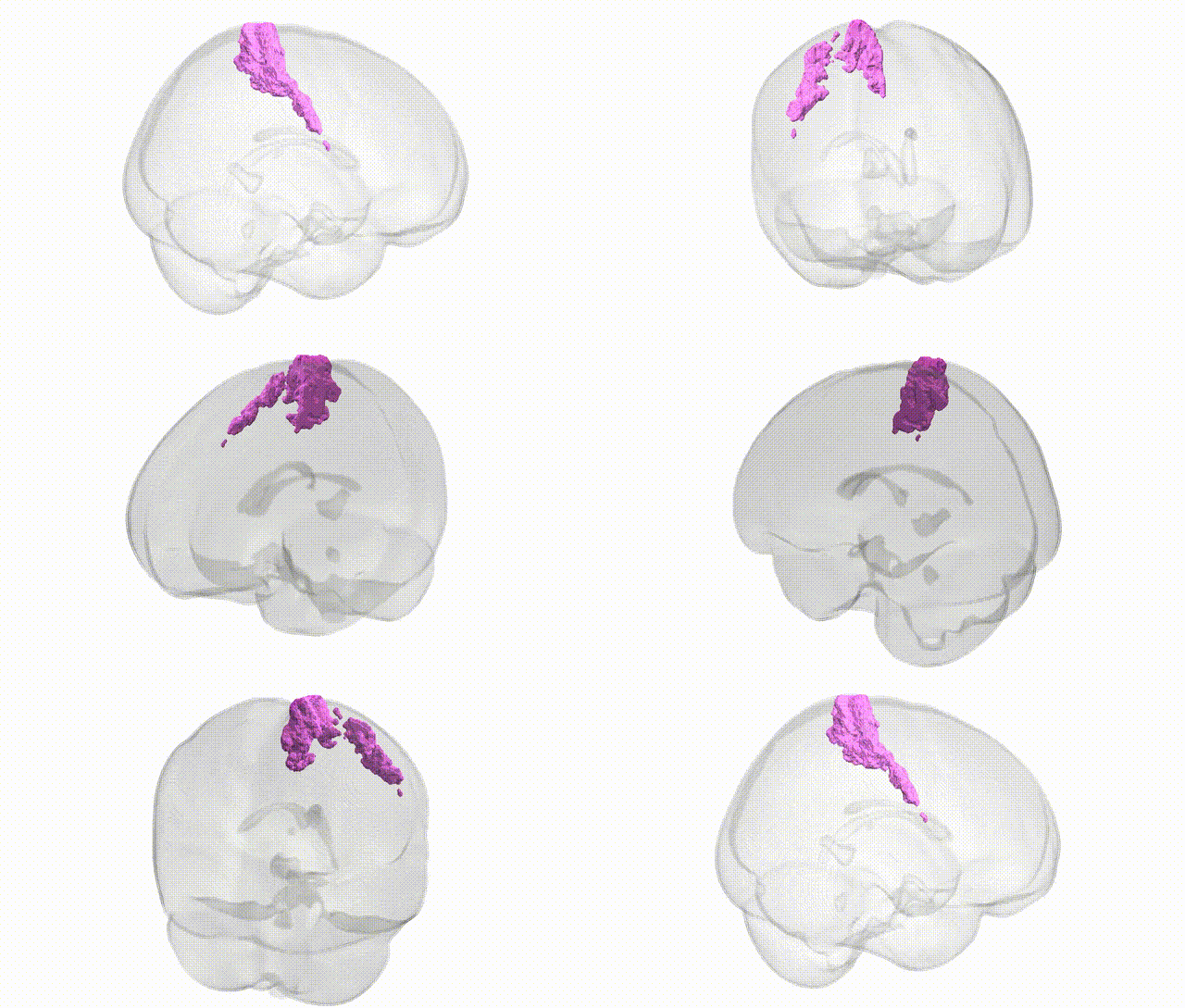
Full Quality Version: Download MP4
Wali Sidiqyar*, Gaurav Rudravaram*, Elyssa M. McMaster, Trent M. Schwartz, Adam M. Saunders, Kurt G. Schilling, Bennett A. Landman "Introducing SPINS: A Shared Public Visualization Library of Neuroanatomical Structures." Medical Imaging with Deep Learning- short paper
This resource is licensed under CC0 1.0 Universal (Public Domain).